Superman/Batman: Public Enemies was released on September 29th, 2009. Directed by Sam Liu and written by Stan Berkowitz it is an adaption of a story arc from Jeph Loeb & Ed McGuinness's run on Superman/Batman comic.
In the first few moments of the film it is established that Lex Luthor has become the President of the United States because a financial crisis (this movie was released the wake of the 2008 housing market crash and following recession) has eroded public trust in the major parties. Most superheroes are seemingly on board with this in the interest of democracy and the hope that Luthor's desire for power and prestige will lead him to make decisions in the public interest. Superman and Batman however, are convinced that Luthor has some ulterior agenda that is not in the interest of the country.
The main plot involves a kryptonite meteor that is headed toward earth, which Luthor plans to eradicate using nuclear missiles. He sets up a meeting with Superman, ostensibly to form an alliance, where the Man of Steel is attacked by Metallo. Batman shows up to aid his friend and both barely escape with their lives. Luthor then has Metallo killed (off-screen) and frames the two heroes for his murder using footage taken from their fight. He puts out a one-billion dollar bounty on Superman. As a result of this Superman and Batman are attacked by a myriad of supervillians most of whom are defeated rather easily by the heroes. The rest dispersed by an energy blast from Captain Atom who, along with Katana, Black Lightning, Power Girl, Starfire, and Major Force arrive on the scene to arrest Superman and Batman. Once again they escape.
Clark and Bruce begin investigating Metallo's death and looking into Luthor's plan to stop the meteor, as they suspect foul play. Power Girl, torn between her loyalty to her team and to her friends eventually side with the world's finest. Batman figures out that Luthor ordered Major Force to kill Metallo and convinces Captain Atom and his team to stop hunting him and Superman. They then go to Luthor's base in the mountains to retrieve data on the meteor. There they are attacked by Hawkman and Captain Marvel.
Meanwhile, Amanda Waller discovers that Lex has been juicing with Kryptonite, causing him to lose his grip on reality. His missiles, she finds out, were never intended to stop the meteor, which he wants to hit earth so he can rule over whatever remains of society. This raises all kinds of questions. How is Luthor able to maintain his
mask of sanity in public? Why, after all this time, does he recklessly reveal this to Waller? How has no one discovered his madness before this? Why, after the initial attempt to stop the
missiles fails, does he furiously attempt to come up with a new plan?
Batman and Superman eventually break into the base but Luthor escapes them. Waller gives them the data on the meteor which they take to the Japanese Toyman, who has designed a spacecraft to destroy it. Luthor shows up and destroys the controls, causing Batman to pilot the ship manually. Superman, believing that his friend has sacrificed himself, destroys Luthor's battle suit in a fit of rage and Captain Atom shows up to arrest the traitorous president. Of course, it turns out that the spacecraft was built to withstand the impact and Bruce survives.
As the story is incredibly rushed the emotional of Power Girl's torn loyalty, Major Force's betrayal, and Batman's sacrifice is basically nonexistent. Superman/Batman: Public Enemies is a film that essentially
functions as an excuse to show the titular characters duking it out with
various other DC heroes and villains from Metallo to Power Girl to
Banshee to Captain Marvel. As such you would think the plot would be
fairly straight forward but it's not, it's confusing, convoluted and
ultimately makes no sense. This wouldn't really be a problem if so much
screen time wasn't devoted to the plot machinations.
Public Enemies is not without it merits. The action scenes are pretty well done, though many of them are rushed and lack satisfying conclusions. Batman and Superman have a lot of chemistry and it's always fun watching them play off of each other. The cast is great, especially Kevin Conroy and Tim Daly (reprising their roles from the Batman and Superman animated series respectively). The animation is pretty decent although, as a matter of personal preference, I'm not a huge fan of Ed McGuinness blocky art-style and this streamlined version of it it even less appealing.
In the end Superman/Batman: Public Enemies can't decide if it wants to be as a simple excuse for superhero action or a functioning narrative story. As a result it doesn't end up succeeding at either.
Score: 6/10
Tuesday, March 5, 2019
Saturday Evening Cartoons: Reign of the Supermen (Fat Tuesday Special #1)
When I reviewed The Death of Superman last year I was pretty enthusiastic. Finally, we had a decent adaptation of this story. I was excited (but also trepidatious) to see what they would do with the second part of the story, Reign of the Supermen. It's a very long, complicated story, one which is, I think, impossible to do justice in a 90 minute film. With that said, it should not be surprising that this film is a serious step-down from its predecessor.
I should point out, however, that The Death of Superman was far from a perfect setup for this. For one thing, though it does an admirable job of giving the film emotional stakes, all things considered it was a mistake to adapt this story when this version of Superman has barely been established on screen (The Death of Superman was the first solo Superman film in the new DC animated universe). This is a story that explores the emotional toll of Superman's passing and it worked a lot better in the comics when there were 10 years of post-crisis Superman stories to build on.
Beyond that though, the focus just wasn't always in the right place. The film, like the comic, should have ended with Superman's death (or perhaps his funeral) instead, they writers decided to end it by teasing his return (both literally and figuratively) in this film. This undermines a lot of the emotional weight that his death brought to that film. It also means that Reign of the Supermen starts off on the wrong foot. Instead of feeling triumphant, Superman's return in this film comes across as perfunctory.
A big part of the problem, as I hinted earlier, is that there simply isn't enough screen time to do this story justice. In retrospect, it should have been a three part story. This way you could end the first film immediately after Superman dies in his battle with Doomsday. Then you would use the second film to explore the emotional impact of his death and also to establish the four new supermen. Finally, in the third film you could have the conflict between Superboy, Steel, Eradicator and Cyborg Superman come to a head before the real Superman returns to set things right. As it is, everything is rushed and under-cooked.
With all that said, the film isn't terrible. There is a lot of good action, the four Supermen have well established personalities, even if their motivations are barely explored, and the plot is surprisingly coherent given how condensed the story is. Rainn Wilson's take on Lex Luthor even grew on me a little.
In the end, Reign of the Supermen is a largely disappointing conclusion to this story. In retrospect, I'm not sure it really could have turned out better without delaying the story until later on and expanding it to three films. It's not a bad film exactly, but it's largely forgettable. I'd recommend mostly because it serves as a functional conclusion to the superior first part.
Score: 7/10
I should point out, however, that The Death of Superman was far from a perfect setup for this. For one thing, though it does an admirable job of giving the film emotional stakes, all things considered it was a mistake to adapt this story when this version of Superman has barely been established on screen (The Death of Superman was the first solo Superman film in the new DC animated universe). This is a story that explores the emotional toll of Superman's passing and it worked a lot better in the comics when there were 10 years of post-crisis Superman stories to build on.
Beyond that though, the focus just wasn't always in the right place. The film, like the comic, should have ended with Superman's death (or perhaps his funeral) instead, they writers decided to end it by teasing his return (both literally and figuratively) in this film. This undermines a lot of the emotional weight that his death brought to that film. It also means that Reign of the Supermen starts off on the wrong foot. Instead of feeling triumphant, Superman's return in this film comes across as perfunctory.
A big part of the problem, as I hinted earlier, is that there simply isn't enough screen time to do this story justice. In retrospect, it should have been a three part story. This way you could end the first film immediately after Superman dies in his battle with Doomsday. Then you would use the second film to explore the emotional impact of his death and also to establish the four new supermen. Finally, in the third film you could have the conflict between Superboy, Steel, Eradicator and Cyborg Superman come to a head before the real Superman returns to set things right. As it is, everything is rushed and under-cooked.
With all that said, the film isn't terrible. There is a lot of good action, the four Supermen have well established personalities, even if their motivations are barely explored, and the plot is surprisingly coherent given how condensed the story is. Rainn Wilson's take on Lex Luthor even grew on me a little.
In the end, Reign of the Supermen is a largely disappointing conclusion to this story. In retrospect, I'm not sure it really could have turned out better without delaying the story until later on and expanding it to three films. It's not a bad film exactly, but it's largely forgettable. I'd recommend mostly because it serves as a functional conclusion to the superior first part.
Score: 7/10
Blog Update 3/5/2019
I've had the flu for the past week and have not been posting as often as I would have liked to but I did watch a bunch of movies while I was sick and will (hopefully) be posting a bunch of reviews later today. Also, as this is Fat Tuesday (Pączki Day for us Polish Americans) I would like to announce that, once again, I will be doing Lent Reviews, so look forward to reviews of religiously themed movies each week of Lent. As usual, I will be trying to abstain, to some extent, from more "secular" forms of entertainment so Western Wednesdays and Saturday Evening Cartoons are on hold until after Easter. I haven't done any Musical Monday reviews in a long while as they are, generally, the least popular of my regular featured reviews. I may try to pick up the slack after Lent, but we shall see...
Saturday, February 23, 2019
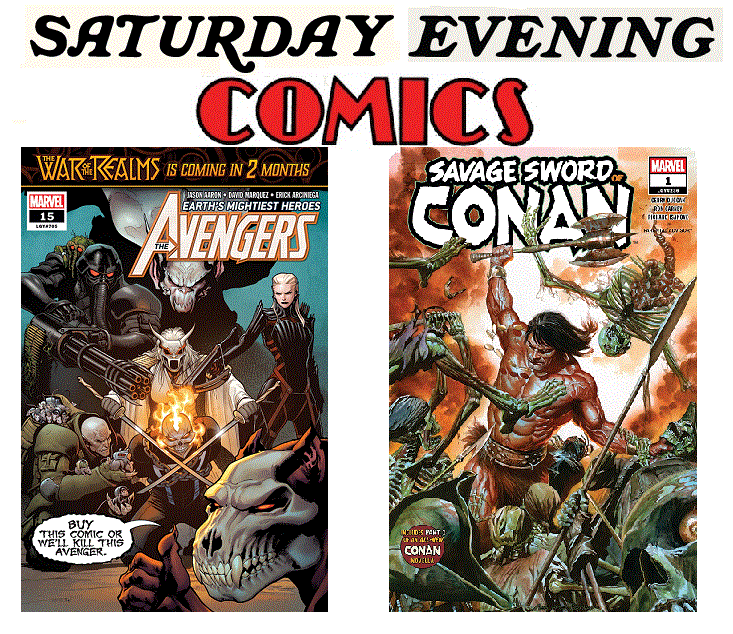
Saturday Evening Cartoons: Savage Sword of Conan and Avengers
This week I reviewed Savage Sword of Conan #1 and Avengers #15.
I also read:
Detective Comics #994 which is another solid entry in Tomasi's run. I'm a bit of an Etrigan fan so it's always cool when he shows up in books I'm reading.
Batman #65 which is starting to wear me out with all the doom and gloom, though it's not badly written.
Star Wars: Age Of Republic - Count Dooku #1 was another pretty decent (if unmemorable) prequel era tale from Jodie Houser. It's cool seeing Dooku before the clone wars.
Spider-Man/Deadpool #46 which is a fun and clever parody of event comics, though Robbie Thompson will have to work pretty hard to explain how this fits with the current 616 continuity (or it will just be brushed over really conveniently, which in this context would actually be fine).
Wednesday, February 20, 2019
Revisiting Walt Disney's Davy Crockett: Part 4 (Western Wednesdays)
The first episode of Walt Disney's Davy Crockett, Davy Crockett Indian Fighter, aired on Disneyland on December 15, 1954. Walt had started Disneyland earlier in 1954 in order to finance his dream amusement park. He wanted the episodes of the series to represent the park's four main sections: Adventureland, Tomorrowland, Fantasyland, and Frontierland. Davy Crockett would represent Frontierland. The show would be an unprecedented success, setting off a national craze that would generate 300 million dollars in profit, almost 3 billion dollars in today's money when adjusted for inflation.
Watching the show today, after having grownup with the movie versions, is a somewhat strange experience. Exchanges of dialogue are extended, the musical score and sound-mixing are different and there are quite a few scenes that were cut from the films entirely. These scenes help to further flesh out Crockett and also contain additional bits of action.
The show, immediately, has a more folksy, down-to-earth feel then the movies. The very first scene is one which was deleted from the theatrical release. In it Crockett is seen leaving his homestead to go off to fight the Creek War. Polly tells Georgie Russell, "If you don't stop makin' up those outlandish songs about Davy, there's no telling what will happen to the Crockett name." The first time we meet Davy in the movie, he's trying to grin down a bear, but here he is seen saying goodbye to his wife and children. This sets a general precedent for much of the deleted material: Crockett feels more flawed and human.
Interestingly, River Pirates actually includes a scene that was cut from the first episode of the second series, "Davy Crockett's Keelboat Race". In it Crockett and Russell, pulling into a port after their ship is sabotaged by Fink, discuss sabotaging the Gullywhumper in retaliation but Crockett refuses, "No", he says, "we gotta win this race fair and square." The show, on the other hand shows Crockett tying a rope to the Gullywhumper so his own boat can be towed by it (until, of course, Fink discovers this).
I have yet to really talk about Fess Parker's performance. Both the larger-then-life movie Davy and the more relatable TV Davy are perfectly embodied by Parker. He is the reason the show was such a success. He captured Crockett's easy going manner, his stalwart, righteous heroism, and his matter-of-fact country wisdom that came to embody the American Frontier spirit. Parker's easy, slow southern drawl, his formidable physical presence, his easygoing cheerful manner, and the subtle hints of sadness and melancholy he brings to the role made a huge impression on me as a youngster (along with millions of other kids from an earlier generation).
As a result of this I have never been able to accept anyone else in the role. From John Wayne to Billy Bob Thornton (who actually bears pretty decent physical resemblance to the historical Crockett) all ring false to me. Fess Parker IS Davy Crockett. On the other hand, Buddy Esben, who was considered for the role of Crockett before Parker was chosen, is in a way, a composite of Crockett as George Russell (who, I'm surprised to learn was actually one of Crockett's comrades during the Creek war).While Parker is every inch the chivalrous paragon of virtue, Ebsen is fun loving, mischievous, and is portrayed as the one mainly responsible for perpetuating the Crockett myth.
It's really fascinating how writer Tom Blackburn was able to integrate so many disparate sources of Crockett lore into the series. The almanacs, written to capitalize on Crockett's popularity, are seen here written by Russell. "I put up with your singin' them lies about me, but printin' 'em is goin' too far," Davy tells his friend. The description of Crockett as "half horse, half alligator and a little attached to a snappin' turtle" is also from the almanacs, and was further popularized in James Hackett's satirical play The Lion of the West. Crockett's autobiography, written during his last term in congress, is used to frame the narrative, with each episode opening and closing with an image of a book entitled "Davy Crockett's Journal." Crockett's traveling to the Alamo with a riverboat gambler and a Comanche Indian is taken from the spurious Col. Crockett's Exploits and Adventures in Texas, allegedly written by Crockett a few days before his death.
And, of course, much actual history is referenced. Crockett did fight in the Creek Indian War though he didn't defeat a Creek chief hand-to-hand and singlehandedly end the conflict. His wife, Polly, passed away before he entered politics, though the show makes no mention of his second wife Elizabeth Patton. He did oppose Andrew Jackson's Indian Removal bill and make an impassioned speech against it on the House Floor. He did go on a tour of the eastern cities during his final term, recorded in the book: An Account of Col. Crockett's Tour to the North and Down East. He also received a rifle he named "Old Betsy" but while the episode shows him receiving it from the citizens of Philadelphia on his tour of the eastern cities, it was actually given to him by his constituents in Lawrence County during his tenure in the state legislature. Of course he did go to Texas where he died at the Alamo, although the manner of his death remains a subject of heated dispute.
In the end, I would say that the shows are, in some respects, better then the movies. This is not surprising, considering the fact that it was conceived with episodic television in mind. Nevertheless, the films do an admirable job of tightening the pace while leaving the narrative largely intact. Going back to the show all these years later was a fascinating experience. I was able to see this story I knew and loved in a new light. There are no "missing episodes" of Disney's Davy Crockett, but this restored material allowed me, in a small way, to relive the experience of watching the movies for the first time all over again.
Watching the show today, after having grownup with the movie versions, is a somewhat strange experience. Exchanges of dialogue are extended, the musical score and sound-mixing are different and there are quite a few scenes that were cut from the films entirely. These scenes help to further flesh out Crockett and also contain additional bits of action.
The show, immediately, has a more folksy, down-to-earth feel then the movies. The very first scene is one which was deleted from the theatrical release. In it Crockett is seen leaving his homestead to go off to fight the Creek War. Polly tells Georgie Russell, "If you don't stop makin' up those outlandish songs about Davy, there's no telling what will happen to the Crockett name." The first time we meet Davy in the movie, he's trying to grin down a bear, but here he is seen saying goodbye to his wife and children. This sets a general precedent for much of the deleted material: Crockett feels more flawed and human.
Interestingly, River Pirates actually includes a scene that was cut from the first episode of the second series, "Davy Crockett's Keelboat Race". In it Crockett and Russell, pulling into a port after their ship is sabotaged by Fink, discuss sabotaging the Gullywhumper in retaliation but Crockett refuses, "No", he says, "we gotta win this race fair and square." The show, on the other hand shows Crockett tying a rope to the Gullywhumper so his own boat can be towed by it (until, of course, Fink discovers this).
I have yet to really talk about Fess Parker's performance. Both the larger-then-life movie Davy and the more relatable TV Davy are perfectly embodied by Parker. He is the reason the show was such a success. He captured Crockett's easy going manner, his stalwart, righteous heroism, and his matter-of-fact country wisdom that came to embody the American Frontier spirit. Parker's easy, slow southern drawl, his formidable physical presence, his easygoing cheerful manner, and the subtle hints of sadness and melancholy he brings to the role made a huge impression on me as a youngster (along with millions of other kids from an earlier generation).
As a result of this I have never been able to accept anyone else in the role. From John Wayne to Billy Bob Thornton (who actually bears pretty decent physical resemblance to the historical Crockett) all ring false to me. Fess Parker IS Davy Crockett. On the other hand, Buddy Esben, who was considered for the role of Crockett before Parker was chosen, is in a way, a composite of Crockett as George Russell (who, I'm surprised to learn was actually one of Crockett's comrades during the Creek war).While Parker is every inch the chivalrous paragon of virtue, Ebsen is fun loving, mischievous, and is portrayed as the one mainly responsible for perpetuating the Crockett myth.
It's really fascinating how writer Tom Blackburn was able to integrate so many disparate sources of Crockett lore into the series. The almanacs, written to capitalize on Crockett's popularity, are seen here written by Russell. "I put up with your singin' them lies about me, but printin' 'em is goin' too far," Davy tells his friend. The description of Crockett as "half horse, half alligator and a little attached to a snappin' turtle" is also from the almanacs, and was further popularized in James Hackett's satirical play The Lion of the West. Crockett's autobiography, written during his last term in congress, is used to frame the narrative, with each episode opening and closing with an image of a book entitled "Davy Crockett's Journal." Crockett's traveling to the Alamo with a riverboat gambler and a Comanche Indian is taken from the spurious Col. Crockett's Exploits and Adventures in Texas, allegedly written by Crockett a few days before his death.
And, of course, much actual history is referenced. Crockett did fight in the Creek Indian War though he didn't defeat a Creek chief hand-to-hand and singlehandedly end the conflict. His wife, Polly, passed away before he entered politics, though the show makes no mention of his second wife Elizabeth Patton. He did oppose Andrew Jackson's Indian Removal bill and make an impassioned speech against it on the House Floor. He did go on a tour of the eastern cities during his final term, recorded in the book: An Account of Col. Crockett's Tour to the North and Down East. He also received a rifle he named "Old Betsy" but while the episode shows him receiving it from the citizens of Philadelphia on his tour of the eastern cities, it was actually given to him by his constituents in Lawrence County during his tenure in the state legislature. Of course he did go to Texas where he died at the Alamo, although the manner of his death remains a subject of heated dispute.
In the end, I would say that the shows are, in some respects, better then the movies. This is not surprising, considering the fact that it was conceived with episodic television in mind. Nevertheless, the films do an admirable job of tightening the pace while leaving the narrative largely intact. Going back to the show all these years later was a fascinating experience. I was able to see this story I knew and loved in a new light. There are no "missing episodes" of Disney's Davy Crockett, but this restored material allowed me, in a small way, to relive the experience of watching the movies for the first time all over again.
Sunday, February 10, 2019
Comic Reviews: Detective Comics and Daredevil (Saturday Evening Cartoons)
Sorry this is late, I was crazy busy last week.
Once again, I reviewed Detective comics...
... and I reviewed Chip Zdarsky's first issue of Daredevil.
Spider-Man/Deadpool #45 features solid art from Jim Towe, more fun writing from Robbie Thompson and is a fairly satisfying end to the Blastaar arc. Its basically just a slug-fest, but since when is that a bad thing in a Marvel comic?
Batman #64, written by Joshua Williamson instead of Tom King for "The Price" crossover with the Flash. It's an intriguing, though depressing, opening so far.
In Avengers #14 the vampire war finally begins and it's mostly worth the wait.
Deadpool #9 is another darkly fun tale from Skottie Young. Nic Klein's art, reminiscent of Micheal Gaydos work on Alias fits the satirical noir story really well.
Star Wars #61 is pretty mediocre. Subpar art, overly "hip" dialogue and a pretty uneventful story make this issue a pretty poor end to the current arc.
Star Wars Age Of Republic Anakin Skywalker #1 is a fun throwback for fans of The Clone Wars, even if the story is a bit rushed. Cory Smith's artwork is solid.
Saturday, February 2, 2019
Comic Reviews: Detective Comics and Star Wars (Saturday Evening Cartoons)
Once again I've done two comic book video reviews over the past few weeks.
First off Detective Comics #996
Secondly, Star Wars #60
I also read:
Star Wars Age Of Republic Special #1, which was ok. The three short stories were mostly superfluous and each one is successively less good then the last, but it's worth reading for the Mace Windu story (though maybe not worth the $3.99 cover price). The Asajj Ventress story has the best art of the three, courtesy of Carlos Gómez.
Spider-Man/Deadpool #44, which is good fun. Spidey, DP and the Eternals fight Blastaar and a brainwashed Ransak in the Negative Zone. What's not to like?
Batman #63, which was frustrating. Bruce is still stuck in some kind of illusion and, aside from emphasizing that he's upset about Selina leaving him and Dick getting shot, I'm not sure what the point of this is.
Avengers #13 continues the series solid run so far. The story, a flashback about the original Iron Fist, is bonkers in all the right ways and Andrea Sorrentino kills it with the art. With that said, Aaron really needs to stop stalling and get back to the main plot.
Subscribe to:
Posts (Atom)