Sunday, October 24, 2021

Shocktober 2021, Week 3

Supernatural horror, probably the purest form of horror, was the overriding theme this week. . . 


1. The Innocents (1961)

     A fantastic adaptation of Henry James' "The Turn of the Screw", The Innocents is able to maintain the novella's sense of ambiguity while perfectly translating its chilling atmosphere to the screen. Deborah Kerr carries the film as the harried but steadfast nanny and her young co-stars, Martin Stephens and Pamela Franklin, impress as her two youthful charges. Not to be overlooked is Megs Jenkins, who imbues the film with some badly needed warmth and humanity as Mrs. Grose. Freddie Francis' deep focus cinematography is fantastic and greatly contributes to the film's eerie, unsettling atmosphere as does Jim Clark's unusual editing. It's a great film.

Score: 10/10

2. The Omen (1976)

I decided to re-watch this (minor?) classic in memory of the lately deceased Richard Donner (RIP) though I had previously reviewed it for Shocktober in 2018. It still holds up and actually improved on a second viewing. By keeping us in the dark about Damien's true nature for much of the film, it is able to build up a real sense of mystery around him. We, like Gregory Peck's skeptical Robert Thorn, only gradually come to accept the terrible truth. Despite its occasional goofiness (the deaths can be hilariously over-the-top) Donner maintains a remarkable sense of tension throughout the film and the suspense builds and builds until the moment when Thorn drags his protesting son to the altar, fully intending to slay him. Though we, like Thorn, are fully convinced of Damien's diabolical nature by this point we can't help but sympathize when he looks at this seemingly innocent child and proclaims "God help me!"

Score: 8/10

3. Damien: Omen II (1978)

A truly lame, and completely unnecessary, sequel. The first Omen film worked because of the sense of mystery surrounding Damien. This is totally lacking here. Since we know from the start that he is the Antichrist we are left waiting around for the other characters to figure this out and it is a remarkably dull experience. William Holden and Lee Grant are largely wasted in their thankless roles as Damien's new guardians. Jonathan Scott-Taylor has at least a little more to do as a grown up Damien who, interestingly, is unaware of his own demonic nature but his transition from unassuming teenage boy to unfeeling anti-Christ is so quick as to be practically non-existent.

Score: 5/10

 4. Poltergeist (1982)

The film that defined the modern haunted house movie, Poltergeist manages to keep the story focused on the plight of its beleaguered family amid all the wacky supernatural high jinks. As in E.T. (often cited as a kind of companion piece) where Spielberg (the producer and possibly co-director for this film) seemed to almost uncannily tap in to a child's sense of wonder, this film taps into childhood fears. Indeed, the line separating the two becomes increasingly blurred in both films. It's not a perfect film. Some of the effects hold up better then others and it's portrayal of the supernatural is a bit muddled at times. For the most part, however, Poltergeist remains an effective piece of horror film-making, thanks to strong direction from Tobe Hooper (and quite possibly Spielberg as well) and an, as always, terrific score from Jerry Goldsmith.   

Score: 9/10 

 5. The Conjuring: The Devil Made Me Do It (2021)

The third entry is the Conjuring series is a distinct step down from its predecessors. This may be due in part to the absence of director James Wan, whose tight direction was so crucial to the success of the first two films. Another problem is that the stakes have been appreciably lowered here, with the threat coming not from a demon but a completely human demon-worshiper, who seeks to manipulate others not through possession but witchcraft. The film simply fails to conjure up (get it) the scares of its predecessors. This is not to say that The Devil Made Me Do It is a bad film, far from it. Patrick Wilson and Vera Farmiga continue to carry the series on their shoulders as paranormal investigators and authors Ed and Lorraine Warren and the films' unambiguous portrayal of demonic evil, and the power of the Church to combat it, is more welcome now then ever.

Score: 8/10

6. I Married a Witch (1942)

A welcome break from all the violence and terror, I Married a Witch makes for ideal light-hearted October viewing. Veronica Lake makes for a delightfully eccentric foil for Fredric March's befuddled gubernatorial candidate and (despite the fact that the two actors did not get along behind the scenes) they have wonderful chemistry together. The film's portrayal of witchcraft, though tinged with irony, is refreshingly wholesome by today's standards. Both Jennifer (Lake) and her father (Cecil Kellaway) are shown to be unambiguously wicked ("'Twill be sweet  to plague the human race again" says Jennifer) prior to the former's reform and subsequent abandonment of her witchcraft. The script Robert Pirosh and Marc Connelly has all the wit and absurdity one comes to expect from a screwball comedy of this era and director René Clair keeps the film moving at a good clip.

Score: 9/10

 7. The Sixth Sense (1999)

Say what you will about M. Night Shyamalan, The Sixth Sense is still an absolute masterpiece. I honestly marvel at the films economy. Though deliberately paced (the first ghost does not appear until nearly the halfway mark) the film is also remarkably short and not a minute of screen-time is wasted. Shyamalan's ability to coax amazing performances, both from veteran actors and, especially, newcomers, is also incredible. There is a naturalistic quality to his best films that helps to ground them despite their heightened stories. He is greatly aided here by Tak Fujimoto's fluid, uneasy camerawork and James Newton Howard's subtle, emotional score. If you haven't watched it recently (or perhaps have never seen it) do yourself a favor and check it out. 

Score: 10/10

Next week Hammer!

Sunday, October 17, 2021

Shocktober 2021, Week 2

This week my brother and I watched sci-fi horror films. Due to a late night at work on Thursday, we missed a day this week, which is why there are only six films instead of the usual seven...

1. A Quiet Place: Part II (2021) 

A pretty solid sequel. A Quiet Place Part II is able to recreate the tense, harrowing atmosphere of the first film while expanding on its world and further developing its character (or most of them anyways). It also compounds some of that films contrivances and lacks the same kind of emotional pay-off (though I'm not sure if trying to recreate that would necessarily be a good idea). The returning cast all do a fine job as does the always reliable Cillian Murphy. Krasinki continues to impress behind the camera, building tension slowly and largely avoiding cheap jump scares.  

Score: 8/10

2. The Blob (1988)

This remake of the 1958 cult classic (which I watched and reviewed a few years back) takes the story in a darker, more paranoid direction. It also ups the ante in terms of blood and gore and the effects work is all top-notch. Though the supporting characters are generally less likable then those in the original film the two main characters are both well written. I disliked the tacked-on sequel bait ending but, other then that, this was a surprisingly good remake. 

Score: 8/10

3. The Thing (1982)

Largely ignored on its initial release, The Thing has gone on to become an essential classic and is, probably, John Carpenter's masterpiece. His talent for slowly for building tension is at an all-time high here and the isolated, paranoid atmosphere he creates is absolutely chilling. The cast of characters (lead by an overstrung Kurt Russel) all have distinctive personalities, making the thing's ability to imitate them all the more unnerving. The brilliant but revolting effects work by Rob Bottin still holds up today. Opting to ape Carpenter's signature synth sound, Ennio Morricone's score is an unusual one for the composer. It's understated but unsettling score is a perfect complement to Carpenter's paranoid, claustrophobic thriller. 

Score: 10/10

 4. Color Out of Space (2019)

This recent adaptation of my favorite Lovecraft short-story is a strange one. While it does an admirable job slowly descending into madness, the tone is inconsistent. Though it largely plays its admittedly absurd premise fairly straight, at times it descends into camp. The film also lacks focus, and can;t seem to decide who the central character is. On the one hand, Nicholas Cage (at his, well, "Cagey-est" as the father who, more then anything, fears turning into his own abusive father) has a pretty clear character arc and his actions, more then anyone else, move the story forward. Madeleine Arthur on the other hand, gets the most screen-time as the Wiccan practicing daughter Lavinia while Elliot Knight's Hydrologist  Ward Phillips serves as a sort of inconsistent POV character. drifting in and out of the story too frequently for the conceit to really work. It's an intriguing effort but one that ultimately convinced me that this story (like much of the writer's work) is unadaptable.

 Score: 6/10

5. E.T. The Extra-Terrestrial (1982)

Not a horror film but a fun one to watch with the family around this time of year. I have to admit that I've always been a bit befuddled by the sterling reputation of this Spielberg classic. This viewing was a better experience, overall, then my first. I really appreciate how much of the story is told visually rather then trough dialogue (John William's score is absolutely essential in this regard). The film also does a good portraying how scary but also how wonderful, childhood can be. There is an element of mystery, even of sublimity to the titular alien that evokes the awe and wonder with which a child looks at the world. My main problem is still Elliot himself. I just find the character too whiny to really latch on too (his brother and sister are far more likable). In any case the film has grown on me, but I've yet to fully understand it's lofty reputation. 

Score: 8/10

6. The Thing (2011)

This premake was better then I expected it to be. It does a fairly decent job staying consistent with the events suggested by the original film while also adding enough original material to keep things interesting. With that said, it is far inferior to the 1982 film. Director Matthijs van Heijningen Jr. clearly has a love and reverence for Carpenter's film, but he lacks that director's penchant for building suspense. An early scene which takes place in the States is ill-advised and unnecessary, taking away from the film's sense of isolation and claustrophobia. The sense, in the original film, that anyone at anytime could be the Thing, is only rarely realized here. The character's are also less well drawn with only Mary Elizabeth Winstead's lead and Ulrich Thomsen's Dr. Sander making much of an impression. Reportedly the film underwent extensive re-shoots and editing at the behest of the studio, who also insisted on replacing the film's practical effects with CGI. It would be interesting to see the director's original cut but, until then this remains a frustrating film, though one that's probably better then it had any right to be. 

Score: 7/10 

Next week we're watching supernatural horror. Stay tuned!

Monday, October 11, 2021

Shocktober 2021, Week 1

It's that time of year again...

          Though we usually do a different theme each week, my brother and I decided to watch random films the first week, both to catch up with some old favorites, and watch a few horror films that we had been wanting to get to but that didn't really fit with the themes we were going for later in the month. 

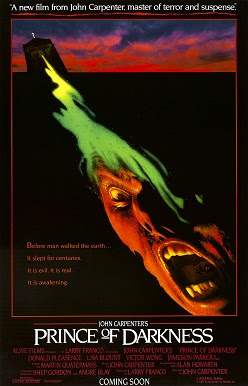
1. Prince of Darkness (1987)

Certainly, the cosmology that it posits (Satan is the off-spring of an all-powerful, anti-God who the Church is trying to prevent from entering into our world from the realm of anti-Matter), though preposterous, is deeply disturbing. On the other hand, the mixture of science fiction and the supernatural never quite gels together and the script is, at times, pedantic, explaining too much about the phenomenon and leaving too little to the imagination. Outside of Donald Pleasence's shaken priest and Victor Wong's unorthodox professor, the characters never really come alive. Overall this is a lesser effort from Carpenter but is has lot of creativity and is genuinely unsettling at times. 

Score: 7/10

2. The Fog (1980)

The first really "pure" horror film I ever watched was John Carpenter's The Fog (before this I had seen films like Jaws and Predator, whose entry in the genre some might dispute). I've always had a soft spot for it despite some of it's flaws. It's fairly obvious, for instance that the film was extensively re-shot to make it more graphic. Despite this, it manages to maintain a relatively consistent tone and is wonderfully atmospheric. Dean Cundy provides maybe the strongest cinematography of any of his collaborations with Carpenter. It also features one of the director's best musical scores. A cast which includes Carpenter regulars like Adrienne Barbeau, Tom Atkins, Nancy Loomis and Charles Cyphers is buffered by veteran actors Hal Holbrook and Janet Leigh.

Score: 9/10

3. Dr. Jekyll and Mr. Hyde (1931)

Perhaps fittingly, Dr. Jekyll and Mr. Hyde is a film of strange dichotomies. On the one hand, it takes the novella's themes about the duality of man in a much more explicitly Christian direction. Jekyll's attempt to separate his bestial nature from his higher self are seen as an abomination, an attempt to blasphemously science to circumvent man's fallen state. At one point, Jekyll cries out, "This is my penance. Do you hear, oh, God?" On the other hand, it is a rather provocative film (at least for the time it was made) in it's portrayal of sexual degeneracy (when it was re-released in 1936, the Code required 8 minutes to be removed before the film could be distributed to theaters). Technically the film is a marvel. It's use of long, tracking shots is especially striking for this period and the make-up used for the transformation scenes is frankly astounding. 

Score: 8/10

4. Dead Snow 2: Red vs. Dead (2014)

Like the first film, Dead Snow 2 delights in its gratuitous violence. The first film owed a great deal to Sam Raimi's The Evil Dead (both feature a group of young people who find themselves under attack from the undead in an isolated cabin) so its not surprising that this one is often indebted to its sequels Evil Dead II (particularly the scenes where Ash's arm begins attacking him) and Army of Darkness (which also features the protagonist summoning an undead army). Like those films it has a more comedic, tongue-in-the-cheek tone then its predecessors. It also (clearly) has a bigger budget. Because of this, some of the low-budget charm of the original is lost but it remains entertaining for those who like this sort of film. With that said I found the intrusion of the stereotypical nerd characters irritating and the ending, which is supposed to be heartwarming, came across as rather perverse. 

Score: 7/10

5. Constantine (2005)

This is basically the Matrix meets the Exorcist. Director Francis Lawrence directs with real panache and Keanu is right in his element as the jaded (but ultimately good-hearted) Constantine. I'm a sucker for this over-the-top demon hunting sort of film (cross-shaped firearms for the win!). Constantine presents a rather muddled cosmology, one tainted with strains of manichaeism: Angels and demons are locked in an eternal struggle for mankind's souls originating in a standing wager between God and Lucifer. Constantine's redemption is highly problematic from a theological perspective, As is a scene where Lucifer "releases" a soul from Hell though I must admit that I'm rather keen on Peter Stormare's portrayal of the fallen angel. His perverse, serpentine presence is contrasted with a petty kind of spite that seems somehow fitting. More troubling is the film's portrayal of the arch-angel Gabriel as a demented, overzealous servant, bent on forcing humanity to become worthy of God's grace by aiding Mammon, the son of Lucifer, in setting up his own kingdom.

Score: 6/10

6. Duel (1971)

Spielberg's first feature-length film remains a gripping thriller. The stripped down plot (man angers a truck driver when passing him on the highway and ends up being hunted down by him) has a surprising amount of mileage (no pun intended). Is it a horror film? I think so. Significantly, the driver of the truck is never really seen, making the vehicle almost a force of nature. This element of an unknown, seemingly unstoppable menace, is at the heart of horror. Dennis Weaver carries the film as the mild mannered business man who must find his inner manhood in order to survive this harrowing ordeal (if the film has a message it is certainly "don't be a simp"). It's a great little film.

Score: 9/10

7. Black Sunday (1960)

The directorial debut of Mario Bava, a Italian director who would go on to direct such classic horror films as Black Sabbath (1963) and Blood and Black Lace (1964). A classic piece of gothic horror, the plot of the film involves a witch (Barbara Steele) returning from the grave after 200 years to exact revenge on the ancestors of the men who put her to death. Black Sunday is a wonderfully atmospheric film, invoking, at times the classic Universal monster cycle. It is also a rather violent and provocative film for its time (in one scene the witch's robe is lifted up, revealing the rotting, undead flesh inside). In this it reflects the contemporaneous films from the British Hammer Film Productions. It also shares those films use of religious iconography as an weapon against evil. 

Score: 8/10


Wednesday, August 25, 2021

Western Wednesdays: A Coffin for the Sheriff (1965)

     A Coffin for the Sheriff was released on December 23rd, 1965. Directed by Mario Caiano and written by David Moreno and Guido Malatesta it stars Anthony Steffen as Shenandoah, a drifter who joins up with a band of outlaws in his pursuit of vengeance for his wife, who was raped and murdered by one of their number. 

     A Coffin for the Sheriff is a very uneven film. Some scenes are rather inspired: Shenandoah's initiation into the gang which involves a cat and mouse with one of the bandits, where the latter is given twelve bullets and Shenandoah only one, and the climax where he stalks his wife's killer through the streets of Richmond. Unfortunately, much of the film is plodding and predictable and the script is incredibly stilted, even by genre standards. It is also tonally inconsistent at times, with the comic relief (mostly supplied by Jesús Tordesillas' anonymous old man) clashing with the films dark, violent story. 

     Director Mario Caiano, whose first western, Bullets Don't Argue, was an uninspired rip-off of American westerns, takes this film in a much more dark and brutal direction. The scene where Shenandoah is beat by the gang after they discover his true motives lives up to the genre's usual sadistic standards and the attempted rape of Luciana Gilli's Jane Wilson is, in particular, hard to watch. If nothing else, Caiano was skilled at directing action scenes and this film has some good ones. The aforementioned climax is a highlight as is the furious shootout which precedes it. Earlier scenes, where the bandits flee the town after a robbery and where they attack Wilson's (George Rigaud) ranch are also well done. 


     Anthony Steffen is solid in the lead role. He plays it stoically through most of the film but really comes alive near the end, when the identity of his wife's killer is revealed. Eduardo Fajardo is practically dripping with evil as the murderer Murdock while Armando Calvo brings his own sense of menace to Lupe Rojo, the leader of the gang. Arturo Dominici brings plenty of sleaze to Jerry Krueger, the cowardly lawyer turned bandit. María Vico imbues Lupe's much abused mistress with a real sense of pathos and bitterness while Luciana Gilli gives the otherwise wilting Jane Wilson a spirited streak. Her father on the other hand, as portrayed by George Rigaud seems peculiarly indifferent through most of the proceedings. 

     In the end, A Coffin for the Sheriff is a thoroughly routine and at times rather crude spaghetti western. It is worth checking out for its action scenes and its suspenseful climax. 

Score: 6/10

Wednesday, August 18, 2021

Western Wednesdays: Buchanan Rides Alone (1958)

     Released on August 6th, 1958, Buchanan Rides Alone is directed by Budd Boetticher and prodcued by Harry Joe Brown. Written by Charles Lang, it is an adaptation of the 1956 novel, The Name's Buchanan by Jonas Ward. In it Randolph Scott plays Tom Buchanan, a gun-for-hire who is embroiled in an internal conflict in the town of Agry, California.

     The fourth of a six film collaboration between Brown, Boetticher and star Randolph Scott, Buchanan Rides Alone was the second written by Charles Lang, however, Boetticher was unsatisfied with Lang's screenplay and asked his regular writer, Burt Kennedy (who had scripted Seven Men from Now and The Tall T), to touch it up a bit. It definitely bears the mark of Kennedy's writing, with witty lines like "This sure is a $10 town." Scott's character here is almost the antithesis of Bart Allison who he played in the previous film, Decision at Sundown (1957).  While Allison was a broken, ragged man, on the edge of sanity, Buchanan is perfectly cool and at ease, seemingly unperturbed by the predicaments he finds himself in throughout the film. 


      The cast are all around excellent. Barry Kelley, Tol Avery Peter Whitney and William Leslie play a group of brothers who have come to rule the town which bears their name through corruption and subterfuge. Avery's Judge Simon Agry is the leader of the bunch, a manipulative  and unscrupulous politician, willing to do whatever it takes to get ahead. Kelley plays his more ruthless and cruel brother, town sheriff Lew Agry while Whitney is the groveling third wheel, Amos, dissatisfied with his lowly position as clerk at the hotel, is constantly scheming to get his piece of the pie. Finally, Leslie is the hot headed younger brother Roy, whose murder sets the plot in motion. Manuel Rojas is the murderer, Juan de la Vega, whose determination to avenge the honor of his sister, raped by Roy, borders on fatalism. Craig Stevens plays the shrewd Abe Carbo, the judge's right hand man and, in many ways, the real brains of the organization. A young L. Q. Jones is the honorable thug, Pecos Hill whose affinity for Buchannan as a fellow west Texan leads to his reform (and eventual demise). Of course Randolph Scott is supremely confident as the unflappable Tom Buchanan, going through the film with the swagger of a matador (the subject was an ongoing obsession of Boetticher who got his big break with Bullfighter and the Lady (1951) and closed out his career with the bullfighting documentary Arruza in 1971).

     Boetticher cited Buchanan Rides Alone as his personal favorite among his collaborations with Scott. It is the lightest in tone and, compared to the other films in the cycle, is a little sparse both with the action and the romance. While the action could almost be said to revolve around women in the other films of the Ranown cycle, the only women in this has fairly minor, inconsequential roles. Cinematographer Lucien Ballard, who was a frequent collaborator with Boetticher and would go on to shoot some of Sam Peckinpah's best films, does some solid work here and is especially adept at blocking, with characters artfully arranged in the foreground and background. 

     Though probably the weakest of the Ranown cycle Buchanan Rides Alone is still a solid western, with a clever script, a terrific cast and sturdy direction from Boetticher.

Score: 8/10


Wednesday, August 11, 2021

Western Wednesdays: Wagon Tracks (1919)

     Wagon Tracks was released on July 29th, 1919. Directed by Lambert Hillyer and written by C. Gardner Sullivan it stars William S. Hart as Buckskin Hamilton, the captain of a wagon train, who sets out to the avenge the murder of his brother, Billy.

     The film opens by showing how his brother was murdered. Catching a card shark (Robert McKim's David Washburn) who was trying to cheat him in a poker game, Billy disarms him only to be accosted by his sister (Jane Novak's Jane Washburn), who mistakenly believes that Billy is threatening her brother. In the shuffle Washburn sneaks up and pulls the trigger, killing Billy, and then convinces Jane that she was responsible. 

     Hart was a strict moralist, a fact which shines through every film he ever starred in. Though the characters he plays often live wicked lives, they are always reformed by the end of the picture. The character he plays here is a straight shooter from the beginning but the deep shame Buckskin feels at his brother's seemingly dishonorable death and his utter disbelief at the suggestion that a woman could have killed him are very typical of the kinds of characters Hart liked to portray. 

     The film also puts forth a distinctly Christian, if somewhat puritanical concept of justice. When Buckskin finally discovers that Washburn killed his brother, he foregoes his vengeance for the good of the settlers. Spurred on by Jane, he shows mercy to Washburn but, since justice demands that he die for his crimes, he gives him the choice of giving himself up to the Indians, presumably to be tortured, or taking his own life. Assuming he will take the cowards way out, Hamilton determines to offer himself as a scapegoat in Washburn's place. Duplicitous to the end, Washburn attempts to escape only to fall into the hands of the Indians, both (inadvertently) satisfying justice and preventing innocent blood from being shed. 

     The Indians are treated in a surprisingly sympathetic manner. They have a legitimate grievance with the white settlers as one of their number is killed over a misunderstanding. They also offer to let one man pay for this injustice instead of the whole party. As is typical of the westerns of this period, relations between the white settlers and the natives is ultimately seen as a tragic culture clash rather then dominance of one group over another or as the "triumph of civilization."

     Wagon Tracks features some of the most effective use of tinting I've seen in a silent film. The sepia tones give a sense of the oppressive heat, which is contrasted with the cool blue tints of the night scenes whereas the scenes in front of the fireplace, where Washburn's fate is decided, have an almost hellish tone. It's a little short on the action, as was increasingly common in Hart's later film's, focusing more on melodrama. Lambert Hillye, who directed many of Hart's westerns and would go on to helm many B-westerns well into the 40's, milks this melodrama for everything it's worth, getting heartrending, theatrical performances from the whole cast.   

     In many ways Wagon Tracks is the summation of the William Hart western. It is not a film for fans looking for the fast paced action of a Tom Mix or Hoot Gibson picture, but if you want a melodramatic morality play, look no further.

Score: 8/10

Monday, August 2, 2021

My Favorite Films: The Great Muppet Caper (1981) (Musical Mondays)

     Of all the Muppet films, The Great Muppet Caper is probably the one I've seen the most. Along with Muppet Treasure Island, it was a film that my siblings and I would routinely borrow from our local public library when we were growing up. It's one of the movies I could probably recite line-by-line. It's also easily the funniest of the eight theatrical films.

     Of course, the Muppet performers are all in top form but a lot of credit for this has to go the the human actors. For one thing you have the incomparable Diana Rigg as Lady Holiday. Her dry sense of humor contrasts wonderfully with all the zaniness around her. Charles Grodin, playing her brother Nicky ("an irresponsible parasite") is wonderfully over-the-top, and he plays the character's absurd infatuation with Miss Piggy with a hilarious earnestness. Both actors play brilliantly off of each other and off of their Muppet co-stars, as do many of the more minor players. Of course it helps that this film features the two greatest cameos in movie history from John Cleese and Peter Falk.

     The real key to the films success however is its script, by Muppet regular Jerry Juhl along with Jack Rose (an Academy Award nominated veteran of classic Hollywood comedies) and Tom Patchett and Jay Tarses (who both worked on The Bob Newhart Show and The Carol Burnett Show). Combining running jokes, sight gags, non sequiturs, and absurd (often fourth-wall breaking) humor, The Great Muppet Caper represents the Muppet's at the height of their comedic power. When I was a kid watching Beauregard driving like a madman around London was the funniest thing ever. Now I can appreciate how sharp the screenplay really is and the jokes that went over my head as a kid ("It's plot exposition it has to go somewhere.", "My wife isn't feeling very well...") are the ones I laugh the hardest at now. 


      Of course, like its predecessor, the film constantly breaks the fourth wall. As I mentioned in my review of that film, this maintains the meta slight-of-hand that helped make the Muppets feel real. The Great Muppet Caper does this somewhat more effortlessly then its predecessor, and the Muppets drift in and out of character seamlessly at different points throughout the film. Just watch the scene where Kermit and Piggy get into a heated argument in front of the duck pond and slip into a behind-the-scenes dispute ("I am playing 800 different emotions." "Well, try to play one of them right"). It's just brilliant writing.

     The Great Muppet Caper is generally more focused on sending up Hollywood clichés then the The Muppet Movie was. That film used the template of a road trip movie to tell the story of how the Muppets got together whereas this is essentially a heist film with elements of film noir romances and classical Hollywood musicals thrown in for good measure. It is clear that Jim Henson and co. had a love for this kind of genre fare. This is most obvious in some of the films more impressive musical numbers. "The First Time It Happens" channels Busby Berkely while "Piggy's Fantasy" hearkens back to the so-called "aquamusicals" of Esther Williams.

     The songs, by Joe Raposo (who worked on both Sesame Street and The Muppet Show), are not as memorable as Paul Williams and Kenneth Ascher's music for The Muppet Movie, but Raposo does a respectable job following in their footsteps nonetheless. The film opens with "Hey A Movie!", which sets the tone for the film's send-up of classical Hollywood cliches ("There'll be mystery and catastrophe. But it's all in fun, you paid the money, wait and see") and also sets the plot into motion as Kermit, Fozzie, and Gonzo (playing investigative reporters) are so busy with the opening number that the miss the jewel robbery, and all the other slapstick hijinks, occurring around them, prompting them to go to London to interview Lady Holiday, whose jewels are stolen, to redeem themselves in the eyes of their boss, Mr. Tarkanian (Jack Warden).

     "Happiness Hotel", probably the films most memorable tune, introduces the rest of the Muppet gang as residents of the dilapidated London hotel where Kermit, Fozzie, and Gonzo are staying. "Steppin' Out With a Star" serves as kind of a love theme for Kermit, who channels Fred Astaire by dancing with a clothes rack. It transitions into a tercet with Gonzo and Fozzie as he agrees to let them come along on his "date". "Night Life" serves as an ironic accompaniment to Kermit and Piggy's first date, as they ride to the Dubonnet Club on Happiness Hotel bus while Dr. Teeth and the Electric Mayhem boogie away. Finally, the gentle "Couldn't We Ride" provides the often frantic film with a leisurely change of pace, as the Muppets take a bicycle ride through the London park after Kermit and Piggy resolve their differences.

     In general, The Great Muppet Caper is more impressive in its production value then its predecessor, likely thanks to its bigger budget. The sets are much more elaborate and there is a much larger cast of extras. Much of the film was shot on location in England and Oswald Morris cinematography is more crisp and polished looking then Isidore Mankofsky's softer look for The Muppet Movie. After showing Kermit riding a bicycle in that film caused such a stir, Jim Henson, stepping into the directors chair for the sequel, took it even further this time around, creating a complex system of rods, marionette wires and remote control bicycles for the scene wherein all the Muppets are seen bicycling at the same time. But it's in the "Piggy's Fantasy" number that they really pulled out all the stops, building a custom-made heated pool on the sound stage, giving Frank Oz scuba training, and designing special, water-resistant Miss Piggy puppets.

     Yet, for all that, the film never loses that sense of whimsy and innocence which is at the heart of Jim Henson's creation. As Henson intended, this is a film that people of all ages can enjoy, from the young and wide-eyed to the old and jaded. Like its predecessor, The Great Muppet Caper is a true family film.