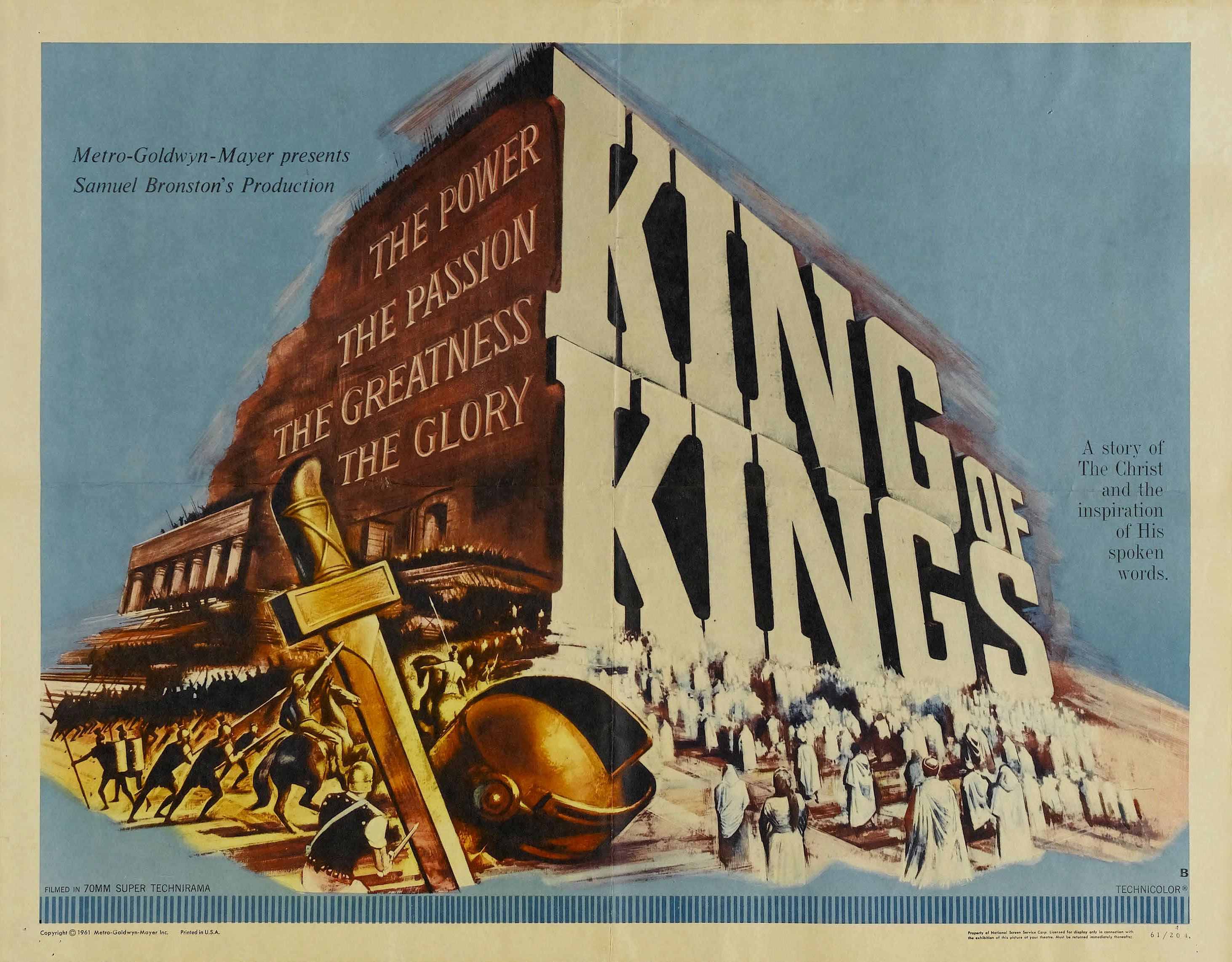
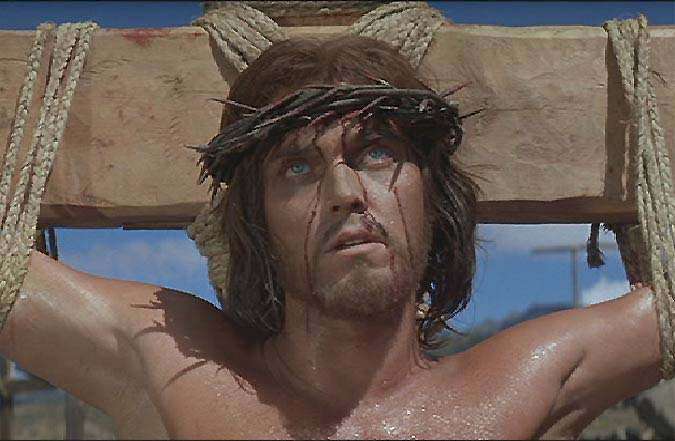
The King of Kings was released on April 19th, 1927. Directed by Cecil B. DeMille and written by Jeannie Macpherson it is a retelling of the Gospel accounts of the life of Christ, from His public ministry to His death and resurrection.
Macpherson's script does a good job bringing various episodes from the Gospel's together to form a coherent narrative. The conflict between Jesus and the Pharisees is established early on and continues to drive the story for the remainder of the film. It begins by showing Mary Magdalene (Jacqueline Logan), here portrayed as a courtesan in Judea, who is furious that her lover, Judas (Joseph Schildkraut), has taken up with a poor carpenter. We are next introduced to Jesus (H. B. Warner) who is shown performing various miracles, including the healing of a lame boy revealed to be a young Mark the Evangelist (Micky Moore). We are also introduced to the apostles and Mary (Dorothy Cumming). Then, in a dramatic scene, Jesus expels seven demons (here personifying the seven deadly sins) from Mary Magdalene.
The action then shifts to the countryside and several scene's from Matthew 17 are combined together. First Judas is shown attempting to expel a demon in Jesus name. When he fails, the parents of the possessed boy bring him to Jesus, who cures him. Then Matthew (Robert Edeson), the tax collector, sent by Caiaphas' (Rudolph Schildkraut) conniving, show up and demand that Jesus pay the tribute to Caesar. As they are without funds, Jesus sends Simon Peter (Ernest Torrence) to retrieve money from a fish. The question about the legality of collecting taxes from Matthew 22 is then brought up, prompting the famous response about rendering unto Caesar. After this there is a short scene where Jesus, quoting Mark 10:14, sits
with a group of little children, one of whom has a doll with a broken
leg which He fixes. Jesus is then approached by Martha and Mary of Bethany (Julia Faye and Josephine Norman) who ask him to heal their brother Lazarus (Kenneth Thomson), who is sick. The raising of Lazarus from John 11 then proceeds.
Jesus then goes to Jerusalem where he saves the women caught in adultery (from John 8) and overturns the tables of the moneylenders (from Matthew 21, Mark 11, and John 2). Following this this, in a scene which combines the entry into Jerusalem with the end multiplication of the loaves from John 6, Jesus is welcomed as the Messiah by the people and Judas tries to have him crowned king but Jesus passes "through the midst of them" and withdraws to the temple where he is tempted by Satan with "the kingdoms of the world and the glory of them (in a scene drawn from the temptation in the desert). Finally Jesus is betrayed to the Pharisees by Judas and the Last Supper is portrayed followed by Jesus' passion, death Resurrection and ascension.
The film is not without it's flaws. The opening scene with Mary Magdalene is overly sensualized and indulgent. It also seems to set up Mary as a major character only to have her disappear from narrative after her exorcism until the passion. Like all of DeMille's work, The King of Kings is
quite theatrical at times. When Jesus is arrested, for instance, the
apostles start a riot to try and free him before being told by the
Master to stop. After Christ's death there is not only a great storm and
earthquakes, as in Matthew 27:51: "And, behold, the veil of the temple
was rent in twain from the top to the bottom; and the earth did quake,
and the rocks rent", but here the men who mocked Jesus fall into a great
gulf caused by the earthquake and are swallowed up by hellfire.
At the same time the film is filled with breathtaking scenes of visual poetry: the healing the blind girl at the beginning of the film, where Jesus is revealed for the first time in a POV shot, as the girl slowly recovers her sight, surrounded by a halo; the cleansing of Mary Magdalene, utilizing multiple exposure to portray the seven demons; the close-up of the cross being dragged through the streets of Jerusalem; the Resurrection, shot in glorious two-strip technicolor in contrast to the black and white cinematography of the rest of the film (the longer premiere version, superior in most aspects, also features technicolor in the opening scene, sadly undermining the effect at the end).
The premiere cut (which adds the scenes dealing with Jesus paying taxes) also features some wonderful scenes of Marian piety. In one surprising artistic addition, the Blessed Mother comforts the mother of the impious thief on Calvary, seemingly taken on the role of the mother of mankind. Later, Jesus appears to his mother first after His resurrection, before Mary Magdalene (a Catholic oral tradition). Coming from a wayward Episcopalian like DeMille, this is surprising.
The King of Kings has an excellent cast. H. B. Warner is a particularly warm Jesus, more approachable then the almost almost stoic figure portrayed by Max von Sydow in The Greatest Story Ever Told or Robert Powell in Jesus of Nazareth. He projects both compassion and authority, though he is a little lacking in energy during the cleansing of the temple, casually flipping tables over more then violently overturning them (Warner was 55 when he took on the role). Joseph Schildkraut is the other stand out performance as Judas, completely pompous in the early parts of the film and tragically despairing after his betrayal. Ernest Torrence is almost childlike as Simon Peter, potrayed here as an overzealous gentle giant. Dorothy Cumming is simply wonderful as the Virgin Mary, tender, loving, even radiant at times. Jacqueline Logan's Mary Magdalene, though sadly somewhat objectified in the opening scene, does a fine job in the rest of the picture as Jesus devoted follower, even protesting, futiley, during his condemnation. Rudolph Schildkraut makes for a particularly despicable Caiaphas. Victor Varconi is great as a Pontius Pilate completely bored and disgusted with Hebrew politics. Micky Moore is, at times, distracting as the impetuous young Mark but it's a welcome lively performance in a largely solemn picture.
The King of Kings though certainly flawed is a great film nonetheless. It's easily the best Hollywood film on the life of Christ.
Score: 9/10
Showing posts with label Biblical epics. Show all posts
Sunday, March 1, 2020
Tuesday, April 23, 2019
Lent Reviews Year 6 Week 6: Jesus of Nazareth (1977)
Jesus of Nazareth originally aired during the Lent and Easter season of 1977. It is directed by Franco Zeffirelli and written by Zeffirelli, Anthony Burgess, and Suso Cecchi d'Amico (Bicycle Thieves, The Leopard, The Taming of the Shrew). It stars Robert Powell as Jesus.
Jesus of Nazareth was an extremely ambitious undertaking. The middle part of a loose trilogy, which began with Moses the Lawgiver in 1973 and ended with A.D. (chronicling the Acts of the Apostles) in 1985 (all of which were co-written by Burgess), it seeks to present a fairly comprehensive adaptation of the four gospels. Never before had this much running time been devoted to the a film about Jesus' life. Like all Jesus films, the real challenge for the writers is to construct a traditionally structured story from the rather episodic Gospel accounts. Because this is a miniseries, broken up into 4 episodes, they had an advantage. Consequently, Zeffirelli, along with Burgess and d'Amico, do an admirable job weaving all the disparate threads together into a relatively cohesive narrative. The first episode focuses on the Nativity story from Luke's Gospel. Episode two focuses on the preaching and execution of John the Baptist (Michael York) and the beginning of Jesus' public ministry. Episode three continues the story of Jesus ministry and the tensions between Him and the Sanhedrin. Finally, the last episode, drawing primarily from John's Gospel, focuses on Jesus' entry into Jerusalem, His betrayal and death, and (all too briefly) His Resurrection.
Zefirelli is a great director and imbues many of the gospel episodes with a real cinematic flair. For instance, the scene where Jesus tells the parable of the prodigal's son is simply amazing. A revelatory re-imaging of the calling of Peter (James Farentino) and Matthew (Keith Washington), here Peter resents Matthew for collecting taxes for the Romans and creating an undue burden for his family. When Jesus goes to Matthew's house for supper, he is shocked that this man, who he has recognized as a prophet would, "eat with tax collectors and sinners." Undaunted, Jesus invites Peter to come with him. Jesus then relates the story of the prodigal son, as Peter listens from the doorway, and it becomes clear that in this scenario, Peter is the elder son, resentful that his sinful younger brother is being treated with mercy. He and Matthew then tearfully reconcile.
The portrayal of the Annunciation, witnessed by her Mary's mother Saint Anne (Regina Bianchi), is beautifully subtle. The angel is not seen or heard, we only hear Mary's (played by Olivia Hussey) response to it, as she kneels before a window with moonlight shining through. Zeffirelli's framing hear is immaculate. Brilliant too is the scene where John (John Duttine), following Jesus instruction to proclaim the kingdom of God, goes to visit the Blessed Mother, greeting her with the words, "Blessed are you among women" to which she replies, "Anyone who obeys our Father in Heaven is His mother, His sister, His brother." This line is often used by some protestants to attack Mariology so having her say it, thus leading John to the Father through her, strikes me as a particularly Catholic choice.
This is something of an anomaly as many other choices in the film (for instance Mary has birth pains when Jesus is born) are more conciliatory toward Protestants and people of other Judeo/Christian faiths. It was the intention of the filmmakers to make the story 'acceptable to all denominations and there is special care placed on the film's portrayal of Jews. The Sanhedrin are more sympathetic then usual, and Pilate is shown to be just as culpable for Christ's death as they. Both Joseph of Arimethea and Nicodemus are given prominent roles and are shown trying to defend Jesus at his trial. Zeffirelli was clearly influenced by Vatican II's Nostra aetate (the Declaration on the Relation of the Church with Non-Christian Religions) and its condemnation of antisemitism and recognition that Christians and Jews share a common heritage. Because of this, Jesus' own Jewish heritage is stressed again and again. We even see his Bar Mitzvah, despite the fact that this ceremony was introduced over a thousand years after Jesus died!
With all that said, the series does come up short in some places. Though Herod's (Christopher Plummer) interest in Jesus is established (in a scene from the synoptic Gospels where he wonders if perhaps it is John the Baptist raised from the dead) his meeting with Jesus before the crucifixion is not portrayed, making the passion narrative feel a bit incomplete as a result.
The presence of Ian Holm's fictional pharisee, Zerah, is a bit intrusive at times. His propose in the story is to manipulate Judas into betraying Jesus. They take this a little too far and make Judas into more of an innocent dupe then the conniving Zealot he is usually portrayed as. He is also shown to wield a certain degree of influence with Pilate. That a former zealot like Judas would trust a man who was respected by the Romans seems to me a bit dubious. Finally he is continually shown during the passion scenes, walking alone in the temple as Jesus carries his cross. I found this distracting and ultimately pointless.
By downplaying the especial guilt of Judas and the Sanhedrin, the film emphasizes the fact that we are all culpable for Jesus' death. As Peter tells the other apostles after the resurrection, "I denied him because I was a coward! We are all cowards! We accused Judas of being a traitor, but we all betrayed him! We all abandoned him." Nevertheless, changing Judas' motivations so drastically problematic, especially in light of his suicide so soon afterward.
In some ways Jesus of Nazareth is The Godfather saga of Jesus movies, similar in it's subdued, realistic approach and in it's universal appeal and acceptance into the popular culture (if not so much in its near perfect execution). Robert Powell, cast in part due to his resemblance to Warner Sallman's Head of Christ, has become an iconic and popular image of Christ in his own right. The same can be said, though to a lesser extent, for Olivia Hussey's Virgin Mary. Also like The Godfather, Jesus of Nazareth has become a staple of TV broadcasts, particularly around the Easter Season.
All of the cast, indeed, embody their characters as well or better then in any other adaptation of the Gospels. James Farentino's Simon Peter is a grizzled, self-doubting man, struggling to reconcile his zeal for Christ with his all too human timidity. Ian McShane's Judas Iscariot, despite some of the writing issues, still manages to convey the traitor's conniving and failure to surrender his own vision for Christs. Micheal York's Baptist is every bit the powerful orator that Heston (The Greatest Story Ever Told) and Ryan (King of Kings) were. Christopher Plummer is a suitably besotted yet deeply conflicted and guilt ridden Herod Antipas. Rod Stieger is at once world-weary, comprehending, and merciless as Pilate. Olivia Hussey is easily my favorite on-screen Mary with the possible exception of Maia Morgenstern (The Passion of the Christ). Humble, compassionate and on fire with love for her Son her performance inspires that Marian devotion that is so dear to us Catholics.
While Robert Powell is, generally, a more reverential and remote Jesus he still has plenty of relatable human moments and his subdued delivery of Christ's parables and teaching is incredibly effective. As per Zeffireli's instructions, Powell rarely blinks during film, echoing both H.B. Warner (The King of Kings) and Max von Sydow (The Greatest Story Ever Told). This accentuates the actor's already penetrating eyes. For the scenes dealing with the passion, Powell fasted on a diet of only cheese for twelve days prior to shooting. Portraying the child Jesus Lorenzo Monet is a good match for Powell, though his (obviously dubbed) voice is a bit distracting.
Jesus of Nazareth, despite its flaws, remains one of the best (and easily the most iconic) portrayals of the life of Christ on film. Highly recommended!
Score: 9/10
P.S. I am sorry that this is fashionably late (as is pretty much par for the course on this blog) but this was a daunting review! Happy Easter everyone!
Jesus of Nazareth was an extremely ambitious undertaking. The middle part of a loose trilogy, which began with Moses the Lawgiver in 1973 and ended with A.D. (chronicling the Acts of the Apostles) in 1985 (all of which were co-written by Burgess), it seeks to present a fairly comprehensive adaptation of the four gospels. Never before had this much running time been devoted to the a film about Jesus' life. Like all Jesus films, the real challenge for the writers is to construct a traditionally structured story from the rather episodic Gospel accounts. Because this is a miniseries, broken up into 4 episodes, they had an advantage. Consequently, Zeffirelli, along with Burgess and d'Amico, do an admirable job weaving all the disparate threads together into a relatively cohesive narrative. The first episode focuses on the Nativity story from Luke's Gospel. Episode two focuses on the preaching and execution of John the Baptist (Michael York) and the beginning of Jesus' public ministry. Episode three continues the story of Jesus ministry and the tensions between Him and the Sanhedrin. Finally, the last episode, drawing primarily from John's Gospel, focuses on Jesus' entry into Jerusalem, His betrayal and death, and (all too briefly) His Resurrection.
Zefirelli is a great director and imbues many of the gospel episodes with a real cinematic flair. For instance, the scene where Jesus tells the parable of the prodigal's son is simply amazing. A revelatory re-imaging of the calling of Peter (James Farentino) and Matthew (Keith Washington), here Peter resents Matthew for collecting taxes for the Romans and creating an undue burden for his family. When Jesus goes to Matthew's house for supper, he is shocked that this man, who he has recognized as a prophet would, "eat with tax collectors and sinners." Undaunted, Jesus invites Peter to come with him. Jesus then relates the story of the prodigal son, as Peter listens from the doorway, and it becomes clear that in this scenario, Peter is the elder son, resentful that his sinful younger brother is being treated with mercy. He and Matthew then tearfully reconcile.
The portrayal of the Annunciation, witnessed by her Mary's mother Saint Anne (Regina Bianchi), is beautifully subtle. The angel is not seen or heard, we only hear Mary's (played by Olivia Hussey) response to it, as she kneels before a window with moonlight shining through. Zeffirelli's framing hear is immaculate. Brilliant too is the scene where John (John Duttine), following Jesus instruction to proclaim the kingdom of God, goes to visit the Blessed Mother, greeting her with the words, "Blessed are you among women" to which she replies, "Anyone who obeys our Father in Heaven is His mother, His sister, His brother." This line is often used by some protestants to attack Mariology so having her say it, thus leading John to the Father through her, strikes me as a particularly Catholic choice.
This is something of an anomaly as many other choices in the film (for instance Mary has birth pains when Jesus is born) are more conciliatory toward Protestants and people of other Judeo/Christian faiths. It was the intention of the filmmakers to make the story 'acceptable to all denominations and there is special care placed on the film's portrayal of Jews. The Sanhedrin are more sympathetic then usual, and Pilate is shown to be just as culpable for Christ's death as they. Both Joseph of Arimethea and Nicodemus are given prominent roles and are shown trying to defend Jesus at his trial. Zeffirelli was clearly influenced by Vatican II's Nostra aetate (the Declaration on the Relation of the Church with Non-Christian Religions) and its condemnation of antisemitism and recognition that Christians and Jews share a common heritage. Because of this, Jesus' own Jewish heritage is stressed again and again. We even see his Bar Mitzvah, despite the fact that this ceremony was introduced over a thousand years after Jesus died!
With all that said, the series does come up short in some places. Though Herod's (Christopher Plummer) interest in Jesus is established (in a scene from the synoptic Gospels where he wonders if perhaps it is John the Baptist raised from the dead) his meeting with Jesus before the crucifixion is not portrayed, making the passion narrative feel a bit incomplete as a result.
The presence of Ian Holm's fictional pharisee, Zerah, is a bit intrusive at times. His propose in the story is to manipulate Judas into betraying Jesus. They take this a little too far and make Judas into more of an innocent dupe then the conniving Zealot he is usually portrayed as. He is also shown to wield a certain degree of influence with Pilate. That a former zealot like Judas would trust a man who was respected by the Romans seems to me a bit dubious. Finally he is continually shown during the passion scenes, walking alone in the temple as Jesus carries his cross. I found this distracting and ultimately pointless.
By downplaying the especial guilt of Judas and the Sanhedrin, the film emphasizes the fact that we are all culpable for Jesus' death. As Peter tells the other apostles after the resurrection, "I denied him because I was a coward! We are all cowards! We accused Judas of being a traitor, but we all betrayed him! We all abandoned him." Nevertheless, changing Judas' motivations so drastically problematic, especially in light of his suicide so soon afterward.
In some ways Jesus of Nazareth is The Godfather saga of Jesus movies, similar in it's subdued, realistic approach and in it's universal appeal and acceptance into the popular culture (if not so much in its near perfect execution). Robert Powell, cast in part due to his resemblance to Warner Sallman's Head of Christ, has become an iconic and popular image of Christ in his own right. The same can be said, though to a lesser extent, for Olivia Hussey's Virgin Mary. Also like The Godfather, Jesus of Nazareth has become a staple of TV broadcasts, particularly around the Easter Season.
All of the cast, indeed, embody their characters as well or better then in any other adaptation of the Gospels. James Farentino's Simon Peter is a grizzled, self-doubting man, struggling to reconcile his zeal for Christ with his all too human timidity. Ian McShane's Judas Iscariot, despite some of the writing issues, still manages to convey the traitor's conniving and failure to surrender his own vision for Christs. Micheal York's Baptist is every bit the powerful orator that Heston (The Greatest Story Ever Told) and Ryan (King of Kings) were. Christopher Plummer is a suitably besotted yet deeply conflicted and guilt ridden Herod Antipas. Rod Stieger is at once world-weary, comprehending, and merciless as Pilate. Olivia Hussey is easily my favorite on-screen Mary with the possible exception of Maia Morgenstern (The Passion of the Christ). Humble, compassionate and on fire with love for her Son her performance inspires that Marian devotion that is so dear to us Catholics.
While Robert Powell is, generally, a more reverential and remote Jesus he still has plenty of relatable human moments and his subdued delivery of Christ's parables and teaching is incredibly effective. As per Zeffireli's instructions, Powell rarely blinks during film, echoing both H.B. Warner (The King of Kings) and Max von Sydow (The Greatest Story Ever Told). This accentuates the actor's already penetrating eyes. For the scenes dealing with the passion, Powell fasted on a diet of only cheese for twelve days prior to shooting. Portraying the child Jesus Lorenzo Monet is a good match for Powell, though his (obviously dubbed) voice is a bit distracting.
Jesus of Nazareth, despite its flaws, remains one of the best (and easily the most iconic) portrayals of the life of Christ on film. Highly recommended!
Score: 9/10
P.S. I am sorry that this is fashionably late (as is pretty much par for the course on this blog) but this was a daunting review! Happy Easter everyone!
Sunday, March 18, 2018
Lent Reviews Week 4: The Ten Commandments (1956)
The Ten Commandments was released on October 5th, 1956. It is directed by Cecil B. DeMille and written by Aeneas MacKenzie, Jesse L. Lasky Jr., Jack Gariss and Fredric M. Frank. It tells the story of Moses (Charlton Heston) from the book of Exodus, beginning with his birth and ending with God's giving him the covenant on Mount Sinai.
The Ten Commandments is so ingrained in the American pop culture consciousness that reviewing it is almost a futile exercise at this point. But, having set out to review religious films every lent, I knew I'd have to tackle it sooner or later. Most of my readers are probably already familiar with Heston and Brynner's larger-then-life portrayal of Moses and Rameses, with DeMille's penchant for pageantry and spectacle and with the film's questionable fidelity to biblical and historical texts. Of course, almost everyone knows the basic story. The baby Moses is hidden in the Nile to escape the wrath of Pharaoh but is found by the monarch's daughter who raises him as her own son. After learning of his true heritage Moses is forced to flee Egypt when he kills the overseer. In the desert he encounters God, speaking through the burning bush, who tells him to return and free his people from bondage. Moses and his brother Aaron confront Pharaoh, there are nine plagues, and eventually Pharaoh allows the Israelites to leave Egypt.
DeMille's film focuses on three characters: Moses, his cousin Rameses (Yul Brynner) and the Egytptian princess, Nefretiri (Anne Baxter). Moses and Nefretiri are in love with each other, but Rameses wants both the Princess and the throne of Egypt and he sees Moses as a rival. Rameses father, Sethi (Sir Cedric Hardwicke) favors Moses for the throne, as he is the more level headed and fair minded of the two men. This is displayed in the movie by contrasting the strategies Moses and Rameses use to build Sethi's great city. In order to thwart Moses, Rameses persuades Sethi to have his cousin oversee the building of a new city in honor of the Pharaoh's jubilee, a task that Rameses has struggled with due to the intractability of the Hebrew slaves. But Moses succeeds where Rameses failed by treating the slaves with dignity (as much as that's possible for a slave) and winning their respect.
Despite this, Moses is doomed to fail. When his mother's servant, Memnet (Judith Anderson), attempts to reveal his true origins as a Hebrew slave, Nefretiri kills her to silence her. When Moses finds out he rejects his Egyptian upbringing and joins his Hebrew brothers as a slave, though he does not reveal his true identity to them. His true identity is eventually found out by Rameses when Moses kills the overseer, Baka (Vincent Price), to save Joshua (John Derek), a Hebrew stone-cutter, from death. Sethi, on learning of his sister's long deception and of Moses true origin, asks him if he is their promised deliverer. Claiming that he would deliver them from bondage if he had the power, Moses is banished from Egypt and Rameses becomes the new Pharoah.
While Moses and Rameses are placed in contrast as examples of good and bad leadership, Nefretiri is caught between the two men. Her desire for Moses is slowly revealed to be an unhealthy one. First, when she kills Memnet to keep her from revealing Moses origin, thereby keeping him off the throne and out of her reach, we see how far she is willing to go to keep Moses by her side. When Moses returns from the desert with a newfound faith and devotion to God he rejects her. This turns her love for him into spite and she manipulates Rameses, now her husband, into rejecting Moses request to let his people go. Even then, however, she still hopes that Moses holds a place in his heart for her, refusing to believe that her son will die as Moses warns. When he is killed by the angel of God on the night of Passover, her feelings toward Moses turn to bitterness and hatred. When Rameses relents and lets the Hebrews go she once again "hardens his heart" persuading him to pursue them with his chariots.
This idea, that God uses Nefretiri to harden the heart of Pharoah, is one of The Ten Commandments more novel interpretations of the scriptural story. Quoting (or rather paraphrasing) scripture the narration announces that "again, pharaoh's, heart was hardened" right before she convinces him to take his chariots and pursue the Israelites. DeMille takes many liberties with scripture, chiefly, his "Americanization" of the Exodus story. As he queries in his opening introduction, "Are men the property of the state?" "Or are they free souls under God?" This, he says, is the theme of the movie. He and the writers have, essentially, refocused the exodus story. Here, it is not so much about God delivering his chosen people from bondage, foreshadowing the spiritual liberation Christ would later bring about, but rather it shows the conflict between Moses and Pharaoh as one between a dictator and his enslaved people. In 1950's America, with cold war hysteria at a fever pitch, the parallels between this and America's fight against international communism must have been obvious.
There's a subplot involving the romance between the stone-cutter and later the lieutenant of Moses, Joshua (John Derek) and Lilia (Debra Paget). Their love for each other is thwarted by the cowardly Egyptian collaborator Dathan (Edward G. Robinson) and the overseer Baka, both of whom lust for Lilia themselves. Joshua is saved from death by Moses when he is caught trying to save Lilia from Baka's advances. When Dathan witnesses this, he informs Rameses, who has Moses arrested and awards Dathan with the Governership of Goshen. Dathan uses his new found power to pressure Lilia into becoming his mistress, threatening to have Joshua executed if she refuses. When the Hebrews are freed from bondage, Dathan is forced to go with them as Joshua has placed the blood of a lamb on his door to protect Lilia from the angel's wrath. Dathan plots to turn the Hebrews against Moses and persuade them to return to Egypt. It is he who pressures Aaron to make the golden calf while Moses is on Mount Horeb, hoping to present it to Rameses as a gift. He also wants to sacrifice Lilia to the calf. In this way DeMille connects the giving of the Ten Commandments with plot threads from earlier in the film. Otherwise it would feel out of place after so much focus on the conflict between Moses and Rameses.
DeMille's direction is fairly restrained, using close-ups and camera movement very sparingly. He was an old school director and his visual style, preferring sweeping vistas and painterly wide shots to more intimate closeups, evolved little since his early silent pictures. This style is complemented by the films vibrant production design. From the ostentatious garb of the Pharoah and the royal family to the exotic clothing of the Ethiopians who come to pay tribute to Ceaser, the wardrobe department really outdid themselves for this film. Similarly the sets are magnificent, bringing Ancient Egypt to life. The groundbreaking special effects add to the film's visual power. Some of the blue screen effects no longer hold up but the nine plagues are wonderfully realized, especially the Nile turning to blood. The film's centerpiece, the parting of the Red Sea, is absolutely breathtaking. Combining actual footage of the Red Sea with special effects shots done on the Paramount backlot, the sequence is considered the most difficult special effects ever done up to that point. Elmer Bernstien's bombastic score is not one of his best but its quite good none-the-less and certainly fits the over-the-top nature of the material.
The performances, like Demille's direction, are decidedly old school and would feel right at home in a silent film. Charlton Heston, who reminded DeMille of Michelangelo's statue of Moses, was born to play the part. His commanding voice and physical presence are brought to full bear to bring the patriarch to life. Early on, his character is not unlike those he would later play in films like Ben-Hur and El Cid, a just, honorable man in a corrupt and unjust world. After receiving the vision of God in the desert he changes, both physically and emotionally. Aging many years and growing a long grey beard, he is the Sunday school image of Moses brought to life. His personality too becomes unbending, as he takes up God's call with a fiery determination. Yul Brynner's Rameses is more subdued. Cold, calculating and absolutely sure of himself at the beginning of the film, we slowly watch the man break as his world crumbles around him. Brynner and Heston have great chemistry together and the two character's disdain for each other bleeds off the screen. Anne Baxter is also perfectly cast as the shrewd, manipulative Nefretiri. Caught between two acting legends she holds her own as the woman who seems to inadvertently bring about God's vengeance on Egypt.
The supporting cast is equally strong. Sir Cedric Hardwicke brings a tragic quality to Sethi, the Pharaoh who sees his house torn asunder. Nina Foch as Bithiah, the women whose compassion and genuine desire for a child starts Moses on his path, is quite good, bringing a vulnerability and also a quiet dignity to the role. Judith Anderson's Memnet, on the other hand, is filled with bitterness and spite, she can't stand the fact that a slave like her might ascend the throne of Egypt. Martha Scott is heartrending as Yoshebel, the mother who gives up her son out of love for him. Edward G. Robinson and Vincent Price are their usual slimy, despicable selves as Baka and Dathan. Yvonne De Carlo brings a quiet contrast to Baxter's over-the-top performance, winning Moses heart through her sense of self worth and dutifully following along once he sets out on his holy quest. John Derek brings an almost swashbuckling quality to Joshua, the brash, rebellious Hebrew slave who becomes Moses friend and follower. Debra Paget's Lillia and John Carrdine's Aaron are somewhat lost among all the other characters, but that's to be expected in a huge epic like this.
The film is not without its flaws. The Sunday school nature of the proceedings clashes with DeMille's predilection for lust and pageantry. The film almost revels in Ramese's and Nefretiri's spiral of destruction. This, in some ways, is reflected of the contradictions present in Cecile B. DeMille's own life, deeply religious but worldly and adulterous. This may have been alleviated if some of the more pure female characters, like Yoshebel and Sephora, had more prominent roles. As I said before, not all of the special effects hold up. Even compared with other films of the period, the blue screen is often badly composited and animated effects for the pillar of fire and the burning bush are quite fake looking, though in some ways this adds to the storybook quality of the film.
Despite these flaws (or perhaps, in part, because of them) The Ten Commandments remains an vital piece of film history, the ultimate biblical epic.
Score: 9/10
The Ten Commandments is so ingrained in the American pop culture consciousness that reviewing it is almost a futile exercise at this point. But, having set out to review religious films every lent, I knew I'd have to tackle it sooner or later. Most of my readers are probably already familiar with Heston and Brynner's larger-then-life portrayal of Moses and Rameses, with DeMille's penchant for pageantry and spectacle and with the film's questionable fidelity to biblical and historical texts. Of course, almost everyone knows the basic story. The baby Moses is hidden in the Nile to escape the wrath of Pharaoh but is found by the monarch's daughter who raises him as her own son. After learning of his true heritage Moses is forced to flee Egypt when he kills the overseer. In the desert he encounters God, speaking through the burning bush, who tells him to return and free his people from bondage. Moses and his brother Aaron confront Pharaoh, there are nine plagues, and eventually Pharaoh allows the Israelites to leave Egypt.
DeMille's film focuses on three characters: Moses, his cousin Rameses (Yul Brynner) and the Egytptian princess, Nefretiri (Anne Baxter). Moses and Nefretiri are in love with each other, but Rameses wants both the Princess and the throne of Egypt and he sees Moses as a rival. Rameses father, Sethi (Sir Cedric Hardwicke) favors Moses for the throne, as he is the more level headed and fair minded of the two men. This is displayed in the movie by contrasting the strategies Moses and Rameses use to build Sethi's great city. In order to thwart Moses, Rameses persuades Sethi to have his cousin oversee the building of a new city in honor of the Pharaoh's jubilee, a task that Rameses has struggled with due to the intractability of the Hebrew slaves. But Moses succeeds where Rameses failed by treating the slaves with dignity (as much as that's possible for a slave) and winning their respect.
Despite this, Moses is doomed to fail. When his mother's servant, Memnet (Judith Anderson), attempts to reveal his true origins as a Hebrew slave, Nefretiri kills her to silence her. When Moses finds out he rejects his Egyptian upbringing and joins his Hebrew brothers as a slave, though he does not reveal his true identity to them. His true identity is eventually found out by Rameses when Moses kills the overseer, Baka (Vincent Price), to save Joshua (John Derek), a Hebrew stone-cutter, from death. Sethi, on learning of his sister's long deception and of Moses true origin, asks him if he is their promised deliverer. Claiming that he would deliver them from bondage if he had the power, Moses is banished from Egypt and Rameses becomes the new Pharoah.
While Moses and Rameses are placed in contrast as examples of good and bad leadership, Nefretiri is caught between the two men. Her desire for Moses is slowly revealed to be an unhealthy one. First, when she kills Memnet to keep her from revealing Moses origin, thereby keeping him off the throne and out of her reach, we see how far she is willing to go to keep Moses by her side. When Moses returns from the desert with a newfound faith and devotion to God he rejects her. This turns her love for him into spite and she manipulates Rameses, now her husband, into rejecting Moses request to let his people go. Even then, however, she still hopes that Moses holds a place in his heart for her, refusing to believe that her son will die as Moses warns. When he is killed by the angel of God on the night of Passover, her feelings toward Moses turn to bitterness and hatred. When Rameses relents and lets the Hebrews go she once again "hardens his heart" persuading him to pursue them with his chariots.
This idea, that God uses Nefretiri to harden the heart of Pharoah, is one of The Ten Commandments more novel interpretations of the scriptural story. Quoting (or rather paraphrasing) scripture the narration announces that "again, pharaoh's, heart was hardened" right before she convinces him to take his chariots and pursue the Israelites. DeMille takes many liberties with scripture, chiefly, his "Americanization" of the Exodus story. As he queries in his opening introduction, "Are men the property of the state?" "Or are they free souls under God?" This, he says, is the theme of the movie. He and the writers have, essentially, refocused the exodus story. Here, it is not so much about God delivering his chosen people from bondage, foreshadowing the spiritual liberation Christ would later bring about, but rather it shows the conflict between Moses and Pharaoh as one between a dictator and his enslaved people. In 1950's America, with cold war hysteria at a fever pitch, the parallels between this and America's fight against international communism must have been obvious.
There's a subplot involving the romance between the stone-cutter and later the lieutenant of Moses, Joshua (John Derek) and Lilia (Debra Paget). Their love for each other is thwarted by the cowardly Egyptian collaborator Dathan (Edward G. Robinson) and the overseer Baka, both of whom lust for Lilia themselves. Joshua is saved from death by Moses when he is caught trying to save Lilia from Baka's advances. When Dathan witnesses this, he informs Rameses, who has Moses arrested and awards Dathan with the Governership of Goshen. Dathan uses his new found power to pressure Lilia into becoming his mistress, threatening to have Joshua executed if she refuses. When the Hebrews are freed from bondage, Dathan is forced to go with them as Joshua has placed the blood of a lamb on his door to protect Lilia from the angel's wrath. Dathan plots to turn the Hebrews against Moses and persuade them to return to Egypt. It is he who pressures Aaron to make the golden calf while Moses is on Mount Horeb, hoping to present it to Rameses as a gift. He also wants to sacrifice Lilia to the calf. In this way DeMille connects the giving of the Ten Commandments with plot threads from earlier in the film. Otherwise it would feel out of place after so much focus on the conflict between Moses and Rameses.
DeMille's direction is fairly restrained, using close-ups and camera movement very sparingly. He was an old school director and his visual style, preferring sweeping vistas and painterly wide shots to more intimate closeups, evolved little since his early silent pictures. This style is complemented by the films vibrant production design. From the ostentatious garb of the Pharoah and the royal family to the exotic clothing of the Ethiopians who come to pay tribute to Ceaser, the wardrobe department really outdid themselves for this film. Similarly the sets are magnificent, bringing Ancient Egypt to life. The groundbreaking special effects add to the film's visual power. Some of the blue screen effects no longer hold up but the nine plagues are wonderfully realized, especially the Nile turning to blood. The film's centerpiece, the parting of the Red Sea, is absolutely breathtaking. Combining actual footage of the Red Sea with special effects shots done on the Paramount backlot, the sequence is considered the most difficult special effects ever done up to that point. Elmer Bernstien's bombastic score is not one of his best but its quite good none-the-less and certainly fits the over-the-top nature of the material.
The performances, like Demille's direction, are decidedly old school and would feel right at home in a silent film. Charlton Heston, who reminded DeMille of Michelangelo's statue of Moses, was born to play the part. His commanding voice and physical presence are brought to full bear to bring the patriarch to life. Early on, his character is not unlike those he would later play in films like Ben-Hur and El Cid, a just, honorable man in a corrupt and unjust world. After receiving the vision of God in the desert he changes, both physically and emotionally. Aging many years and growing a long grey beard, he is the Sunday school image of Moses brought to life. His personality too becomes unbending, as he takes up God's call with a fiery determination. Yul Brynner's Rameses is more subdued. Cold, calculating and absolutely sure of himself at the beginning of the film, we slowly watch the man break as his world crumbles around him. Brynner and Heston have great chemistry together and the two character's disdain for each other bleeds off the screen. Anne Baxter is also perfectly cast as the shrewd, manipulative Nefretiri. Caught between two acting legends she holds her own as the woman who seems to inadvertently bring about God's vengeance on Egypt.
The supporting cast is equally strong. Sir Cedric Hardwicke brings a tragic quality to Sethi, the Pharaoh who sees his house torn asunder. Nina Foch as Bithiah, the women whose compassion and genuine desire for a child starts Moses on his path, is quite good, bringing a vulnerability and also a quiet dignity to the role. Judith Anderson's Memnet, on the other hand, is filled with bitterness and spite, she can't stand the fact that a slave like her might ascend the throne of Egypt. Martha Scott is heartrending as Yoshebel, the mother who gives up her son out of love for him. Edward G. Robinson and Vincent Price are their usual slimy, despicable selves as Baka and Dathan. Yvonne De Carlo brings a quiet contrast to Baxter's over-the-top performance, winning Moses heart through her sense of self worth and dutifully following along once he sets out on his holy quest. John Derek brings an almost swashbuckling quality to Joshua, the brash, rebellious Hebrew slave who becomes Moses friend and follower. Debra Paget's Lillia and John Carrdine's Aaron are somewhat lost among all the other characters, but that's to be expected in a huge epic like this.
The film is not without its flaws. The Sunday school nature of the proceedings clashes with DeMille's predilection for lust and pageantry. The film almost revels in Ramese's and Nefretiri's spiral of destruction. This, in some ways, is reflected of the contradictions present in Cecile B. DeMille's own life, deeply religious but worldly and adulterous. This may have been alleviated if some of the more pure female characters, like Yoshebel and Sephora, had more prominent roles. As I said before, not all of the special effects hold up. Even compared with other films of the period, the blue screen is often badly composited and animated effects for the pillar of fire and the burning bush are quite fake looking, though in some ways this adds to the storybook quality of the film.
Despite these flaws (or perhaps, in part, because of them) The Ten Commandments remains an vital piece of film history, the ultimate biblical epic.
Score: 9/10
Saturday, April 15, 2017
Lent Reviews Week 5: Quo Vadis (1951)
Quo Vadis was released on December 25th, 1951. It is directed by Mervyn LeRoy with a script by S. N. Behrman, Sonya Levien, and John Lee Mahin. Based on the novel by Henryk Sienkiewicz the film follows legate Marcus Vinicius (Robert Taylor) who falls in love with Lygia (Deborah Kerr), a devout Christian, and becomes intrigued by her faith amid the backdrop of Emperor Nero's (Peter Ustinov) reign.
Quo Vadis is one of the better biblical epics I've watched though its not among the best. It does a decent job synthesizing a fairly long and complicated event, namely the beginning of the Christian persecution in Rome, into a workable movie. It certainly takes dramatic license at times. Nero may have been responsible for the fire of Rome but he certainly would not have done it with the help and full knowledge of other Roman officials. On the other hand, I quite enjoyed its portrayal of early Christians, who are viewed with suspicion by the Roman people. The film contrasts their piety with the decadence and moral indifference of Roman society and gives the viewer a good understanding of how different the early Christians were from the people around them.
You may noticed that I haven't mentioned the two main characters. That's because this film, like many Hollywood epics, has focus problems. The subplot, or background plot, involving Nero and the larger impact of the Christian persecution, distracts from main drama. Part of the problem is that not enough time is spent with Marcus and Lygia. But its also true that Peter Ustinov, with his brilliant unhinged, melancholy take on Nero, and Leo Genn, as a wonderfully sardonic Patronius, steal the show. Indeed while Deborah Kerr's performance is solid Robert Taylor is somewhat bland in his role and the two have little chemistry. So their romance is a bit stilted and underdeveloped.
Quo Vadis features a great score by Miklos Rozsa, anticipating his later work for Ben-Hur and King of Kings. His use of hymns and chant is particularly effective here. Mervyn LeRoy's classical style of composition serves the material well, allowing the story to take center stage but always reinforcing the meaning of a scene through the visuals. Cinematographers Robert Surtees and William Skall provide some striking imagery particularly during the scenes depicting the Great Fire of Rome and the crucifixion of Christians in the arena.
Quo Vadis is a typically flawed but never-the-less highly entertaining Biblical epic. While the central drama falls a little short, this is more than made up for by Peter Ustinov's performance as Nero and some good old Hollywood spectacle.
Score: 8.5/10
Quo Vadis is one of the better biblical epics I've watched though its not among the best. It does a decent job synthesizing a fairly long and complicated event, namely the beginning of the Christian persecution in Rome, into a workable movie. It certainly takes dramatic license at times. Nero may have been responsible for the fire of Rome but he certainly would not have done it with the help and full knowledge of other Roman officials. On the other hand, I quite enjoyed its portrayal of early Christians, who are viewed with suspicion by the Roman people. The film contrasts their piety with the decadence and moral indifference of Roman society and gives the viewer a good understanding of how different the early Christians were from the people around them.
You may noticed that I haven't mentioned the two main characters. That's because this film, like many Hollywood epics, has focus problems. The subplot, or background plot, involving Nero and the larger impact of the Christian persecution, distracts from main drama. Part of the problem is that not enough time is spent with Marcus and Lygia. But its also true that Peter Ustinov, with his brilliant unhinged, melancholy take on Nero, and Leo Genn, as a wonderfully sardonic Patronius, steal the show. Indeed while Deborah Kerr's performance is solid Robert Taylor is somewhat bland in his role and the two have little chemistry. So their romance is a bit stilted and underdeveloped.
Quo Vadis features a great score by Miklos Rozsa, anticipating his later work for Ben-Hur and King of Kings. His use of hymns and chant is particularly effective here. Mervyn LeRoy's classical style of composition serves the material well, allowing the story to take center stage but always reinforcing the meaning of a scene through the visuals. Cinematographers Robert Surtees and William Skall provide some striking imagery particularly during the scenes depicting the Great Fire of Rome and the crucifixion of Christians in the arena.
Quo Vadis is a typically flawed but never-the-less highly entertaining Biblical epic. While the central drama falls a little short, this is more than made up for by Peter Ustinov's performance as Nero and some good old Hollywood spectacle.
Score: 8.5/10
Friday, March 24, 2017
Lent Reviews Week 2: Ben-Hur: A Tale of Christ (1925)
I apologize that so much of this review is taken up with comparisons to the more well-known remake but it's hard to watch this film without thinking of it...
Ben-Hur:A Tale of Christ is on the novel of the same name by General Lew Wallace. It was released on December 30th, 1925 and is directed by Fred Niblo and stars Ramon Navarro as the titular hero. It is the most expensive film of the silent era and, despite being overshadowed by the 1959 William Wyler remake, has had a great influence on the film industry.
This film follows the same basic plot that most of you are probably familiar with from the 59' film. Judah Ben-Hur is unjustly condemned to the galleys when he inadvertently knocks a tile off the roof of his home, nearly killing the Roman Governor Gratus. He eventually wins his freedom by saving Consul Quintus Arrius (Frank Currier) and sets out to find his mother (Claire McDowell) and his sister Tirzah (Kathleen Key) who were imprisoned by Gratus. Along the way he clashes with his former friend Messala, now a Roman tribune, and comes into contact with a certain young prophet named Jesus.
Generally speaking this film is much closer to the book, but the 1959 film still borrows ideas directly from it. Jesus' face is never seen, always shown from the back or from a great distance, and his presence always fills those around him with reverence and awe. Both films portray the birth of Christ but this film also shows Him saving the adulteress from being stoned and instituting the Eucharist at the last supper. Unlike in the later film, Ben-Hur is not a pacifist here. As in the book, he becomes a fiery zealot and is inspired by Jesus' popularity to organize a rebellion to overthrow the Romans. After witnessing Jesus' death, and the cure of his mother and sister from leprosy, he gives up this idea. Messala is also far less sympathetic in this version, and doesn't die in the chariot race. Because of this there is less focus on Ben-Hur as a character and more on the suffering caused by the Roman occupation.
This film is more than an hour shorter than its remake and as a result is much more briskly paced. Since this version is, as already mentioned, less character driven, this faster pace actually serves it fairly well. There's enough time to tell the story but, unlike the 1959 film, there much less time for to sit back and let the drama sink in. Nonetheless this film is still very enjoyable in its own right, provided you like silent movies (which I do). The chariot race is spectacular, rivaling the one from the Wyler film which it clearly had an influence on and the sea battle is also a sight to behold.
Personally I prefer the remake to both the original movie and the book its based on. It's simply a more character driven story. With that said both have strengths and weaknesses. The romance between Ben-Hur and Esther is more subtle and convincing than the, admittedly, somewhat stilted one in the remake. As I mentioned before it also gives you a better understanding of the political backdrop, which helps to make Judah's rebellious actions more sympathetic. On the other hand, it relies too much on inter-titles to give the audience information and, half the time, they aren't really needed anyway. It also lacks focus at times, with a certain character introduced half-way through the movie who disappears before the climax.
The silent version of Ben-Hur may be overshadowed by its remake, but it's still a pretty entertaining and inspiring film in its own right. If you like silent epics or are a fan of the novel, it's definitely worth checking out.
Score: 8.5/10
Ben-Hur:A Tale of Christ is on the novel of the same name by General Lew Wallace. It was released on December 30th, 1925 and is directed by Fred Niblo and stars Ramon Navarro as the titular hero. It is the most expensive film of the silent era and, despite being overshadowed by the 1959 William Wyler remake, has had a great influence on the film industry.
This film follows the same basic plot that most of you are probably familiar with from the 59' film. Judah Ben-Hur is unjustly condemned to the galleys when he inadvertently knocks a tile off the roof of his home, nearly killing the Roman Governor Gratus. He eventually wins his freedom by saving Consul Quintus Arrius (Frank Currier) and sets out to find his mother (Claire McDowell) and his sister Tirzah (Kathleen Key) who were imprisoned by Gratus. Along the way he clashes with his former friend Messala, now a Roman tribune, and comes into contact with a certain young prophet named Jesus.
Generally speaking this film is much closer to the book, but the 1959 film still borrows ideas directly from it. Jesus' face is never seen, always shown from the back or from a great distance, and his presence always fills those around him with reverence and awe. Both films portray the birth of Christ but this film also shows Him saving the adulteress from being stoned and instituting the Eucharist at the last supper. Unlike in the later film, Ben-Hur is not a pacifist here. As in the book, he becomes a fiery zealot and is inspired by Jesus' popularity to organize a rebellion to overthrow the Romans. After witnessing Jesus' death, and the cure of his mother and sister from leprosy, he gives up this idea. Messala is also far less sympathetic in this version, and doesn't die in the chariot race. Because of this there is less focus on Ben-Hur as a character and more on the suffering caused by the Roman occupation.
This film is more than an hour shorter than its remake and as a result is much more briskly paced. Since this version is, as already mentioned, less character driven, this faster pace actually serves it fairly well. There's enough time to tell the story but, unlike the 1959 film, there much less time for to sit back and let the drama sink in. Nonetheless this film is still very enjoyable in its own right, provided you like silent movies (which I do). The chariot race is spectacular, rivaling the one from the Wyler film which it clearly had an influence on and the sea battle is also a sight to behold.
Personally I prefer the remake to both the original movie and the book its based on. It's simply a more character driven story. With that said both have strengths and weaknesses. The romance between Ben-Hur and Esther is more subtle and convincing than the, admittedly, somewhat stilted one in the remake. As I mentioned before it also gives you a better understanding of the political backdrop, which helps to make Judah's rebellious actions more sympathetic. On the other hand, it relies too much on inter-titles to give the audience information and, half the time, they aren't really needed anyway. It also lacks focus at times, with a certain character introduced half-way through the movie who disappears before the climax.
The silent version of Ben-Hur may be overshadowed by its remake, but it's still a pretty entertaining and inspiring film in its own right. If you like silent epics or are a fan of the novel, it's definitely worth checking out.
Score: 8.5/10
Monday, March 28, 2016
Lent Reviews Week 6: The Greatest Story Ever Told
The Greatest Story Ever Told bears some resemblance to King of Kings (1961) in that they both frame Jesus' ministry in the context of a larger struggle between Rome and Isreal. Herod Antipas, like his father (played by Claude Rains in his last performance), is afraid that Jesus might pose a threat to his reign. His conflict with John the Baptist (played by Charlton freaking Heston!) is quite well done and sets the stage for his encounter with Christ. Pilate's role in the Passion is less well developed. Jesus' main "antagonists" however, are the Sanhedrin. As with Pilate there is not really enough set up for that conflict in the film. This is an emerging pattern with this film, it is often unfocused.
Jesus himself, played by Max von Sydow, feels appropriately human at times and divine at others. Unfortunately he is shown mostly at a distance, in wide shots, and his voice is much more of a presence than his face. This succeeds, for the most part, in distancing the audience from Christ which makes the film feel rather cold and unfeeling. The visuals and score, which are rather low key in comparison to other Hollywood epics of the time, add to this feeling. The supporting characters, besides Pilate and John the Baptist, are all rather underdeveloped. This is especially problematic in the case of Judas, who's highly dramatized betrayal and suicide I can't really understand the motivation behind. The usual Zealot motivation is not shown and he does not seem interested in the money. Once again the Blessed Mother is sidelined, only to be seen during the birth of Christ and once more at His death. With that said the film is well paced, there are alot of good visuals, and Alfred Newman's score is quite good though, as I said, far less bombastic and instantly memorable than other epics of this period (King of Kings in particular).
Max von Sydow, though an unconventional choice for Jesus, is very good once you get used to his Swedish accent (and prominent chin). He is able, with the limited material given him, to portray Christ's weak humanity at certain points, His righteous anger at others, and (mostly) His strong authoritative personality. The rest of the casting is somewhat hit or miss. Heston is great as John the Baptist, an obvious choice in retrospect. Donald Pleasence is his usual creepy self as Satan. Claude Rains final performance as Herod is quite strong, with Rains at his most despicable. Jose Ferrer is also solid as Herod Antipas. Sal Mineo and Ed Wynn are great as the lame man and the blind man (respectively) that Jesus' heals, who then become his followers. David McCallum's Judas is decent, if a bit overwrought. Gary Raymond's Peter comes off, mostly, as arrogant. And finally Telly Savalas can't help but be slightly distracting as Pilate. Alot has been made of the distracting celebrity bit roles in this film but I found most of them to be to brief to really distract me.
Overall, like many biblical epics, The Greatest Story Ever Told is a bit of a mess but it's (mostly) strong performances, visuals, and score make up for this to a certain extant.
Score: 7.5/10
Sunday, March 20, 2016
Lent Reviews Week 5: Risen
Risen (released earlier this year) is directed by Kevin Reynolds (of Waterworld fame) and stars Joseph Fiennes. It tells the story of Clavius, a Roman tribune tasked with investigating the rumored Resurrection of Jesus.
| Clavius fishing with the apostles |
Risen opens with an attack on Jewish Zealots by a Roman legion lead by Clavius in which Barabbas is captured and killed. Clavius is then summoned before Pilate, who sends him to see that Jesus, who is being crucified as they speak, is dead. My immediate thought during this scene was "if Jesus is still on the cross, Barabbas really didn't waste any time after being released to start an uprising". This is the one of many ways the film plays with the biblical narrative of Christ's death and resurrection. The main change is that Clavius' quest to find Jesus' body creates a sense of tension and danger for the apostles which is not present in the story we all know. In addition to this, his presence during many biblical scenes later in the film is somewhat distracting. I also find it odd that the Blessed Mother is not seen at all in the film outside of the Crucifixion, though , to be fair she is not explicitly mentioned in the bible during the events of the Resurrection. In my review of Noah I defended many of its departures from the text. But, while that film loosely followed the biblical narrative to create its own unique world and story, Risen follows these events much more closely, making the changes that are present much more jarring. Despite this Risen is still able to tell a fairly compelling, faith based story.
The Roman world this film portrays is a nihilistic one. Looking at a corpse that Clavius says may be Jesus' Pilate proclaims "That's us in but a few short years" (*I may be misquoting). Clavius hopes, through his service to the empire, to attain "a day without death", to attain some peace. His journey to find this peace changes him from a nihilistic skeptic, trying to come to terms with events that are beyond his comprehension, to a more charitable man who believes that Jesus is indeed the Son of God. It works in part but, once Clavius meets Jesus he seems stuck in a perpetual mood of ponderous questioning, effectively stopping his character arc mid-narrative. This is the films biggest flaw. It is fairly compelling in the first act, as Clavius struggles to find Jesus' body and round up his followers, but falls apart in the second.
| Yeshua and John |
Reynold's direction is, mostly, competent. The films portrayal of the Crucifixion is especially well done, effectively conveying a somewhat disinterested view of a truly savage act. Joseph Fiennes' stoic performance works well in the first half of the film , as Clavius struggles, more and more despairingly, to uncover the "conspiracy" surrounding Jesus' death but after he comes into contact with the apostles this stoicism works less well (this may be due to the actor not having much to work with). The supporting cast is an equally mixed bag. Peter Firth is good as the jaded Pilate as is Tom Felton as the ambitious Lucius (no relation Lucius Malfoy). Stewart Scudamore and Maria Botto put in solid performances as Simon Peter and Mary Magdelene respectively. Joe Manjón's Bartholomew is, perhaps, less convincing, coming across like some kind of 1st Century Charismatic. I appreciate that Cliff Curtis, who plays Jesus (referred to as Yeshua throughout the film), is not a white European but of Polynesian descent, after all Jesus himself was Hebrew not Aryan. With that said Curtis' portrayal of Jesus is one of the weaker one's I've seen. He comes across as "nice" but there isn't much else there.
In the end, Risen's strong first act makes up enough for its weak second act that I would recommend it.
Score: 8/10
Sunday, April 12, 2015
Lent Reviews Week 6 - Kings of Kings
King of Kings was released in 1961. It was directed by Nicholas Ray (Rebel Without a Cause) and stars Jeffrey Hunter as Jesus. The film tells the story of Jesus life, from his birth to his death and resurrection.
The film does not do a perfect job juggling all of these characters. Peter's character arc, for instance, never feels complete as his threefold confession of love to Jesus after the Resurrection, counterpointing his threefold denial, is omitted. I also felt confused about Barabbas' arc. How does Judas' and Jesus' death affect him? Does he decide to embrace Jesus' way of peace or does he continue in his violent ways? Fortunately, other characters fair better. Judas' motivations are very well established and his end feels appropriately tragic. Herod and Pilate both ultimately fall to their lust and arrogance. John is vindicated in his mission before his martyrdom. One character I haven't mentioned is the Roman Centuriun Luscious (Ron Randell), early in the film Herod's father Herodias orders him to see to the slaughter of the innocents, a task he is not entirely comfortable with. Later he encounters Jesus as a young boy in Nazereth and starts to suspect His greater destiny when he learns that he was born in Bethlehem, and therefore must have escaped Herodias' wrath. He continues to have encounter's with Christ throughout the film, finally being converted at the end despite telling Pilate in an earlier scene that the things he's seen serving for Rome have shown him "that there can be no God."
Jesus himself feels somewhat unapproachable in this film. He influences those around him and ultimately brings about the redemption of man but you never get to know him as a person (and Jesus is a Person). I don't necessarily disagree with this sort of second hand approach to telling the story but in this case I think that more focus needed to be placed on Jesus in order to hold the film together better. As it is, there are just too many characters and none of them ultimately feel like the main focus of the movie.
With that said King of Kings is not a bad film. There is still alot of interesting character study, even if it's not focused. Some of the performances are pretty good, particular Robert Ryan's. Of course being an old school epic there are alot of great visuals, the sermon on the mount being particularly impressive. Finally, Miklos Rosva's put's out another amazing score, serving as an interesting companion piece to his score for Ben Hur, from which he reuses certain themes.
Score: 8/10
Sunday, March 29, 2015
Lent Reviews Week 4: Noah
Ok so I guess I didn't get both reviews up last week after all...
Noah was released in 2014. It stars Russell Crow and is directed by Darren Aronofsky. It tells the biblical story of the great flood from Genesis.
This film sparked alot of controversy among christian viewers as it significantly altered the biblical narrative. I used to be something of a purist when it came to theatrical adaptions of books, plays, true historical narratives, and the like but, more recently, I have laxed this somewhat in this sentiment. In any case I think that its a mistake to lambast a film for biblical accuracy when it is so filled with truly christian values and in line with Catholic moral teaching. Noah is exactly that. Some have accused it of being a environmentalist propaganda piece. Though there are certainly environmental themes in the movie, I wouldn't say that it's overly extreme. Noah and his family are depicted as being vegetarians as dictated by the creator. Though many may not know this, it is actually in line with the biblical narrative which say's that man was not allowed to eat meat until after the flood (see Genesis 9:2). Another thing that's important to remember is that, though God gave the world to man to "fill ... and subdue" we ought to follow his example and be kind masters and stewards of the gift he has given us, as the catechism says "Man must therefore respect the particular goodness of every creature, to avoid any disordered use of things which would be in contempt of the Creator and would bring disastrous consequences for human beings and their environment." Noah reflects this teaching very well, as Noah's love and care for God's creation is contrasted with Tubal Cain's might-makes-right ideology. This comparison is also used to illustrate the film's themes about sin and violence among men.
One of the things that shocked viewers the most about the film was Noah's proposed killing of a newborn. This obviously does not happen in the biblical text. But those who things that this is somehow demeaning to the actual man would do well to remember that another, even more revered biblical figure almost did the same thing: Abraham. I can't help but feel that Noah's idea to kill Ila's child was inspired by the story of Abraham and Isaac. The difference being that God directly commended that sacrifice, while Noah is only doing what he perceives (falsely in this case) as being God's will for him. The reason he believes this is that the whole reason for the flood is to purify the earth of sin and man has been tainted by the sin of Adam. Noah believes, perhaps somewhat understandably that man is incapable of doing better and therefore must be destroyed. There is one particular moment where Noah looks up toward the cloudy sky asking God for an answer, but he receives none. In this I can't help but think of Job when he say's "Where then does wisdom come from? ... It is hidden from the eyes of every living thing" (Job 28:20-21) Like Job, and like Noah in the film, we too must discern God's will for us without direct contact with him. Ultimately Noah decides that God is loving and merciful, and wished to give the human race a second chance. And this is the film's main message.
Another controversial thing in the film is the presence of the Watchers, giant rock giants who were once angels but came to earth to assist fallen man in disobedience to the creators wishes. However these are actually based on the Nephilim as mentioned in Genesis 6:4. This portrayal may not be in line with traditional interpretations of them, however they add a very mythological feel to the film. Indeed the film sets up a really impressive bible-based mythology about creation, the fall, and the great flood. Filmed (partly) in Iceland, the landscape has simultaneously a really new, young look and a wasted, used up feel. It may seem sacrilegious to portray a biblical story in this kind of mythological way but I like to recall the words of C.S. Lewis, "I was by now too experienced in literary criticism to regard the Gospels as myths. They had not the mythical taste. And yet the very matter which they set down in their artless, historical fashion...was precisely the matter of the great myths. If ever a myth had become fact, had been incarnated, it would be just like this.... Here and here only in all time the myth must have become fact; the Word, flesh; God, Man. This is not “a religion,” nor “a philosophy.” It is the summing up and actuality of them all."
With that in mind I feel very comfortable saying that Noah may be both the best high fantasy since Peter Jackson's Lord of the Rings, and the best biblical epic since Mel Gibson's The Passion of the Christ.
Score: 9/10
Noah was released in 2014. It stars Russell Crow and is directed by Darren Aronofsky. It tells the biblical story of the great flood from Genesis.
This film sparked alot of controversy among christian viewers as it significantly altered the biblical narrative. I used to be something of a purist when it came to theatrical adaptions of books, plays, true historical narratives, and the like but, more recently, I have laxed this somewhat in this sentiment. In any case I think that its a mistake to lambast a film for biblical accuracy when it is so filled with truly christian values and in line with Catholic moral teaching. Noah is exactly that. Some have accused it of being a environmentalist propaganda piece. Though there are certainly environmental themes in the movie, I wouldn't say that it's overly extreme. Noah and his family are depicted as being vegetarians as dictated by the creator. Though many may not know this, it is actually in line with the biblical narrative which say's that man was not allowed to eat meat until after the flood (see Genesis 9:2). Another thing that's important to remember is that, though God gave the world to man to "fill ... and subdue" we ought to follow his example and be kind masters and stewards of the gift he has given us, as the catechism says "Man must therefore respect the particular goodness of every creature, to avoid any disordered use of things which would be in contempt of the Creator and would bring disastrous consequences for human beings and their environment." Noah reflects this teaching very well, as Noah's love and care for God's creation is contrasted with Tubal Cain's might-makes-right ideology. This comparison is also used to illustrate the film's themes about sin and violence among men.
One of the things that shocked viewers the most about the film was Noah's proposed killing of a newborn. This obviously does not happen in the biblical text. But those who things that this is somehow demeaning to the actual man would do well to remember that another, even more revered biblical figure almost did the same thing: Abraham. I can't help but feel that Noah's idea to kill Ila's child was inspired by the story of Abraham and Isaac. The difference being that God directly commended that sacrifice, while Noah is only doing what he perceives (falsely in this case) as being God's will for him. The reason he believes this is that the whole reason for the flood is to purify the earth of sin and man has been tainted by the sin of Adam. Noah believes, perhaps somewhat understandably that man is incapable of doing better and therefore must be destroyed. There is one particular moment where Noah looks up toward the cloudy sky asking God for an answer, but he receives none. In this I can't help but think of Job when he say's "Where then does wisdom come from? ... It is hidden from the eyes of every living thing" (Job 28:20-21) Like Job, and like Noah in the film, we too must discern God's will for us without direct contact with him. Ultimately Noah decides that God is loving and merciful, and wished to give the human race a second chance. And this is the film's main message.
Another controversial thing in the film is the presence of the Watchers, giant rock giants who were once angels but came to earth to assist fallen man in disobedience to the creators wishes. However these are actually based on the Nephilim as mentioned in Genesis 6:4. This portrayal may not be in line with traditional interpretations of them, however they add a very mythological feel to the film. Indeed the film sets up a really impressive bible-based mythology about creation, the fall, and the great flood. Filmed (partly) in Iceland, the landscape has simultaneously a really new, young look and a wasted, used up feel. It may seem sacrilegious to portray a biblical story in this kind of mythological way but I like to recall the words of C.S. Lewis, "I was by now too experienced in literary criticism to regard the Gospels as myths. They had not the mythical taste. And yet the very matter which they set down in their artless, historical fashion...was precisely the matter of the great myths. If ever a myth had become fact, had been incarnated, it would be just like this.... Here and here only in all time the myth must have become fact; the Word, flesh; God, Man. This is not “a religion,” nor “a philosophy.” It is the summing up and actuality of them all."
With that in mind I feel very comfortable saying that Noah may be both the best high fantasy since Peter Jackson's Lord of the Rings, and the best biblical epic since Mel Gibson's The Passion of the Christ.
Score: 9/10
Subscribe to:
Comments (Atom)