Sunday, November 19, 2023
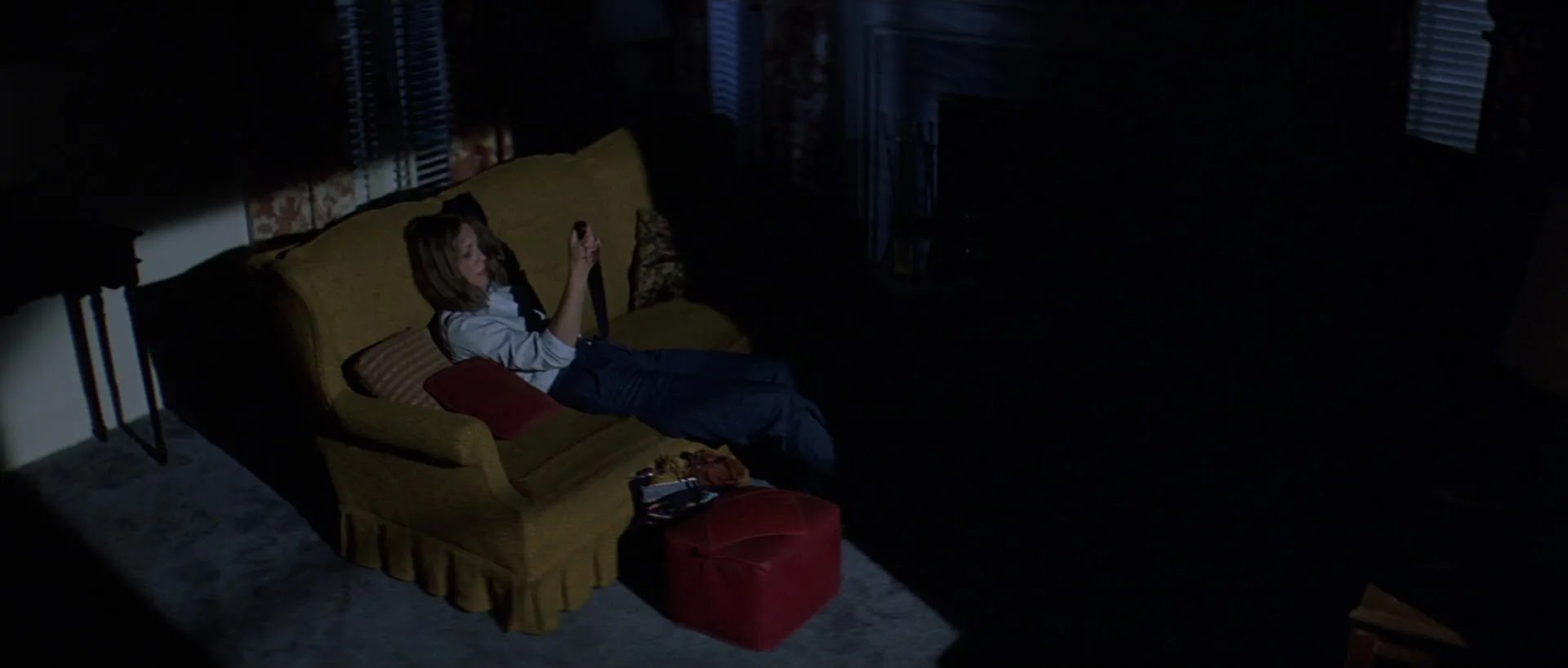
My Favorite Films: Halloween (1978)
Monday, November 28, 2022
My Favorite Films: Singin' in the Rain (1952)
In contrast to films like The Longest Day and Davy Crockett: King of the Wild Frontier which my brothers and I practically watched on repeat, Singin' in the Rain is one of those films I grew up with that remained "in the background" as it were. It was a film I remember watching on Friday nights when it would air on Elliot Wilhelm's show on PBS (good times) and that my sisters would check out from the library occasionally when they were in the mood for a musical. It was only as a grew an appreciation for Hollywood history in my late high school years that I began to appreciate the film more.
Like many musicals of the era Singin' in the Rain is essentially built around its musical numbers and, what may surprise many given the film's stature, they are almost all taken from earlier films. The idea for the film was thought up by Arthur Freed, the head of the "Freed Unit" at MGM which was responsible for the studio's musicals. His idea was to produce a musical based on the studio's back catalog of songs (many written by himself). This was a relatively common practice at the time but one which suits Singin' in the Rain uncommonly well.
The film, essentially, sets out to tell the story of the difficult transition to sound. Freed brought in screenwriters Betty Comden and Adolph Green to craft a coherent story around the songs and, as both writers had personal experience with this period, it was only natural that they zeroed in on it in order to accomplish this goal. The technical problems Monumental Pictures encounter in trying to produce The Dueling Cavelier with primitive sound equipment are reflective of the real-life struggles of many movie studios from this era, even if it's a little exaggerated. You would think the bad audio would have been picked up by the editors before the test screenings but no matter, it makes for hilarious viewing as Comden and Green milk the premise's innate comedic potential for all its worth.
The opening flashback sequence presents something of an overview of early Hollywood history as we see the rise of Don Lockwood from a poor kid on the street to a struggling vaudeville actor to a Hollywood superstar. Similar to real life actors like Douglas Fairbanks and Tom Mix, Lockwood gets his start as a stuntman before being recognized as a potential star and given a major role by the head of studio. Gene Kelly's narration of this sequence is layered with irony as he paints a rosy picture of his career ("dignity, always dignity") that directly contrasts what we see on screen.
In general, the film presents the glamourous world of Hollywood with a sense of irony but one tempered by a breezy, light-hearted tone. The fictionalized tabloid romance between Don and his leading lady Lina Lamont (Jean Hagen) is brushed off by him as a minor irritant while Lina, true to her "dumb blonde" stereotype, seems to fall for her own press. Lina's inevitable fall as a major star is tragic but the film plays it for laughs. Of course, Lamont's scheming to use Kathy to permanently prop up her own career relieves us of any uneasy feelings we may have had on this score.
The musical numbers are uniformly great, lavished with all the production value and talent that old Hollywood could muster. Many of them are diegetic. "Fit as a Fiddle (And Ready for Love)" is used for the aforementioned opening sequence, where we see Lockwood and his childhood friend Cosmo Brown struggling to please an unreceptive crowd during their time on Vaudeville. "All I Do Is Dream of You", is sung by Kathy Seldon during the party celebrating the premiere of The Royal Rascal, a scene which reveals that she is a struggling young actress. In the "Beautiful Girl Montage" we see Kathy in her first screen appearance, and she is reunited with an apologetic Don as a result. "Would You?" is used when Don and Cosmo convince the studio exec to repurpose The Dueling Cavelier, as a musical as is "Broadway Melody." The latter, in particular, is a perfect showcase of Hollywood glitz, and is practically a short film it its own right, chronicling the rise of a promising young Hollywood star who struggles to maintain enthusiasm for his work.
The most memorable songs are those sung by the characters in a non-diegetic fashion. In these songs there's often an absurdity to lyrics that complements the film's tongue-in-cheek tone. This is nowhere more clear than in "Moses Supposes" where Don and Cosmo make the best of a tedious speech class they have to take by turning the tongue twister Don is tasked with reciting into some rather nonsensical lyrics for a song ("A rose is for Moses as potent as toeses"). There is a sense of whimsy and exuberance to this song that characterizes the tone of the film in general. Though this film was never a favorite of mine growing up, there was one song I really liked: "Make 'Em Laugh" (which bears a striking resemblance to Cole Porter's "Be a Clown" from The Pirate). There was something infectious about watching Donald O'Connor's cartoonish antics and it appealed to the show-off in me.
Though musical numbers are uniformly great what really makes the film work is Gene Kelly's performance. Kelly is so athletic and filled with energy, so charming and magnetic that it's impossible not to have a giant grin while watching him on screen. Reportedly, he did not get along with co-star Debbie Reynolds, but you'd hardly know this by watching them together on screen. On the contrary they have wonderful chemistry. "You Are My Lucky Star" (originally from Broadway Melody of 1936 (1935)) serves as the film's love theme and, along with "You Were Meant for Me" (from The Broadway Melody (1929)) is sung by Don to express his love for Kathy. Both are at once corny and endearing in a way that only old school Hollywood could pull off.
The films centerpiece is the one-two punch of "Good Morning" (from Babes In Arms (1939)) followed by the film's titular song (adapted from The Hollywood Revue of 1929). The former is a wonderfully catchy and carefree little tune yet its practically eclipsed by "Singin' in the Rain." This is fitting as the former expresses the sense of release that Don, Kathy and Cosmo feel in having come up with a winning scheme to save The Dueling Cavelier and, by extension, Don's career while the latter channels the exuberant euphoria that Don feels at falling in love with Kathy. Even viewed in isolation there is something wonderfully cathartic about the sequence. Kelly's dance through the rain-soaked streets has justly become the stuff of Hollywood legend.
Singin' in the Rain may not be the most daring or original musical Hollywood ever produced, but its certainly the most fun. It's one of those movies that feels like it was made by Hollywood for Hollywood. There is a strong meta-commentary on the industry in a way that paints a rather rosy picture of it. Even if we might "know better" by now, while watching the film is hard not to be swept up in the magic.
Monday, November 21, 2022
The World, the Flesh, and the Devil in Nosferatu
One of the most influential movies ever made, Nosferatu celebrates its 100th anniversary this year. An unsettling film, its outdated special effects and inconsistent frame rate actually serve to make it feel more alien and frightening. It evokes a genuine sense of dread, which is the genre's peculiar raison d'être. In addition to this, it is the themes of Nosferatu that have made it endure. In particular, the film explores (unconsciously or otherwise) the Catholic idea of the central sources of temptation. As the holy fathers of the Council of Trent proclaimed, "... let those who think themselves to stand, take heed lest they fall, ... for, knowing that they are born again unto a hope of glory, but not as yet unto glory, they ought to fear for the combat which yet remains with the flesh, with the world, with the devil (emphasis added)."
The World
"The world" denotes an opposition to God in favor of the "spirit of the world" which is under the dominion of Satan. It is the preferring of empty, passing values to what is eternal. This can be seen in the film in the form of greed, as when Hutter agrees to go to Transylvania for the allure of filthy lucre. "You could earn a lot of money ..." his boss, Knock, tells him as he sinisterly suggests that Hutter offer the Count the house across the street from Hutter's home. Hutter is initially thrilled with the opportunity. Against his better judgment, he shrugs off the warnings he receives from the Transylvanian people living around the count's castle of a diabolical evil residing there. By the time he realizes his mistake it is too late, he has fallen into the vampire's power.
The Flesh
A less pronounced theme in the film then in the novel "the flesh" denotes our disordered sensual passions, especially that of lust. In the novel, Dracula's victims are inexplicably drawn to him in a way reminiscent of carnal desire. In the film, Hutter's wife Ellen is continually drawn towards Orlock, sleepwalking on to her balcony at night in anticipation of his arrival. The central motive for Hutter's escape is to protect her chastity, having heard Orlock's veiled suggestions of his designs toward her.
The Devil
The most prominent of the of these films, the devil, is personified by Orlock himself. It is mostly through the allure of the world and the flesh that the demons extend their power over the hearts of men, but there are some who, in the words of G. K. Chesterton, wish to "sup on horrors." Knock is such a one. In the scene wherein he is introduced he can be seen examining a scroll filled with occult symbols. His suggestion that Hutter offer the count the house opposite his own is filled with thinly veiled sinister intentions.
The dominion of the devil is often synonymous with the dominion of death, the unavoidable consequence of Adam's sin. Images of coffins and gravestones permeate the picture, creating an atmosphere of oppression and dread. This idea is especially manifest in the films climax. The vampire's arrival in Hutter's village provokes fears of a plague and the people begin to be ruled by this fear. Knock is put away for insanity but eagerly awaits the arrival of the count, convinced that his "master" will reward for his foul deeds. Eventually this catches up with him, as the fear of the villagers metastasizes into a mad frenzy and the once peaceful townsfolk turn into an angry mob out for Knock's blood. Here we see a conformity to the spirit of the world that defies even natural reason.
Thus far, we have seen how the evil of the vampire is brought to Hutter's town as a result (directly or indirectly) of sin. Now we come to another major theme which distinguishes from many more contemporary horror films: hope. Many modern horror films emphasize the impotence of man in the face of diabolical forces. In John Carpenter's seminal Halloween, Laurie survives Michael Myers assault but the ultimate defeat of "the shape" is not forthcoming. After being shot six times Michael mysteriously vanishes, living on to kill another day. In this paradigm, the forces of evil may only be defeated temporarily, there is no hope a final victory over them. It is reflective of the pre-Christian world of pagan darkness.
Not so Nosferatu. Though many of the more explicitly Catholic elements of the novel are muted in the film, it is surely no accident that the vampires defeat mirrors the triumph of Christ on Calvary. Ellen discovers a passage in a book which speaks of the only way of defeating the monster; a "sinless maiden" must "give him her blood willingly." Like Christ, she offers herself as a pure, sacrificial victim in order to see the evil defeated. In the films last moments, when all seems lost and Orlock feasts on the blood of Ellen, the sun rises and the Count, heedless of the approaching danger, is destroyed.
The above quoted passage from the Council of Trent, after warning the faithful of the dangers of these three temptations, goes on to say that "they cannot be victorious, unless they be with God's grace." Ellen is powerless on her own and must place herself in the hands of some transcendent power. Once she does this, the defeat of evil is as sure as the rising of the sun. Christ is risen. The prince of this world is cast out and, though the world still labors under his dominion, we have only to await the second coming of Our Blessed Lord and so "the victory", in the immortal words of St. Maximilian Kolbe, "is already ours."
Maranatha!
Wednesday, August 10, 2022
My Favorite Films: Winchester '73 (1950)
Winchester '73 was my introduction to the films of Anthony Mann who has since become one of my favorite directors. While not as famous say John Ford or Sergio Leone, Mann's contribution to the western genre was enormous. In particular, the five westerns he made with James Stewart stand out for their excellence.
Mann's command of cinematic grammar is nowhere more apparent. His noir roots are especially on display in this film (the only one of the sequences shot in black and white) in his use of low angles for example, which often punctuate moments of violence or brutality on the part of the hero. Mann also had a penchant for shooting outdoors and, in his westerns, the landscape practically becomes a character in its own right. This is particularly true in the climax, where Stewart's character plays a deadly game of cat-and-mouse with his own brother, their fratricidal battle pitted against a rocky backdrop which suggests a struggle against nature itself. Cinematographer William H. Daniels captures these moments beautifully.
Mann's unique visual qualities are greatly complemented by Borden Chase's screenplay, which explores some of the genre's core themes. For Mann the west was a mythic canvas, on which he could tell stories about the human condition. Winchester 73' was originally a Fritz Lang project with very existential themes about a man whose identity becomes tied to the weapon he carries, leading to a desperate journey to recover it when it is stolen. Mann and Chase completely overhauled this script, crafting a story about retribution and the nature of power against a backdrop of genuine western history.
The film uses famous figures and events from the history of the west very loosely. The shooting contest which opens the film takes place in Dodge City where none other than Wyatt Earp (Will Greer) is the sheriff! The film takes place shortly after the Battle of Little Big Horn, which would place it sometime in the summer of 1876, which happens to be the same year that Earp was made the sheriff of Dodge. Mann and Chase use the audience familiarity with these historical figures and events to inform character and are able to avoid what might otherwise have been tedious exposition. Earp's reputation precedes him. So much so that when the very mention of his name is enough to cause Lin to back down when he confronts the sheriff (who's not wearing his badge) over the forced removal of Lola from the town. Because we, the audience, know who Earp is, we immediately understand McAdam's reaction when he learns the sheriff identity. Similarly, the oblique references to the Custer's last stand lend an immediate air of danger to the film's setting.
The film uses these historical references to explore the "winning of the west." We learn early on that Custer and his men have been massacred by the Sioux at Little Big Horn, and it was their use of the repeating rifle that gave them an edge over the calvary, who were still using the older single shot weapons. This advantage is turned against them when they attempt to attack the cavalry detachment that Linn and High Spade are hold up with. Expecting to overwhelm the cavalry with superior fire power they are taken by surprise when they come up against the civilian's Winchesters. Through this use of superior force, the white men win the day.
Masculinity is a prominent theme in many of Mann's films and in Winchester 73' the titular rifle, "One of a Thousand," acts as a sort of metaphor for the masculine, as we see it pass through the hands of various figures who embody, or fail to embody, various masculine traits. Stewart's character Linn McAdam wins the rifle in a shooting match and is, notably, the only character to obtain it legitimately. This symbolizes McAdam's moral uprightness. By contrast McNally's "Dutch" Henry Brown steals the rifle from McAdam after losing the contest to him. Again, this illustrates the difference between the two men. One has an innate sense of justice and fairplay, the other is willing to do whatever it takes to get what he wants.
From Dutch Henry the rifle passes to John McIntire's Joe Lamont, a man who makes his living selling rifles to the Indians. Lacking in both moral fiber of McAdam and the ruthlessness of Dutch Henry, Lamont must resort to duplicity to obtain the weapon. He swindles the outlaw out of it by asking an outrageous price (which Dutch can't afford) for the guns and ammunition he desperately needs. It is afterwards taken by Chief Young Bull (Rock Hudson), whose mode of acquisition (he kills Lamont when the trader refuses to sell him the gun) is consistent with his single-minded drive to punish the race who have taken so much from his people. Young Bull too is killed, this time in battle involving McAdam. But rather than being returned to its rightful owner, who is blissfully unaware that his stolen property has fallen into Indian hands, it is instead awarded to one Steve Miller (Charles Drake) by a grateful calvary sergeant for his apparent bravery in fighting off the Indian attack.
Miller only ended up joining the fight after abandoning his fiancé, Shelley Winters' Lola Manners, on the prairie. He is haunted by this act of cowardice and sees the rifle as a token of redemption. His newfound sense of self-worth is tested when he meets up with Dan Duryea's "Waco" Johnnie Dean. Refusing to sell the rifle he is goaded by Waco into going for his gun and subsequently killed. Waco is a malicious and cruel man, a fact illustrated by the way he humiliates Miller in order to obtain the rifle, but he is also cowardly in his own way. He surrenders to rifle to Dutch Henry without argument, implying to Lola that he will shoot him in the back later. He is only willing to stand up to those he perceives to be weaker than himself.
The masculinity of these characters is also illustrated in the way they treat women. Steve treats Lola with servile deference and betrays a deep insecurity about her which leads to his downfall. Waco, after murdering him by exploiting these weaknesses, treats her with contempt while Dutch Henry wants nothing to do with her. Only Lin treats her with respect and dignity. His first instinct is always to protect her. When they first meet, she is being railroaded out of town and Lin attempts to intervene only to find that the sheriff (who happens to be the famous Wyatt Earp) is the man forcing onto the stage. Later, when they meet in the cavalry encampment, he lends her his pistol. He allows Dutch too escape, temporally, when she jumps in the line of fire to help a young child about to be trampled.
Lola herself is something of a "prostitute with a heart of gold" archetype, she feels trapped in her profession and longs for a more domestic life. In many ways this reinforces the films' themes about gender roles, men have a protective role and women a nurturing one. But does break away from the archetype, at least to some extent. Lola is willing to stand up to Waco, even shaming him for using woman and children as a shield. But she's also smart enough to realize that she has to go along with him for the time being. She is generally shown to be somewhat "street smart". When McAdam gives her his pistol, she tells him that she "knows about the last one." Later, when he tries to pass off the Sioux war signals as birdcalls, she asserts that she knows what they are.
Ultimately, Linn recovers the rifle by slaying Dutch who, it is revealed, is Linn's brother and the murderer of their father. Though this is portrayed as a just act, the ambiguity of introduced by the intensely personal nature of McAdam's quest for retribution is also explored. Linn admits too his friend "High-Spade" Frankie Wilson that he feels uneasy about tracking down Dutch but "Some things a man has to do, so he does 'em." His friendship with High Spade is another thing that humanizes Linn. Qouting his departed father he tells him "He said if a man had one friend, he was rich. I'm rich."
Mann always brings out the best in his actors and this film has an excellent cast. Stewart's performance brings out the actor's darker side, something Mann would probe more and more as their collaboration continued. Stewart's ability to convey emotion and thought with the subtlest change of facial expression never ceases to amaze me. Millard Mitchell provides a laid-back counterweight to Stewart as his friend "High-Spade", his dry sense of humor providing some much-needed levity. Shelley Winters spirited performance captures both the vulnerability and the toughness of her character. Stephen McNally terse delivery and his permanent scowl give Dutch Henry a genuine sense of menace while Dan Duryea provides a more colorful contrast as Waco Johnnie Dean, stealing every scene he's in with his sardonic, scornful wit. Charles Drake is perfectly cast as the cowardly Steve Miller while Mann regulars John McIntire and Jay C. Flippen round out the cast in memorable supporting roles.
Winchester 73' set a high bar for Mann and Stewart's collaborative efforts. Mann's shrewd directing is bolstered by a magnificent cast and a sharp, economical script from Borden Chase. The actor and director would go on to collaborate on more ambitious projects, but none are quite as flawless as this first effort.
Thursday, January 6, 2022
My Favorite Films: It's a Wonderful Life (1946)
“I would rather be what God chose to make me than the most glorious creature that I could think of; for to have been thought about, born in God's thought, and then made by God, is the dearest, grandest and most precious thing in all thinking.”
― George MacDonald
It's a Wonderful Life is my favorite film of all time. Because of this, the idea of reviewing it has always intimidated me. It's an incredibly rich film. Every time I watch it (an annual Christmas tradition in my home) I glean some new insight from it. On the other hand, it's also a film that has become so ingrained in the culture that one fears having nothing new to say. With that said, though I feel a little like George Bailey sitting in Mr. Potter's chair, I think I have finally reached a point where I am ready to take a crack at it.
Perhaps Capra's greatest strength was his ability to cast actor's well suited for their roles and to get great performances from them. In It's a Wonderful Life he paints a convincing picture of a small-town American community, and the strength of the cast goes a long way to selling that image. The film is filled with experienced character actors and the casting is pitch perfect, from Thomas Mitchell as Uncle Billy to Frank Albertson as Sam Wainwright to Ward Bond as Bert the cop and Frank Faylen as Ernie the taxi driver to Gloria Grahame as the flirtatious Violet. Todd Karns is the embodiment of the all-American boy as Harry Bailey, who seems to attain the fame George so longs for without even trying. Who but the great Lionel Barrymore could have played Mr. Potter? Who could imagine anyone other than Henry Travers as Clarence Odbody? Who would have thought that H. B. Warner (best known for playing Jesus in The King of Kings) would make such a convincing old drunk? I'd be remiss not to mention Beulah Bondi who plays Ma Bailey with affection and (in the alternate reality where George wasn't born) antipathy. Samuel S. Hinds' Pa Bailey, though only appearing briefly, looms large over the whole film. Finally, Bobby Anderson does an admirable job in the unenviable role of the younger George Bailey.
Even as a young child I was mesmerized by James Stewart's acting in this film. His career defining performance came at the end of his tour of duty in the Second World War. The actor reportedly felt nervous about stepping behind a camera for the first time in 5 years but you would hardly know this from watching the film. He brings a sense of darkness to the role that audiences hadn't really seen before but also channels the characters innate decency and heroic self-sacrifice. The relative newcomer Donna Reed holds her own as Mary Hatch, whose devotion to George, and stalwart support of him, ultimately lead to his redemption.
All of these qualities, the efficiency of the script, the deft hand of Capra behind the camera and the brilliance of the performances, particularly from Stewart and Reed, are on full display in the scenes leading up to and immediately preceding George's marriage. The later scenes serve as a sort of climax for George's rivalry with Potter. George, by using the money he had saved for his honeymoon, is able to prevent his patrons from falling into Potter's hands. It is not insignificant that Mary is the one to suggest this. By participating in his heroic sacrifice she shows herself a companion not just in their marriage but in his work for the community. This is solidified in the following scene where, together, they welcome the Martini's into their new home.
The earlier scene is, perhaps, even more crucial. We see George brought to a real crisis as he is drawn by his mother, by his attraction to Mary, and by his circumstances, to stay in Bedford Falls and put down roots, but he rebels against this with every inch of his being. In a wonderfully acted moment between Stewart and Reed, he ultimately gives in, though he resists and protests every step of the way. As C. S. Lewis once observed, "The hardness of God is kinder than the softness of men, and His compulsion is our liberation."
Monday, August 2, 2021
My Favorite Films: The Great Muppet Caper (1981) (Musical Mondays)
Of all the Muppet films, The Great Muppet Caper is probably the one I've seen the most. Along with Muppet Treasure Island, it was a film that my siblings and I would routinely borrow from our local public library when we were growing up. It's one of the movies I could probably recite line-by-line. It's also easily the funniest of the eight theatrical films.
Of course, the Muppet performers are all in top form but a lot of credit for this has to go the the human actors. For one thing you have the incomparable Diana Rigg as Lady Holiday. Her dry sense of humor contrasts wonderfully with all the zaniness around her. Charles Grodin, playing her brother Nicky ("an irresponsible parasite") is wonderfully over-the-top, and he plays the character's absurd infatuation with Miss Piggy with a hilarious earnestness. Both actors play brilliantly off of each other and off of their Muppet co-stars, as do many of the more minor players. Of course it helps that this film features the two greatest cameos in movie history from John Cleese and Peter Falk.
The real key to the films success however is its script, by Muppet regular Jerry Juhl along with Jack Rose (an Academy Award nominated veteran of classic Hollywood comedies) and Tom Patchett and Jay Tarses (who both worked on The Bob Newhart Show and The Carol Burnett Show). Combining running jokes, sight gags, non sequiturs, and absurd (often fourth-wall breaking) humor, The Great Muppet Caper represents the Muppet's at the height of their comedic power. When I was a kid watching Beauregard driving like a madman around London was the funniest thing ever. Now I can appreciate how sharp the screenplay really is and the jokes that went over my head as a kid ("It's plot exposition it has to go somewhere.", "My wife isn't feeling very well...") are the ones I laugh the hardest at now.
Of course, like its predecessor, the film constantly breaks the fourth wall. As I mentioned in my review of that film, this maintains the meta slight-of-hand that helped make the Muppets feel real. The Great Muppet Caper does this somewhat more effortlessly then its predecessor, and the Muppets drift in and out of character seamlessly at different points throughout the film. Just watch the scene where Kermit and Piggy get into a heated argument in front of the duck pond and slip into a behind-the-scenes dispute ("I am playing 800 different emotions." "Well, try to play one of them right"). It's just brilliant writing.
The Great Muppet Caper is generally more focused on sending up Hollywood clichés then the The Muppet Movie was. That film used the template of a road trip movie to tell the story of how the Muppets got together whereas this is essentially a heist film with elements of film noir romances and classical Hollywood musicals thrown in for good measure. It is clear that Jim Henson and co. had a love for this kind of genre fare. This is most obvious in some of the films more impressive musical numbers. "The First Time It Happens" channels Busby Berkely while "Piggy's Fantasy" hearkens back to the so-called "aquamusicals" of Esther Williams.
The songs, by Joe Raposo (who worked on both Sesame Street and The Muppet Show), are not as memorable as Paul Williams and Kenneth Ascher's music for The Muppet Movie, but Raposo does a respectable job following in their footsteps nonetheless. The film opens with "Hey A Movie!", which sets the tone for the film's send-up of classical Hollywood cliches ("There'll be mystery and catastrophe. But it's all in fun, you paid the money, wait and see") and also sets the plot into motion as Kermit, Fozzie, and Gonzo (playing investigative reporters) are so busy with the opening number that the miss the jewel robbery, and all the other slapstick hijinks, occurring around them, prompting them to go to London to interview Lady Holiday, whose jewels are stolen, to redeem themselves in the eyes of their boss, Mr. Tarkanian (Jack Warden).
"Happiness Hotel", probably the films most memorable tune, introduces the rest of the Muppet gang as residents of the dilapidated London hotel where Kermit, Fozzie, and Gonzo are staying. "Steppin' Out With a Star" serves as kind of a love theme for Kermit, who channels Fred Astaire by dancing with a clothes rack. It transitions into a tercet with Gonzo and Fozzie as he agrees to let them come along on his "date". "Night Life" serves as an ironic accompaniment to Kermit and Piggy's first date, as they ride to the Dubonnet Club on Happiness Hotel bus while Dr. Teeth and the Electric Mayhem boogie away. Finally, the gentle "Couldn't We Ride" provides the often frantic film with a leisurely change of pace, as the Muppets take a bicycle ride through the London park after Kermit and Piggy resolve their differences.
In general, The Great Muppet Caper is more impressive in its production value then its predecessor, likely thanks to its bigger budget. The sets are much more elaborate and there is a much larger cast of extras. Much of the film was shot on location in England and Oswald Morris
cinematography is more crisp and polished looking then Isidore
Mankofsky's softer look for The Muppet Movie. After showing Kermit riding a bicycle in that film caused such a stir, Jim Henson, stepping into the directors chair for the sequel, took it even further this time
around, creating a complex system of rods, marionette wires and remote control bicycles for the scene wherein all the Muppets are seen bicycling at the same time. But it's in the "Piggy's Fantasy" number that they really pulled out all the stops, building a custom-made heated pool on the sound stage, giving Frank Oz scuba training, and designing special, water-resistant Miss Piggy puppets.
Yet, for all that, the film never loses that sense of whimsy and innocence which is at the heart of Jim Henson's creation. As Henson intended, this is a film that people of all ages can enjoy, from the young and wide-eyed to the old and jaded. Like its predecessor, The Great Muppet Caper is a true family film.
_theatrical_poster.jpg)


.jpg)