Showing posts with label Saturday evening cartoons. Show all posts

Saturday, May 8, 2021

Saturday Evening Cartoons: Ponyo (2008)


     Ponyo was released on July 19th, 2008. Written and directed by Hayao Miyazaki it is loosely based on The Little Mermaid by Hans Christian Andersen. In it a young human boy named Sōsuke (voiced by Frankie Jonas in the English dub) befriends a goldfish named Ponyo (Noah Cyrus), who begins turning into a human after ingesting some of his blood.

     Like most of Miyazaki's movies Ponyo is loosely plotted. There are two central conflicts, one arising from the other. The first is between Ponyo and her father Fujimoto (Liam Neeson), a human wizard/scientist. After meeting and falling in love with Sōsuke, Ponyo longs to become human but her father forbids it. Ponyo runs away from her father to be with Sōsuke, using her magic to make herself human, but the magic that is released as a result of this creates an imbalance in nature, resulting in an enormous tsunami which threatens to destroy Sōsuke's sea-side village home. Both conflicts are resolved rather easily when Fujimoto tells Ponyo's mother Gran Mamare (Cate Blanchett) about her actions and she decides that Ponyo can become human providing that Sōsuke can prove his love for her. This also restores the balance of nature. 

      There is a general theme of familial conflict running throughout the film. Ponyo's clashes with her father who does not want her to become human. It can be inferred that Fujimoto, having turned his back on the human world for a life under-the-sea, is hurt by his daughter's desire to, essentially, do the opposite. In any case the parallel between Fujimoto, who gave up a human life after falling in love with a sea goddess, and Ponyo, who gives up her life as a fish after falling in love with a human. There is also tension among Sōsuke's family. His mother (Tina Fey) harbors resentment toward his father (Matt Damon), a sailor who, because of his job, is never around. 

     Ponyo is a lovely looking film, even if less impressive then some of Studio Ghibli's earlier efforts. It features more streamlined animation then many of the studio's earlier films. The backgrounds are not as painterly and the characters more cartoonish. Yet it has that quality that many of their films do of making the movement and expressions of the characters feel grounded. Its portrayal of magic is also very matter-of-fact magic, as is Miyazaki's custom, and the characters feel like real people with real problems. The voice cast are uniformly solid except perhaps for Neeson, who feels a little miscast as Ponyo's quirky wizard father. 

     Ponyo is an enchanting little movie with beautiful animation and likable characters. The story may be a little lightweight but that's part of the charm.

Score: 8/10

Saturday, April 17, 2021

Saturday Evening Cartoons: All-Star Superman (2011)

      All-Star Superman was released on DVD and Blu Ray on February 22nd, 2011. An adaptation of the acclaimed comic book series of the same name by Grant Morrison and Frank Quitely the film is directed by Sam Liu and written, for the screen, by Dwayne McDuffie. 

     All-Star Superman opens with a classic bit of super-heroics, as Superman rescues Dr. Leo Quintum and his scientist, who are researching the sun from a genetically-enhanced time-bomb clone controlled by Lex Luthor. It turns out that, in doing so, he received an overdose of solar radiation, supercharging his cells but also, slowly, killing them off. In other words, Superman is going to die. Clark decides to make the most of his remaining time on earth, most importantly, revealing his identity to Lois Lane. Lex, who engineered Superman's demise, has escaped from prison and is carrying out his plans the hero's final humiliation and his own rise to power. 

     Meanwhile, Superman performs various heroic deeds as he prepares for his death, including finding a permanent home for the people of Kandor, giving Lois superpowers for 24 hours as a birthday present by using a formula he created from his DNA,  confronting (and ultimately saving) two lost Kryptonian astronauts, answering the "Unanswerable Question" posed by the The Ultra-Sphinx, and fighting off an invasion by the Subterranosauri caused by Samson and Atlas. The film greatly condenses the original miniseries. There Kal-El had to complete 12 labors before he died, much like Herucles. The film cuts six of these completely and dramatically changes a seventh, which undercuts the mythological feel of the comic. Two major subplots, involving Superman traveling to the Underverse and traveling back in time to meet his father, are also cut which is a shame as these were some of the more emotionally resonant chapters in the comic. It also cuts out one of the comic's most iconic moments, where Superman saves a young girl who is about to commit suicide. 

     Nonetheless, the film does a good job bringing the story to the screen and preserving its central themes. Indeed, I found that I better understood the comic (I had only read it once) after watching the film. One of the main thematic threads is Lex Luthor's envy of Superman. He has pursued power and knowledge all his life, but compared to Superman's abilities (which he didn't have to work to attain), all of his efforts seem to pale. As he tells Clark Kent when he comes to interview him in prison, "Doesn't his very existence diminish you? Diminish us all?" But, despite everything, Superman does not resent Luthor, he instead feels regret that this man has wasted his own talents on his hateful, self-centered pursuits. 

     Unfortunately, there are also some strongly transhumanist themes here. In some ways this was always sort-of inherent to the character but it is brought to the fore-front here. This is most apparent in Dr. Quintum's P.R.O.J.E.C.T. lab which "engineer(s) new forms of humanity ... for the eventual betterment of mankind." Dr. Quintum is the kind of character who might easily be a villain in another story, but to Morrison he is an inspirational figure. This issue also extends to Superman himself. Because he can't have children with Lois, he eventually figures out how to use artificial insemination so that Lois can bear a son like him. The movie does change this, which I get to shortly. 

     The presence of these themes is mitigated by the film's much more traditional central themes of mortality and sacrifice. Kal-El must come to terms with his imminent death. Like the hero he is, this serves not as a crushing blow but as a motivation to do better. When he flies away for the last time to repair the broken sun, he is prepared to lay down his life for the people of earth, even if the film suggests that he will ultimately survive. It is this sacrifice that inspires Luthor to make amends, in some extent, for all his wrongs, analyzing the heroes DNA so that he can figure out a way for Lois to bear a "son" like Superman. This is probably the biggest change form the comic, where Superman figures it out himself. I like this better as it shows that Superman's greatest power has always been to inspire others. 

     The film does a good job bringing Frank Quitely's unique art style to life. It is somewhat streamlined, as you'd expect, but many of the iconic moments from the book are nonetheless rendered beautifully. The voice cast is excellent all around. James Denton does a fine job as Superman, evoking that duel sense of down-to-earth humanity and unwavering moral uprightness and optimism that have made the character so endearing. Christina Hendricks is a fairly solid Lois Lane though, as in the comic, she is not given that strong of material to work with. Anthony LaPaglia is excellent as Lex Luthor and Morrison's take on the character is one of the most unique and interesting that I've read. 

     In the end, All-Star Superman, though not a perfect adaptation, does get to the essence of the comic it's based on and even makes some subtle improvements though it also shares many of the original story's flaws.

Score: 7/10

Tuesday, February 16, 2021

Saturday Evening Cartoons: Song of the Sea (2014) (Fat Tuesday Special #1)

     Song of the Sea was released on December 10th, 2014. It is directed by Tomm Moore and produced by the studio Cartoon Saloon. Like their first feature, The Secret of the Kells (2009), it borrows heavily from Irish folklore, telling the story of a young boy named Ben (voiced by David Rawle), who gets whisked off on a supernatural adventure after finding out that his sister is a selkie, a mythological sea creature who can change into human form.

     The story begins with the birth of Ben's sister Saoirse (Lucy O'Connell). Shortly before giving birth, his mother Bronagh (Lisa Hannigan) disappears, leaving the child behind. It is later reveled that Bronagh was a selkie and was turned to stone by the sea-witch Macha (Fionnula Flanagan), who, ever since her son, the giant Mac Lir, had his heart broken, has made it her mission to take away the pain of others, bottling up their emotions in literal jars. The story is all about coming to terms with grief, which most of the characters are running away from in one way or another. Ben has repressed his memory of his mother's death and harbors a deep seated fear of the sea (it later revealed that she drowned, or seemed to), though he still cherishes his seaside home as it reminds him of her. His father, though he initially tries to cherish the memory of his wife and keep his family in their old home is ultimately persuaded by his overprotective mother (voiced, like Macha, by Fionnula Flanagan) to separate and she takes them to her home in the city. It is only when these characters confront their fear that the world can be set right.

     This theme is a little lacking in subtlety at times, which is certainly the film's biggest flaw. Nevertheless, it is often handled quite deftly. Take Macha, who is intentionally paralleled with Ben's overprotective grandmother. Though her motives are relatable her actions are clearly wrong and she is able to acknowledge this and to make amends before the end of the film (the grandmother, on the other hand, who simply made an error in judgement because she didn't fully understand the situation, is embraced by Ben's family at the end of the film without any resentment).  This stands in contrast to mythical villains in other animated movies (Moana comes to mind) who never take responsibility for the damage they've done. 

     Tomm Moore depicts a faerie world that exists right on the fringes of the ordinary human one. Characters travel back and forth between the two worlds in an almost matter-of-fact manner, to the point where it is hard to distinguish one from the other. This, in my estimation, is the mark of good fantasy. The film also features all kinds of Catholic milieu (again, like Kells) which exist side-by-side with the film's pagan elements, though they never seem to possess the same sense of mystery or enchantment. This may be a matter for concern for concerned Catholic parents, but it is less problematic then the pagan/Christian dichotomy in Kells


      Song of the Sea features some really gorgeous, stylized animation. It takes the angular style established in Secret of the Kells and improves on it, feeling more natural and utilizing more fluidity of movement. The characters, as a result, are more expressive (which is fitting since they are also more fleshed out from a writing perspective). The design is simply beautiful but the film is also rich in its subtle use of of light and shadow. The score, by Bruno Coulais and Irish folk music band Kíla (who also collaborated on Secret of the Kells), is stirring but also subtle, and is used sparingly to punctuate emotional moments, rather then serving as a constant accompaniment to the characters journey, as is so common in modern cinema. 

      Song of the Sea is another solid effort from Tomm Moore and Cartoon Saloon, improving, in many ways on their first feature while retaining its low-key, subtle sensibilities. 

Score: 9/10

Saturday, January 30, 2021

Saturday Evening Cartoons: Frozen II (2019)

     Frozen II was released on November 22nd, 2019. The 58th animated film produced by the Walt Disney Animation, it is written and directed by Chris Buck and Jennifer Lee. In this sequel to the 2013 hit, Elsa and Anna are living an idyllic existence which is interrupted when a mysterious, mystical force from the past returns to haunt Arendelle. 

     The film opens with a flashback, wherein a young Elsa and Anna are told by their parents the story of the Enchanted Forest. Their grandfather, King Runeard, established a treaty with the inhabitants of the forest, the Northuldra, by building them a dam, but when a fight broke out between them the elemental spirits of the forests were angered and trapped everyone within the forest in a wall of mist. Only their father, Agnarr, lived to tell the tale, saved by a mysterious rescuer. In the present, Elsa hears a mysterious voice calling out to her, and follows it only to awaken the elemental spirits who strip many of the kingdoms resources away, forcing the inhabitants to flee. Elsa, Anna, Kristoff, Sven and Olaf must discover the secret behind the Enchanted forces and set things right.

     As with the first film, Frozen II features some stunning animation but the unique setting and more diverse atmosphere this time around allow for some really gorgeous landscapes. The first film was remarkable for the way it animated snow, but the sequel also plays with water, ice and snow in ways I've never seen before. The addition of a new culture here means we get plenty of new, elaborate costume designs this time around as well. 

     But if the sequel surpasses the original in the areas where it excelled, it stumbles even more in the areas where it fell short. The music is, once again, a mixed bag. The songs are memorable but inconsistent in tone and style, and never really mesh with the orchestral score. "Lost in the Woods," which Kristoff sings around the halfway point, after Anna and Elsa leave him behind, is particularly out of place, starting off somber and then turning into self-parody by the end. It also features 80's style rock instrumentals, which clash with the films Nordic, choral infused score.

     The big weakness of Frozen was its script. The source of Elsa's fear of her powers, namely her parents misguided reaction to them, was rather contrived. This film exacerbates this issue by revealing that Elsa's mother was one of the Northuldra. If this is true, why hide it from her husband and daughter and why not be more supportive of her gifts? But the problems don't end their. If the first film was lacking in focus at times, this one is even more so. Elsa's arc here seems to be about discovering her true heritage and the source of her power. Anna's arc is being able to let go of her sister and allow her to pursue her own destiny. Meanwhile, Kristoff is given a subplot of his own, trying to propose to Anna throughout the film but bungling every opportunity. This is mostly played for comedic effect and, while I actually found it the most consistently entertaining part of the film, it's perhaps selling his character a little short.

     In any case, it's in the climax where the film really gets lost. Discovering that her grandfather tricked the Northuldra and made the dam to reduce their resources, she sends this information to Anna before becoming frozen as a result of wandering too far into Ahtohallan. It appears, at this point in the film, that Elsa has died and Olaf, without her magic, fades away as well. Anna is distraught, having lost the person she loves most in the world, and must decide to go on herself. She determines to destroy the dam, even though this will mean the destruction of Arendelle. 

     This decision is made far too quickly considering its disastrous consequences and no alternatives are considered. There is really no reason for this urgency as the Northuldra have been trapped in the enchanted forest for years anyways. The whole thing comes across as needlessly reckless. Compounding these problems, Elsa is quickly thawed out as a result of the dam being broken and she saves Arendelle from being destroyed in the flood. Soon after Olaf too is restored to life. So the stakes, which were pretty high even in a contrived way, are almost instantly deflated. The denouement is equally frustrating. Why does Elsa decide to stay with the Northuldra, who she's only just met? In many ways this seems to go against the message of the first movie. Perhaps this is why fairy-tales films should not, generally, have sequels. 

Score: 5/10

Monday, December 21, 2020

Staurday Evening Cartoons: Moana (2016)


     Released on November 23rd, 2016, Moana is the 56th animated feature film produced by Walt Disney Animation Studios. Directed by Ron Clements and John Musker from a screenplay by Jared Bush it tells the story of a young Polynesian princess (voiced by Auli'i Cravalho) who sets out to find the demigod Maui (Dwayne Johnson) in order to reverse a terrible curse that threatens the people of her island village.

     After production on The Princess and the Frog wrapped in 2009, directors Clements and Musker pitched three new story treatments to studio head John Lasseter. One of them was centered around the Polynesian demigod Māui, an idea Musker had come up with after learning about Polynesian culture and mythology.  Lasseter greenlight the idea and sent the two directors off on a research trip to Fiji, Samoa, and Tahiti so they could learn more about the people and culture of the South Pacific Ocean. On this trip they learned that three thousand years ago the Polynesia people had, all of a sudden, stopped making long-distance voyages to explore other lands. Deciding to shift the focus from Maui (who became a supporting character) to a young daughter of a chief, the two men began forming their fictional story around this event. 

     Moana hearkens back to the renaissance era Disney films, particularly The Little Mermaid. As both films share the same directors, Ron Clements and John Musker this should come as no surprise. Moana, like Ariel, has an overly protective father and leaves her home to find adventure despite his commands to the contrary. While this kind of plot point has become annoyingly commonplace (in Disney films especially), this films at least gives the father an understandable motivation. He too tried to leave the island as a young man but was shipwrecked and lost his best friend in the attempt.


      The main conflict in the film for Moana herself is one of legacy. She wants to honor her fathers wishes and her peoples traditions, but also feels compelled to leave the island in order to save them. This inner crisis is resolved early on, as Moana discovers that her ancestors were seafaring explorers and that she has been chosen by the ocean itself to restore the heart of Te Fiti, which was stolen by Maui as a gift for humankind. The rest of the film focuses on her adventures with Maui and the relationship between the two characters. Maui at first wants nothing to do with Moana but is forced to accompany her on her quest because it is the will of the ocean. Maui goes through a bit of an arc himself. Having been cast aside by is parents as an infant only to be found by the gods and given superhuman powers, Maui has spent most of his life trying to win the favor of human beings. The disastrous consequences of his stealing the heart of Te Fiti, which include loosing his magic fishhook, the source of his power, has shattered his confidence but, with Moana's help, he regains both. 

     Aside from the overly familiar character drama, my biggest issue with the film is, again, the self aware  humor that creeps in here and there. Maui's wisecrack about how wearing a dress and having an animal sidekick makes you a princess, a reference to the cliches in Disney princess movies that it makes no sense for Maui to reference within the universe of the film, is particularly egregious. Also frustrating is the films mythology. For one thing the ocean, which is portrayed as a kind of force of nature with a will of its own, continually interferes in the plot to the point where it becomes a bit of a contrivance. More troubling, from a theological perspective, is the film's climax which establishes that Te Fiti is also Te Kā, the demon who has made the ocean perilous and, slowly over time, poisoned the islands Moana's people live on, and was corrupted into this by Maui rash actions. This makes the gods seemingly subject to the actions of humans and unable to control their own actions. 

     The film has some beautiful animation, particularly of the ocean. The art design is really vibrant and filled with wonderful details. Particularly impressive are the tattoos that cover Maui's body. Done in traditional hand-drawn animation, the tattoos come to life to display the demigod's past exploits to Moana and also (seeming to have a will of their own) reprimand Maui when he makes bad choices. The music, by Opetaia Foa'i, Mark Mancina, and Lin-Manuel Miranda, is quite strong as well. A rising  Broadway star, Miranda injects a lyrical wit into his songs that has not been seen since the days of Howard Ashman during the Disney renaissance. Maui's big number "You're Welcome", in particular, is both clever and wonderfully catchy with lyrics like:

"Kid, honestly I could go on and on
I could explain every natural phenomenon
The tide, the grass, the ground
Oh, that was Maui just messing around"

belted out in rapid succession. Samoan artist Opetaia Foa'i contributes a really authentic Polynesian spirit to songs like "We Know the Way" while veteran composer Mark Mancina provides both a fitting instrumental accompaniment to these songs and contributes a solid orchestral score.

     The film features strong voice work all around. Hawaiian actress Auliʻi Cravalho brings a real sense of spunk and energy to Moana while also making the character feel down-to-earth and emotionally vulnerable. Dwayne Johnson, who's Maui bears at least some resemblance, plot wise, to the genie from Aladdin, brings his usual infectious charisma and confident masculinity to the role. Though he's no Robin William's, Johnson may be the most entertaining comedic sidekick in a Disney film since the departed comedian, which is impressive considering that Johnson is not really a comic himself. Temuera Morrison (Jango Fett from Star Wars) and Nicole Scherzinger do a good job in their thankless role as Moana's parents. Rachel House, by contrast, gets to shine as Moana's eccentric grandmother, Tala. Finally, Jemaine Clement makes the most of his limited screen-time to imbue the villainous crab Tamatoa with an exotic and self obsessed personality.

     In the end, despite some flaws, Moana is still a pretty fun ride and contains enough lovely animation, well written songs and entertaining comedic material to make it worth your while.

Score: 7/10


Monday, December 14, 2020

Musical Mondays: Frozen (2013)


     The 53rd Disney animated feature film, Frozen was released on November 22nd, 2013. Written and directed by Chris Buck and Jennifer Lee it is inspired by Hans Christian Andersen's "The Snow Queen." It tells the story of Queen Elsa of Arendelle (Idina Menzel), who looses control of her ice creating powers resulting in a massive blizzard engulfing her kingdom. When a tormented Elsa flees into hiding it is up to her sister Anna (Kristen Bell) to help her see reason and save Arendelle from an eternal winter.

     The Walt Disney studio had begun plans to adapt the works of Hans Christian Andersen as far back as 1937. By 1940 they had begun working on a co-production with Samuel Goldwyn about the life of the author. Disney would animate Andersen's fairy tales, including "The Snow Queen" while Goldwyn would shoot scenes from Andersen's life in live-action. This plans were put on hold during the Second World War, as the studio was focused on making propaganda films to support the war effort. After the war the Anderson biopic went ahead without Disney's involvement, and was released as a wholly live-action film in 1952.

     "The Snow Queen" lay dormant at Disney until the late 1990s, when the studio, spurred on by the tremendous success of their Renaissance era films, began developing a new adaptation. This project too came to a halt in 2002, when Glen Keane left the project to work on Rapunzal (which eventually became Tangled). When John Lasseter was named the new head of the studio in 2006 he convinced his old friend Chris Buck to return to Walt Disney Animation Studios from Sony Pictures Animation. Buck pitched several ideas for new films to Lasseter, including a new concept for "The Snow Queen."

     Production on the film began in 2011 after the success of Tangled. Buck's aim was to "to do something different on the definition of true love," something outside of the studios usual prince/princess romances. The writers struggled to update Anderson's story to fit this aim and to make it seem relatable to modern audiences. By March of 2012, when Jennifer Lee was brought on as a screenwriter, the process of crafting the films story had effectively collapsed. It was not until November of that year that a shooting script was finally completed, leaving the animators with less then a year to complete the film. In the meantime, the script continued to go through revisions, and it was not until June of 2013 that it was finally finished. 
     My first viewing of Frozen was a decidedly lukewarm experience. I didn't dislike it but I was confounded by the level of praise it was receiving. Seeing again after all the hype has died down has not improved my opinion of it, quite the reverse in fact. The script, as might be expected considering the chaotic writing process that went into it, is a a bit of a mess. The source of the conflict is Elsa's fear of her own powers, a fear which leads her to suppress said powers until her ability to control them is compromised. The films opening scene establishes the reason for her fear, but its all rather clunky.

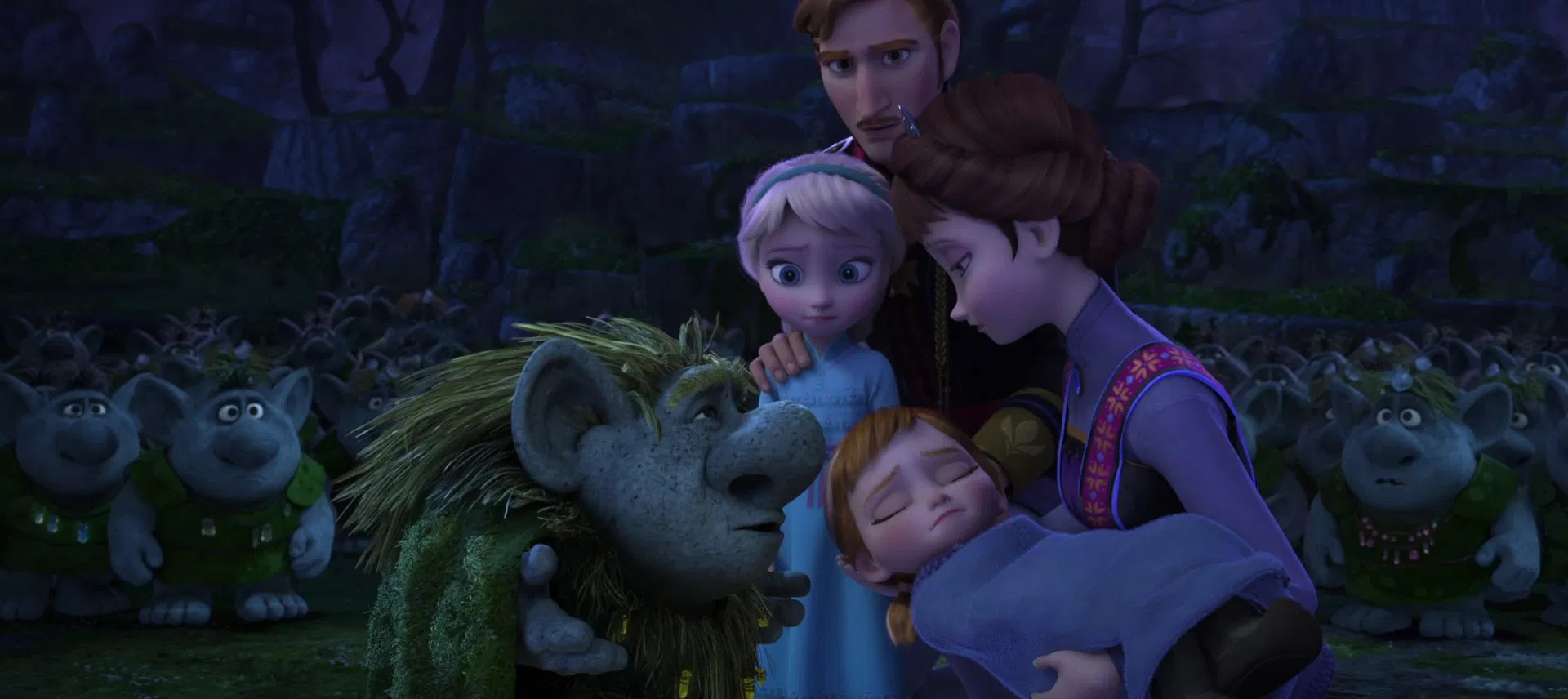
     When playing with her sister as a child, Elsa accidentally injures her sister with her magic. Their parents take Anna to a colony of trolls, whose leader, Grand Pabbie, is able to heal their daughter but, for some reason, must also alter her memory so that she has no relocation of her sisters magical abilities. Despite the Grand Pabbie's advising them that Elsa must learn to control her powers and his warning that fear will be her greatest enemy, her parents completely isolate her and do everything they can to suppress her powers. This is portrayed as a well meaning misinterpretation Grand Pabbie's advice on their part, but it is really a blatant disregarding of it. This flimsy and contrived backstory cripples the whole film and makes Elsa's isolation and fear more frustrating then tragic.  

     A subplot involves Anna finding true love (or does she) with a visiting prince named Hans (Santino Fontana), predictably falling in love at first sight, a fact that we are continuously reminded of throughout the film, to the point that it becomes obnoxious. Of course it turns out that Hans is manipulating Anna for his own ends, and hopes to take the throne of Arendelle for himself. Much has been made of this twist and the way it subverts to typical Disney romance. Little girls should not be taught that "love at first sight" is a reasonable foundation for a relationship, it is argued. 

     However the older Disney classics were firmly in the tradition of the old fairy tale and never meant to offer commentary on real world relationships, rather they presented an idyllic and largely symbolic stories meant to reveal deeper truths about the human experience. Men and women should not, generally, rush into marriage. Because of our flawed and fallen state, it takes time and effort to establish meaningful and loving relationships. However, this does not mean that we should reject the idea that there is someone special that we are meant to be with, for God in his infinite wisdom has decreed every truly good human relationship from eternity. It is this truth that the fairy tale reveals. In any case Anna's relationship with Sven, the films "sensible" alternative to Hans, is not particularly nuanced either.
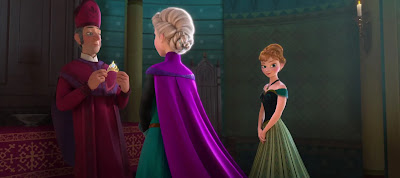
     Of course, the main purpose of the twist was to shift the focus from the romance to the sisterly relationship between Elsa and Anna. This is an idea I could easily get behind. Unfortunately it is a little lacking in execution. The main problem is that there is not enough screen-time between Elsa and Anna to really flesh out there relationship. After the accident that injured her sister, Elsa is kept away from Anna by their parents, and later of her own volition, in order to protect her. Anna, having had the memory of the accident and of her sisters powers erased, does not understand this but, nonetheless, continues to love her sister. 

     Later, when Anna finally finds her sisters frozen retreat and informs her of the fate of Arendelle, a confused and upset Elsa inadvertently injures her sister once again. Going to the trolls once again Anna is told that only an act of true love can save her. The resolution comes when Anna, to protect her sister from the treacherous Hans, sacrifices herself. This is the "act of true love" to which Grand Pabbie referred and allows Anna to be thawed out. This also makes Elsa realize that love is the key to controlling her powers. Again this is not a bad idea for a climax in principle, but it has not been set-up adequately to be satisfying. After all, Elsa does not learn to control her powers because of a loving relationship with her sister (the thing she has been deprived of since childhood) but by a heroic sacrifice, something that Elsa herself has done, albiet in a misguided fashion, in order to protect her sister. 

     The film does have some good music, both the songs by Robert and Kristen Anderson-Lopez and the score by Christopher Beck. As much as "Let it Go" was overplayed to the point of lunacy I have to admit that it is very well done song (it certainly helps to have a professional mezzo-soprano like Idina Menzel) and works well in the dramatic context of Anna's repressed powers finally finding release, as clumsily developed as that was. Indeed, all of the songs are well written and feature clever lyrics, from the bittersweet and tragic "Do You Want to Build a Snowman?" to, my personal favorite, the Sondheim-esque "In Summer", an ironic little ditty sung by the films comic relief, Josh Gad's aloof snowman Olaf. 

     Frozen is, maybe, the most broadway-esque musical in the Disney canon in its approach. The songs are presented as a natural extensions of conversation between the characters and reveal their emotional states. Take the scene where Anna finally confronts her sister, their increasingly heated conversation giving way to a reprise of "For the First Time in Forever" with Anna singing in a major key and Elsa in a minor key. This kind of thematic connection occurs again and again between the various musical numbers and even the instrumental score. Unfortunately the pop/rock instrumentals that accompany the songs do not blend well at all with Beck's orchestral score and the film is left feeling rather uneven as a result. 

     The film can be a little dull visually at times. The backgrounds largely consist of endless expenses of barren, empty landscape covered in a blanket of snow. To be fair this approach does lend itself well to the story, which is largely one of isolation and emotional repression, at least from Elsa's point-of-view. For the most part, however, the animation is consistently amazing. The interiors of the castle and the town of Arendelle are wonderfully vibrant filled with eye-popping detail. The facial work too, is remarkably expressive, and easily the best the studio had done with 3D animation up to that point. Also of note is the elaborate costume design. Frozen displays a level of detail in the costumes never before seen in an CG animated, a medium which, up to this point, had regulated itself to the generally more streamlined designs exemplified by The Incredibles

     The most impressive thing in the film is the way it animates snow. The studio wanted to create a tool that would provide snow effects without the need for switching between different methods and the effects team created a random snowflake generator that allowed them to generate over 2,000 unique snowflakes for the film. The animators also had to figure out how to believably portray the characters interactions with their snow filled landscape. To achieve this, software engineers used advanced mathematics and physics to create a snow simulator software application that could depict realistic snow in a virtual environment. Much research was done in order to make this all as convincing as possible and the results are seamless. 

     In the end, despite some amazing animation and some really memorable songs, Frozen, mostly thanks to its overstuffed script, never gels into a satisfying whole. 

Score: 6/10

Saturday, November 21, 2020

Saturday Evening Cartoons: Tangled (2010)

     Tangled is the 50th animated feature film to be released by Walt Disney Animation Studios. Directed by Nathan Greno and Byron Howard from a screenplay by Dan Fogelman, it is a retelling of the German fairy tale Rapunzel. In it Mother Gothel (Donna Murphy), on finding a magical healing flower, hoards it for herself in order to retain her youth. When the people of the kingdom take the flower in order to heal the ailing queen, Gothel wisks away their newborn daughter Rapunzel (Mandy Moore), whose golden hair has taken on the flowers restorative properties. 

     Like The Princess and the Frog, the plot of Tangled gives equal focus both the the Princess character and her male love interest (Zachary Levi's Flynn Rider). Indeed, Rider is the film's POV character, narrating the events of the film for the audience. He is introduced as a rogue, a thief and a ladies man with a cocky, swashbuckling personality but, later in the film, this is revealed to be an act, imitating a folk hero that the outlaw, who's real name is Eugene Fitzherbert, read about as a young orphan. Rapunzel's innocence and wide eyed naivete disarm the cynical Rider and bring out a vulnerable emotional side that has been buried inside Eugene for many years. Eugene, like Prince Naveen from The Princess and the Frog, decides to make a heroic sacrfice for his new found love in the film's climax, but it is unfortunately undercut by a rather dubious deus-ex-machina.

     Rapunzel's flaws are not as clearly defined as Tiana's. She is mostly just naive and easily manipulated, which is perfectly understandable considering that she was raised by a surrogate mother who pretends to love her in order to keep her locked up and gain exclusive access to her hair's magical properties. Mother Gothel may be the most thoroughly despicable villain in the Disney canon, driven purely by vanity and selfishness. Her abusive relationship with Rapunzel is one of the films more interesting ideas, and provides some unusually dark and at times unsettling subtext for a Disney film. Rapunzel too offers a heroic sacrifice, allowing Mother Gothel to keep her imprisoned if she allows her to save Eugene's life.


     The songs, composed by Alan Menken with lyrics written by multiple Tony Award nominee Glenn Slater are very evocative of contemporary Broadway and as such, hearken back to the Disney Renaissance. It is clear that the studio wanted the film to be reminiscent of the older classics, so Menken was a natural choice having composed the music for Beauty and the Beast (1991), Aladdin (1992), Pocahontas (1995), The Hunchback of Notre Dame (1996), and Hercules (1997). While not reaching the heights of Beauty and the Beast or Aladdin (Glenn Slater is no Howard Ashman) Tangled still features some strong material. "Mother Knows Best" is certainly the best of the bunch (no pun intended) capitalizing on Donna Murphy's vocal range and experience on Broadway it also succinctly captures, in a winking, comedic way, Mother Gothel's cold calculating manipulation of the unsuspecting Rapunzel. 

     The biggest drawback for me is the ironical, winking tone that dominates most of the songs, a tonal problem that also extends to Zachary Levi's narrative voice-over. This kind of self-awareness, so pervasive in modern cinema, takes away from the genuine emotional core of the story. This is especially irksome in a Disney fairy-tale, once a bastion of sincere, morally unambiguous family fare. On the other hand the film is incredibly funny at times. The romantic banter between Rapunzel and Rider is endearing but the real showstopper is the outrageous slapstick between Rider and Maximus, the police horse who acts more like a loyal bloodhound. There's one sequence in the film's second act that is so flamboyant in its levels of bravado and daring stunts that it wouldn't feel out of place in a Pirates of the Caribbean film.

     What Tangled really has going for it is its innovative, at times draw-dropping animation. Glen Keane, who came up with the concept for the film in 1996 and originally proposed doing it with traditional 2D animation, wanted the film to have a more fluid appearance, hearkening back to the Golden era of Disney animation. Computer animation technology was not able to achieve this in the early 2000's when the film was first proposed but, by the time Keane was replaced with Byron Howard and Nathan Greno in 2008, significant strides had been made. Rather then focusing on realism, as previous Disney CG efforts had, the animators were able to replicate the intuitive sense of depth inherent in hand-drawn animation. To do this they used a new technique called multi-rigging where each pair of virtual camera is used on a separate element, like the background, foreground, and characters, without adjusting for the relation with the other cameras, resulting in something that would be visually impossible in the real world. 


     Visually, the film hearkens back to the rococo style of Cinderella and takes inspiration from the oil paintings of Jean-Honoré Fragonard. It's one of Disney's most beautiful looking films. The backgrounds have a lush, painterly quality and the characters are expressive and move in with wonderful fluidity. The film's use of lighting is particularly striking: the way the sunlight streaks through the windows of Rapunzel's tower or the way the lanterns, floating through the sky, cast a reflection on the water below, suspending Rapunzel and Eugene in a pool of sparkling luminescence.

     Though suffering from an overabundance of ironic humor and featuring a contrived denouement Tangled still manages to come out on top thanks to its strong characters, a solid soundtrack from Alan Menken, and some of the best looking animation of the past decade. 

Score: 8/10


Saturday, November 7, 2020

Saturday Evening Cartoons: The Princess and the Frog (2009)

     The Princess and the Frog was released on December 11th, 2009. The 49th Disney animated feature film it was the first film the studio produced featuring traditional, hand-drawn animation since Home on the Range in 2004. It is a loose retelling of The Frog Princess by E. D. Baker (itself an adaptation of the Brothers Grimm fairy-tale). 

     In this film, an aspiring young chef named Tiana (Anika Noni Rose) hopes to one day own her own restaurant and sees her chance when her rich friend Charlotte La Bouff (Jennifer Cody) puts on a masquerade ball for Prince Naveen of Maldonia (Bruno Campos), a foreign noble who has come to New Orleans hoping to marry into money after being cut off financially by his parents. Charlotte asks Tiana to bake for the ball, which will give her enough money to purchase the building for her restaurant. Chaos ensues when Naveen and his valet, Lawrence, go to a witch doctor (the unscrupulous Dr. Facilier, voiced by Keith David) and the prince is turned into a frog. He hopes that a kiss from a princess will change him back to normal and asks Tiana (who is dressed like a princess at the urging of Charlotte) to oblige. Since she is not a real princess this backfires, and Tiana too is turned into an amphibian. 

     The Princess and the Frog is somewhat unique in the pantheon of Disney fairy tales for giving both the Princess and the Prince a story arc. Tiana's main weakness, at the beginning of the film is her concern for her career above all else. Her mother (Oprah Winfrey) continually pushes her to "find a man" and, though Tiana dismisses this as being old fashion, her mother is, in the end, right. There's more to life then making money (even if its by doing something you love) and Tiana must learn this over the course of the film. Naveen, on the other hand, is a lazy spend thrift who thinks that marrying a rich southern belle will solve all of his problems. He must learn the value of hard work and take responsibility for himself. As they grow closer together, and begin falling in love, Tiana and Naveen learn from one another and their character arcs are perfectly intertwined with the development of their romance. 

     Worthy of remark, especially from a traditional Catholic perspective, is the film portrayal of voodoo. In most Disney fairy tales the magic is vaguely defined and not terribly similar to real world occult practices. Here, Dr. Facilier uses tarot cards and communes with evil spirits, a practice which ultimately leads to his own downfall. This seems to me like a pretty clear cut condemnation of witchcraft and meddling with the occult. It is, unfortunately, undermined somewhat by Mama Odie (Jenifer Lewis), a benign voodoo priestess who helps our heroes defeat the wicked witch doctor. But her occultism is much more in the tradition of the loosely defined Disney fairy godmother and she makes it clear to Tiana and Naveen that magic won't solve their problems. The traditional church wedding at the end of the film is also a plus. In the end, the film's portrayal of witchcraft leans more toward the morally correct kind then not. 

     The cast all do a great job, especially Anika Noni Rose and Bruno Campos, who have great chemistry together. Michael-Leon Wooley provides some boisterous comic relief as Louis, an alligator who dreams of joining a jazz band. Jim Cummings is also great as the other animal sidekick character, Ray, a Cajun firefly, whose unrequited love for the Evening Star, Venus, which he believes to be a female firefly named Evangeline, helps teach Tiana and Naveen about the true nature of love. Oprah Winfrey and Terrence Howard are both solid as Tiana's parents, who are both much more grounded and sympathetic then your average Disney parent figures. Keith David is perfectly cast as the nefarious Dr. Facilier while Jenifer Lewis does a good job as the eccentric Mama Odie. Finally, Jennifer Cody and John Goodman are fun as the friendly but buffoonish La Bouffs.

     The music, by Randy Newman, is a mix of jazz, zydeco, blues, and gospel. It fits the films setting perfectly and Newman comes up with some memorable tunes, even if his lyrics (a weak point of the composer's work in general) are a little twee. The highlights are "Friends on the Other Side", Keith David's spooky villain-song and "Gonna Take You There" a Cajun melody sung by Jim Cummings. Unlike the renaissance Disney films, no professional vocalists were used for The Princess and the Frog but, given the more Jazzy nature of the score as compared to the more dramatic, Broadway style of Alan Menken and Howard Ashman, the voice actors do well enough.

     To direct The Princess and the Frog the studio went to Ron Clements and John Musker, who had helmed The Little Mermaid and Aladdin during the renaissance era. The two had left the studio after the relative failure of Treasure Planet and were coaxed by John Lasseter, the new head of the animation department, to return for this film. Lasseter, who had left the studio in the 80's to pursue his computer animation ideas, hoped the film would kick-start a new era for Walt Disney Animation, where CGI and hand drawn animation would exist side-by-side. Sadly, the film was only moderately successful at the box office and this, coupled with the relative failure of Winnie the Pooh in 2011, effectively spelled the death knell for traditional animation at the studio.

     The style of animation that Clements and Musker decided on for The Princess and the Frog hearkens back to the studio's early days. Both Bambi and Lady and the Tramp were particularly influential, the former serving as a model for the naturalistic bayou scenes and the latter for the film's turn-of-the-century New Orleans setting. The character designs abandoned the more realistic, CGI influenced look of Treasure Planet in favor of a more dynamic, sculptural look that had been favored in the studio's output in the 50's. The result is a true return to form for the studio, a film that hearkens back to the visual style of the classic Disney features while updating it using more modern techniques.

 Score: 9/10