Sunday, November 19, 2023
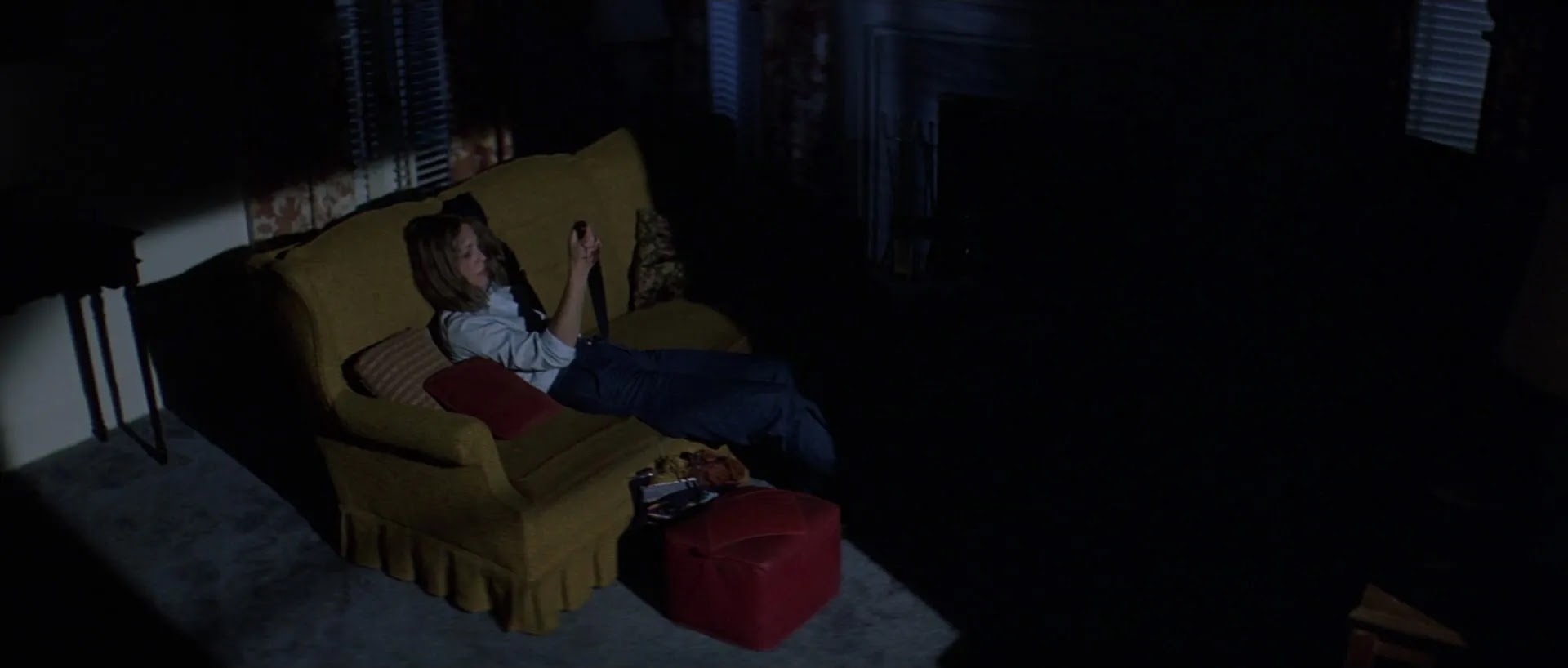
My Favorite Films: Halloween (1978)
Monday, November 28, 2022
My Favorite Films: Singin' in the Rain (1952)
In contrast to films like The Longest Day and Davy Crockett: King of the Wild Frontier which my brothers and I practically watched on repeat, Singin' in the Rain is one of those films I grew up with that remained "in the background" as it were. It was a film I remember watching on Friday nights when it would air on Elliot Wilhelm's show on PBS (good times) and that my sisters would check out from the library occasionally when they were in the mood for a musical. It was only as a grew an appreciation for Hollywood history in my late high school years that I began to appreciate the film more.
Like many musicals of the era Singin' in the Rain is essentially built around its musical numbers and, what may surprise many given the film's stature, they are almost all taken from earlier films. The idea for the film was thought up by Arthur Freed, the head of the "Freed Unit" at MGM which was responsible for the studio's musicals. His idea was to produce a musical based on the studio's back catalog of songs (many written by himself). This was a relatively common practice at the time but one which suits Singin' in the Rain uncommonly well.
The film, essentially, sets out to tell the story of the difficult transition to sound. Freed brought in screenwriters Betty Comden and Adolph Green to craft a coherent story around the songs and, as both writers had personal experience with this period, it was only natural that they zeroed in on it in order to accomplish this goal. The technical problems Monumental Pictures encounter in trying to produce The Dueling Cavelier with primitive sound equipment are reflective of the real-life struggles of many movie studios from this era, even if it's a little exaggerated. You would think the bad audio would have been picked up by the editors before the test screenings but no matter, it makes for hilarious viewing as Comden and Green milk the premise's innate comedic potential for all its worth.
The opening flashback sequence presents something of an overview of early Hollywood history as we see the rise of Don Lockwood from a poor kid on the street to a struggling vaudeville actor to a Hollywood superstar. Similar to real life actors like Douglas Fairbanks and Tom Mix, Lockwood gets his start as a stuntman before being recognized as a potential star and given a major role by the head of studio. Gene Kelly's narration of this sequence is layered with irony as he paints a rosy picture of his career ("dignity, always dignity") that directly contrasts what we see on screen.
In general, the film presents the glamourous world of Hollywood with a sense of irony but one tempered by a breezy, light-hearted tone. The fictionalized tabloid romance between Don and his leading lady Lina Lamont (Jean Hagen) is brushed off by him as a minor irritant while Lina, true to her "dumb blonde" stereotype, seems to fall for her own press. Lina's inevitable fall as a major star is tragic but the film plays it for laughs. Of course, Lamont's scheming to use Kathy to permanently prop up her own career relieves us of any uneasy feelings we may have had on this score.
The musical numbers are uniformly great, lavished with all the production value and talent that old Hollywood could muster. Many of them are diegetic. "Fit as a Fiddle (And Ready for Love)" is used for the aforementioned opening sequence, where we see Lockwood and his childhood friend Cosmo Brown struggling to please an unreceptive crowd during their time on Vaudeville. "All I Do Is Dream of You", is sung by Kathy Seldon during the party celebrating the premiere of The Royal Rascal, a scene which reveals that she is a struggling young actress. In the "Beautiful Girl Montage" we see Kathy in her first screen appearance, and she is reunited with an apologetic Don as a result. "Would You?" is used when Don and Cosmo convince the studio exec to repurpose The Dueling Cavelier, as a musical as is "Broadway Melody." The latter, in particular, is a perfect showcase of Hollywood glitz, and is practically a short film it its own right, chronicling the rise of a promising young Hollywood star who struggles to maintain enthusiasm for his work.
The most memorable songs are those sung by the characters in a non-diegetic fashion. In these songs there's often an absurdity to lyrics that complements the film's tongue-in-cheek tone. This is nowhere more clear than in "Moses Supposes" where Don and Cosmo make the best of a tedious speech class they have to take by turning the tongue twister Don is tasked with reciting into some rather nonsensical lyrics for a song ("A rose is for Moses as potent as toeses"). There is a sense of whimsy and exuberance to this song that characterizes the tone of the film in general. Though this film was never a favorite of mine growing up, there was one song I really liked: "Make 'Em Laugh" (which bears a striking resemblance to Cole Porter's "Be a Clown" from The Pirate). There was something infectious about watching Donald O'Connor's cartoonish antics and it appealed to the show-off in me.
Though musical numbers are uniformly great what really makes the film work is Gene Kelly's performance. Kelly is so athletic and filled with energy, so charming and magnetic that it's impossible not to have a giant grin while watching him on screen. Reportedly, he did not get along with co-star Debbie Reynolds, but you'd hardly know this by watching them together on screen. On the contrary they have wonderful chemistry. "You Are My Lucky Star" (originally from Broadway Melody of 1936 (1935)) serves as the film's love theme and, along with "You Were Meant for Me" (from The Broadway Melody (1929)) is sung by Don to express his love for Kathy. Both are at once corny and endearing in a way that only old school Hollywood could pull off.
The films centerpiece is the one-two punch of "Good Morning" (from Babes In Arms (1939)) followed by the film's titular song (adapted from The Hollywood Revue of 1929). The former is a wonderfully catchy and carefree little tune yet its practically eclipsed by "Singin' in the Rain." This is fitting as the former expresses the sense of release that Don, Kathy and Cosmo feel in having come up with a winning scheme to save The Dueling Cavelier and, by extension, Don's career while the latter channels the exuberant euphoria that Don feels at falling in love with Kathy. Even viewed in isolation there is something wonderfully cathartic about the sequence. Kelly's dance through the rain-soaked streets has justly become the stuff of Hollywood legend.
Singin' in the Rain may not be the most daring or original musical Hollywood ever produced, but its certainly the most fun. It's one of those movies that feels like it was made by Hollywood for Hollywood. There is a strong meta-commentary on the industry in a way that paints a rather rosy picture of it. Even if we might "know better" by now, while watching the film is hard not to be swept up in the magic.
Wednesday, August 25, 2021
Western Wednesdays: A Coffin for the Sheriff (1965)
Wednesday, August 18, 2021
Western Wednesdays: Buchanan Rides Alone (1958)
Released on August 6th, 1958, Buchanan Rides Alone is directed by Budd Boetticher and prodcued by Harry Joe Brown. Written by Charles Lang, it is an adaptation of the 1956 novel, The Name's Buchanan by Jonas Ward. In it Randolph Scott plays Tom Buchanan, a gun-for-hire who is embroiled in an internal conflict in the town of Agry, California.
The fourth of a six film collaboration between Brown, Boetticher and star Randolph Scott, Buchanan Rides Alone was the second written by Charles Lang, however, Boetticher was unsatisfied with Lang's screenplay and asked his regular writer, Burt Kennedy (who had scripted Seven Men from Now and The Tall T), to touch it up a bit. It definitely bears the mark of Kennedy's writing, with witty lines like "This sure is a $10 town." Scott's character here is almost the antithesis of Bart Allison who he played in the previous film, Decision at Sundown (1957). While Allison was a broken, ragged man, on the edge of sanity, Buchanan is perfectly cool and at ease, seemingly unperturbed by the predicaments he finds himself in throughout the film.
The cast are all around excellent. Barry Kelley, Tol Avery Peter Whitney and William Leslie play a group of brothers who have come to rule the town which bears their name through corruption and subterfuge. Avery's Judge Simon Agry is the leader of the bunch, a manipulative and unscrupulous politician, willing to do whatever it takes to get ahead. Kelley plays his more ruthless and cruel brother, town sheriff Lew Agry while Whitney is the groveling third wheel, Amos, dissatisfied with his lowly position as clerk at the hotel, is constantly scheming to get his piece of the pie. Finally, Leslie is the hot headed younger brother Roy, whose murder sets the plot in motion. Manuel Rojas is the murderer, Juan de la Vega, whose determination to avenge the honor of his sister, raped by Roy, borders on fatalism. Craig Stevens plays the shrewd Abe Carbo, the judge's right hand man and, in many ways, the real brains of the organization. A young L. Q. Jones is the honorable thug, Pecos Hill whose affinity for Buchannan as a fellow west Texan leads to his reform (and eventual demise). Of course Randolph Scott is supremely confident as the unflappable Tom Buchanan, going through the film with the swagger of a matador (the subject was an ongoing obsession of Boetticher who got his big break with Bullfighter and the Lady (1951) and closed out his career with the bullfighting documentary Arruza in 1971).
Boetticher cited Buchanan Rides Alone as his personal favorite among his collaborations with Scott. It is the lightest in tone and, compared to the other films in the cycle, is a little sparse both with the action and the romance. While the action could almost be said to revolve around women in the other films of the Ranown cycle, the only women in this has fairly minor, inconsequential roles. Cinematographer Lucien Ballard, who was a frequent collaborator with Boetticher and would go on to shoot some of Sam Peckinpah's best films, does some solid work here and is especially adept at blocking, with characters artfully arranged in the foreground and background.
Though probably the weakest of the Ranown cycle Buchanan Rides Alone is still a solid western, with a clever script, a terrific cast and sturdy direction from Boetticher.
Score: 8/10
Monday, August 2, 2021
My Favorite Films: The Great Muppet Caper (1981) (Musical Mondays)
Of all the Muppet films, The Great Muppet Caper is probably the one I've seen the most. Along with Muppet Treasure Island, it was a film that my siblings and I would routinely borrow from our local public library when we were growing up. It's one of the movies I could probably recite line-by-line. It's also easily the funniest of the eight theatrical films.
Of course, the Muppet performers are all in top form but a lot of credit for this has to go the the human actors. For one thing you have the incomparable Diana Rigg as Lady Holiday. Her dry sense of humor contrasts wonderfully with all the zaniness around her. Charles Grodin, playing her brother Nicky ("an irresponsible parasite") is wonderfully over-the-top, and he plays the character's absurd infatuation with Miss Piggy with a hilarious earnestness. Both actors play brilliantly off of each other and off of their Muppet co-stars, as do many of the more minor players. Of course it helps that this film features the two greatest cameos in movie history from John Cleese and Peter Falk.
The real key to the films success however is its script, by Muppet regular Jerry Juhl along with Jack Rose (an Academy Award nominated veteran of classic Hollywood comedies) and Tom Patchett and Jay Tarses (who both worked on The Bob Newhart Show and The Carol Burnett Show). Combining running jokes, sight gags, non sequiturs, and absurd (often fourth-wall breaking) humor, The Great Muppet Caper represents the Muppet's at the height of their comedic power. When I was a kid watching Beauregard driving like a madman around London was the funniest thing ever. Now I can appreciate how sharp the screenplay really is and the jokes that went over my head as a kid ("It's plot exposition it has to go somewhere.", "My wife isn't feeling very well...") are the ones I laugh the hardest at now.
Of course, like its predecessor, the film constantly breaks the fourth wall. As I mentioned in my review of that film, this maintains the meta slight-of-hand that helped make the Muppets feel real. The Great Muppet Caper does this somewhat more effortlessly then its predecessor, and the Muppets drift in and out of character seamlessly at different points throughout the film. Just watch the scene where Kermit and Piggy get into a heated argument in front of the duck pond and slip into a behind-the-scenes dispute ("I am playing 800 different emotions." "Well, try to play one of them right"). It's just brilliant writing.
The Great Muppet Caper is generally more focused on sending up Hollywood clichés then the The Muppet Movie was. That film used the template of a road trip movie to tell the story of how the Muppets got together whereas this is essentially a heist film with elements of film noir romances and classical Hollywood musicals thrown in for good measure. It is clear that Jim Henson and co. had a love for this kind of genre fare. This is most obvious in some of the films more impressive musical numbers. "The First Time It Happens" channels Busby Berkely while "Piggy's Fantasy" hearkens back to the so-called "aquamusicals" of Esther Williams.
The songs, by Joe Raposo (who worked on both Sesame Street and The Muppet Show), are not as memorable as Paul Williams and Kenneth Ascher's music for The Muppet Movie, but Raposo does a respectable job following in their footsteps nonetheless. The film opens with "Hey A Movie!", which sets the tone for the film's send-up of classical Hollywood cliches ("There'll be mystery and catastrophe. But it's all in fun, you paid the money, wait and see") and also sets the plot into motion as Kermit, Fozzie, and Gonzo (playing investigative reporters) are so busy with the opening number that the miss the jewel robbery, and all the other slapstick hijinks, occurring around them, prompting them to go to London to interview Lady Holiday, whose jewels are stolen, to redeem themselves in the eyes of their boss, Mr. Tarkanian (Jack Warden).
"Happiness Hotel", probably the films most memorable tune, introduces the rest of the Muppet gang as residents of the dilapidated London hotel where Kermit, Fozzie, and Gonzo are staying. "Steppin' Out With a Star" serves as kind of a love theme for Kermit, who channels Fred Astaire by dancing with a clothes rack. It transitions into a tercet with Gonzo and Fozzie as he agrees to let them come along on his "date". "Night Life" serves as an ironic accompaniment to Kermit and Piggy's first date, as they ride to the Dubonnet Club on Happiness Hotel bus while Dr. Teeth and the Electric Mayhem boogie away. Finally, the gentle "Couldn't We Ride" provides the often frantic film with a leisurely change of pace, as the Muppets take a bicycle ride through the London park after Kermit and Piggy resolve their differences.
In general, The Great Muppet Caper is more impressive in its production value then its predecessor, likely thanks to its bigger budget. The sets are much more elaborate and there is a much larger cast of extras. Much of the film was shot on location in England and Oswald Morris
cinematography is more crisp and polished looking then Isidore
Mankofsky's softer look for The Muppet Movie. After showing Kermit riding a bicycle in that film caused such a stir, Jim Henson, stepping into the directors chair for the sequel, took it even further this time
around, creating a complex system of rods, marionette wires and remote control bicycles for the scene wherein all the Muppets are seen bicycling at the same time. But it's in the "Piggy's Fantasy" number that they really pulled out all the stops, building a custom-made heated pool on the sound stage, giving Frank Oz scuba training, and designing special, water-resistant Miss Piggy puppets.
Yet, for all that, the film never loses that sense of whimsy and innocence which is at the heart of Jim Henson's creation. As Henson intended, this is a film that people of all ages can enjoy, from the young and wide-eyed to the old and jaded. Like its predecessor, The Great Muppet Caper is a true family film.
Wednesday, July 21, 2021
Western Wednesdays: Three Ruthless Ones (1963)
Three Ruthless Ones was released on December 19th, 1963. Written and directed by Joaquin L. Romero Marchent (Jesús Navarro Carrión and Rafael Romero Marchent also helped with the script) it stars Richard Harrison, Robert Hundar and Miguel Palenzuela as three brothers who are determined to avenge their father, murdered when they were still just children.
Released before A Fistful of Dollars revolutionized the Spaghetti western genre, Three Ruthless Ones has more in common with American westerns then its later Italian counterparts (it even features a singing cowboy!). Though the plot centers around vengeance, probably the most common plot in the spaghetti western genre (though there are no shortage of American westerns which also use it), the film condemns this pursuit where many spaghettis would either treat it with ambiguity or, in some cases, glorify it.
The central conflict of the film is between the oldest brother Chet (Robert Hundar) and the youngest brother Jeff (Richard Harrison). The fiery Chet is consumed with his desire for vengeance and is willing to do anything to get it while the more kind hearted Jeff is determined to abide by the law and see that the killers are brought to a fair trial and hung for their crimes. The pragmatic, level headed middle brother Brad (Miguel Palenzuela) is stuck in the middle, willing to follow the law to a certain extent but recognizing that it has limits. The two older brothers are influenced by their bitter mother (Gloria Milland) who has made them swear, on their father's grave, that they will avenge him.
The main cast is fairly solid and the characters are all well drawn. With his handsome face and impassioned delivery, Richard Harrison is well cast as the forthright Jeff Walker. He is equally determined to bring his father's killers to justice and to abide by the letter of the law. This brings him into conflict with his family and later with his girl Susannah (Gloria Osuna) who, it turns out, is the daughter of the man who killed his father. Chet is the antithesis of Jeff. He is cynical, moody and consumed with his need for revenge and Robert Hundar does a fine job in the role, alternating between an angry scowl and a malicious grin through most of the film. His best scene occurs about halfway through, when Chet, on the run from the law, almost murders a man who tries to stop him from stealing his horse, only to be dissuaded by the sight of his wife and child. Miguel Palenzuela certainly has the least intriguing material to work with as the dependable, level-headed Brad Walker. Like Chet, Brad has a cruel streak, but it is softened by his wife May (Dina Loy) who, in a scene that could be culled from a hundred other westerns, pleads with him to forego his vengeance when Chet discovers the whereabouts of their father's killer. But "there are things that a man can never forget."
Louise Walker, the boys' mother, is a women almost overcome by bitterness, the poison of which has infected her sons. Gloria Milland, though young for the role (she was only 24 at the time of the films release) puts in a really strong performance, particularly during the tragic ending scene where she breaks down and weeps over the body of her slain son, realizing too late what her desire for vengeance has brought him to. Fernando Sancho, a familiar face to any fan of the genre, imbues the film with some much needed warmth and humor as the wandering Mexican Pedro Ramirez, who hires himself on as the family's cook and is later deputized by Jeff to help him clean up the town where his father's killers reside. He is often a voice of reason and, though he himself has experienced tragedy in his past, urges Louise to let go of her hatred before it destroys her.
Joaquin L. Romero Marchent's direction is efficient if somewhat undistinguished. His framing is always on point and he handles both the action and the more intimate scenes with equal dexterity. The sensitive script juggles its rather large cast of characters admirably (it also features Francisco Sanz, Gloria Osuna, and Freddie Toehl in small but memorable roles). The film sags in the second act where the it becomes is out with scenes from a rodeo, which are impressively mounted but hardly relevant to the plot. The score, by the usually reliable Riz Ortolani is memorable in its own right but, at times, obtrusively upbeat for the context of the film, especially during the climax.
Though not without its flaws Three Ruthless Ones is a well made western with an unusually emotional story line.
Score: 8/10
Wednesday, June 30, 2021
Western Wednesdays: Winnetou (1963)
Originally released in West Germany on December 11th, 1963 Winnetou was released in the U.S. on May 1st, 1965 under the title Apache Gold. Based on the novel by Karl May, the film is directed by Harald Reinl and stars Pierre Brice and Lex Barker. Though the second film in the series to be released (after The Treasure of Silver Lake) Winnetou is the first, chronologically, and chronicles the first meeting of the titular Apache (played by Brice) and his soon-to-be blood brother, Old Shatterhand (Barker).
The plot involves the construction of the Great Western Railroad which is causing conflict between the Apache and the white settlers. Old Shatterhand is sent by the railway officials to discover why the railroad is not being diverted around the Indian land, as planned. He soon discovers that a man named Santer (Mario Adorf) is behind the trouble. Santer is after a goldmine hidden on Apache land, and will stop at nothing to get it. When a white missionary who has been adapted by the Apache is killed by Santer's gang, it is up to Old Shatterhand to rescue a captured Winnetou and stop Santer before a war breaks out.
The Winnetou series is notable for featuring a protagonist who is an Apache (though he is played by Frenchman Pierre Brice) and the films are generally more sympathetic to Indians then their American counterparts. Unscrupulous white men are invariably the villains. In this film Santer bribes the railway official to build the line through Apache land, and he stirs up the Kiowa against the Apache to further his own ends. Winnetou is much more headstrong then usual in this movie. He is justly angered by the incursions onto Apache land but this leads him to an irrational hatred and mistrust for all the whites. Its only when Old Shatterhand saves his life that he begins to see things differently.
There is a rather contrived the conflict between Winnetou and Old Shatterhand. Winnetou blames Old Shatterhand for not preventing Santer's injustices and is not aware that it was he who saved him (somehow he didn't see Old Shatterhand untie him!). Set to be burned at stake, Old Shatterhand claims an ordeal by battle and is able to triumph without loss of life. It is later proved that he freed Winnetou when Winnetou's sister Nsho-tshi (Marie Versini) produces his necklace, which Old Shatterhand retrieved after saving Winnetou, in the white man's jacket.
Sadly, before this can occur, there is much needless bloodshed, as Winnetou attacks the town of Roswell where Santer is holed up and many innocent settlers and Apache are killed. The film has a tragic tone in general. Shatterhand falls in love with Nsho-tshi, only to loose her during the climax. Santer's girl, who tries to rebel against him, is also tragically killed during the Apache attack. This clashes greatly with the films often obnoxious comic relief leading to some egregious tonal inconsistency. Interestingly much of this comic material was cut from the original U.S. release, with Chris Howland's English news photographer removed completely (conveniently he shares no screen time with Winnetou or Old Shatterhand). This may be one of the few times where the shortened U.S. version is actually superior!
Despite these flaws, Winnetou is still an exciting and well made film. It features one of Lex Barker's better performances in the series as a younger, less experienced Shatterhand. His reaction to Nsho-tshi's death is actually pretty effective. Pierre Brice plays a much more hotheaded Winnetou then usual here, which is an interesting change of pace even if it makes him unlikable at times. Like the other films in the series, it has much more production value then most European westerns made in this period. Harald Reinl's direction is solid and he shows a real command of the action scenes in particular. Ernst W. Kalinke provides some gorgeous cinematography and the film is accompanied by a pleasent, if occasionally ill fitting, score from Martin Böttcher.
Score: 7/10
Wednesday, May 26, 2021
Western Wednesdays: The Sons of Katie Elder (1965)
The Sons of Katie Elder was released by Paramount Pictures on June 24th, 1965. Directed by Henry Hathaway it stars John Wayne and Dean Martin. Inspired by true events, the film tells the story of four brothers who return home for their mother's funeral only to find that she was cheated out of her land by an unscrupulous businessman who is bent on taking over the territory the very night their father was mysteriously murdered.
The original script by William H. Wright was based on the story of the Marlow brothers. As in the film, the brothers were involved in a local feud and framed for robbery. They did fight their way out of an ambush (while still handcuffed) while being transported to Weatherford, Texas (Laredo in the film) for trial. Unlike the film their were five brothers in real life, three of whom were killed (in the film one dies and the fate of two others remains uncertain). The sheriff, in the film, is shot in the back by the bad guys but in realty he was accidently shot by one of the brothers during an altercation. The two deputies, honorable men in the film, were in reality in league with the criminals and both survived the ambush only to be tried for conspiracy to murder. Dean Martin's character, in the film, is wanted for killing a disgruntled barkeep who took a shot at him. The real brother, Boone Marlow, had killed a man named James Holstein who had allegedly been hired to intimidate settlers. Also, their mother was still alive during all of these events...
In any case the script went through quite a few changes before the film was made. The final version is credited to Allan Weiss, Harry Essex and Talbot Jennings in addition to Wright. When Paramount bought the script in 1955 John Sturges was going to direct the picture and Alan Ladd was slated as the lead. After Ladd backed out the project was put on hold for several years before being reborn as a John Wayne vehicle.
It's a solid western with Wayne in top form as the eldest brother, John Elder. John, an infamous gunslinger, is torn throughout the film between his sense of honor in tracking down his father's killer and his sense of guilt for living a violent life that his mother never approved of. Dean Martin brings his unique sense of charm to the role of Tom Elder. A gambler and troublemaker, of the bunch Tom is the most self-serving. Michael Anderson Jr. is overshadowed by his more famous co-stars as the youngest son Bud Elder, who Katie saved up to send to college, hoping to preserve the family name in some way. Finally, Earl Holliman is all but invisible as the middle brother Matt, a failing hardware dealer who wants to leave a better legacy for his deceased mother.
James Gregory brings his usual sense of deviousness to Morgan Hastings, the ambitious businessman who swindled the Elder's father out of his land while George Kennedy is positively dripping with menace as the hired gunfighter Curley. Paul Fix imbues the Sheriff, Billy Wilson, with a real sense of authority and sympathy in contrast to his overeager and temperamental deputy Ben Latta, played by Jeremy Slate. Martha Hyer brings spunk and a sense of matter-of-fact kindness to the role Mary Gordon, the owner of the boarding house who was a good friend of Katie before she passed on. Dennis Hopper, Rhys Williams, John Doucette, Strother Martin and Sheldon Allman are also featured in small but memorable roles.
Henry Hathaway, a veteran director at this point, does a fine job behind the camera. The action is particularly well done with the ambush at the bridge being a highlight. Lucien Ballard, who would go on to shoot many of Sam Peckinpah's most famous movies, puts in some strong work on this, his third film with Hathaway. He beautifully captures the New Mexican landscape and does a great job with the night shooting, which is particularly heavy in this film. Composer Elmer Bernstein, meanwhile, provides yet another rousing score.
The film's biggest shortcoming is Earl Holliman's Matt, the second oldest brother, who is simply not as well defined a character as his three brothers. This is not Holliman's fault, he simply didn't have enough to work with. The most we glean about Matt Elder is that he loved his mother and, like John, is invested in honoring her memory, suggesting they buy a monument for her grave and later fully supporting John in his desire to complete Bud's college education. By the time the third act rolls around and he is tragically killed, we really haven't learned much else. Another issue is that, while the climax is magnificent, the film's denouement is a little rushed and doesn't quite manage to tie up all the loose ends. George Kennedy's gunfighter, who has a growing rivalry with Wayne as the film goes on, has a rather anticlimactic death. The Elder's also clear their name in a somewhat contrived manner. Finally the film leaves certain plot threads hanging. Does Bud go to college? Does Mary fall for John? Do the brothers ever deliver Striker's horses?
Though it falters a little in the last act, The Sons of Katie Elder is still a solid western with a fantastic cast, solid direction, and a memorable score from Elmer Bernstein.
Score: 8/10
Wednesday, April 28, 2021
Western Wednesdays: Junior Bonner (1972)
Junior Bonner was released on June 11th, 1972. It is directed by Sam Peckinpah and written by Jeb Rosebrook. It stars Steve McQueen as Junior 'J.R.' Bonner, a down-on-his-luck rodeo rider who enters the Independence Day rodeo in his hometown of Prescott, Arizona.
Junior Bonner is a film about aging. 'J.R.' Bonner is over the hill. As the film opens, we see him being thrown from a bull during a rodeo, an event he thinks back to again and again over the course of the film. When he returns to Prescott he finds that his childhood home is being bulldozed, courtesy of his entrepreneurial brother, Curly (Joe Don Baker). Like most of Peckinpah's protagonists, J.R. is a man out of sync with modernity.
So is his father, Robert Preston's Ace Bonner, who has a complicated relationship with his son. Ace, like J.R., was a rodeo rider, and it is pretty clear that he was a major inspiration for his son. On the other hand, Ace always had a stormy relationship with his wife, Elvira (Ida Lupino). Ace is a womanizer and a heavy drinker and, as a result of this, he and Elvira have separated. Ace is also a financial failure, having become so desperate that he sells his land to his own son at a ridiculously low price to fund his ill-advised gold mining attempts.
Junior Bonner is also a film about family. Bonner is disgusted by Curly's cynical, money making schemes, particularly his selling of their fathers land. He struggles to avoid becoming his father, and repeating his failures, while at the same time trying to follow in his footsteps. Both men refuse to bend to the cynical, greedy ways of the modern world. Both want nothing to do with Curly's money-making schemes and Junior even turns down an offer from rodeo owner Buck Roan (Ben Johnson) to become a financial partner. At one point, as Junior and his mother discuss her moving to a mobile home, she tells him, "You and Ace. Maybe you're the lucky ones, drifting the way you do." To this Bonner replies, "Maybe." This exchange, I think, sums up the film's central themes really well.
This is probably the most uplifting, or at least, the least depressing of Peckinpah's films. It ends with J.R. using his winnings from the rodeo to buy his father a ticket to Australia, where he has been planning to go to pursue gold mining again. He helps his father but on his own terms, doing it because he chooses to and not because of any manipulation from Ace. At the same time there is, to some extent, reconciliation between the members of the Bonner family. Junior and Curly settle their differences while Ace and Elvira are able to let go of their bitterness toward each other. While they all go their separate ways, they depart on terms of mutual understanding.
Peckinpah's signature use of staccato editing is fully on display here, especially in the first act of the film, with its continual flashing back to Junior's failed ride on the bull and the juxtaposing of Ace's house being demolished and Junior driving through the construction site. In another, particularly lyrical scene Ace and Junior escape the rodeo parade and ride through the town together, ending up at an abandoned railway station, with Peckinpah making striking use of slow motion to emphasize how out-of-sync these men are with their surroundings.
Interestingly, Robert Preston and Ida Lupino were only 12 years older then McQueen, despite playing his parents. The aging actors give subtle, sensitive performances, especially McQueen whose able to temper usual his cool-as-ice persona with a world-weary, melancholy demeanor. Joe Don Baker is great as the Junior's sleazy younger brother while Barbara Leigh does the best she can with limited material as woman who shares a fleeting sexual encounter with Bonner. Familiar faces like Dub Taylor, Don 'Red' Barry, Bill McKinney and, of course, Ben Johnson fill out the cast nicely.
Though not as immediately arresting as some of the more violent pictures that Peckinpah was known for, Junior Bonner a still great film.
Score: 9/10
Saturday, April 10, 2021
Thoughts on the Snyder Cut (Video)
So I watched the Snyder Cut of Justice League the other night and decided to do a video giving my initial thoughts.
Upon further reflection I still feel that the film is not good but is easily better then the theatrical cut as well as Man of Steel and Batman v Superman (which I just re-watched). There are definitely some contrivances with the way Steppenwolf is called to the earth initially and, as I address in the video, I am not convinced that the League's becoming united is adequately developed.
Score: 6/10
Saturday, April 3, 2021
Lent Reviews Week 6: A Time for Miracles (1980)
A Time for Miracles is a made-for-television movie produced by ABC. Directed by Michael O'Herlihy and written by Henry Denker in collaboration with Sister Mary Hilaire, it originally aired on December 21st, 1980. It tells the story of the first American born saint, Elizabeth Ann Seton, here played by Kate Mulgrew (best known for playing Captain Janeway on Star Trek: Voyager).
The film opens with a group of clergy discussing Mother Seton's cause for canonization. The Postulator for her cause (played by John Forsythe) still needs to produce one more miracle in order for her to be canonized. That miracle, he will later argue, is the fruit of her life's work: the Catholic parochial school system in the United States. Looking through the notes he has compiled on her case, the Postulator begins reminiscing on her life. The film relies too heavily on this narrative device at times, breaking the cardinal rule of show-don't-tell. Some important moments in her life, including the death of her daughter, are revealed via Forsythe's voice-over and glossed over in one or two brief scenes.
Nevertheless, the film does a pretty fair job of retelling her life story. After loosing her husband to tuberculosis, she finds herself poor and destitute with four young children to take care of. The Fellichi's, an Italian family that Elizabeth and her husband were staying when they went in Italy hoping the climate would improve his health, offers her financial and emotional support. Inspired by their generosity she begins to form an attraction to Catholicism, despite her strict Episcopalian upbringing. Returning to America, she starts a school for young girls but, after becoming a Catholic, she finds herself without any students, being looked on with suspicion by the largely Protestant, anti-Catholic community in her home state.
Archbishop John Carroll (Lorne Greene) invites her to start a school for girls in Baltimore and found a religious congregation, based on the rule of the Sisters of Charity (founded by Saint Vincent de Paul), to run the school. Though reluctant at first because of her obligations to her children, she eventually agrees, on the condition that her children remain under her care and that the school be free-of-charge for the poor. Though she is successful at first, this is not the end of her troubles. Her first school house is primitive and provides little shelter from the winter's cold. Later, her faith is challenged when she looses both of her daughters to sickness. But through it all she perseveres.
The film does take some liberties with the real story. The romantic attraction between her and Fillipo Fillici (Rossano Brazzi) is, as far as I'm aware, an invention but, other then that, the film stays true to the saint's inspiring story. Elizabeth's devotion to the Blessed Virgin is not portrayed, though the film does emphasize her deep love for Jesus in the Blessed Sacrament and her devotion of St. Joseph.
The film's writer, Henry Denker, was not a Catholic but a Jew. I would not wonder that this informed the films attitude toward Religious intolerance, as much emphasis is placed on the persecution faced by American Catholics at this time. He did, however, have experience with Christian material having written the script for the religious radio series The Greatest Story Ever Told (later adapted into the novel and, subsequently, the film of the same name). He was also helped in his duties by Sister Mary Hilaire. Denker was a prolific author and playwright and it shows. Despite the constraints placed on him by the film's limited runtime, he and Sister Mary provide the film with a fairly witty screenplay. The scenes between Mother Seton and Father Caroll are especially good. One scene in particular sticks out, where Elizabeth, after being offered coffee by the Archbishop, says, "I'm partial to coffee, so in this instance at least, I can say, 'Father, take this cup from me.'" With that said, there are times when the dialog is a little too on-the-nose, especially in the aforementioned narration.
Kate Mulgrew is magnificent as the titular saint and the film stands, firmly, on her shoulders. She brings a real sense of pluck and vigor to the role of the indefatigable saint, but there's also a tragic side to Mother Seton which Mulgrew brings out. We get a real grasp of her deep sense of pain and loss at losing her husband and later her two daughter, her self-doubt regarding her mission and the burden it places on her family but also of her ultimate faith and trust in God. Lorne Greene puts in a solid performance despite his questionable accent. The rest of the older supporting cast do an adequate job but many of the younger actors fair less well. I should also note that the film is well shot by Don Birnkrant, who makes good use of shadows and contrasts.
All in all, A Time for Miracles is a middling made-for-TV movie, elevated by its occasionally clever script and a truly great performance from Kate Mulgrew.
Score: 7/10
_theatrical_poster.jpg)