Showing posts with label reflection. Show all posts

Monday, November 21, 2022

The World, the Flesh, and the Devil in Nosferatu

    One of the most influential movies ever made, Nosferatu celebrates its 100th anniversary this year. An unsettling film, its outdated special effects and inconsistent frame rate actually serve to make it feel more alien and frightening. It evokes a genuine sense of dread, which is the genre's peculiar raison d'ĂȘtre. In addition to this, it is the themes of Nosferatu that have made it endure. In particular, the film explores (unconsciously or otherwise) the Catholic idea of the central sources of temptation. As the holy fathers of the Council of Trent proclaimed, "... let those who think themselves to stand, take heed lest they fall, ... for, knowing that they are born again unto a hope of glory, but not as yet unto glory, they ought to fear for the combat which yet remains with the flesh, with the world, with the devil (emphasis added)."

The World

    "The world" denotes an opposition to God in favor of the "spirit of the world" which is under the dominion of Satan. It is the preferring of empty, passing values to what is eternal. This can be seen in the film in the form of greed, as when Hutter agrees to go to Transylvania for the allure of filthy lucre. "You could earn a lot of money ..." his boss, Knock, tells him as he sinisterly suggests that Hutter offer the Count the house across the street from Hutter's home. Hutter is initially thrilled with the opportunity. Against his better judgment, he shrugs off the warnings he receives from the Transylvanian people living around the count's castle of a diabolical evil residing there. By the time he realizes his mistake it is too late, he has fallen into the vampire's power. 

The Flesh

    A less pronounced theme in the film then in the novel "the flesh" denotes our disordered sensual passions, especially that of lust. In the novel, Dracula's victims are inexplicably drawn to him in a way reminiscent of carnal desire. In the film, Hutter's wife Ellen is continually drawn towards Orlock, sleepwalking on to her balcony at night in anticipation of his arrival. The central motive for Hutter's escape is to protect her chastity, having heard Orlock's veiled suggestions of his designs toward her. 

The Devil

    The most prominent of the of these films, the devil, is personified by Orlock himself. It is mostly through the allure of the world and the flesh that the demons extend their power over the hearts of men, but there are some who, in the words of G. K. Chesterton, wish to "sup on horrors." Knock is such a one. In the scene wherein he is introduced he can be seen examining a scroll filled with occult symbols. His suggestion that Hutter offer the count the house opposite his own is filled with thinly veiled sinister intentions. 

    The dominion of the devil is often synonymous with the dominion of death, the unavoidable consequence of Adam's sin. Images of coffins and gravestones permeate the picture, creating an atmosphere of oppression and dread. This idea is especially manifest in the films climax. The vampire's arrival in Hutter's village provokes fears of a plague and the people begin to be ruled by this fear. Knock is put away for insanity but eagerly awaits the arrival of the count, convinced that his "master" will reward for his foul deeds. Eventually this catches up with him, as the fear of the villagers metastasizes into a mad frenzy and the once peaceful townsfolk turn into an angry mob out for Knock's blood. Here we see a conformity to the spirit of the world that defies even natural reason. 

    Thus far, we have seen how the evil of the vampire is brought to Hutter's town as a result (directly or indirectly) of sin. Now we come to another major theme which distinguishes from many more contemporary horror films: hope. Many modern horror films emphasize the impotence of man in the face of diabolical forces. In John Carpenter's seminal Halloween, Laurie survives Michael Myers assault but the ultimate defeat of "the shape" is not forthcoming. After being shot six times Michael mysteriously vanishes, living on to kill another day. In this paradigm, the forces of evil may only be defeated temporarily, there is no hope a final victory over them. It is reflective of the pre-Christian world of pagan darkness. 

    Not so Nosferatu. Though many of the more explicitly Catholic elements of the novel are muted in the film, it is surely no accident that the vampires defeat mirrors the triumph of Christ on Calvary. Ellen discovers a passage in a book which speaks of the only way of defeating the monster; a "sinless maiden" must "give him her blood willingly." Like Christ, she offers herself as a pure, sacrificial victim in order to see the evil defeated. In the films last moments, when all seems lost and Orlock feasts on the blood of Ellen, the sun rises and the Count, heedless of the approaching danger, is destroyed.

    The above quoted passage from the Council of Trent, after warning the faithful of the dangers of these three temptations, goes on to say that "they cannot be victorious, unless they be with God's grace." Ellen is powerless on her own and must place herself in the hands of some transcendent power. Once she does this, the defeat of evil is as sure as the rising of the sun. Christ is risen. The prince of this world is cast out and, though the world still labors under his dominion, we have only to await the second coming of Our Blessed Lord and so "the victory", in the immortal words of St. Maximilian Kolbe, "is already ours."

Maranatha!

Thursday, May 14, 2020

The Prequels Reconsidered

     In my most recent watch through of the Star Wars movies I had a decidedly positive experience with the prequels, films I've treated with disdain on this blog in the past. As Disney Star Wars films have become increasingly terrible I have come to recognize that a big part of this failure lay in the way the movies present themselves as an answer to the negative reaction to the prequels. People complained about the CGI so Disney emphasized their use of practical effects in the advertising for their new films. People complained about the "boring" politics in the prequels so the new films are almost completely free of politics. Many have pointed out that the prequels seem to lack the fun and energy of the originals, so everything in the sequel trilogy is filled with canned humor and characters who are constantly hyperventilating.

     While the new films have been coming out, a lot of people online have been coming around on the prequel trilogy and defending it quite eloquently. For my own part, in doing research for my reviews of Episodes V and VI, I began to gain a greater appreciation for George Lucas as a storyteller. As I considered all of this I came to the realization that all of these complaints about the prequels were really surface level. There was not a lot of substantive criticism, even alas, in my own reviews.

     Story wise, all three prequels work really well, at least on paper. Each one tells its own story while contributing to and building on, the series as a whole. But were they well executed? For a long time I have thought not. My criticisms here largely echoed those of the RedLetterMedia reviews and other prominent critics of the prequels online. What really changed my viewpoint was watching a video by YouTuber and indie comic book writer Rick Worley, which I can't recommend highly enough. In it he dives deep into the many cinematic inspirations for Star Wars and the way Lucas drew on these sources to create his own unique visual short hand.

     I've always known that there were many ways to approach visual storytelling. When I first started to read about film as an artform, I remember reading how John Ford used camera movement very sparingly, so that it would have a greater impact when he did. Similarly, rapid editing can ruin a good action scene, but if it is used intentionally to communicate the chaotic nature of a fight or chase then it works. What's important is how a filmmaker uses the various tools at his command to tell his story and, looking at the prequels with fresh eyes, I can see how well Lucas does this.

     When you really break it down the prequels are really brilliant on a visually storytelling level. In the RedLetterMedia review for Revenge of the Sith, Mike Stoklasa accuses Lucas of laziness, particularly in the way he stages dialogue. But this isn't true at all. Lucas shoots these kinds of scenes using a variety of methods. Scenes like Anakin's conversation with Padme on the balcony are shot in a traditional straightforward style, shot reverse shot. But look at a more dramatic scene, the one where Palpatine reveals himself for example. Here Lucas moves the camera around the actors as they circle each other, heightening the sense of manipulation on Sidious' part.

     In the latest episode of The Gallery: The Mandolorian, producer Dave Filoni (creator of The Clone Wars) talks about the climatic lightsaber duel in The Phantom Menace. He explains what the real stakes are in this scene, and how it is critically important for the series as a whole. "What's at stake is really how Anakin is going to turn out. Because Qui-Gon is different than the rest of the Jedi, and you get that in the movie." When Qui-Gon dies Anakin essentially loses his father figure (Obi-Wan is more like an older brother) and it's only by becoming a father himself, when he saves Luke, that he is finally redeemed. "So the son saves the father and the father saves the son and it works out perfectly. And I draw that line all the way from Phantom Menace to Return of the Jedi. That's the story of Star Wars." This really brought home something I recognized when I watched through the six movies, that there is this cohesive thematic thread, the sense that the six episodes are all a part of what is, essentially, one long movie. This, more then anything, has helped me to appreciate not just the prequels but the saga as a whole in a better light.

     If you grew up liking the prequels and were soured on them because of no-it-all internet critics like me I would like to take this opportunity to apologize. In any case, whether you always hated these films are have grown to dislike them, I would urge you to watch them again and try to put aside whatever preconceptions you may have had about their quality. Try to approach the series like you would The Lord of the Rings, as one epic story divided into smaller chapters. For my part, it was a rewarding, and enlightening, experience.

Sunday, July 21, 2019

My Non-Review of The Lion King (2019)

     I'm not going to see The Lion King remake in theaters. I've had my mind made up about this for some time. I may or may not check it out when it is released on home video and streaming but I have no interest in supporting its theatrical run. As I have quite liked some (though not all) of the Disney live-action remakes, I felt the need to address this on my blog.

     First of all I have made an informal resolution to watch less Disney films in theaters. There are many reasons for this including the studio's promotion of abortion and other left-wing causes that I find distasteful (to put it mildly) but the main reason is that the corporation (calling it a studio is no longer really adequate) has gained an increasingly dangerous amount of monopolistic control over Hollywood in the last ten years. The acquisition of 20th Century Fox is what really clinched it for me. While many geeks celebrated what would (eventually) mean the entry of the X-Men and Fantastic Four into the MCU, I looked on in horror as the big six Hollywood studios became the big five. Consequently I have also felt compelled to support other studio releases (especially Warner Brothers) more often, not because they're not monopolies themselves (they are) but because Disney is the biggest and most dangerous at this point, so the enemy of my enemy is my friend.

     With that said I still go to see some Disney films in theaters. Marvel is certainly the biggest exception though I will also probably see whatever their next animated film is out of a (likely misplaced) sense of loyalty for what the studio used to be. But I skipped Mary Poppins Returns and have thus far avoided seeing Toy Story 4 and Spider-Man: Homecoming (my younger siblings will probably drag me to one or both eventually).

     So what is it about The Lion King in particular that impels me to give it a pass? Well, for one thing, I have a lot of affection for the original film (despite not having grown up with it) and I respect how formative it was for many who saw it at a young age. I also resent the cloying appeals to nostalgia that have become so commonplace in Hollywood today. Then there's the fact that, as their are no human characters in The Lion King, a "live-action" remake would really be a CGI remake and, unlike Cinderella or The Jungle Book, which were based on source material that could be further drawn from, The Lion King is a wholly original film. This, along with it's iconic status, seemed to make it likely that the film would be highly unoriginal.

One of these shots has atmospheric lighting, dynamic camera angles and
expressive facial animation. The other ... does not.
     All of this made me wary of the film from the moment it was announced. I held out a certain amount of hope because of the involvement of Jon Favreau who, in my opinion, did an excellent job with The Jungle Book. Perhaps this remake would resemble that film as opposed to Beauty and the Beast, which was essentially a shot-for-shot remake. But the release of the trailer made it pretty clear that this would not be the case. Then there was the Rotten Tomatoes video which compared the visuals of the trailer with shots from the original film showing "how much animation has evolved in the last 25 years" despite the fact that 1) hand-drawn animation and CGI are not remotely comparable and 2) it only served to highlight how bland and expressionless the new film looks in comparison to the original. This was the moment, I think, that I decided I was not going to see the film.

     Now, some might argue that there is nothing wrong with revisiting a beloved story with some new gloss. After all, tribute bands have been a thing for years and popular theatrical plays are revived time and time again. The difference is that plays and concerts are fleeting things. They exist only for the short moment in time that you are watching them. That some might want to recapture such moments is only natural. But film is a different thing. Like books they exist perpetually (as long as they are properly preserved) and, with all the benefits of modern home video technology, one can revisit them at any time. Because of this it seems rather pointless to remake a film that many people consider a peerless classic. If people want to see it on the big screen why not just re-release it? The 25th anniversary of the original release would have been a perfect opportunity to do this and indeed the studio did so two years ago to coincide with the film's 4k release.

     Of course the answer to all of these questions is rather obvious: money. Movie studios have long operated under the conviction that re-releasing a classic film (except in a very limited venue) was a waste of time unless something new was tacked on, whether that was new footage, 3D or updated special effects. Perhaps this explains, in part, why I'm spending more and more of my theater-going expenses on Fathom Events and other classic film series, as if in silent protest to this trend.

     In many ways this is all a natural consequence of my growing disdain for modern Hollywood. Gone are the days when big studios produced films with modest budgets for niche audiences (or even one as broad as a "family"). Now studio's feel the need to pander to the widest audience possible by appealing to nostalgia and vulgar brand recognition. It's hard to argue against this strategy as it has clearly paid off for the major studios but I no longer want to be a part of that equation. Perhaps instead I'll revisit the original film on Blu-Ray. I would invite my readers to do the same.


Wednesday, December 12, 2018

Revisiting Walt Disney's Davy Crockett: Part 1 (Western Wednesdays)

I'm back! And I've finally graduated from college! To celebrate I wanted to do a bit of a retrospective/review on one of the formative pieces of media from my childhood: Walt Disney's Davy Crockett.

     I was first introduced to Fess Parker as Davy Crockett through the 1955 movie Davy Crockett: King of the Wild Frontier and its sequel, Davy Crockett and the River Pirates. Disney was mostly taboo in my home growing up (a fairly sensible restriction in retrospect) but there were a few exceptions. Movies that my father had grown up with, like Mary Poppins and the aforementioned Crockett pictures were allowed as he considered them to be of exceptional moral and artistic quality. My brothers and I were immediately hooked. We watched both movies so many times growing up that I believe I could recite all the dialogue verbatim if I really wanted to. We spent countless hours reenacting scenes from the movies and inventing new adventures of our own. Who would play Davy and who would be regulated to play his trusty companion Georgie Russel  (or worse, one of the bad guys) was a constant source of contention.

     This would lead me to a keen interest with anything Crockett related: books, documentaries, action figures; but also with other American frontiersman like Daniel Boone (who I was introduced to through the Disney series with Dewey Martin), Jim Bowie, and Grizzly Adams; and a longstanding fascination with the battle of the Alamo. But none of this was able to satisfy my Crockett craze. What I really longed for was a continuation of those two Fess Parker movies. Fueling this frenzy was my father's continued insistence that he remembered watching other "lost" episodes that Disney had never released on video. This, it turns out, was partly true.

When our family first got access to the internet (my dad needed it for his work-from-home job) I investigated his claims for myself. I found that, while there weren't entire episodes missing, the movies had edited the original five episodes quite a bit to shorten the run time. The three episodes that made of King of the Wild Frontier had each lost around fifteen minutes of footage while River Pirates, which only combined two episodes, had been edited much more minimally.  Disney had never seen fit to release to full, unedited episodes on home video. Since this discovery I had always hoped for an eventual release.

     Finally, I discovered the Walt Disney Treasures box sets. To celebrate Walt Disney's would-be 100th birthday the studio released a bunch of their early titles, including Crockett, uncensored, unedited and uncut on DVD. Unfortunately, these sets were sold in limited quantities and as a result were hard to find and expensive. Davy Crockett was upwards of $150 which was way out of my budget for a five episode mini-series at the time though I knew I would break down and buy it one day barring a less expensive alternative.

     Then I discovered YouTube. Low and behold, some one had uploaded the entire series (this was back in the early days of the website when you could still easily find copyrighted material for free). I was ecstatic when I first discovered this, like a kid on Christmas all over again (I was probably 15 or 16 at the time). I watched the first episode with my brothers as soon as I could find the time. But then something strange happened. My enthusiasm vanished. Like a man who spends his whole life hunting for something and then feels purposeless when he finally does. I decided to wait to watch the rest of the series, to savor it a little longer.

     I continued to procrastinate until, finally, the series was removed from YouTube for copyright restrictions. By this time I had moved on to other interests (comic books, WWII reenacting, western films, science fiction and fantasy stories), yet there was still a part of me that planned to revisit the series one day....

To be continued next week!

Wednesday, July 18, 2018

Subjectivity and Objectivity in Film Criticism (Video)

This is a video response to a recent debate between some YouTube critics.


     The original debate, featuring Mauler and The Dishonoured Wolf against Just Write, was provoked by Just Writes two video's on Star Wars: The Last Jedi (see below). Though obstebly about The Last Jedi, the three YouTubers spend most of the video arguing about subjectivity and objectivity. This really got me thinking about my own approach to reviewing movies.

The debate (Just Write enters the conversation around the 2:10:00 mark):

Just Writes video's on TLJ (the second one provoked the debate):


Sunday, July 1, 2018

Christian Humanism and True Terror in A Quiet Place

"It is in the face of death that the riddle a human existence grows most acute. Not only is man tormented by pain and by the advancing deterioration of his body, but even more so by a dread of perpetual extinction. He rightly follows the intuition of his heart when he abhors and repudiates the utter ruin and total disappearance of his own person."
-Gaudium et spes, the Pastoral Constitution on the Church in the Modern World


     The film A Quiet Place contains one of the most positive, life affirming portrayals of a family I've seen in a mainstream Hollywood film in the last decade. This might seem ironic on its face, after all this is a horror film. On further reflection however, it makes a lot of sense.

Cheap thrills in Halloween 5: The Revenge of Michael Myers (1989)
     Many horror writers have talked about the distinction between horror and terror. Terror, they say, is the feeling of dread and anticipation before a scare, while horror is the feeling of revulsion that follows after. Ann Radcliffe, the pioneer of Gothic literature, wrote that, "Terror and Horror are so far opposite, that the first expands the soul and awakens the faculties to a high degree of life; the other contracts, freezes and nearly annihilates them." Many films in the genre evoke horror, attempting to shock the audience with grotesque imagery or startle them with a loud noise (a "jump scare" as many would call it). Truly great horror films are those which evoke terror, which produce a sense of dread.

Overcoming fear in It (2017)
     What does this all have to do with the family and humanism? Well in his book Danse Macabre Stephen King writes that, "Horror, terror, fear, panic: these are the emotions which drive wedges between us, split us off from the crowd, and make us alone ... The melodies of the horror tale are simple and repetitive, and they are melodies of disestablishment and disintegration ... but another paradox is that the ritual outletting of these emotions seems to bring things back to a more stable and constructive state again." In other words horror stories can be a source of catharsis, the dread they invoke can, "expand the soul", can lead to a greater sense of hope. And hope is something that many modern families desperately need.

     So often, in this day and age, it feels as if the very institution of the family is under attack from societal forces. Indeed, Popes from Pius XII all the way up to Francis have spoken on this subject again and again. In the Vatican II document Gaudium et spes, the Pastoral Constitution on the Church in the Modern World, we read, "As for the family, discord results from population, economic and social pressures, or from difficulties which arise between succeeding generations, or from new social relationships between men and women." Similarly the Abott family in A Quiet Place struggles to cope with the harsh world around them and also with internal discord. The alien monsters that devoured their youngest child are a constant source of fear and dread but its the guilt that each of the family members carry for this event that really threatens to undo them.

     The father, Lee (John Krasinski), wishes he would have prevented Cade from taking the electric spaceship toy, the noise of which leads to his death. The mother, Evelyn (Emily Blunt, Krasinki's real life spouse), wishes she had carried him home so she could have kept an eye on him. The daughter, Regan (Millicent Simmonds), who encouraged Cade to take the spaceship despite their father's disapproval, not knowing that he also snuck along the batteries for it, feels responsible and thinks that her father blames her for Cade's death.

     There's a really important scene about halfway through the film when Mr. Abbot and his son Marcus are returning from a trip though the woods and come across an elderly man whose wife has died. Emotionally crushed by this event the man yells out in despair and is killed by one of the creatures, who are sightless but have a keen sense of hearing. Isolation and loneliness lead to despair and annihilation. Similarly, the tension between Mr. Abott and his deaf daughter Regan which arises because of her guilt about what happened to her brother, causes both him and her to feel isolated and alone. This is of course exacerbated by the extreme circumstances they find themselves in. Gaudium et spes says, "as current events often attest; riddles of life and death, of guilt and of grief go unsolved with the frequent result that men succumb to despair."

     But the family ultimately overcome their sense of fear and loss. While the father and Marcus are away from the farm the mother goes into labor and they return just in time to ward off the monsters before they are attracted by her screams. Marcus and Regan end up being separated from their parents in the confusion and its up to their father to save them. This leads to a brilliant moment, where Lee sacrifices himself for his daughter, screaming to lead it away from the truck where she and Marcus are hiding. Witnessing this, Regan finally sees that her father never stopped loving her and doesn't blame her for her brother's death. While the old man's scream was one of despair, Lee's is an act of unconditional love for his children.

     Lee, in this climatic scene becomes something of a Christ figure. As Christ conquered death by embracing his own death, Lee overcomes despair and renews hope by giving up his own life. The scream that was an act of despair and nihilism from the old man becomes redeemed, sanctified even. Once again, Gaudium et spes says, "Through Christ and in Christ, the riddles of sorrow and death grow meaningful." This is also an echo of that famous passage in St. John's Gospel, "Greater love hath no man than this, that a man lay down his life for his friends."

     This theme of hope in the face of nihilism and despair is also found in the Abbot's soon-to-be born child. Mr and Mrs. Abbot are willing to risk having another child despite the fact that they lost one so recently. This, I think, is their way of not giving in to despair. Despite all of the dangers of raising an infant in this film's dangerous world, they are willing to do whatever is necessary to try to make it work. This seems especially relevant in a time where many parents feel ambivalent about bringing new life into this crazy, often times unforgiving world.

     This is why A Quiet Place is still my favorite film of 2018 so far. It's not a perfect film by any means, some of the world building raises more questions then it answers, it often relies to much on musical score to create tension, and there are some fairly noticeable contrivances, but it is a film that really resonated with me as a Christian and a Catholic.

How rightly Sir Maurice Powicke says, "there have been civilized people in all ages." And let us add, "In all ages they have been surrounded by barbarism."
-C.S. Lewis, Surprised by Joy

Sunday, April 30, 2017

John Wick, Logan and the Current State of Action Movies in Hollywood

     The action genre has been in a bit of a dearth since the late 90's. The emergence of CGI and the increasing popularity of frenetic, rapidly edited action scenes has meant that many action films today feature subpar action set pieces, often filmed in constrained circumstances by a second unit. These sequences are shot with as much coverage as possible and then edited and in a rapid pace to make them feel artificially intense and to cover up any clumsiness. As a result modern action scenes are often incoherent, rarely feel connected with the story and any impressive stunt work is lost in the editing.
     Since the beginning of the decade this has been changing, slowly but surely. The first real sign of hope was 2011's The Raid, a foreign release, but one that did unusually well in the US. Later that year Mission Impossible: Ghost Protocol took everyone by surprise, becoming the best received and most financially successful film in that franchise. Both of these films featured more old school approach to the action. Since then films like Mad Max: Fury Road have continued this trend but perhaps none were more successful or as surprising as 2014's John Wick.


     John Wick was made on a fairly modest budget of 20 million dollars. It was helmed by two directors who had previously on worked on second units and it's star, Keanu Reeves, hadn't had a real hit in almost 10 years. It opened to wide acclaim from critics, made over 80 million dollars at the box office, and became something of an instant classic.  All of a sudden, Keanu Reeves was cool again, and it was only a matter of time before John Wick got a sequel. That sequel, John Wick: Chapter 2, has gone on to even greater success.

     As a fan of the action genre I couldn't be happier about the success of these movie and the changes in the industry they seem to be promoting. A good action scene is like a well choreographed dance, if you shoot and edit it in a way where you can't appreciate the choreography or, worse, can't even comprehend what's going on, it kind of misses the point. There are exceptions to this however, realistic war films and crime dramas often make the violence intentionally off-putting or confusing. This can help to simulate the confusion and revulsion one might feel in an actual fight but it also helps to ensure that these films, which take their content seriously, don't glorify violence.

     This brings me to Logan, a film that is fully aware of the consequences that violence can have in a persons life, and explores how someone who has killed as many people as Wolverine, has to live with this. Like many Western hero's Logan finds that he ultimately can't escape his life of violence, it leaves scars that never really heal. As Laura says near the end of the film, quoting George Steven's Shane (1953), "there's no living with with a killing. There's no going back from one. Right or wrong, it's a brand. A brand sticks." The action scenes in Logan are not as amazingly choreographed as those in John Wick, nor are they as easy to follow, but that's kind of the point. There meant to be grueling, hard to watch even.

     A few years back I did a moral analysis of John Woo's The Killer (a film that, according to the directors, had an influence on John Wick). I ultimately determined that the portrayal of violence in that film, though problematic at times, was ultimately morally acceptable from a Christian perspective. I not going to diverge into a similar analysis of the John Wick movies here, though I will say that I think they ultimately work by portraying the violence as cyclic and a part of the corrupt world created by the film, as opposed to being cathartic or redemptive. I'll also say that the sequel, in many ways, helps this case by making John's plight a direct consequence of his actions in the first film.

     The point I'm making is that as glad as I am to see the direction action films are going, Christian audiences should always approach movies like this with caution. They should ask themselves if any given film wants you to question the violence in it and, if not, is that ok?

Saturday, August 27, 2016

Suicide Squad and Why Critics Matter

     I probably won't review Suicide Squad. I find myself with nothing of real interest to say about it that hasn't been said already. So here are my thoughts in a nutshell: Suicide Squad is lacking in a consistent tone, vision or narrative structure and somehow, despite having a fairly novel central concept for a film in this genre, it feels like every other superhero movie ever made. In addition to this, despite being filled with easter eggs and references to the comics, the writers of the film don't seem to have a very good grasp of who these characters are. So much for that. On to the main point of this article...


     The release of Suicide Squad has reignited a controversy about movie critics that's been going on for a long time now. Someone's even started a petition to shut down Rotten Tomatoes. The question is: are critics hurtful or helpful to the film industry? As I'm (sort of) a critic myself I strongly feel that critics are not just a helpful but an important part of the industry. I should clarify that if you enjoyed Suicide Squad or BvS that's fine, your entitled to your opinion buts there's no reason to begrudge critics of their own.

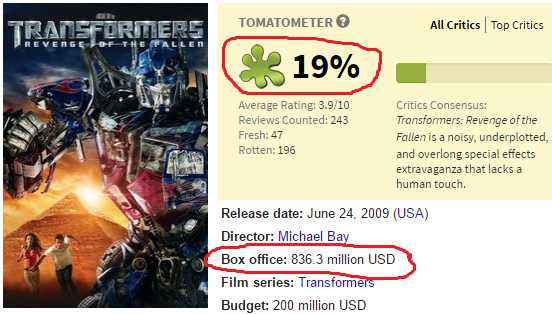
     A complaint I often hear is that critics are too critical. But being "critical" is a critic's job. The whole point of being a critic is to analyze a piece of art and determine whether or not we think it's worthwhile. Some argue that art is completely subjective and therefore the whole thing is essentially pointless. I wholeheartedly disagree. There are certain objective standards that can applied to any art-form. The main thing is to determine what the intention behind any given piece is and then to decide a) was this a worthwhile endeavor and b) does it effectively achieve what it was intended to. A movie like say, Transformers: Revenge of the Fallen fails to meet the first criteria because it's a cynical cash grab that's designed to appeal to the baser instincts of its audience. The fact that it does this successfully is beside the point. On the other hand a film like say Star Trek V: The Final Frontier meets the first criteria because it's an installment in a beloved and successful franchise which its fans have a vested interest in seeing continue. But it utterly fails to meet the second criteria due to weak writing and terrible special effects. Finally you have a film like Batman and Robin that fails to meet either criteria.

Disparity much?
     It is not my intention here to reduce film criticism to some sort of litmus test of movie quality. This is simply the way, in a broad sense, that I personally tend to asses to overall quality of a film. Obviously a critic can and should go into more depth and try to appreciate a film from different angles. My point is that critics are, in a certain sense, guardians of quality and good taste in the film industry. If the recent DC films have proven anything it's that critical consensus can have an impact on the financial performance of a film, even if this is not always the case (look at the box office of the Transformers or Twilight films for proof of this). Why is this a good thing? Because it would be easy for movie studios to look at success of Micheal Bay or Roland Emmerich films and decide to make more films that are soulless spectacle with little to no heart or narrative coherence. When movies like Batman v Superman and Suicide Squad under-perform it makes them reconsider this strategy and pay more attention to what critics are saying. In other words, if critics continue to pan these movies and audiences continue to look at this and spend their hard earned money elsewhere, maybe, just maybe, DC will finally take note and release a movie that's actually good.

Sunday, August 7, 2016

Les Miserables Review/Reflection


     I've never reviewed a book on this blog before. Although I love books I'm not as knowledgeable about literature as I am about film. But I had an experience while reading Les Miserables that I really wanted to right about. This novel touched me emotionally in a way that no book for a long time (or maybe ever) has.

     Before reading this book I had seen the 2012 musical film and really enjoyed it. One scene in particular got me a little choked up. But that was a more superficial emotional response. The book touched me on a much deeper level.

     There is a scene early on in the novel where the ex-convict Jean Valjean is given a meal and a place to sleep by the local bishop, Myriel. Everyone else in the town has denied him food or lodging up to this point because of his status as a convict. Notwithstanding the bishop's act of kindness Valjean steals some of his few valuable possessions, silverware, and flees into the night while the bishop sleeps, only to be caught by the police and brought back to the bishop's house. Valjean claims that the bishop gave him the silverware as a gift. Rather than expose this lie and condemn Jean Valjean back to prison the bishop backs up his story and gives him two silver candlesticks in addition to the silverware. The bishop tells him to see God's will in this act and to reform his life. This scene is very touching but what happens next is what really got to me.

     At this point, Jean Valjean, accustomed to nothing but misery and bad treatment from others, broods over the bishop's words and actions. Should he turn over a new leaf and dedicate his life to God? While this is going on Valjean meets a young urchin called Petit Gervais who is carrying a 40 sous piece which he drops. Out of malicious habit Jean Valjean covers this sous with his foot and, when confronted by Gervais, chases him off. Afterward, realizing what he's done and disgusted with himself he vows to honor Bishop Myriel's wishes and become an honest man,

     Believe it or not, I had an experience many years ago that parallels Jean Valjean's. Having come home from adoration one day I found that mom had made my favorite cookies, oatmeal raisin. My little sister, who often annoyed me decided to try one and, not wanting her to have one before I did I intentionally cut in front of her to try and prevent her from getting one. My dad noticed and scolded me for it. Usually I might have shrugged this off but something really struck me in this instance. Why had I done this? My little sister certainly meant me no harm, she just wanted a cookie like me. Why would I want to deprive her of that? I was coming face to face with my own selfish , malicious human nature. Subsequently I wept, out loud, in front of my father. I also made a kind of resolution never to act in this way again. Of course I have not perfectly lived up to that but I did change toward my sister. Things that would have annoyed me before no longer really bothered me.

     Reading about Jean Valjean's transformation in Les Mis brought me back to that moment. and made me realize, again, how much it had shaped me. There are plenty of books and movies that have moved me emotionally but none have connected with me so much at a personal level.


     I also connected with the character of Marius. His experience of moving away from royalism and toward republicanism and the rift this causes between him and his Grandfather reflects my own shifting political views of late and the inner struggle this has caused me as I've moved away from some of my parents political views. I also appreciate that Hugo's own views are somewhat moderate. While I can't agree with his unquestioning support of the French Revolution, given all the violent turmoil it led to, I was grateful that he did not fall prey to atheistic anti-clerical attitude of many of his peers. On the contrary, despite the fact that it was banned by the Catholic Church at the time of its publication, I was surprised to find Les Miserables to be, generally, a very pious work.

     Finally I would like to briefly address the two biggest potential problems with Les Mis, its astronomical amount of plot contrivances and Hugo's predilection for lengthy digressions from the text.

     Les Miserables is filled with plot contrivances. Characters that have past history with one another keep meeting, by pure chance, at very convenient moments in the story. At one point, for instance, Jean Vlajean is on the run from the police and takes shelter in a convent where a man he was saved just happens to work as a gardener. This man then helps Jean Valjean escape the police. The reason I don't really mind these kind of coincidences, which would usually strike me as lazy writing, is that there is a theme of divine providence which runs through the narrative and these contrivances reinforce this theme.

     Hugo also fills the book with some rather lengthy discussions about the Battle of Waterloo, the argot (jargon) of French criminals, Paris street urchins, and cloistered religious orders. This may be irritating to some but as a student of history I found it really interesting to look at these events and institutions through the eyes of someone who lived through it. It helps to place the reader in the historical period in which the story is set. It also gives the novel an epic feel. This is not just a book about some people living through the tumultuous period of post-Napoleonic France, it's the story of that period itself.

     I don't usually like to say that any piece of art is among my favorites without giving more time for it to really sink in but in this particular case I feel fairly confident in saying that Les Miserables is now one of my favorite novels.

Monday, July 4, 2016

Independence Day (1996) Review


"And should we win the day, the Fourth of July will no longer be known as an American holiday, but as the day the world declared in one voice: We will not go quietly into the night! We will not vanish without a fight! We’re going to live on! We’re going to survive! Today we celebrate our Independence Day!"

     So says President Whitmore (Bill Pullman) in Roland Emmerich's Independence Day released 20 years ago today. I'm not going to claim that this movie is very deep or even very clever but the film does work, in retrospect, as an embodiment of what President George Bush Sr. called a "new world order", for all the good or ill that may portend. The idea behind this "new world order" was that the world's super-powers, lead by the United States, would cooperate internationally to protect human rights and ensure economic and political stability around the globe. What made people question this idea was the emergence of U.S. hegemony (dominance in world affairs) after the end of the Cold War. What Bush and his supporters saw as international collaboration others saw as American interventionism.


     In Independence Day the various nations around the world unite to face a common threat: annihilation from an alien race. Thus we see Bush's "new world order" in action. At the same time this is an example of U.S. hegemony as it's President Whitmore and the American military who take the lead in combating the aliens. The other military forces seem to just wait around for the U.S. to tell them what to do. Indeed we don't even see these nations beat the aliens. After President Whitmore and the American military takes down the ship over Area 51 General Grey (William Loggia) tells the radio operator to inform the other forces "how to bring those sons of bitches down". In other words these countries don't seem to have much agency on there own. In any case, regardless of political affiliation or where you may stand on the idea of U.S. hegemony and international cooperation, I think that this film is an interesting showcase of 90's optimism.


     Besides it's historical resonances Independence Day offers some pretty fun if also somewhat brain-dead entertainment. The script often resorts to cheap tricks and contrivances to move the plot forward and many of the characters feel more like archetypes than people. But the film never takes itself too seriously and the performances, particularly from Will Smith and Jeff Goldblum, are able to add some levity and humanity to what might otherwise be a mindless explosion fest. It's also nice that an African American (Smith's Captain Steven Hiller) and a nerdy Jewish guy (Goldblum's David Levinson) are the one's who save the day. The action is fun, the effects (mostly) hold up and David Arnold's score is appropriately stirring.

     Independence Day is a dated film but in many ways I feel that this is is greatest strength. If your looking for a dumb/fun 90's movie that also gives you a peak into the cultural milieu of the time you could certainly do worse.

Score: 8/10

Sunday, April 17, 2016

I Want to Believe a Man Can Fly - The Man of Steel Problem

Warning: Spoilers for Man of Steel, Batman v Superman: Dawn of Justice, Superman vs. the Elite, and the comic book What's So Funny About Truth, Justice, and the American Way.


    The portrayal of Superman in Man of Steel and Batman v. Superman has been the source of much controversy. I don't believe that this controversy is the result not of a nefarious agenda by Zach Snyder or anyone at DC to undermine the character's integrity, as some (see this article) would suggest. Rather I think that their idea was too create a more conflicted but ultimately still heroic version of the character (as this article surmises). The problem is that the writing is so confused and at odds with itself that this these ideas are lost.


    To start off, the two main problems people tend to have with Superman in these movies are 1) he doesn't have enough regard with the consequences of his actions (i.e. the destruction in Man of Steel) and 2) he doesn't have much faith in humanity. As to the first problem I think that the real issue is that the filmmaker's themselves don't have any regard for all of the collateral damage in Man of Steel and don't expect the audience to either. In many ways it appeared that Batman v. Superman would address this but ultimately the interesting questions raised in the films first half are left behind in favor of more "big dumb" action in the film's climax. Related to this problem is the problem of Superman directly killing Zod. Again it had looked like BvS might address this but it only served to muddy the waters further.

     Lois Lane is at the heart both films understanding of Superman. To once again refer to the Mark Hughes article, Lois is meant to represent humanity for Superman. She believes in him so he hopes that others might as well. This is shown when he tells her "you are my world" right before he sacrifices himself. The problem is that, at times, it really feels like he's only interested in saving her and ignores the safety of others as a result. At the beginning of the film Superman saves her from some (alleged) African terrorists. This causes all kinds of controversy. Part of the reason for this is that mercenaries working for Lex Luthor kill a bunch of terrorists and Superman is blamed for their deaths. But Superman himself flies a guy through a concrete wall. Are we supposed to believe he didn't kill him? Is this something Snyder was thinking about when he shot the scene or did he just think that Superman flying a guy through a wall was a cool image? When Lois confronts Superman about the incident he say's "I didn't kill those men." Unfortunately this sounds like its referring to the men that Luthor's thugs killed and not the guy he flew through a wall, so it doesn't clear anything up. After this Superman proceeds to climb into the tub with Lois and (presumably) have sex. Lois herself decides to investigate the incident. Why doesn't Superman help? It seems like he's more interested in making out with Lois then with confronting these issues. A similar scene takes place in Man of Steel, after Superman kills Zod, Lois comes into the building and they embrace. Perhaps part of the problem is that the writers don't seem to know what kind of Superman story this is. Is it the good ol' fashioned kind where he saves the day and gets the girl or a more pragmatic kind where Superman's actions lead to unforeseen consequences that he then has to deal with. Tangent to this problem is the fact that both films feature so many in-your-face Jesus parallels. You can only take such parallels so far, especially if your presenting a more flawed version of Superman.


     There is one scene from BvS in particular, involving Jonathan Kent, that I think gets to the heart of this problem. In a flashback (or fantasy/hallucination I'm not really sure) Jonathan tells Superman a story about saving his farm from a flood which only ended up diverting it to a nearby farm whose horses ended up drowning. This haunted Jonathan for a long time and gave him nightmares. It was only when he met Martha that he was finally able to move past it. The idea here is that Martha gave him something to live for and made him realize that the best any man can do is to try to do the right thing in the moment. We can't always predict or control the consequences of such actions. The problem is, for one thing. that this message is two fold. Jonathan says, "She (Martha) gave me faith that there's good in this world. She was my world." The second sentence could indicate that being with Martha, effectively, allowed him to turn his back on his past mistakes and on the worlds problems. This is especially troubling when you have Martha telling Clark stuff like "I never wanted this world to have you" and "You don't owe this world a thing". Also, when Superman seems to have such an uncanny way of knowing when Lois is in danger it sort of feels like he's obsessed with her. This idea is further enforced during Batman's vision of the future (at least I think that's what it is) where Superman appears to be a despotic and violent tyrant. In this "hallucination" Flash tells Batman that he was right about Superman and that Lois Lane is the key. So when Superman tells Lois "this is my world. You are my world", before sacrificing himself, it's hard to know if he's doing it for humanity, or just for Lois. Another problem with this whole message about trying to do the right thing in the moment is that it runs counter to what Jonathan told Clark in the first film, that he should be willing to sacrifice people's lives for the greater good. In general I don't really understand what Jonathan wants for Clark or how Clark sees him. Superman and Lois have a conversation in the middle of the film and he says "all this time I've been living my life the way my father saw it, righting wrongs for a ghost." At first I thought he was talking about Jor El, because it seems like his actions have been much more in line with his philosophy than with Jonathan's. It was only when he says, "Superman was never real, just the dream of a farmer from Kansas" that I realized who he was actually talking about.


    So how is Superman seen by fans traditionally? What does it mean to stand for truth, justice and the American way? Well for one thing, Superman is not supposed to represent the power or superiority of America, rather he represents the values that Americans hold dear, in particular individualism. Man of Steel tries to show this by having Superman be the first natural birth on Krypton in many years and therefore capable of choosing his own destiny, unlike Zod and all the other Kryptonians who were bred for a specific purpose. This message, like so many others the film, gets lost in the shuffle. Pa Kent at one point tells him, "You have to decide what kind of man you want to be Clark" but he also keeps insisting that Clark has a destiny and is meant for greater things. These messages contradict each other. More importantly,we never really get to see Clark choose who he wants to be. He just wanders around somewhat aimlessly until he stumbles on the Kryptonian ship and Jor El gives him some much needed direction.


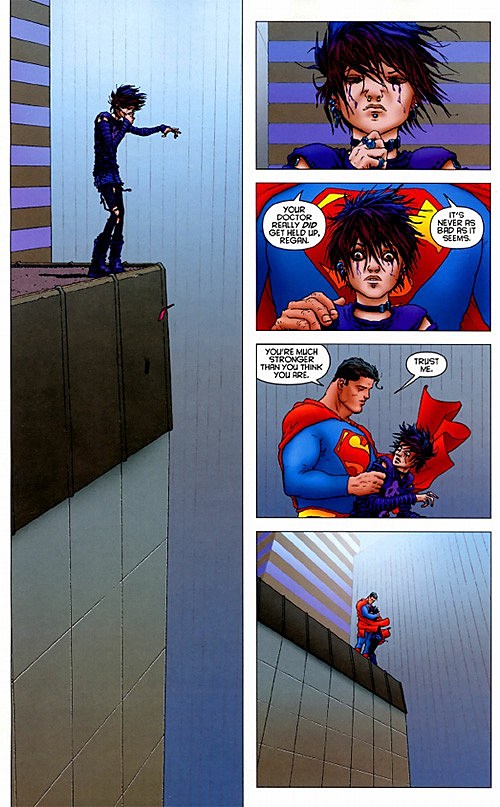
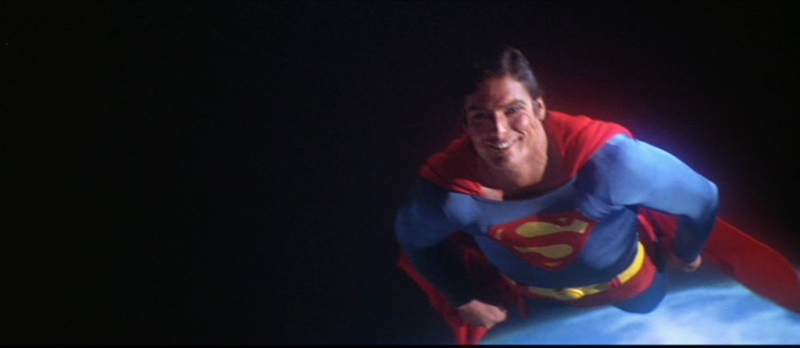
Contrast this page from All Star Superman with this
   
     Superman is also seen as a kind of working class hero. In the very first Superman story ever published, Action Comics #1, we see him rescue a small business owner from the machinations of a powerful bank that he owes money to. Also, Superman's an alien immigrant who works a fairly low paying job at as a writer for the Daily Planet. Contrast this to Batman, a rich playboy who spends his nights beating up low level thugs. Batman v Superman tries to explore this concept by having him pursue a story about Batman being a menace and preying on the underprivileged, but it goes nowhere and he never really seems to come to an understanding about Batman.

     Most importantly Superman is a symbol of hope. Not because he's always their to save the day but because he always tries to do the right thing and believes that humanity can aspire to the same ideal. This is where the film's Jesus iconography really misses the point: Superman's not inspiring because we believe in him but because he believes in us. This gets back to what I was saying about Pa Kent, that he seems to be telling Superman to always try to do the right thing in the moment. As I already explained this message is really mishandled. Perhaps the best illustration of this is Superman's line, "No one stays good in this world." That's the most un-Superman thing he could possibly have said.

-S.H.I.E.L.D. takes the world as it is,
not as we'd like to be.
And it's getting damn near past time
for you get with that program, Cap.
-Don't hold your breath.
I think a good contrast to DC's handling of Superman of late is what Marvel Studios has done with another American icon, Captain America. In The Winter Soldier Cap is confronted with the cynicism of the modern world but he doesn't let this defeat him. He refuses to compromise his principles in the face of corruption and public condemnation. DC seems less confident in their hero, it seems like they're worried that Superman is "not cool" anymore. This is not entirely unfounded. In the early 2000's Warren Ellis and Mark Millar wrote a comic called the Authority, a superhero who, unlike Superman, is willing to kill for the greater good. This comic was selling better than the current Superman book at the time. This bothered writer Joe Kelly, who decided to use the book to address this issue. In an story entitled What's So Funny About Truth, Justice, and the American Way he pits Superman against a new, hip team of superheroes (a meta stand in for the Authority). At the end of this story Superman fights this team on the moon (no collateral damage here ;)) and beats them, pretending to kill them but ultimately revealing to there leader that they are only knocked out, showing them (hopefully) the value of restraint (the end of this comic can be viewed here). The animated film adoption of this story, called Superman vs. the Elite, takes this a step further, with Superman broadcasting this fight to the whole world in order to show them the "ugliness of violence as a solution." Like Cap in Winter Soldier, Superman in this story continues to try and inspire people even if they reject him and ultimately he is able to make them see reason and reject nihilistic, violent solutions.


     Given the largely negative response to Man of Steel and especially to Batman v Superman, it seems like moviegoers, like the citizens of Metropolis in Superman vs. the Elite, may be rejecting this darker, conflicted Superman as well. Maybe, when he inevitably rises from the grave, Cavill's Superman will be the man we all know and love once again, the one that inspires us to be our better selves. Perhaps that sounds naive but hey, a guy can hope right?