Showing posts with label make mine Marvel. Show all posts

Tuesday, June 18, 2019

Dark Phoenix (2019) Review

     Dark Phoenix is written and directed by Simon Kinberg. The last film in the main line of Fox X-Men movies, it is the second adaptation of the "The Dark Phoenix Saga" from the comics. In it Jean Grey (Sophie Turner) develops cosmic powers as a result of an accident in outer space. When she begins to endanger her fellow X-Men, they must decide whether to turn against her or to stand by her and risk destroying everything they've built.

     At this point Dark Phoenix has a pretty terrible reputation. It is currently the lowest grossing X-Men film and the only one that did not top the box office the week of its release. It is being savaged by critics and largely ignored by audiences. It is also well known as this point that the production was plagued with problems, including multiple re-shoots and delays in the film's release. I'm not going to argue that it's a great film (or even a good one) but it's not as bad as I was lead to believe. It has a very consistent and ominous tone, aided, no doubt, by Hans Zimmer's oppressive score (sadly John Ottman is gone, along with his signature theme) and The action scenes make novel use of the mutants varied powers but are often somewhat lacking in tension, largely as a result of weak writing and poorly established stakes.

     The opening of the film shows a lot of promise. The X-Men are now operating in the public eye and with the cooperation of the U.S. Government. This feels like a natural development of the status quo set up by Days of Future Past and Apocalypse. Xavier (James McAvoy), having finally achieved his lifelong dream has become overly focused on maintaining popularity with the public. On a mission to rescue a failed NASA shuttle launch, he makes a decisions which threatens to jeopardize the X-Men's safety in order to save one of the crew. Mystique has become disillusioned with Xavier's leadership and tries to persuade Beast to leave but he convinces her to stay. But then it turns out that Jean Grey (Sophie Turner), who miraculously survived the mission unscathed, has joined with a mysterious cosmic force which protected her and that threatens to destroy the mental blocks that Xavier established to protect her. When the Phoenix is unleashed members of the team begin to reconsider if Xavier has lead them down the right path and Magneto, who is now the leader of a group of mutant refugees on Genosha, intervenes to stop Jean before something disastrous happens.

     The biggest problem with Dark Phoenix is that the character arcs are rather rushed. Charles has his over confident new outlook shattered when Jean's mental blocks break down, leaving her emotionally unstable. He blames himself for everything she does, but still insists on protecting her. (SPOILER ALERT) He is able to find some closure in the end but has still lost faith in himself and retires from the school and from public life. Many were angered at the films portrayal of Professor X, feeling that he was thrown under the bus for the sake of the plot. I agree to some extent, though I feel that the direction they took could have worked if their had been more time to explore his character and if the resolution of his arc was more satisfying. Beast has an arc that could have been interesting, turning against Xavier after discovering his responsibility for Jean's mental breakdown, but it's far too rushed to really work at all.

     The rest of the X-Men are given short shrift with Cyclops getting the most attention. He is the only X-Man, other then Xavier, who firmly believes that Jean can be saved. Storm disagrees with him, partly because of her experience with Apocalypse but stands with him and Professor X when the chips are down. Nightcrawler does really have any character development at all and is basically just along for the ride. Raven and Quicksliver, meanwhile, are conveniently written out of the film in the first act.

     Jean Grey herself is fares the best overall. The Last Stand made the mistake of focusing too much on Wolverine in a story that should have been about her. This film, at least, avoids that mistake. Jean finds herself without a clear path as she is afraid of endangering the people she cares about and also beginning to loose her trust in them while, at the same time, desperately in need of their guidance and support. Eventually she finds a mentor of sorts in the form of Jessica Chastian's mysterious villainess (whose identity I won't spoil). The main problem with Jean, and with all of the characters introduced in the previous film, is that their relationships have have really been properly established. So, for instance, when Cyclops remarks that Jean is not acting normal in the scenes where they flirt right after the opening mission, we pretty much have to take his word for it.

     Once again Magneto has retired to find a life of peace only to seek after vengeance when someone he cares about is killed and once again (SPOILER ALERT) he eventually sees reason and let's go of his need for vengeance. It's not nearly as contrived or as counterintuitive as it was in Apocalypse but it's not given enough time to develop naturally and feels played out at this point. The same could be said for the franchise as a whole. In one scene, Charles confronts Erik and tries to persuade him to spare Jean's life prompting Erik to say, "You're always sorry Charles and there's always a speech but nobody cares anymore." That statement could very well sum up the current state of this franchise.


Score: 6/10

Saturday, June 8, 2019

X-Men: Apocalypse Revisited

     When I reviewed X-Men: Apocalypse back in 2016, my overall impression of the film was that it was "more uneven and disappointing than bad." Over time, my estimation of the film has eroded even more. As I mention in my original review, the only character to get much development is Magneto and his initial arc is really contrived and redundant. Erik doesn't really need more motivation to assert the superiority (as he sees it) of mutantkind. Indeed by the end of Days of Future Past, he appears just as devoted to this cause as ever. It really makes no sense that he would go into hiding and try to live a normal life, as he does in this film. After his family is killed by the superstitious villagers he basically becomes consumed with hatred and, after meeting Apocalypse, sets out to destroy humankind once and for all. The second arc he goes through, being redeemed by Charles and the X-Men, who remind him of who he is (or something), is even more rushed and unconvincing. This is really my core issue with the movie. The series has always been driven by character growth, and this installment is severely lacking in that department.

     It also plays a little like an X-Men greatest hits album. There is another Quicksilver rescue scene that attempts to top the one from Days of Future Past but it ultimately feels less exciting and creative and is, overall, lacking in tension. Once again we deal, briefly, with Wolverine and the Weapon-X program and it is incredibly intrusive and only serves to delay the development of the plot. They even recreate, word for word, the conversation between Charles and Erik at the end of the original X-Men. We also revisit Auschwitz in a scene that is so miscalculated and insensitive to Jewish history that I'm honestly surprised it made the final cut. Portraying Magneto as a holocaust survivor was a good way to emphasize the civil rights allegory and was one of the original movie's better ideas, but having Magneto destroy the remains of Auschwitz in a fit of rage seems to me to a gross appropriation of a powerful cultural symbol for a cheap emotional moment.

     In summary I no longer think that X-Men: Apocalypse works as a film and especially not as a sequel to Days of Future Past. It has some good moments and is certainly better then The Last Stand, but it's a mediocre piece of work overall.

Score: 6/10

Friday, June 7, 2019

X-Men: Days of Future Past (2014) Review

     X-Men: Days of Future Past was released on May 23rd, 2014. It is directed by Brian Singer and written by Simon Kinberg from a story by Kinberg, Matthew Vaughn and Jane Goldman. A loose adaptation of the "Days of Future Past" story-line from Uncanny X-Men #141–142, it sees Hugh Jackman's Wolverine sent back in time from a post-apocalyptic future to warn a young Charles Xavier and Erik Lehnsherr about an impending threat that will lead to destruction both of humans and mutants.

     After more then ten years, Brian Singer finally returned to the X-Men franchise with Days of Future Past. As such it is a return to the franchise's roots with its combination of social commentary, slick action, and soap opera storytelling. Uniting the casts of the original films with those of First Class, this film attempts to streamline the continuity which was derailed by The Last Stand, X-Men Origins: Wolverine, and First Class all of which contained contradictory origins for various characters. It is only partially successful in this. X-Men Origins is essentially ignored and implicitly retconned, getting rid of the discrepancies that existed between that film's depiction of countless characters, including Xavier, Sabretooth, and Emma Frost. The conflicts between First Class and the Singer films remain, but this film, at least, makes things easier for future installments by creating an alternate timeline.

     Days of Future Past is easily my favorite film in the franchise other then X2. This is largely because of my fondness for the first two films. This film, while mainly functioning as a sequel to First Class, is also a send-off for the original cast and it's great to see to see them together one last time. I also love that Xavier is really the central character here. In the first few films he was a mentor figure for Wolverine and the other X-Men but here the roles are reversed, and Logan has to be a mentor for him.

     This film also continues to explore the relationship between Charles and Erik in a really compelling way. At the beginning of the film Xavier has given up on his dream of peaceful coexistence between human and mutant-kind. In First Class his beliefs were shown to be somewhat naive and we see the natural consequence of that here when he loses most of his students to Vietnam and does not have Raven or Moira MacTaggert to fall back on, so he falls into depression and drug addiction (cleverly symbolized by his use of the drug that suppresses his powers). It's only when he communicates with his future self that he is able to face the future with some measure of hope, albeit a more realistic one.

     Magneto meanwhile, in finding out about the apocalyptic future caused by a human scientist's attempt to build a robot capable of defeating them, becomes more convinced of his viewpoint (that mutants should dominate mankind) then ever. Rogue, once again, is caught between the two men. Since the end of First Class she has separated from Erik, who has been imprisoned, and began trying to protect her mutant brothers and sisters from the U.S. Government and particularly scientist Bolivar Trask, who has cruelly experimented on them to create his sentinels. When Magneto learns that her powers are what leads Trask to perfecting his program, he tries to kill her. Unlike Erik, Rogue is not so assured in her beliefs as to be able to commit such unthinkable acts, but she is obsessed with getting revenge on Trask. In the end, Charles helps her to see a better way and she spares his life. This is the moment that he really becomes the Professor from the first three movies, a man capable of inspiring others through his conviction and sheer force of personality.

     I also enjoy the way Days of Future Past plays with historical events. Magneto was imprisoned because he was implicated in the JFK assassination but, as we learn, he was actually trying to save the President (who was also a mutant!) by using his powers to defect the bullet. Richard Nixon, meanwhile, is shown to be the one who approves the sentinel program. First Class reimagined a historical event (the Cuban missile crisis) as a central part of its plot and it's great to see this film continue that trend.

     It is far from a perfect film and continues to suffer from continuity problems. The time-travel logic is confusing in many ways. For one thing, how do Kitty Pryde's phasing powers allow her to send other mutants through time? For another how does Wolverine remember anything from this time, as he hasn't yet got his adamantium claws and had his memories erased through the Weapon X program? Another problem is the idea that Mystique is the key to the sentinel program. We are told that, because of Mystique's shape shifting powers, Trask is able to program his sentinels to adapt mutant powers but Rogue's powers allow her to change her appearance, not to take other mutant powers. The Rogue Cut does alleviate this problem to some degree by revealing that Rogue, who can assume other mutant powers, was also experimented on, but the central premise, that Raven was the "key" to perfecting the sentinels, is still confusing.

     John Ottman returns to do the score for Days of Future Past and it's a welcome one. He provides another stirring score and gives the film a greater emotional connection to the earlier ones. With the exception of some questionable green-screen here and there the film has solid visual effects and once again Singer delivers some great action scenes. The breakout from the Pentagon, where we see Quicksilver save everyone in slow motion, is of course a standout, as is the sentinel attack that closes the film, which features some of the most creative use of superpowers I have seen in an action setpiece. The new additions to the cast are great especially Evan Peters as Quicksilver. Peter Dinklage also does a fine job as Bolivar Trask.

     X-Men: Days of Future Past is both a great political thriller and a clever science fiction film. It succeeds both in continuing the story that began with X-Men: First Class and as a heartfelt epilogue for the original cast. It's one of the best X-Men films and one of my favorite superhero movies of the past decade.


Score: 9/10

Wednesday, May 29, 2019

X-Men: First Class (2011) Review

We now get to the first attempt to reboot the X-Men franchise. I have intentionally skipped over X-Men Origins: Wolverine as I only plan to cover the core six films, which means no Deadpool or Wolverine solo films, at least for now...

     X-Men: First Class was released on June 1st, 2011. It is directed by Matthew Vaughn and written by Vaughn, Ashley Edward Miller, Zack Stentz and Jane Goldman from a story by Sheldon Turner and Brian Singer. A prequel to the previous X-Men films, it tells the story of Charles Xavier's first meeting with Erik Lehnsherr and their forming of the X-Men set against the backdrop of the Cuban Missile Crisis.

     The idea for a prequel X-Men film had been floated around since before the release of X2. The script went through many revisions and the film's production was put on hold as the studio hoped to pursue a Magneto origin picture instead. When this idea was scrapped, Fox went ahead with First Class and, initially, Brian Singer was set to direct it. When Singer backed out due to his commitments with Jack the Giant Slayer the studio went to Matthew Vaughn, who had at one point been considered as a director for The Last Stand. Vaughn, who had also wanted to direct a 60's spy thriller and an X-Men movie, jumped at the chance to combine both ideas into one.
     X-Men: First Class is a really great prequel. It succeeds where so many other films have failed in telling a really compelling backstory for it's main characters. It is easy to believe that Charles and Erik become the men we know from the earlier installments after the events of this film. There's a lot of good character work here and the friendship between Xavier and Erik is well developed considering how little screen-time is actually devoted to it. Xavier guides Erik and helps him become a better person. Erik, at the beginning of the film, is driven only by personal revenge. Charles helps him to see a bigger cause and helps him to hone his powers, which he struggles to control because of his anger.

     As in X2 Xavier and Erik's worldviews are contrasted with that of the villain, in this case Kevin Bacon's Sebastian Shaw. Here, Erik has a much less extreme worldview then he does in X2. There, he is in favor of wiping out all of humankind but here that position is represented by Shaw, who believes that mutants should rule over humans and he, as the most powerful mutant, should rule over everyone. Though Magneto chooses, in the end, to violently oppose the humans who oppress mutant-kind he is not a genocidal maniac but he has a more cynical viewpoint then Xavier, who believes that mutants can show humans a better way. Raven is trapped between these two viewpoints and she ultimately sides with Erik. Her relationship with Hank mirrors that between Charles and Erik, and each person chooses a different side in the end. Mystique position is not as extreme as Erik's (something that will be further explored in the sequel) while Hank actually goes further then Charles and tries to suppress his mutant powers so he can blend in with humanity.

     It's definitely not a perfect film. There's some retconning (which seems almost impossible to avoid in prequel films). In the first movie, we learn that Professor X and Magneto built Cerebro together but here it is built by the Hank McCoy working for the U.S. Government without either man's knowledge. Magneto's helmet was built by the Russian Government rather then by Magneto himself. Finally, Mystique's childhood friendship with Xavier doesn't really seem to mesh with original three films, where the two characters don't seem to share any connection.

     Vaughn's direction is a little so-so, it lacks the energy of Singer's films and is a little bland visually, especially considering the colorful sixties setting (though the costume designer's do a great job especially compared to the ugly and uncomfortable looking black leather of Singer's films). The supporting characters are also given a bit of short shrift. Outside of Mystique and maybe Beast, I don't really understand why some of them choose to go with Erik and some with Xavier at the end.

     X-Men: First Class is a fine prequel, one that deepens the mythology and relationships of the characters while telling it's own, compelling story. It is not perfectly consistent with the earlier films and lacks some of their energy and flair but it's still a worthy entry in the series overall.

Score: 8/10

Thursday, May 16, 2019

X-Men: The Last Stand (2006) Review

     X-Men: The Last Stand, was released on May 26th, 2006. Directed by Brett Ratner and written by Simon Kinberg and Zak Penn it continues where X2 left off. Jean Grey's death has shaken the X-Men to the core, particularly Scott Summers (James Marsden) who has fallen into a state of depression. Meanwhile a group of scientists lead by Warren Worthington II (Michael Murphy) has developed what they believe to be a "cure" for mutants suppressing the x-gene so as to make the subject a "normal" person.

     With X2's production wrapping in  November of 2002, Brian Singer fully intended to return for the third X-Men film. This was not to be. Instead, he was offered the director's chair for Superman Returns from Warner Brothers. Singer could not turn down the offer to direct a film with such a high profile character but Fox did not want to delay X-Men 3 so they went ahead without him. Along with Singer left screenwriters Dan Harris and Michael Dougherty. Fox offered a variety of different directors the job, including Joss Whedon and Darren Arronofsky but eventually Matthew Vaughn got the job. Unfortunately Vaughn ended up leaving the project as he felt he didn't have enough time to make the film he wanted to make. In desperation the studio went to Brett Ratner, who had been in line to direct the first film. Zak Penn would be the only writer to return joined by newcomer Simon Kinberg who had worked on early drafts of Fantastic Four and Elektra (and who is the sole writer/director of the upcoming Dark Phoenix film).

     All of this would result in a rushed script, one that was continually interfered with by the studio. James Mardsen was busy filming Superman Returns so Cyclops is killed early in the film. This was fine with the studio because, "Wolverine’s the most popular character" and "With Cyclops, you can’t see his eyes. It’s a harder character to relate to for the audience (from a Zak Penn 2008 interview)." At one point, they even considered killing him off-screen. The Fox executives felt Dark Phoenix story was too dark, so the focus shifts away form Jean's story in the second half of the film.

     Almost everything that happens in The Last Stand feels like an anticlimax. After a brief flashback of Jean Grey's first meeting with Charles and Eric (who are working together despite seemingly having completely different visions of how to deal with young mutants) we are introduced to Warren Worthington III (Ben Foster) and given an incredibly rushed backstory for Angel. Then we learn about the cure and see Mystique (who has evidently been captured since the events of X2) being broken out of prison by Magneto, who is infuriated by the very idea of a mutant cure and begins forming a resistance.

     Then Cyclops is killed after a brief reuniting with Jean, who is found by Wolverine and Storm. After this we see Angel run away from Worthington industries, he will not appear again until the third act. Back at the X-Mansion, Xavier explains to Wolverine that Jean survived with the help of a power he calls "the Phoenix" which he had repressed up to this point. Shortly after, Jean runs away. Of course Magneto wants to use the Phoenix power for his own ends so both he and Charles go to her old home, where she is hiding. There she kills Xavier in front of a horrified Logan and Eric. She then leaves with Magneto. This is roughly the end of the first act.

     By the end of the film Mystique, Magneto and Rogue have all lost their powers (Rogue willingly takes the cure) and Jean has been killed by Wolverine. The cure is still in use, its controversial  existence unresolved (though the final shot suggests that it might be faulty). Nothing has really been resolved, or even learned by anyone and the characters whose stories have come to an end have not had their arcs resolved satisfactorily. Why  the studio thought it would be a good idea to introduce a bunch of new characters (Angel, Kitty Pryde, Beast, and Juggernaut, just to name a few) while killing off or shunting aside pre-established ones is anyone's guess (though it probably has something to do with merchandising).

     The direction is mostly unremarkable and there is a shift in the visual style from the first two films, with the colors being much more saturated. There are some fun action scenes, though they are handled with far less sense of geography and clarity then those of X2. The score, by John Powell, is much more bombastic and densely orchestrated then either Kamen or Ottman's music, which works for the more over-the-top tone of this film. Powell, like Ottman, makes good use of lietmotif though he abandons Ottman's melodies completely. It's a fine score, one too good for such a mediocre film.

     In the end, X-Men: The Last Stand, is a huge step down from it predecessors. Many previous superhero threequels had been disappointing, but none of them had quite as much riding on them as The Last Stand. This trend would continue (with less disastrous results) with the following year's Spider-Man 3.

Score: 5/10


Sunday, May 5, 2019

My Favorite Films: X2 (2003)

     When discussing the greatest superhero movie of all time a few films will come to mind: Christopher Nolan's The Dark Knight, Richard Donner's Superman, Brad Bird's The Incredibles, Sam Raimi's Spider-Man 2 (which I would probably argue for), The Avengers (which I probably wouldn't). The more enthusiastic might be quick to crown Black Panther, Logan, or Spider-Man: Into the Spider-Verse as the pinnacle of the genre. But one film that isn't really talked about, at least not nearly enough, is X2.

     X2 explores social issues like prejudice, civil rights, race relations, and even disabilities and it tackled these weighty issues in a serious and reflective manner before Christopher Nolan (who is usually credited with the maturation of the genre) did it with his Batman Trilogy. A lot of credit has to go to writer/director Brian Singer, who had a very clear vision of what his X-Men movies should be about. Singer, despite his personal vices, is a talented director and he brought a lot of passion and energy to these movies.

     Singer does not deserve all the credit  however. A host of others, including Michael Dougherty, Dan Harris, David Hayter and Zak Penn, worked on the script. Hayter, in particular, knew the comics really well and mined them for more obscure characters and stories, including "God Loves, Man Kills", the story that introduced William Stryker. In a story focusing on the human/mutant conflict Stryker is a perfect antagonist. Reworking him as Wolverine's creator allowed the filmmakers to continue to explore Logan's backstory in an organic way without taking time away from the central plot. It was Dougherty and Harris who decided to include Lady Deathstrike in the film, a character who serves as an interesting foil for Wolverine and also provides an opportunity for one of the film's most memorable action set-pieces, the fight between her and Logan in the very chamber where Stryker gave him claws.

     More then anything else, it is the script that makes this movie hold up so well. The first film explored Professor X and Magneto's opposing worldviews with the former believing, optimistically, that mutants can peacefully coexist alongside humans and the latter, more pessimistically, thinking that Mutant's need to assert their dominance or live under oppression. Here a third worldview, mirroring that of Magneto's, is presented through Stryker. Both he and Erik Lehnsherr have been powerfully shaped by their pasts. Magneto suffered at the hands if the Nazis during the holocaust while Stryker was tormented by his telepathic mutant son, Jason, whose horrific psychic illusions led his wife to commit suicide. Both men are motivated by fear and hatred of the other race but while Magneto was content, in the first film, to change all of the humans into mutants, Stryker wants to eradicate all of the mutants. After his treatment at Stryker's hands, Magneto becomes even more extreme, adapting Stryker's plan for his own ends, to kill all of the humans instead. As he tells a brainwashed Xavier,  "From here, it doesn't look like they're playing by your rules. Maybe it's time to play by theirs."

     In contrasting these three different viewpoints, X2 achieves a more nuanced exploration of the series' core themes then the first film. While X-Men toyed with the idea that some mutants were so powerful that they might pose a legitimate threat to others and that there powers was more of a gift then a curse this film goes farther, portraying a mutant (Jason Stryker) who is truly a monster. The writers also weave Wolverine's backstory into the narrative in a way that, far from distracting from the main plot, actually contributes to the central theme. Throughout the film Logan is hoping to learn more about his past from his creator, Stryker. When he begins to suspect that Xavier might know more then he's letting on, he goes off on his own. Ultimately, however, he let's Stryker die in favor of helping his new family. Unlike Stryker and Magneto, Wolverine is able, partly because of his memory loss, to let go of his past and he doesn't let it define him. Consequently, X2 is a better adaptation then of "Weapon X" storyline X-Men Origins: Wolverine turned out to be.

     In addition to exploring Wolverine, Eric, Xavier and Striker it also develops Bobby Drake's relationship with Rogue and with his family, who don't know that he's a mutant. He and Rogue, as they continue to develop their powers and come closer to becoming full-fledged X-Men, begin to figure out their relationship. The film does a good job exploring their emotional connection and shared sexual frustration. It is especially helpful that we get to meet Bobby's family and learn where he came from. This is contrasted with Pyro, who has no family, though he clearly wants one. After witnessing Bobby's family reject him after he reveals that he is a mutant (admittedly not the most subtle scene) Pyro becomes increasingly convinced that, perhaps, Magneto has a point, and, in the end, he leaves the X-Men to join with Eric and Raven. Indeed, the film does a good job juggling all the characters, with the exception, alas, of Cyclops (scenes detailing his brainwashing at the hands of Stryker were cut by the studio despite David Hayter's protests). Though there are at least some nice emotional moments between him and Jean, he still ends up as the third wheel in her romantic triangle with him and Logan.

     Newcomers Alan Cumming, Brian Cox, and Aaron Stanford all do a great job here. Cumming really captures Nightcrawler's sense of optimism and reluctant heroism. He's not the swashbuckler from the comics but he does provide a fresher, and less world weary, outlook. As a Catholic myself, I greatly appreciate the positive portrayal of Kurt's Catholicism. Brian Cox is perfectly cast as William Stryker. Though despicable and monstrous in his actions, he is not an altogether unsympathetic character and Cox manages to make him feel more human. Aaron Stanford is appropriately jerky as Pyro and convincingly pulls off the character's turn to "the dark side." Kelly Hu and Michael Reid McKay also acquit themselves admirably in there rather limited roles as Deathstrike and Jason Stryker respectively.

     The returning cast members, taking advantage of the more character driven script, all put in some of their best performances here. Patrick Stewart is able to stretch his muscles a little more this time around, especially in the scenes where he is psychologically manipulated by Jason. Ian McKellen too displays greater range as a Magneto who is both more sympathetic and more evil then he was in the first film. Famke Janssen continues to show that she was a great pick to play Jean Grey, as the character struggles with her own doubts and fears while continuing to support her fellow X-Men. James Marsden's best scenes come early in the film, as he offers Jean moral support. Halle Berry gets more to do as Storm and has some great exchanges with Alan Cumming's Nightcrawler. Rebecca Romijn once again has a blast as Mystique and, for once, gets to do a scene without her elaborate make-up. Anna Paquin doesn't get as much screen-time as the first film but her character does experience character growth and Paquin's performance conveys Rogue's increased sense of confidence. Shawn Ashmore has a much more involved role this time around, and has good chemistry with Paquin, Stanford and Jackman. Finally, Hugh Jackman comes closer to truly embodying Wolverine here then almost anywhere else as we finally get to see him really let loose with animalistic fury during the the X-Mansion attack sequence. This film really focuses in on Wolverine's psychology and his relation to the team and Jackman rises to the occasion.

     Even outside of the character and thematic exploration, X2 is wonderfully nuanced and filled with subtle, humorous little character moments. Wolverine putting out his cigar on his own hand when asked to by Xavier not to smoke in the Cerebro chamber, Bobby chilling Logan's soda with his ice powers, Pyro playing with his lighter during Ice Man's "coming out" scene, little details like this make the characters come alive. The sets too, designed by Guy Dyas, are beautifully detailed, from the replica of the White House, to the (re-constructed) X-Mansion, to Stryker's gloomy, cavernous military base at Alkali Lake. Newton Thomas Sigel, a frequent collaborator of Singer's, does a great job with the cinematography as well. A lot of incorporative lighting was built into the sets, giving the film a really unique, naturalistic look.

     X2 has some of the most consistently well directed action set pieces of any superhero movie, from the amazing opening attack on the White House by Nightcrawler (though they kind of used their best trick too early) to the attack on the X-Mansion, to the fight between Wolverine and Lady Deathstrike. The White House attack, in particular, is a triumph of camerawork and visual effects, one that Singer would try to top in his later entries in the series. The fight between Wolverine and Deathstrike is also shot and edited really dynamically. Especially impressive is a shot where the camera pans downward toward the two combatants only to bounce back when Deathstrike is stabbed in the gut.

     John Ottman, another Singer collaborator, provides a fine score for X2, one which is much more motificly driven then Micheal Kamen's score for the first film. Ottman has worked, not only as a composer, but as a director and editor as well. He has an acute sense of using score to help tell the story. The main theme for the film has deservedly become the signature theme for the series despite other talented composers (Micheal Kamen, John Powell, Henry Jackman) coming up with there own take. In addition to the X-Men theme various characters, including Magneto, Jean and Pyro, are given there own musical motifs and most of them are pretty memorable. The composer uses a variety of timbre, mainly traditionally orchestration with a little choral work and some interesting percussive effects thrown in, but the score is left a little flat because of what sounds like a rather dampened recording. It's not quite up there with William's Superman score or Elfman's work on Batman, but it's a strong score nonetheless.

     Along with it's predecessor X2 builds its own universe and continuity which is distinct from the comics: Stryker creating Wolverine at Alkali Lake, Magneto helping Professor X to build Cerebro, the Father/daughter relationship between Wolverine and Rogue, all of these things, though not from the comics, now feel like a natural part of X-Men continuity. That fact that it strays so far from the comics, while still staying true to the original, allegorical vision for the X-Men and the soap opera nature of the stories, is a credit to the versatility of Stan Lee and Jack Kirby's creation.

     This film somehow succeeds as a swashbuckling adventure, a topical science fiction story, and as an ensemble character piece. Few superhero films made before it feel quite as confident or slick in their execution (the original Superman probably being the only exception). Few films since have been able to balance tone with as much finesse or to handle an ensemble cast so effortlessly. X2 remains a true classic of the genre.

Sunday, April 28, 2019

Fox X-Men Retrospective Reviews: X-Men (2000)

With X-Men: Dark Phoenix, presumably the final chapter in the Fox X-Men franchise, coming out later this year I've decided to look back on the series. To begin we have the movie that started it all...

     While some credit the earlier Blade or the later Spider-Man with igniting the ever ballooning superhero movie craze, and indeed, both films contributed to the formation of the genre, the film that really got the ball rolling was X-Men. Certainly, there had been financially successful comic book films before this but while Superman was very much a tribute to the classic era of comics and Batman was more of a pastiche of the pop culture image of Batman, X-Men was the first really "mature" modern superhero film. Along with Spider-Man, X-Men established the play book that the Marvel cinematic universe would later follow, staying true to the spirit of the comics while forging ahead with its own stories and its own interpretation of the characters.

     Looking back on the film today it's remarkably restrained, especially in light of more recent giant tentpole movies like Avengers: Endgame. Compared to a Captain Marvel (or even a more human character like Iron Man) the X-Men's powers are downright quaint and the conflict has far lower stakes then say, Aquaman. It also has some surprisingly dark scenes. In particular the scene where Wolverine accidentally stabs Rogue after waking up from a nightmare, nearly killing the one person he's made a connection with. Senator Kelly's death, too, is quite shocking. As far as I know, this is the first film to portray superpowers as being as much a curse as a gift, though I'm just about sick of that particular trope at this point.

     The writers do have some ambivalence about the property's comic book origins. This is particularly apparent in groaner lines like, "yellow spandex" or "you know what happens to a toad when it gets struck by lighting? The same thing that happens to everything else." Despite the more grounded approach these movies take, they can't seem to help but draw attention to the more heightened elements of the world. This is something the series would never quite come to terms with (even the recent Deadpool movies suffers from it in a certain sense).

     With that said, the writers do a great job establishing the core relationships, between Wolverine and Rogue, and Xavier and Magneto, and the conflict of ideas between the X-Men and the brotherhood. Rogue and Logan are the two "outsider" characters that help the audience to learn about the world. Both of them are relatable and likable. They also have a strong relationship and good on-screen chemistry. Rogue is not the femme fatale/spitfire she is in the comics but I'm OK with their take on her (more of a mix between Kitty Pride and Jubilee) because her power set strengthens the contrast and complementary nature between her and Logan. She is young and scared, he is old and jaded. She has only just discovered her power and he has forgotten who he was before he had them. Her power is to drain the powers (or life force) from others, while his are to heal.

     Magneto is a great, reliable villain, and remains one of the best comic-book movie villains to this day. This is large-in-part due to the relationship between he and Xavier. The two continue to respect (even love) each other despite their difference of opinion. Both of their points of view are understandable and make sense for their characters. Magneto's experience in the concentration camps made him distrustful of humanity while Xavier, with his mental powers and sensitive understanding for human psychology, has hope for peaceful coexistence. Even the humans, represented by Senator Kelly, are given their day in court so-to-speak. The actions of mutants like Magneto and his brotherhood make his desire for Mutant registration understandable if not exactly justified.

     Unfortunately, not all the characters are as well fleshed out. Jean Grey basically exists to be a love interest for Logan. Similarly Cyclops, who, as the team leader, should really get some character depth, is just a romantic rival for him. Storm gets even less to do though she does have one good moment with Senator Kelly. The brotherhood (Mystique, Sabretooth and Toad) are similarly shallow. Rogue's prospective boyfriend, Iceman, only makes an impression at all because Mystique disguises herself as him .

     Though not all of the characters get a chance to shine, the casting is really great all around. Patrick Stewart and Ian McKellen are inspired choices as Xavier and Magneto. Similarly, Hugh Jackman, though I've always been bothered by his height, is really great as Wolverine and, after all these years, it is hard to imagine anyone else playing him. Anna Paquin is also well cast as the relatable audience surrogate that is this film's version of Rogue. Famke Janssen is a great Jean Grey (though she won't get to shine until the second film). James Marsden is wasted as Cyclops (though ironically this is about the most he gets to do in this series). Rebecca Romijn-Stamos and Ray Park are clearly having a blast as Mystique and Toad. Tyler Mane is an imposing (if practically silent) presence as Sabretooth. Shawn Ashmore isn't in it enough to really put much of a stamp on Iceman but would prove himself later on. Finally, Bruce Davison brings his usual slimey qualities to Senator Kelly.

     The action is well done, even if the CGI and the wire-work is a bit lacking at times and (his despicable sexual conduct notwithstanding) Brian Singer does a good job, in general, behind the camera. There's a lot of dynamic camera movement and the film has a distinct visual style. There's more of a distinct authorial stamp here then in most of the more recent Marvel fare.

     X-Men is not a perfect film but nonetheless, it holds up quite well all these years later. It's hard to imagine what the current movie landscape would be (for better or worse) without it.

Score: 8/10

Sunday, February 10, 2019

Comic Reviews: Detective Comics and Daredevil (Saturday Evening Cartoons)


Sorry this is late, I was crazy busy last week.

Once again, I reviewed Detective comics...

... and I reviewed Chip Zdarsky's first issue of Daredevil.
I also read:
Spider-Man/Deadpool #45 features solid art from Jim Towe, more fun writing from Robbie Thompson and is a fairly satisfying end to the Blastaar arc. Its basically just a slug-fest, but since when is that a bad thing in a Marvel comic?

Batman #64, written by Joshua Williamson instead of Tom King for "The Price" crossover with the Flash. It's an intriguing, though depressing, opening so far.

In Avengers #14 the vampire war finally begins and it's mostly worth the wait.

Deadpool #9 is another darkly fun tale from Skottie Young. Nic Klein's art, reminiscent of Micheal Gaydos work on Alias fits the satirical noir story really well.

Star Wars #61 is pretty mediocre. Subpar art, overly "hip" dialogue and a pretty uneventful story make this issue a pretty poor end to the current arc.

Star Wars Age Of Republic Anakin Skywalker #1 is a fun throwback for fans of The Clone Wars, even if the story is a bit rushed. Cory Smith's artwork is solid.

Saturday, February 2, 2019

Comic Reviews: Detective Comics and Star Wars (Saturday Evening Cartoons)


Once again I've done two comic book video reviews over the past few weeks.
First off Detective Comics #996


Secondly, Star Wars #60


I also read:
Star Wars Age Of Republic Special #1, which was ok. The three short stories were mostly superfluous and each one is successively less good then the last, but it's worth reading for the Mace Windu story (though maybe not worth the $3.99 cover price). The Asajj Ventress story has the best art of the three, courtesy of Carlos Gómez.
Spider-Man/Deadpool #44, which is good fun. Spidey, DP and the Eternals fight Blastaar and a brainwashed Ransak in the Negative Zone. What's not to like?
Batman #63, which was frustrating. Bruce is still stuck in some kind of illusion and, aside from emphasizing that he's upset about Selina leaving him and Dick getting shot, I'm not sure what the point of this is.
Avengers #13 continues the series solid run so far. The story, a flashback about the original Iron Fist, is bonkers in all the right ways and Andrea Sorrentino kills it with the art. With that said, Aaron really needs to stop stalling and get back to the main plot.


Saturday, July 21, 2018

Batman #50 and other comic reviews (Saturday Evening Cartoons) (Video)

I did a bunch of video reviews for recent comics this week...

Batman #50 by Tom King

Superman #1 by Brian Michael Bendis

Amazing Spider-Man: Renew Your Vows #21 by Jody Houser

Daredevil #605 by Charles Soule

Wonder Woman #50 by James Robinson

Hopefully I'll get back to Tomasi's Superman next week.

Sunday, February 11, 2018

My Favorite Films: Iron Man (2008)


     This might come as a surprise to some people, but I'm fairly new to the geek culture scene. Seven years ago I'd never seen a super-hero movie in my life. Along with works of science fiction and fantasy, comic book inspired movies were generally discouraged by my parents. That all changed when I watched Jon Favreau's Iron Man back in 2011. Iron Man seemed like a different kind of superhero. He had no superpowers, no secret identity and he didn't fight flashy supervillains (or so I thought). Surely this was an exception my parents superhero prohibition. Then I watched the movie.

     It initially drew me in with it's Rambo/James Bond style story-line of a man who uses his wits and skills to overcome a superior foe but, as it went on, the comic book world-building (personified by Clark Gregg's agent Coulson) started to draw me in. At this point I was already aware that Iron Man was going to cross over with Hulk, Thor and Captain America in The Avengers, but I never for a second thought that that would ever work. This film and the ones that followed it would prove me wrong. This was the first step in a long journey to my becoming a comic book geek. Seven years later, I've watched every movie and television show in the Marvel Cinematic Universe (sans Inhumans), as well as countless other DC and Marvel films, and am now a regular patron of my local comic book store. And I owe it all to Iron Man.

     So what about the film itself, does it hold up as a piece of entertainment? As should be obvious from the title of this review, yes it does. In fact, it seems even more fresh and exciting than it did when I first saw it. One thing that surprised me was how much of a sleaze Tony Stark is at the beginning of the film. He misses the award ceremony presided over by his friend Rhodey to go gambling, he sleeps with the "crusading" journalist who questions the ethical implications his company's selling of weapons, and he treats the sale of the new, powerful Jericho missile like he's selling a sports car. Taking a self-centered, egotistical but still likable jerk through a redemptive arc has become a staple of the MCU, the origin stories of Thor, Star Lord and Doctor Strange are all variations on this theme, but none of them have felt quite as risque or degenerate as Tony Stark.

     In the comics, Tony Stark doesn't initially stop producing weapons after becoming Iron Man, rather this is something the writers introduced later on, as the comic book industry became more socially aware. Incorporating this into his origin was an ingenious move on the writers' part. The movie does a really good job, in general, with condensing different elements from 40 years of Iron Man comics into a single narrative and with capturing the spirit of its source material. At his core Tony Stark is a man who is constantly trying to atone for the sins of his past in order to build a better future, and that is exactly what the character from the movies is. 

     One thing that really distinguishes this film from many of the other movies in the Marvel Cinematic Universe is its sense of earnestness. There is a scene about halfway through the movie where Tony asks Pepper Potts to hack into Stark Industries computer system in order to uncover who else Obadiah Stane has sold weapons to. Pepper, at first, refuses to help him, as she feels that Tony is endangering his life through his endeavors. Tony, however, is insistent telling her that he shouldn't be alive, "unless it was for a reason. I'm not crazy, Pepper. I just finally know what I have to do. And I know in my heart that it's right."

     Heart is a theme that runs throughout the film, being symbolized, most explicitly, by the arc reactor in Tony's chest, which also serves as the movies maguffin. He builds this in Afghanistan, after being attacked and kidnapped by terrorists, who use his own weapons against him, leaving him with shrapnel traveling toward his heart. Along with this new, artificial "heart" comes the sobering realization that he has lived, up to this point, a lie, deluding himself into thinking that all of his weapons development served the good of humanity. This is emblematic of his life in general, one of constant partying and indulgence but one with no real meaning. At first, Stark's predicament leads him to defeatism and it's only through the encouragement of his fellow prisoner, Yinsen, that he decides to build the Iron Man suit and attempt an escape. Yinsen is killed when he draws off the terrorists to buy Tony time to power up the suit. With his dying breath he tells Stark, "Don't waste it. Don't waste your life." Watching this good man die to save him gives Tony the final push he needs. He decides, from this moment forward, to use his resources and his genius in service of humanity.

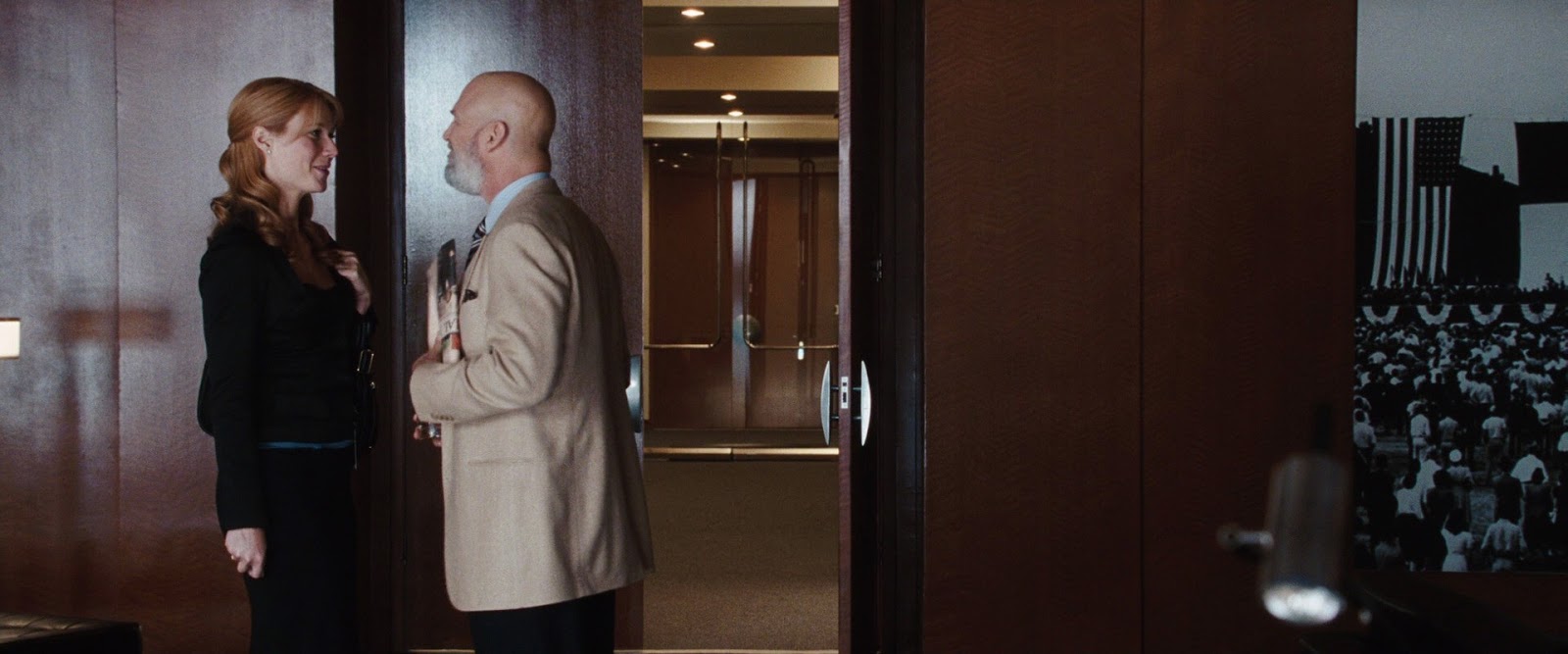
     Tony Stark is, front and center, the focus of this film but the supporting characters are still adequately fleshed out and their relationships with Stark feel genuine. Obadiah Stane is a much more unassuming and restrained supervillain then had been typical up to this point. Though it's clear that he is envious of Tony's fame and success he never let's this get in the way of his plans. Rather he is able to subtlety manipulate Tony so that the revelation that he was behind Stark's kidnapping feels both a shocking and, somehow, like something we should have seen coming. Pepper Potts is also a more fully formed character then your usual movie love interest. She clearly has feelings for Tony but won't pursue them because she knows he's irresponsible and self obsessed. As he grows as a character we see her grow closer to him yet, even by the end of the film she is not ready to fully commit to a relationship, turning the tables when he tries to win her over by reminding her of their almost-not-quite kiss earlier in the film. "Are you talking about the night that we danced and went up on the roof, and then you went downstairs to get me a drink, and you left me there, by myself?"

     The film is subtly subversive like that and the romance between Tony and Pepper owes more to screwball comedies like His Girl Friday then to comic books. The typical hand wringing the protagonist would go through over revealing his secret identity to his significant other is simply not present here. Pepper just stumbles upon Tony as he's changing out of his Iron Man armor and he immediately takes her into his confidence. Similarly, the scene at the end where Tony reveals his secret identity to the world may not seem surprising 10 years later but, at the time, it was unprecedented. In the movie world up to this point every super-hero had a secret identity and this usually played a big role in the story of the film. By having Tony say "I am Iron Man" on national television the film was breaking precedent and opening the door for a different kind of superhero movie moving forward, one less beholden to the conventions of soap opera romance.

     Like most Marvel movies Iron Man is filled with subversive humor but it works dramatically in a way many others don't because having Tony's bravado undercut by a humorous moment serves as a comeuppance for his egoism and vanity rather than undermining the character's heroism. Similarly the characters own sardonic sense of humor is not just there so the audience can have a laugh at the expense of the story, rather it comes from a character place. Tony uses it as a shield, hiding his personal trauma behind a public face that is snarky, irreverent and supremely self-confident.

     One element that really makes Iron Man stand out among it superhero brethren is Jon Favreau's direction. He approached the film like an indie comedy (a genre that Favreau cut his teeth in) making generous use of improvisational acting and overlapping dialogue. Indeed, at the start of production Favreau had more of an outline then a full-fledged script, so most of the dialogue was improvised by he and Robert Downey Jr. The scene at the press conference, where Tony announces that his company will no longer produce weapons, was scripted by Downey himself the night before it was shot. Allowing his actors this level of input into his film allowed them to really shape their characters and bring them to life. It also resulted in more genuine, spontaneous human interaction in the actors' onscreen exchanges. As a result, Iron Man has a realistic, down-to-earth tone that is really unique within the superhero genre.

     Of course, Robert Downey Jr. absolutely carries the film. He was an inspired choice to play Tony Stark. When he was cast the actor was coming off of a six year recovery period after a long struggle with substance abuse, arrests, and numerous legal troubles. His own life had been something of a redemption story and Downey really clearly channeled his life experience into the role. He worked exceptionally well with Jon Favreau, improvising and "creating" his character as the production went along. He also has great chemistry with his fellow cast members, particularly Gwyneth Paltrow. Paltrow and Jeff Bridges really convey the fact that their characters have a long, complicated relationship with Tony that extends beyond what we see in the film. Some actors embody the characters they play but Robert Downey Jr. made Iron Man his own. The success of the film would lead the actor to an unprecedented level of fame and popularity, and he topped Forbes list of highest paid actor's for three years in a row, from 2013 to 2015.

     The world of Iron Man is filled with technology that seems just out of reach, from the computer program's Tony uses, to the weapons he builds, to the suit itself everything feels really believable. This is largely thanks to the many effects artists who worked on the film. This is the last film Stan Winston, the special effects artist behind Jurassic Park and Alien, would ever be involved in and, while there's nothing here as groundbreaking as his earlier work (but really, what is?) the special effects of Iron Man are still spectacular. I would go so far as to say that there as good or better as any Marvel movie made before or since. CGI is always more convincing when used along side practical effects, it gives the effects artists a more realistic basis for there work and helps the audience to believe what there seeing on screen. The suits built by Stan Winston Studios lend Iron Man a sense of realism you couldn't attain otherwise. The sound design, by Skywalker Sound, is also great, helping to breath life into all of Stark's tech.

     For better or for worse Iron Man changed cinema. It made both Tony Stark and Robert Downey Jr. into household names and it kicked off the Marvel Cinematic Universe, an idea the rest of Hollywood is still struggling to try and replicate. Personally it helped me to begin my journey as a comic book fan and led me to a heavier involvement in modern cinema. Besides this, its a great piece of entertainment with witty dialogue, energetic performances, and jaw-dropping special effects all in service of a focused, character-driven origin story with genuine heart and emotion.