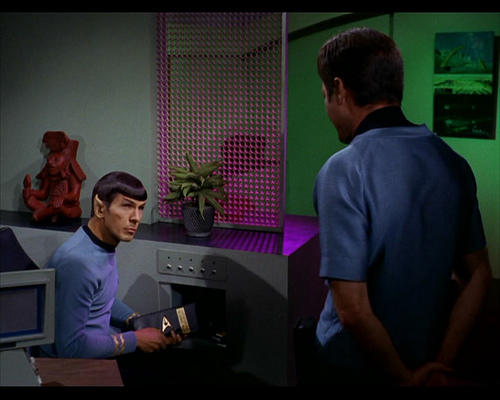
Fifty years ago, on September 8th, 1966, the first episode of Star Trek, "The Man Trap", aired on CBS. In honor of this momentous occasion I present to you my 20 favorite episodes of the original series.
To create this list I went back and watched about 30 episodes that I remembered really liking, then ranked them accordingly. I've tried to include a variety of plots (ie. time travel, parallel world, artificial intelligence, intergalactic war etc.) and tones (both serious and light hearted). I tend to look for three things in any Star Trek episode namely good interaction between the cast (Kirk, Spock and Bones), thought provoking thematic material, and good pacing. All the episodes I selected contain one or more of these things and if supporting cast members (Scotty, Uhura, Sulu, Nurse Chapel, Chekov) are involved more than usual in an episode, so much the better.
Honorable Mentions
"The Enemy Within" (Season 1 Episode 5)
Written by Richard Matheson
Directed by Leo Penn
One of the very first episodes that I ever watched, "The Enemy Within", written by veteren sci-fi writer Richard Matheson (
I Am Legend), is a really intriguing commentary on the duality of man, his animalistic and often violent instincts on one side and his more evolved sense of morality and empathy on the other. It also features one of William Shatner's best performances as a more subdued Kirk who has been physically separated from his darker half. It probably would have made the cut if it wasn't for a rather insensitively handled rape subtext (rape is one subject that Trek writers never seem to get a very good handle on).
"Tomorrow is Yesterday" (Season 1 Episode 19)
Written by D.C. Fontana
Directed by Micheal O'Herlihy
In this episode the
Enterprise is thrown back in time to 60's era earth where they are spotted by a U.S. Air Force pilot and forced to beam him aboard. The crew must figure out how to return to the 23rd century without damaging the timeline. It's a really fun episode and was originally intended to be the second episode of a two parter, following the "The Naked Time". It was reworked into a stand-alone episode written by Trek regular D.C. Fontana. His script anticipates
Star Trek IV: The Voyage Home, both in its lighthearted tone and in establishing that the Enterprise can time travel by using what's called the slingshot effect.
"Bread and Circuses" (Season 2 Episode 25)
Written by Gene Roddenberry and Gene L. Coon (based on a telepaly by John Kneubuhl)
Directed by Ralph Senensky
One of three episodes, along with "A Piece of the Action" and "Patterns of Force", where the crew of the enterprise encounter a planet whose cultural closely parallels earth history. In this case it's ancient Rome. It's not as comically entertaining as the former or thought provoking or well paced as the latter but it's the only one of the three to fully embrace parallel planetary development theory as opposed to someone purposely basing their culture on that of ancient earth and the implication (at the very end of the episode) that Christian worship is able to transcend space and time as a force for peace and liberation really intrigues me. It also features a really nice moment between Spock and Bones which was edited out of the original broadcast version.
Countdown of My 20 Favorite Episodes
20. "Day of the Dove" (Season 3 Episode 7)
Written by Jerome Bixby
Directed by Marvin Chomsky
Tensions run high aboard the
Enterprise when the crew comes into conflict with the crew of a Klingon ship. Kirk, Spock, and Bones discover that they are all being manipulated by a mysterious alien entity that feeds off of violent emotions. They and the crew must overcome their violent impulses, and convince the Klingons to do the same, if they are to escape from the entity's control and from an eternity of pointless conflict.
One of the few great episodes from Star Trek's uneven third season, "Day of the Dove" explores themes of hatred and violence. Watching the cast turn against each other is highly entertaining but there's also a spiritual quality to Jerome Bixby's story. The idea that the entity, or others like it, have been around since the beginning of time causing trouble echo's the Christian idea of the devil, an idea that transcends many different religions and mythologies. When Kirk tell's the entity that "We'll be on guard now" he seems to be speaking for all of humanity. This is also the first episode to really humanize the Klingons and explore their militaristic culture in a meaningful way. This is due in part to the performances of Micheal Ansara and Susan Howard, who play the captain of the Klingon ship and his wife, respectively.
19. "The Ultimate Computer" (Season 2 Episode 24)
Written by D.C. Fontana and Laurence N. Wolfe
Directed by John Meredyth Lucas
The
Enterprise is selected to be the test vehicle for the new "M-5 Multitronic System" designed by renowned computer scientist Dr. Richard Daystrom (William Marshall), a system which will control all the ship's functions without human assistance. When the M-5 malfunctions, destroying an unmanned freighter without provocation, Kirk orders it taken off line. The M-5 then takes over the ship, generating a force field to keep the crew from shutting it off. Under M-5's control the
Enterprise attacks Federation vessels that are taking part in war games as part of the test, causing them to fire on the
Enterprise in retaliation. Kirk, Spock, and Scotty must act fast to take control from the M-5 before the ship is destroyed.
"The Ultimate Computer" is the best of Star Trek's evil AI episodes. The overused plot device of defeating the AI by convincing it to destroy itself works better here because of M-5's connection to Daystrom, who programmed it with his own engrams. This is due, at least partly, to William Marshall's performance. His Richard Daystrom is a man driven by a need to prove himself and reclaim his former glory. Because of this the episode becomes a commentary not just on the dangers of computer automation but also of prideful ambition. Fontana is really good at writing characters whose large ego works toward their detriment. Shatner puts in a solid performance in this episode as well, as Kirk's ego is shaken when he is confronted with the prospect of being replaced by a machine.
18. "A Taste of Armageddon" (Season 1 Episode 23)
Written by Robert Hammer and Gene L. Coon
Directed by Joseph Pevney
The
Enterprise escorts Senator Robert Fox (Gene Lyons) to Eminiar VII to establish diplomatic relations with Federation. On arriving they receive a warning, barring them from approaching the planet surface, but Fox orders Kirk to enter orbit anyway. Deciding to investigate the situation Kirk beams down with Spock and a security team only to find that the planet is involved in a "war" with nearby Vendikar. In this war, attacks are simulated with computers and any person designated a casualty must be executed in a disintegration chamber. The planets leader, Anan 7 (David Opatoshu) informs Kirk that the
Enterprise was "hit" in one of these attacks and that his crew are all considered casualties and must report for execution. When Kirk refuses to senf his men down, he and the landing party are taken prison. Kirk and the others must escape and warn the
Enterprise before Anan 7 can lure them into a trap. Meanwhile, Senator Fox butts heads with Scotty, who distrusts Anan 7 and wants to threaten the planet with military action.
Joseph Pevney and Gene L. Coon can usually be counted on to make an engaging episode and this one is no exception. "A Taste of Armageddon" is notable mostly for its strong ant-war themes. The idea presented is that war on Eminar VII has become so sterile and routine that the people of the planet no are no longer motivated to seek peace and Kirk's impassioned
plea for peace at the end of the episode is just classic Trek. On the other hand the federation's General Order 24 could be read as an allegory for nuclear weapons, in which case this episode could be read as a defense for the use of such weapons to ensure peace. Given this, it's not surprising that this order has since been revoked by Federation law in Trek continuity. This episode is also the first in which Scotty takes command of the
Enterprise. In a scene inspired by James Doohan's military career he disobeys an order from Fox and refuses to lower the shields.
17. "The Doomsday Machine" (Season 2 Episode 6)
Written by Norman Spinrad
Directed by Marc Daniels
Following a distress call from the USS
Constellation, the
Enterprise finds her sister ship stranded in space with only one survivor aboard, her captain, Commodore Matt Decker (William Windom). He informs them that his ship was attacked by a giant, planet-killing machine which severely crippled it. After evacuating his crew to a nearby planet Decker then watched helplessly as it was completely obliterated by the machine. The beleaguered Decker is beamed aboard the
Enterprise while Kirk, Scotty and some engineers attend to the heavily damaged
Constellation. When the planet killer returns, cutting Kirk off from his ship, Decker takes command of the
Enterprise, determined to destroy the machine at any cost.
"The Doomsday Machine" is one of the darkest episodes of the original series and it's also one of the best. Norman Spinrad based his script for the episode on a Moby Dick-esque novella he wrote. William Windom puts in a really good performance as the Ahab-like Commodore Decker, a role reportedly offered to Robert Ryan! His obsession to destroy the planet-killer is what drives the episode and ultimately, makes it work so well. It also serves as an interesting counterpart to "A Taste of Armageddon", an episode which, in some ways, can be seen as justification for the existence of nuclear weapons. This one, on the other hand, can be read as a cautionary tale about the implications of having weapons with such great destructive capacity.
16. "All Our Yesterdays" (Season 3 Episode 23)
Written by Jean Lisette Aroeste
Directed by Marvin Chomsky
The
Enterprise arrives on the planet Sarpeidon in order to evacuate its populace before the planet goes supernova. There Kirk, Spock and Bones meet the planet's last inhabitant Atoz (Ian Wolfe), who shows them the Atavachron, a time portal which the inhabitants of Sarpeidon have used to escape into the planet's past. Before he can explain this, Kirk, hearing a woman scream on the other side of the portal, jumps through it, followed by Spock and Bones. Kirk finds himself stuck in a time resembling 17th century earth. Spock and Bones are stuck in a frozen wasteland with a single inhabitant, a girl named Zarabeth (Mariette Hartley), who Spock finds himself inexplicably drawn toward.
Marvin Chomsky was really the show's secret weapon in it's third season. Both of the episodes he directed are among the best. "All Our Yesterdays" owes a lot to "The City on the Edge of Forever" . Both episodes feature a time portal that a member of the
Enterprise accidentally steps through and both are tragic romances. This time, however, its Spock who falls in love. Eschewing typical Sci-Fi tropes about messing with history this episode instead explores Spock's friendship with Bones and his attraction toward Zarabeth, which he is ultimately forced to choose between. It also showcases the history and culture of both Vulcan and Sarpeidon. Kirk's adventure is less interesting but the parts with Spock and McCoy more than compensate for this.
15. "Arena" (Season 1 Episode 18)
Written by Gene L. Coon and Fredric Brown
Directed by Joseph Pevney
Kirk, Spock, Bones beam onto the Federation outpost on Cestus III with an away team only to find it destroyed. The
Enterprise is then attacked by an unknown enemy. Kirk decides to hunt down and destroy the enemy ship in retaliation for the attack on Cestus III but a powerful alien race called the Metrons intervenes, forcing Kirk to face the captain of the opposing ship one-on-one in a battle to the death on a barren planet, with the fate of the Enterprise in the balance.
An iconic episode "Arena" features the famous (or perhaps infamous) fight between Kirk and the giant lizard like alien called a Gorn. Another Pevney/Coon collaboration with an underlying message about rejecting violence, one which takes a little to long to set up. Kirk's arc here, going from a single minded quest for retribution to finding true cultural understanding showcases Rodennberry's vision of a compassionate and "evolved man. It's also great fun watching Kirk battles the Gorn and improvise a weapon in order to defeat him. Watching the crew of the enterprise use their knowledge of science to ultimately win the day is always satisfying.
14. "Patterns of Force" (Season 2 Episode 21)
Written by John Meredyth Lucas
Directed by Vincent McEveety
Investigating the disappearance of Federation cultural observer John Gill (David Brian), the
Enterprise arrives at the planet Ekos. When the ship is attacked by a primitive nuclear missile, Kirk and Spock beam down to investigate. On the planet's surface they discover a culture closely resembling that of Earth's Nazi Germany, complete with a holocaust against the Zeons, a more advanced culture from a neighboring planet. When they further discover that John Gill is the leader, or Führer, of this Nazi state, Kirk determines to confront Gill on his inexplicable violation of the Prime Directive.
"Patterns of Force" is the best Trek episode dealing with parallel worlds. It's also John Meredyth Lucas' best script. His exploration of the effectiveness of fascism as a system of government is really complex. It's definitely a darker episode, about how easily man can fall into systematic violence when motivated by a strong group mentality. It has some lighter moments as well though, especially when Bones enters the scene. He and Spock's conversation about fascism at the end of the episodes is a particularly good moment. As a student of history I find all of this to be really fascinating. Director Vincent McEveety keeps the episode well paced and suspenseful throughout. If nothing else, this episode can be enjoyed as a solid political thriller.
13. "The Menagerie: Part I and II" (Season 1 Episodes 11 and 12 )
Written by Gene Roddenberry
Directed by Marc Daniels (and Robert Butler)
Responding to a a message from Spock's former captain, Christopher Pike (Sean Kenney), the
Enterprise arrives at Starbase 11. There they find that Pike has suffered from a severe burn accident and is now confined to a wheelchair, able to communicate only by answering yes/no questions with the aid of a red light on his wheelchair. Commodore Mendez, doubting that Pike was even capable of sending the message, orders an investigation. Meanwhile Spock kidnaps Pike and commandeers the
Enterprise for unknown purposes. Kirk and Mendez pursue Spock, forcing him to beam them aboard. Finding out that the
Enterprise is headed for the forbidden planet of Talos IV Mendez convenes a court martial, trying Spock for mutiny and disobeying Star Fleet orders. During the proceedings Spock presents recordings of Pike's original adventures on Talos IV as evidence. These recordings show that he was held against his will by powerful alien telepaths determined to use him to breed a race of slaves. Kirk increasingly worries about what his first officer is up to.
"The Menagerie" was the first Star Trek episode to win a Hugo award for Best Dramatic Presentation. It's also the original series only two-part episode. It was made because Gene Roddenberry ran out of scripts half-way through Season One and, by cleverly utilizing footage from the unaired pilot "The Cage" as Spock's evidence for the court martial, this only episode only required a minimal amount of new material. It takes the brilliant (though somewhat problematic) premise of the pilot and explores it in more humanistic terms. What started as an exploration of reality, illusion, and free will becomes more complex, looking at old age and disability as well. Besides this, it also works well as a thriller. Seeing Spock commandeer the
Enterprise for unknown purposes, at the bemusement of his shipmates, makes for great television. It's also interesting to see the
Enterprise at an earlier date. Captain Pike (played by Jeffrey Hunter in the flashbacks) later became a reoccurring character when J.J. Abrams rebooted the franchise in 2009.
12. "The Corbomite Maneuver" (Season 1 Episode 10)
Written by Jerry Sohl
Directed by Joseph Sargent
When the
Enterprise encounters a mysterious and powerful alien ship, its commander, Balok (Clint Howard), identifying his ship as the flagship of the "First Federation", threatens to destroy the
Enterprise for trespassing into First Federation territory. Kirk enters a game of cat and mouse with Balok, trying to bluff his way out of the situation. Meanwhile his new helmsman, Bailey (Anthony Call), struggles to cope with the stressful situation.
"The Corbomite Maneuver" was the first episode of the series to be produced after NBC bought the pilot "Where No Man Has Gone Before". It is also the first (filmed) appearance of Bones, Uhura, and Janice Rand. It establishes Bones friendly relationship with Kirk really well, though he and Spock's antagonistic rapport had yet to really show itself. Kirk's battle of wits with Balok is really exciting and the episode presents one of the show's central themes, the wonder of discovery and contact with the unknown, really well. There is a somewhat sexist line from Kirk that I don't care for and the uniforms were still being refined but, nevertheless, for people wanting to get into the show, I'd say this is a pretty good entry point.
11. "Dagger of the Mind" (Season 1 Episode 9)
Written by Simon Wincelberg
Directed by Vincent McEveety
During a supply run to the penal colony on Tantalus IV, an escaped inmate stows away aboard the
Enterprise and attacks one of the crew. The inmate, former doctor Simon Van Gelder (Morgan Woodward) demands asylum aboard the
Enterprise only to be subdued by a Vulcan nerve pinch from Spock. On McCoy's insistence, Kirk beams down with psychiatrist Lt. Helen Noel (Marianna Hill) to investigate. There they find the inmates oddly complacent. Dr. Tristan Adams (James Gregory), who runs the facility, shows Kirk an experimental device which, he claims, Dr. Van Gelder mentally injured himself with. Meanwhile, aboard the
Enterprise, Van Gelder becomes increasingly frantic, warning Spock and Bones that Kirk and Noel are in danger.
The first episode of the original series I ever watched "Dagger of the Mind" features strong direction from Vincent McEveety, who keeps the episode really suspenseful. Though it features some nice, lighter moments between Kirk and Noel who, it's revealed, have a history, this episode has some really dark undertones. It's an almost Orwellian exploration of criminal "rehabilitation" at the cost of identity loss. It also introduces the Vulcan mind-meld, a plot device which would become a staple of the franchise. Morgan Woodward said that the role of Simon Van Gelder was the most exhausting of his career and took a toll on his personal life while also opening up new acting opportunities for him.
10. "The Tholian Web" (Season 3 Episode 9)
Written by Judy Burns and Chet Richards
Directed by Herb Wallerstein
The Enterprise encounters her sister ship, the USS
Defiant, after a long search only to find that its crew have killed each other. After discovering that the
Defiant is dissolving in an inter-dimensional drift, Kirk is caught on board and fades away with the ship. With the arrival of an unfriendly Tholian ship and the spread of a kind of space madness caused by proximity to the rift, Spock must decide whether to flee or stay and try to retrieve the captain in hopes that he survived the inter-phase.
"The Tholian Web" is the best episode of Trek's spotty third season. In it we see how much of a middle man Kirk is to Spock and McCoy as their relationship is really put through the ringer in his absence. Watching the whole crew react to Kirk's supposed death one of my favorite scenes in the series. The episode also delves into inter-dimensional theory a concept that would be explored further in the
Enterprise episode "A Mirror Darkly" which was a sequel of sorts to this one. With all the craziness going on, this episode bears a strong resemblance to season one's "The Naked Time" and, like that episode, is well paced and suspenseful. Judy Burns had never written a screenplay before this episode but she could have fooled me.
9. "The Trouble With Tribbles" (Season 2 Episode 15)
Written by David Gerold
Directed by Joseph Pevney
The Enterprise arrives at Deep Space Station K7 in response to a distress call. Arriving there, Kirk meets Under-Secretary Nilz Baris who sent the distress call so the
Enterprise could guard a consignment of grain bound for Sherman's Planet. Annoyed at being summoned for such a menial task Kirk reluctantly agrees, using this as an opportunity for the crew to get some much deserved rest and recreation. A trader named Cyrano Jones (Stanley Adams) gives Lt. Uhura a tribble, a small fuzzy creature which reproduces at a remarkable rate. Soon the
Enterprise and the space station are overrun with the creatures. The arrival of Captain Koloth and his Klingon battle-cruiser further complicates matters, as Baris fears for the safety of his grain.
"The Trouble With Tribbles" is one of the most beloved episodes of the Original Series. Scotty gets more character development in this episode than usual as we learn how much pride he takes in being the engineer of the
Enterprise when some Klingons decide to insult it
. There are themes in the episode dealing with overpopulation and food distribution but the real reason this episode is famous is the comedy. Watching Kirk's exasperation as he tries to deal with Baris, the Klingons and, of course, the Tribbles, is highly entertaining. The climax, or low point of this struggle, where Kirk is literally buried in Tribbles, took eight takes to get right. Perhaps the appeal of this episode is best summed up in the words of William Shatner, "The trouble we had with 'Tribbles' was [to] keep your straight face. It was just a lot of fun."
8. "Space Seed" (Season 1 Episode 22)
Written by Gene L. Coon and Carey Wilbur
Directed by Marc Daniels
The
Enterprise encounters the derelict SS
Botany Bay, a relic of late 20th century earth, floating in space, her crew kept alive in suspended animation. Kirk, Bones and Scotty beam aboard the freighter along with historian Lt. Marla McGivers (Madlyn Rhue) and revive a man that McGivers identifies as the leader. Bringing him on-board the
Enterprise they discover that his name is Khan (Ricardo Montalban). Spock discovers that he is actually Khan Nonien Singh, a warlord and genetically engineered superhuman form the eugenics wars of the 1990's. When Khan seduces McGivers, who has become infatuated with him, into helping him take over the ship, Kirk and his crew must prevent Khan from using the
Enterprise to begin his new rule over mankind.
This episode is famous for introducing Khan but he is not yet the revenge driven mad man of Star Trek II here. The script, originally written as a concept for a different Sci-Fi series by Carey Wilbur is really intelligent and well written. Khan is portrayed as a sophisticated autocrat, one who believes that he ought to ruler over others because his innate superiority makes him more capable. He makes an interesting foil for the more moral and empathetic Kirk, Spock and Bones. Given its somewhat sexist implications, Khan's relationship with McGivers is one of the weaker aspects of the episode, but it's also one of the most fascinating. Having studied history her whole life McGivers is fascinated by this savage, assertive man from the past. She's also sick of serving on the
Enterprise, where she rarely gets a chance to do anything important. Joining Khan gives her the opportunity to take part in and help shape history instead of just studying it. It's just to bad that she seems so indecisive most of the time. Despite this, "Space Seed" remains a really smart and entertaining episode.
7. "The Devil in the Dark" (Season 1 Episode 25)
Written by Gene L. Coon
Directed by Joseph Pevney
When workers at the mining colony of Janus VI are killed by a mysterious creature, the
Enterprise is sent in to investigate and eradicate the creature. On arriving, the Chief Engineer of the colony, Vanderberg (Ken Lynch), explains the situation. Then the creature attacks the colony's nuclear reactor room, killing the guard and stealing the circulation pump. Kirk and the crew must kill the creature and retrieve the pump within 48 hours, or the reactor will go critical. Spock however, has misgivings, suspecting that the creature may be the last of its kind. On finding the creature he and Kirk discover that it is intelligent, and that it's intentions have been misunderstood.
If "The Trouble With Tribbles" is about population control "The Devil in the Dark" is its pro-life counterpart. It's also Coon's best script. Kirk and Spock, in protecting the Horta, demand respect for intelligent life in all it's forms and at all it's stages. What's surprising is the way the miners react when they learn that they've been destroying the Horta's eggs, not with blind anger but compassion and understanding. This episode presents Roddenberry's vision at its most optimistic. The banter between Kirk and Spock which closes the episode is one of the best exchanges between the two characters ever. William Shatner, who's father died during the filming of this episode, has said that it's his favorite, partly because of the positive experience he had when the cast and crew helped him to cope with his loss.
6. "Mirror, Mirror" (Season 2 Episode 4)
Written by Jerome Bixby
Directed by Marc Daniels
During a mission to the peaceful planet Halkan a transporter malfunction causes Kirk, McCoy, Uhura, and Scotty to become trapped in a mirror universe. Here the Federation has been replaced with the brutal Terran Empire which the counterparts of Kirk and his crew in this universe serve. Attempting to impersonate their doppelgangers, who have been trapped in the universe which our heroes left, Kirk and company must find a way to return to their own universe. Matters are further complicated when the Terran Empire orders Kirk to destroy Halkan unless they meet their demands.
Most famous for featuring an evil doppelganger of Spock who sports a beard, "Mirror, Mirror" presents a really interesting parallel universe. Jerome Bixby, who based the story for this episode on a short story he wrote, really digs into the workings of this world and its characters. Seeing how Kirk, Spock, and all the characters turn out in this universe is really interesting. Bone's insistence to save the mirror version of Spock when he is hurt shows how much he really cares for the Vulcan. Kirk's treatment of Lt. Marlena Moreau (Barbara Luna), his "kept woman" in this universe, reveals both the similarities and differences between him and his counterpart. Scotty's easygoing treatment of the whole affair reveals the character's quiet confidence that makes him so good at his job. I especially like how Uhura is able to blend into this world, in many ways, better than Kirk does, suggesting that her and her doppelganger are not that different. Finally, Spock's logical behavior throughout and his decision to let Kirk and company return at the end suggest that he too is not that different than the Spock we all know and love and that he may indeed take Kirk's advice and try to put an end to the Terran empire's reign of terror.

5. "Journey to Babel" (Season 2 Episode 10)
Written by D.C. Fontana
Directed by Marc Daniels
The
Enterprise is tasked with transporting Federation ambassadors, including Spock's father Sarek (Mark Lenard), to the Babel Conference to discuss the admission of the Coridan System to the Federation. Trouble arises when a Tellarite ambassador is murdered and Sarek is the main suspect. Later, he suffers a cardiovascular malfunction and Kirk is attacked and stabbed by an Andorian assassin. With the arrival and attack of an unidentified ship Spock is faced with a choice: give Sarek a lifesaving blood transfusion or take command of the enterprise in accordance with regulations.
"Journey to Babel" along with "Amok Time" helps to flesh out Vulcan culture and Spock's background. It also helps to cement his friendship with Kirk and Bones. Mark Lenard's Sarek makes a really interesting contrast to Spock. Though this is his only appearance on the original series he would return to the franchise many times in the movies and the
Next Generation TV show. His strained relationship with Spock is really the heart of this episode and is something that would not be resolved until the two part
Next Generation episode "Unification". His mother Amanda (Jane Wyatt) acts as a balance between the two men. Her relationship with Sarek is also fascinating and always leaves me wishing for more. The way Kirk and Bones go out of their way to help Spock helps to further establish the depth of their friendship.
4. "Balance of Terror" (Season 1 Episode 14)
Written by Vincent McEveety
Directed by Paul Schneider
While inspecting a line of Federation outposts, the
Enterprise finds that many of them have been destroyed by an unknown enemy. A wedding aboard the ship, officiated by Captain Kirk, is interrupted when Outpost 4, near the Romulan neutral zone, is attacked. The
Enterprise travels there to investigate and aid the the men at the outpost. After arriving they witness the outpost being destroyed by a cloaked Romulan Bird of Prey. Kirk decides to follow the Bird of Prey to the edge of the neutral zone before they can return to Romulus and report about the Federation's weaknesses. A games of cat and mouse ensues between the two ships and their commanders.
Another episode featuring Mark Lenard but this time as a Romulan Captain (so much for continuity), "Balance of Terror" is a taught thriller in the tradition of old submarine movies. Indeed, writer Paul Schneider drew much inspiration from the WWII film, The Enemy Below but his script goes a step further and explores themes of racial distrust in time of war. In addition to introducing the Romulans this episode hints at their shared ancestry with Vulcans. This would become an important part of Trek mythology later on, as Spock would seek to reunify the two cultures, a goal he would pursue all the way up to his last prime universe appearance in
Star Trek (2009). Vincent McEveety, who always excels at delivering suspense driven episodes, is at the top of his game here. Watching Kirk go toe to toe with the Romulan commander is probably the most intense climax in any episode of the original series. As a side note the woman getting married at the beginning of the episode, Angela Martine (Barbara Baldavin), is shown genuflecting, which was a bold move for the producers as prejudice against Catholics was common in the United States in the 1960's.
3. "The City on the Edge of Forever" (Season 1 Episode 28)
Written by Harlan Ellison
Directed by Joseph Pevney
While treating Lt. Sulu, Dr. McCoy accidentally injects himself with an overdose of cordrazine. Delusional, he flees from the bridge and beams down to a nearby planet where Kirk and a landing party pursue him. There they come across a large stone ring and a voice, calling himself the Guardian of Forever, explains that this is a time portal to any place and time. When McCoy appears and jumps through the portal and the landing party loses contact with the ship the Guardian explains that McCoy has changed history, causing both the ship and the Federation to be erased from history. Kirk and Spock decide to follow Bones through the portal and repair whatever damage he's done to the timeline and the Guardian agrees to return them to the present time once this is done. They come through and find themselves in Depression era New York City. They must use whatever crude tools they can find there to determine when McCoy will pass through the portal so they can stop him.
Probably the most famous and acclaimed episode of the original series "The City on the Edge of Forever" was plagued with production problems. The script, written by renowned Science Fiction scribe Harlan Ellison, took over ten months to complete as Gene Roddenberry kept requesting rewrites. Before it was done the script had to be doctored by up to four other writers including D.C. Fontana, Gene L. Coon, Steven W. Carabatsos, and Roddenbery himself. Ellison was displeased by the final draft and he and Roddenberry had a long lasting feud as a result. The troubles weren't over even after the episode began filming however as it went $50,000 over budget. Despite all these problems the episode turned out amazingly well and went on to win a Hugo award for Best Dramatic Presentation. It certainly deserved it. This episode is a great exploration of causality and the limits of optimism. It features, perhaps, William Shatner's best performance of the series, as we watch Kirk fall in love with Edith Keeler (Joan Collins) only to be forced to let her go. It also has some great exchanges between Kirk, Spock and Edith Keeler. Joseph Pevney's direction was never stronger. It's simply a must-see episode.

2. "The Naked Time" (Season 1 Episode 4)
Written by John D.F. Black
Directed by Marc Daniels
While documenting the breakup of planet Psi 2000 the crew of the
Enterprise investigate the status of a research team on the planet's surface that has not been heard from in months. A landing party finds the team frozen to death, apparently after suffering from some form of madness. Without realizing it, one member of the party becomes infected with a strange red liquid. Soon more of the crew become infected and begin behaving irrationally with Ensign Riley (Bruce Hyde) getting drunk and taking over the ship via the engine room and Lt. Sulu running around the ship, shirtless, with a sword. Dr. McCoy determines that the water from the planet acts on the bloodstream like alcohol, impairing judgement and self-control. While he works on a cure Kirk and Spock, who are infected themselves, must work to regain control of the ship along with Scotty so they can leave the system before the ship's orbit decays.
"The Naked Time" is a really entertaining episode. The script, by John D.F. Black, helps to shed more light on the characters early in the series run. We learn that Sulu fancies himself a swashbuckler and we see how brilliant of an engineer Mr. Scott is. More importantly, we learn how much the
Enterprise means to Kirk, as his fear of losing command surfaces when he is infected. We also see how vulnerable Spock is and how much he struggles to contain his emotions. We learn that he and Nurse Chapel have feelings for each other when both of them become infected. This is reiterated later in the show. The scene where Spock breaks down crying, which is some of the best acting Nimoy ever did, was improvised. The episode is also a superb thriller, as events keep escalating until the (nearly) explosive conclusion where the Enterprise enters time warp for the first time. It's a favorite of George Takei, who taught himself fencing during his free time and apparently terrorized the film crew by poking them with his sword whenever they walked by.
1. "Amok Time" (Season 2 Episode 1)
Written by Theodore Sturgeon
Directed by Joseph Pevney
Mr. Spock, who has been displaying erratic behavior of late, requests leave to travel to his home planet of Vulcan. When Star Fleet orders the
Enterprise to Altair VI to represent the Federation at the inauguration ceremony for the planet's new president and refuses Spock's request, Kirk, seeing that Spock is in deadly earnest, insists on knowing why he must go to Vulcan. Spock reluctantly explains that he is going through pon farr, a condition experienced by young Vulcans, and that he must mate or he will die. Kirk disobeys Star Fleet orders and takes Spock to Vulcan. Once there he invites Kirk and Bones to attend the mating ceremony. On the planet they meet Spock's intended mate T'Pring (Arlene Martel) who requests the
koon-ut-kal-if-fee, her right to a physical challenge between Spock and her selected champion. When she selects Kirk as her champion he decides, despite Spock's protests, to accept, only to learn that the fight is to the death!
I had a hard time choosing between my top three episodes. Ultimately I picked "Amok Time" because it has the best interaction between Kirk, Spock, and Bones. Theodore Sturgeon really gets at the heart of their relationship and Kelley, Shatner, and especially Nimoy all put in great performances. The scene in the elevator were Spock asks Kirk and McCoy to attend the ceremony is, in particular, a really great, understated character moment as is the scene where Spock finds out that Kirk is alive and smiles, the only time in the series that Spock would show emotion without being influenced by some outside force.
We learn a lot about Spock in this episode, both his culture and his character. We see the planet of Vulcan and meet other Vulcans for the first time. The Vulcan hand salute and the phrase "Live long and prosper" both appear here for the first time as well. Finally, we find out how private and prideful Spock and his culture are, as he avoids telling Kirk about pon farr almost at the cost of his life. There's also another hint at his romantic feelings for Nurse Chapel. Joseph Pevney's direction is quite strong and he gives the scenes on Vulcan a really exotic, otherworldly feel. In the end I love "Amok Time" because it does what Star Trek does best, telling a story about a new and strange world but a story that is surprisingly human and relatable at its core.