Wednesday, June 7, 2017

Western Wednesdays: Forty Guns (1957)

So I guess I need to watch more Samuel Fuller movies...

          In the opening scene of Forty Guns a group of riders ride down a cliff, shot in low angle, bearing down on a solitary wagon, shot in high angle. Immediately the power dynamics and the basic premise of the story are established visually. The three men newly arrived in the wagon are thrown against the territory's established power. This kind of mastery of form is consistent throughout the film. It contrasts greatly with many, less proficient films made today, but is perhaps more common in a 50's western film. What is unusual is the fact that the forty riders are lead not by a man but by a woman.

     The woman is Jessica Drummond (Barbara Stanwyck), a local landowner who runs the territory. The men in the wagon are the Bonnell brothers, lead by Griff (Barry Sullivan), a U.S. Marshal and a famous gunfighter. On arriving in the town Griff meets the sheriff, Chisholm (Hank Worden). Chisholm is going blind and wants Griff to protect him from Brockie (John Ericson), Jessica's hard drinking, unstable younger brother. When Chisholm is killed by Brockie, Griff confronts and arrests him, only for him to be summarily bailed out by Drummond. This creates a conflict between Drummond and Bonnell. Brockie wants to kill Bonnell, while Griff is looking to arrest one of Jessica's men, Howard Swain (Chuck Roberson), for mail robbery.

     Despite being on opposite sides of this conflict, Jessica and Griff feel attracted to each other. Both have lived rough, violent lives that they now want to leave behind. Jessica love for Brockie, who she sees as more of a son then a brother, puts her at odds with her feelings for Griff. Griff, meanwhile, is hesitant to give in to his feelings for her since she is involved in illicit activity. To further complicate matters, Logan (Dean Jagger), the sheriff, is under Drummond's hire and also has feelings for her, making him jealous of Griff. Meanwhile, Griff's brother Wes (Gene Barry) begins courting Louvenie Spanger (Eve Brent), the daughter of the town gunsmith and his younger brother Chico resists Griff's attempts to keep him out of the conflict.

     I won't spoil the ending but I will say that it was unpredictable, both in its violence and its overall optimistic coda. Ultimately, Jessica's loyalty to Brockie is pitted against her love for Griff. While Griff's vengeful, violent tendencies threaten to tear them apart unless Jessica shows herself to be the "better man".

     In addition to the brilliant direction and writing from Samuel Fuller, Forty Guns also features solid performances. Barbara Stanwyck steals every scene she's in as Jessica Drummond moving effortlessly between the hardened cattle baron and the weary, vulnerable woman. Barry Sullivan feels world weary, yet supremely confident as Griff while Gene Barry's Wes provides a more relaxed, happy-go-lucky contrast. John Ericson is appropriately unlikable as Brockie and Dean Jagger does an excellent job in the films best supporting role of the tragically incompetent Ned Logan.

     Forty Guns is a subtlety subversive western written and directed with real panache. Rarely have I seen such a confident piece of film-making.

Score: 9/10

Saturday, June 3, 2017

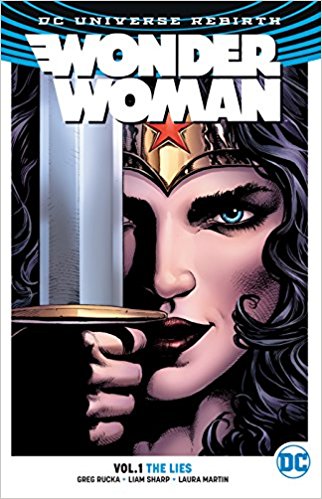
Saturday Evening Cartoons: Wonder Woman Rebirth

This week I'm tackling the first two volumes of Wonder Woman Rebirth. The stories collected in these volumes were originally published at the same time, with Volume 1 collecting the odd numbered issues and Volume 2 the even numbered ones. As the two stories inform each other in some ways and as I originally read them together, I'd figured I should review them both... 


     When DC began its New 52 relaunch way back in 2011, they tweaked the origins of many of their characters. For the Wonder Woman title writer Brian Azzarello changed the traditional story that Diana was formed from clay by her mother Hippolyta and given life by Zeus, instead she was born after an affair between the two, meaning that Wonder Woman was a demi-goddess. In addition to this she was also more headstrong and impulsive and generally more alienated from her Amazonian sisters while figures previously treated as villains, in particular Ares (the God of war) were treated as more sympathetic allies. Meanwhile, in the Justice League book, Wonder Woman and Superman became romantically involved, estranging both superheroes from their traditional love interests, Steve Trevor and Lois Lane respectively. These changes were quite divisive among fans. Personally I thought that Azzarello's run worked as a brilliant, self-contained story, but felt out-of-place in the larger DC universe. As far as the Superman/Wonder Woman romance goes, I simply wasn’t a fan.


     When last years Rebirth relaunch was announced Greg Rucka was slated as the writer for the new Wonder Woman title. Rucka had written Wonder Woman for a few years back in the early 2000’s. Being familiar with his work on the character I was excited to see what he’d do.


     The first arc, called The Lies deals directly with the changes brought about by 52. It seems Wonder Woman has been deceived by some unknown force who has changed her memories of the past, presumably part of the larger conspiracy affecting the whole DCU. In order to rediscover her past she sets out to find Themyscira, enlisting Barbara Anne Minerva, aka the Cheetah, to help her. Cheetah agrees to help only if Wonder Woman will kill the god who cursed her, Urzkartaga, thus freeing her of the curse. Along the way they cross paths with Steve Trevor, who is on a mission to take down a warlord named Cadula, one who, it turns out, worships Urzkartaga.

     Thematically, The Lies is about the damaging effect of deception and the liberating power of truth. Wonder Woman and Cheetah, it turns out, have both been greatly deceived in the past. Rucka’s new take on Cheetah is much more sympathetic than past versions. She is presented as an abusive partner to Urzkartaga. He made her feel responsible for her turning into cheetah and used this to manipulate her. Wonder Woman must not only free her from her curse but from her sense of guilt, liberating her both physically and psychologically.


     There are also themes of abuse and misogyny running through this story. In addition to the abusive relationship between Barbara Ann and Urzkartaga, Cadula is a power hungry misogynist who is using the girls he kidnapped to try and harness Urzkartaga’s power for himself. Steve Trevor is a good foil for Cadula, representing a more evolved sense of manhood. While Barbara Ann must cut her ties from Urzkartaga, Diana must reform her positive relationship with Steve.


     It is implied in this story that Steve and Diana are destined to be together. This feel a little like a corporate mandate conforming with DC’s overall program of returning characters to their roots. However, Rucka is a writer with an affinity for these characters and he makes it work really well. The scenes between the two characters are handled with great subtlety and are filled with genuine emotion. Indeed this run has been filled with moments of subtle, warm humor and character interaction.


     The art throughout this arc, by Liam Sharp and Laura Martin (colors), is pretty great. There's a real sense of atmosphere, particularly in all the jungle scenes and the way the book is plotted is really novel, utilizing vines, prison bars, and other objects for the panel separations. It’s also plotted really well. The action is well paced and has a good sense of urgency while the more intimate moments are given room to breath. Their are some real standout one and two page spreads, particularly one moment when Wonder Woman greets a bunch of people at a shopping mall because “she knows what it means to them.”

     This book is not without its problems. For one thing, while Sharp and Martin did the art for the majority of this volume the first chapter was done by two different teams. Matthew Clark (pencils) Sean Parsons (inks) and Jeremy Colwell (colors) did the first half of the story while Sharp and Martin did the second half. This change in art styles is rather jarring but, thankfully is restricted to the first chapter. It also has some pacing problems. Despite its thematic connection to the main plot of this run (Wonder Woman trying to determine her true origin) the whole Cheetah/Urzkartaga subplot can’t help but feel like a bit of a distraction from it, particularly since this volume is bookended by the main plot. The first chapter doesn’t touch on the cheetah plot at all and it’s wrapped up before the last chapter begins.


     The second volume, Year One, retells Wonder Woman’s origin. Essentially, Rucka sticks to the model set up by George Perez back in 1986. Steve Trevor crash lands on Themyscira, prompting the Amazons to break their self imposed exile from earth by sending an ambassador to them. Ultimately Diana, the daughter of Queen Hippolyta, is chosen to accompany Captain Trevor back to the world of men. What Rucka adds is a new motive for the Amazons. A seer senses that Ares has returned to earth to wreak havoc, so Diana is sent to stop him.

     Even more than The Lies, Year One fleshes out Barbara Ann Minerva. In a chapter dedicated entirely to her, we find out that she has been obsessed with the Amazons since she was a young girl, despite the discouragement from her cold, distant, widowed father. She became an archeologist in order to find evidence of their existence. She is called in by Argus to help them communicate with Diana and ultimately the two become friends. Diana’s relationship with Steve Trevor is also set up, as she helps him to investigate the mysterious terrorist organization Sear.


     Rucka does a really good job juggling all the characters. He really imbues Barbara Minerva, Steve Trevor and, to a lesser extent, Etta Candy, with a sense of real humanity. Wonder Woman herself has a real sense of wide eyed wonder and optimism. She is also a little naive, having been raised in the sheltered atmosphere of Themyscira. The bond formed between these characters feels really genuine.

     Once again the art is really great in this volume. Nikola Scott and Romulo Fajardo Jr. (colors) have a cleaner, brighter style than Sharp and Martin, one that really complements the lighter, more optimistic tone of this arc. It's also really well plotted, with the battle between Wonder Woman and the Sear goons in the mall being a standout. There's also a two page spread in chapter six that's just breathtaking.


    Year One informs The Lies in some really important ways. First and foremost is establishes the truth as an important aspect of Diana's philosophy and mission. It shows how much she misses her home and helps the reader understand why she wants to find it again. It also adds poignancy to her relationships with Steve and Barbara Ann.

     This volume mainly suffers from its place in the Rucka's larger story. Reading it in tandem with The Lies makes it hard to keep track of the story from month to month while reading it separately in trade, though somewhat better, is still awkward. Spending a whole volume away from the story set up in the first one for the purpose of establishing a back story is awkward, not to mention a little backward. In addition, the chapter covering Barbara Ann's background, though it's well written, interrupts the flow of the main story. It would have made more sense, to me at least, to parcel out this information more naturally, throughout the course of the story. Making matters worse, the pencils in this chapter were not done by Nikola Scott but Bilquis Evely whose art style is radically different. At least here its a flashback story and the art doesn't change in the middle of a chapter.

     Why the powers that be decided to publish this book in such a haphazard way is anyone's guess. Nevertheless, I think that Rucka's Wonder Woman is one of the stronger books in DC's relaunch. I would suggest reading it in trade, rather than monthly issues and I would also suggest reading Volume 2 first, as it informs the first volume in important ways and generally stands on its own better.

Score: The Lies - 8/10

Year One - 9/10

Tuesday, May 30, 2017

My Favorite Films: Mary Poppins (Musical Mondays)

     I've written previously about how my father barred me and my siblings from watching Disney films where we were growing up. There were, however, a few notable exceptions to this rule. Mary Poppins was one of those exceptions. As a young boy I saw this film too many times to count and I recently had the pleasure of revisiting it on the big screen at the historic Redford Theatre in Detroit. After all of these years it still retains all of its charm and emotional power.

     The movie really captures the whimsical spirit of P.L. Travers' stories. We are introduced to the magical nature of the world right away as we see Mary Poppins (Julie Andrews) doing her make-up while sitting atop a cloud in the opening credits. We are then brought down-to-earth, quite literally in fact, as we are introduced to the Banks family by Bert (Dick Van Dyke), a jack-of-all trades and an old friend of Mary Poppins. Things gradually become more and more whimsical as the children are introduced to Mary Poppins, she magically cleans up the nursery and they go on a series of magical adventures. In the first of these, the children, along with Mary Poppins and Bert, jump into a chalk picture and, in a groundbreaking blend of animation and live action, our characters explore the world of the drawing in a series of vaudeville-esque songs. Then, we meet Uncle Albert (Ed Wynn), who laughs so much that he literally bounces of the walls, and he can't come down unless he thinks of something sad. "I Love to Laugh" has to be one of the most charming scenes in movie history thanks in no small part to the chemistry between Ed Wynn and Dick Van Dyke and to the incredible special effects.

   Mary Poppins afterwards refuses to acknowledge to the children that either of these events took place while Mr. Banks (David Tomlinson), who is quite upset about the whole thing, refers to them as if they actually happened. As a result, it's hard to tell where the real world ends and the magic begins. Adding to this effect, Edwardian London itself is portrayed in a heightened, fantastical manner. The Banks neighbor, Admiral Boom, lives on top of his home like a navy ship, and promptly fires his canon off every hour causing the entire neighborhood to shake. Later in the film, the children and Mary Poppins go on their final adventure on the rooftops of London where the chimney sweeps, including Bert, seem to inhabit their own strange world and culture. As a child I would often fast-forward my family's VHS copy of the film to this scene. Watching the the chimney sweeps dance and leap about on the rooftops and then, my favorite part, being dispersed by a barrage of fireworks courtesy of Admiral Boom was a pure joy.

     The music adds to this sense of whimsy. The Sherman Brothers begin most of the songs not on the tonic note, as is customary, but one or two chords above, creating a sense of "floating" and easing the listener into the key of the song the same way the film does with the world of Mary Poppins. But what really impresses me as an adult is that the writers were able to synthesize various adventures from different Mary Poppins books into a single, working narrative. When Walt Disney first began pursuing an adaptation of Mary Poppins he gave a copy of the book to Richard and Robert Sherman, a pair of young songwriters who recently came to work at Disney. Over a two week period they developed a basic story and various songs around the book.

     All of their songs inform the characters and drive the story. "Sister Suffragette" sets up Ms. Banks character, one who is simultaneously devoted to women's liberation and submissive to her husband and also a loving mother who, perhaps, doesn't give her children enough attention. "The Life I Lead" followed by "The Perfect Nanny" sets up Mr. Banks character and also the main conflict of the film. Mr. Banks raises his children to be successful but neglects to show them kindness and has little patience for fun and games which are, in Mary Poppins view, incredibly valuable. It also establishes the children's desire for kindness and understanding from their nanny and attention and approval from their father. "A Spoonful of Sugar" establishes Mary Poppins philosophy when it comes to disciplining children, "a spoonful of sugar helps the medicine go down." "Supercalifragilisticexpialidocious"and "I Love to Laugh" show the power of laughter, happiness, and frivolity, themes that return in the film's climax.

     "Feed the Birds" is, in many ways, the most crucial song in the movie. Mary Poppins uses it to convince the children to go with their father on an outing to the bank but through it she sews the seeds of social concern and charity inside them. This will allow the children, essentially, to redeem their father. The "Tuppence a bag" are representative of the small acts of kindness, which are all that are required to make the world a better place and to be a loving parent. It is heard instrumentally throughout the film and returns during the climax as a sort of funeral dirge as Banks walks to his place of work, seemingly for the last time. It sticks out above the other songs because of its slower tempo and dreamlike timbre. "Fidelity Fiduciary Bank" contrasts this spirit of giving with Mr. Banks and the bankers industry and greed. In it they try to convince Micheal, who wants his tuppence to feed the birds, to invest it in their bank. When Micheal refuses he inadvertanly sets off a run on the bank. Later, when his father loses his job, Micheal offers him the tuppence to make up for this.

     In "A Man Has Dreams" the father's theme returns, now much more somber, reflecting his current state of mind in contrast to his earlier drive and ambition. Indeed the most stirring image in the film for me today is no longer the chimney sweeps, dancing atop the rooftops of London, but Mr. Banks, the father, walking to his place of work like a man condemned and dwarfed beneath the spectre of his own bank. This is only made more powerful by the film's optimistic resolution. When facing Mr. Dawes and the officers at the bank he pulls the tuppence out of his pocket reminding him that sometimes it's the seemingly insignificant, even intangible, things that really matter. He then says Supercalifragilisticexpialidocious and marches out of the bank a changed man.

     "Let's Go Fly a Kite" completes the father's arc, as he shows his children that he values their happiness more than his job. He has used the tuppence he so enthusiastically urged Micheal to invest earlier in the film, the tuppence Micheal freely gave him in an act of affection, to fix the kite they damaged at the beginning, metaphorically mending his relationship with his family and Ms. Banks even gives them her suffragette sash to use as a tail, placing her own family above her cause.

     Walt Disney provided the whole cast and crew with a lot of artistic freedom. Everyone's contribution was treated as important and everyone was given a very laid back and stress-free environment to work and create in. Consequently, everyone involved really gave it their all. The Sherman Brothers, along with screenwriters Bill Walsh and Don DeGradi, were really able to shape the film's theme and narrative. Peter Ellenshaw's matte work and Tony Walton's costume and set design gave the film a unique visual flavor, evoking Edwardian England while giving it a sense of the fantastical. Director Robert Stevenson was able to juggle all of these talents admirably and he really brought out the best in his cast.

     Julie Andrews and Dick Van Dyke, neither of whom had ever been in a movie before, were allowed to improvise a lot, breathing more life into their characters through their performances. Both drew from their experiences on the stage. Andrews is instantly iconic as the titular character. She brings just the right mix of sternness, conceitedness and genuine compassion to the role. Little things she does, like splaying her feet out to mimic illustrations of Mary Poppins from the books, really add a lot to the film. Van Dyke basically created the character of Bert. He drew inspiration from silent comedians like Buster Keaton and dancers like Gene Kelly, to create his performance and it's simply a blast to watch. The two children, Karen Dotrice and Matthew Garber were often wowed by all the special effects wizard around them and became swept up in the story, allowing them to react instead of trying to act. Glynis Johns really captures Mrs. Banks conflicting sense of independence and her submissiveness to her husband. Finally, David Tomlinson is simply brilliant as Mr. Banks. His mood swings throughout the film indicate that something beyond the immediate circumstances (probably at work) is bothering him. The look on his face when Jane and Micheal give him the tuppence is just great. It speaks volumes without the character having to say anything at all.

     Mary Poppins is a delightful blend of whimsical fun and heartfelt emotion. Everyone involved in the production, from the special effects artists to the songwriters to the actors, are in top form. It's simply the perfect family film.

Saturday, May 27, 2017

Saturday Evening Cartoons: Kubo and the Two Strings

As I have more free time on my hands over the summer, I've decided to start another weekly (or maybe bi-monthly) series of reviews. As the title suggests I'll be reviewing or discussing an animated film or television series in these posts. In order to keep my options open comics books, or anything related to graphic art or animation, is fair game. Ostensibly, these articles will be posted on Saturdays. This week I'm reviewing the latest film from Laika animation, Kubo and the Two Strings.

     Kubo and the Two Strings was released in 2016. It tells the story of a young Japanese boy named Kubo (Art Parkinson) who, with the help of a talking monkey (Charlize Theron) and a cursed, amnesiac samurai (Matthew McConaughey), must locate a magical suit of armour worn by his late father in order to defeat his evil Grandfather and his two aunts.

     Kubo features some really stunning animation. The art style, inspired by different Japanese art such as origami and ukiyo-e, is at once familiar and unique, blending the Japanese influences with Laika's usual, Burton-esque, visual style. From the giant skeleton that attacks Kubo, Beetle and Monkey, the largest stop-motion puppet ever produced, to little details like a tear running down Kubo's cheek (in close-up no less) the animators at Laika clearly put a lot of hard work and passion into this film. The facial work, done using 3d printing technology, is some of the best I've ever seen in a stop motion film.
     The story is very much that of a classical mythic journey, with Kubo acquiring a series of objects on the way to a final, somewhat mysterious, destination. Thematically, it is a rejection of philosophies that stress detachment from the natural world and retreat into one's self. These philosophies are embodied in Kubo's grandfather, Raiden, who offers him an immortal life, one without pain but also without love and beauty. Kubo and his family, on the other hand, represent a more humanistic philosophy, embracing emotional attachment and accepting death and separation as a necessary,even valuable, part of life.

---Spoiler Alert---
     It's a subtle film, leaving a lot unsaid and instead communicating visually. Early in the film Kubo's mother's memory is slipping and we know this without having to be told. I appreciate this for the most part but there is one scene near the end that is somewhat problematic. Kubo tells his Grandfather, "These are the memories of those we have loved and lost. And if we hold their stories deep in our hearts then you will never take them away from us." This could be interpreted in a atheistic, materialistic sense. I'm pretty sure that the intention is that Kubo is accepting the fact that he cannot talk to or otherwise physically interact with his parents for the time being. This intention is clear from other scenes and themes running throughout the film. Nevertheless the way it is written is somewhat disingenuous and confusing and I would have preferred a little more clarity.  More problematic is the resolution, where Kubo's Grandfather loses his memory and is told by the villagers that he was a good, kind man. I don't mind the grandfather being redeemed but he needs to choose this himself. This ending comes off as intellectually dishonest.
---End of Spoilers---

     Despite these problems I still really enjoyed Kubo and the Two Strings. It's a unique little animated film, one that is far more mature and subtle than most being released today.

Score: 8.5/10

Thursday, May 25, 2017

Western Wednesdays: The Professionals (1966) (Belated)

     1966 was an important year for the western genre. Sergio Leone released what many consider to be his masterpiece, The Good, the Bad and the Ugly. Sergio Corubucci released his seminal Django, launching a myriad of imitators and ripoffs. Howard Hawks made El Dorado, the first of two sort-of follow ups to his classic, Rio Bravo. Damiano Damiani launched the Zapata western subgenre with A Bullet for the General. Amidst all of these classics and genre benchmarks, Richard Brooks The Professionals tends to get lost in the shuffle.

     Featuring an all-star cast, Burt Lancaster, Lee Marvin, Claudia Cardinale, Robert Ryan, Woody Strode, and Jack Palance, The Professionals was independently produced, written and directed by Brooks. It tells the story of four men, weapons specialist  Henry 'Rico' Fardan (Marvin), explosives expert Bill Dolworth (Lancaster), horse wrangler Hans Ehrengard (Ryan), and Apache scout Jake Sharp (Strode), who are hired by Rancher Joe Grant (Ralph Bellamy) to rescue his wife Maria (Cardinale), who has been kidnapped by the Mexican revolutionary leader Jesus Raza (Palance).

     It has a pretty strong script and is filled with memorable lines. When Grant calls Rico a bastard he replies, "Yes, Sir. In my case an accident of birth. But you, Sir, you're a self-made man." Although the title refers to four "professionals" the film really focuses on two of them, Bill Dolworth and 'Rico' Fardan. Both men fought together in the revolution with Raza in the past, only to become disenchanted with it. Dolworth got involved because of his desire for money and excitement while Fardan was an idealistic freedom fighter. Dolworth has serious doubts in regards to their mission, doubts which bear out when they find Ms. Grant, but Dolworth insists on completing their mission. Throughout the film the ethical implications of what their doing are brought into question. Unfortunately their ultimate decision, to stick it to the man, feels a little rushed and Ryan and Strode's characters seem decidedly superfluous by this point.

     Conrad Hall's (Butch Cassidy and the Sundance Kid) cinematography is gorgeous, capturing the stark beauty of Death Valley and Valley of Fire Sate Park, where the film was shot. The four main characters are often enclosed by the surrounding mountains, their fate seemingly sealed by their own stubborn natures. Maurice Jarre's (Lawrence of Arabia) stirring score helps to keep the tone lighter and imbues the film with a fun, adventurous feel.

     It has a good cast. Burt Lancaster and Lee Marvin really carry the film as, again, they have the juiciest roles but when Claudia Cardinale's Maria enters the conflict midway through the film she nearly steals the show from them. Robert Ryan and Woody Strode put in solid performances but their characters, especially Ryan's Ehrengard, are a little underdeveloped. Ralph Bellamy is solid as Grant as is Jack Palance as Raza, though his Mexican accent is not altogether convincing.

It may fall a little short in the last act but The Professionals is still a really entertaining and well made westerns featuring a solid script and strong performances.

Score: 8/10

Saturday, May 20, 2017

Spider-Man (2002) Review

In anticipation for the release of Spider-Man: Homecoming I've decided to re-watch and (hopefully) review all of the previous Spider-Man films...

     Spider-Man is directed by Sam Raimi and stars Tobey Maguire, Kirsten Dunst, William Dafoe, and James Franco. I won't bore you with the plot details as most of you are probably familiar with Spider-Man's origin story.

     I have a somewhat weird relationship with this movie. I did not see it in theaters in its original theatrical run though I was about the right age for it (nine years old). It wasn't until many years later when I started to become interested in superheroes that I finally saw it. I really liked it on my first viewing. even more then its more highly acclaimed sequel in fact. As time went on, however, I became disenchanted with it, partly because of my changing perception of the character via my exposure to him in comics (Brian Micheal Bendis' Ultimate Spider-Man), television shows (The Spectacular Spider-Man), and other film adaptions (Marc Webb's contentious Amazing Spider-Man) and partly because I saw it as being dated in comparison to more mature superhero fare like Bryan Singer's X-Men films or Christopher Nolan's Batman trilogy. More recently I have become more familiar with classic Spider-Man comics and with Sam Raimi's filmography, and have begun to tire of the many gritty reboots of older properties represented by the likes of the DC Extended Universe and the aforementioned Marc Webb Spider-Man films. Coming back to Spider-Man with this mindset gave me a new appreciation for the film.

     David Koepp's screenplay does a good job getting into the psychology of the character. Peter Parker is a kid who's been marginalized and overlooked for most of his life. On suddenly attaining great power Peter at first tries to use it for his own self-aggrandizement but when this leads to a terrible loss, the death of his Uncle Ben, he realizes too late the importance of his uncle's words, "with great power, comes great responsibility." He also seems, at times, to desire a parent who can relate to him more. He clearly loves Uncle Ben and Aunt May but in some ways he associates there old fashion sensibilities with his own social awkwardness. In Norman Osborn he sees a potential father figure who is good at science, is financially successful, and who has shown him care and respect. Throughout the film Norman offers Peter a different path, both by offering him a job as Norman Osborn and by asking Spider-Man to join him as the Green Goblin. Peter continually turns him down choosing instead to honor the memory of his real father figure, Uncle Ben.

     The romance between Peter and May Jane, an often derided aspect of this film, works much better then I remember. Some point out that MJ seems kind of like a gold digger, moving from the school football star to a rich heir, to a superhero throughout the course of the film (and then an astronaut in Spider-Man 2). In many ways I think that's because this is an image projected onto her by others. Her father believes she'll turn out the same way as the mother who abandoned her. Flash Thompson basically treats her like a trophy girlfriend, the homecoming queen who every guy wants to be with. Harry treats her with more respect but seems to hold her to impossibly high standards, and she feels the need to cover up her crummy job to him. Meanwhile his father, whose wife is also absent for reasons unexplained, thinks that she is only dating Harry for his money. She ultimately breaks up with him becomes he refuses to stick up for her in front of his father. The reason she is attracted to Spider-Man initially is because he seems to go out of his way to try and protect her. Similarly, she ultimately falls in love with Peter because he is the only one who supports her and loves her for who she is. Peter idolizes Mary Jane, which is believable for a sociably awkward teenager, but slowly gets to know her better through the course of the film, seeing that she has her own flaws and failings, and this only makes him love her more. He ultimately rejects her love, sacrificing his happiness in order to protect her, reinforcing the film's theme of responsibility. This could be problematic, robbing Mary Jane of her own self determination, but this film is ultimately about Peter and is told from his perspective. The sequel will tackle this issue head on.

     Sam Raimi is easily one of the most unique director to helm a superhero film and it's easy to see his directorial imprint all over this film. He brings a lot of energy and quirkiness to the movie that feels really refreshing in an age of studio-mandated, assembly-line comic book fare. He also clearly has a lot of reverence for the source material, lifting iconic moments from the comics while embellishing them with his own directorial flourishes. His direction is greatly enhanced by Danny Elfman's awesome score, probably one of my favorite written for a superhero movie. His title theme, the motif for Spider-Man himself, contains three different melodies, each reflecting a different aspect of the characters personality: the tragic, the heroic, and the swashbuckling. These themes, along with motifs for other characters, are woven throughout the film, reinforcing the storytelling.

     The casting for Spider-Man is really strong all around. Toby Maguire is a revelation as the titular character, bringing just the right amount of pathos, awkwardness, and genuine humanity to the role. William Dafoe is also great as Norman Osborn, stealing every scene he's in with his theatrical performance. The green goblin costume for this movie looks pretty silly, and is rather constricting, but Dafoe manages to breath life into the iconic villain despite this. James Franco is really solid as Harry Osborn, imbuing the character with his own unique sense of awkwardness and charm. Kirsten Dunst is certainly the weakest of the main cast, though she does manage to evoke Mary Jane's vulnerability while still making her likable. The supporting cast is really great as well. Cliff Robertson and Rosemary Harris seem instantly iconic as Uncle Ben and Aunt May and J.K. Simmons simply is J. Jonah Jameson.

     With all that said, Spider-Man is still a flawed film. David Koepp is a pretty good writer, but he often struggles when it comes to dialogue and this film is no exception. Groaners like "Aunt May, is that an angel" are unfortunately all too common in this film's script. Also, while I appreciate the thematic significance of Spider-Man's rivalry with the Green Goblin, the villain often seems to lack a clear motivation outside of destroying Spider-Man and attaining more power. This is definitely one area where the film is not able to transcend it's source material. Finally, while some of the special effects hold up pretty well others are dated and, to be frank, even by 2002 standards they look pretty bad.

     Spider-Man really changed the game for the superhero genre. It was the first film since Richard Donner's Superman to really embrace its source material and it captured the feel of a comic book like no film before it ever had. Despite some cheesy dialogue and dated effects it still holds up really well as a highly entertaining and emotionally resonant entry into an ever growing genre.

Score: 9/10


Wednesday, May 10, 2017

Western Wednesdays: Unforgiven (1992)

It's been a while, but Western Wednesdays are back...

     The opening shot of Clint Eastwood's Unforgiven, a minute long wide shot of William Munny's (Eastwood) home at sunset, displays a simplicity and elegance which is so often lacking in modern cinema. Consequently, from the very beginning of the film I knew I was in for something special. Most modern westerns either feel like nostalgic throwbacks (Silverado, Tombstone) or subversive reinventions of the genre (Dances With Wolves, 3:10 to Yuma). Unforgiven, in contrast, feels like an authentic entry into the genre while still having something new and fresh to bring to the table, namely, a sobering portrayal of violence.

      The film is more than half way through when we get to the first killing but rather then feeling cathartic, the scene is drawn out, awkward, and off-putting. Though the subsequent action becomes increasingly more intense and over-the-top, this sequence creates a precedent. We, as an audience, see the violence for the ugly, and often, pointless thing it is. As Munny tells the Schofield Kid (Jaimz Woolvett),"It's a hell of a thing, killing a man. Take away all he's got and all he's ever gonna have."

     Violence hangs like a specter over all the main characters. Munny is haunted by his past, literally claiming to see the angel of death at one point in his stupor. Ned (Morgan Freeman), though he seems more confident outwardly, ultimately shows himself to be no longer capable of killing. The Schofield Kid idealizes Munny's violent reputation early on, but is in for a rude awaking once the killing starts. Finally, Daggett (Gene Hackman) sees himself as having moved above his former low life as he now uses his violent tendencies, ostensibly, in defense of civilization but its only a sham, a thin veneer masking his cruelty and sadism.

     David People's script imbues all these characters, along with the supporting players, with real humanity and pathos. Munny, Logan, and Daggett are all shown to be more human and vulnerable then their legendary reputations would seem to suggest. The performances all bring this out beautifully, and Eastwood effortlessly channels Munny's regret and the subsequent releasing of his inner demons with panache. The strong script and performances are also greatly enhanced by the films visuals. Under Eastwood'd direction, cinematographer Jack N. Green imbues the film with a stark and moody feel.

     I'd never seen a western made after the 1970's that I considered to be in the top-tier of the genre. I've seen some great one's, but nothing that could compare to the best works of John Ford, Sergio Leone, or Sam Peckinpah. Unforgiven, I think, may be the one exception. At one point in the picture Delilah, the prostitute whose disfigurement by two cowboys is the source of the film's central conflict, tell's a delirious Munny, "You ain't dead." This echoes an earlier statement by Little Bill, "I even thought I was dead til I found out it was just I was in Nebraska." Munny and Dagget are broken down gunfighters whose glory days, though they might not have been all they were cracked up to be, are behind them. In many ways they can be seen as being representative of the genre itself. The genre, like them, may seem like it's been dead since 1976, but movies like this make me think otherwise.

Score: 10/10