Day of Anger was released on December 19th, 1967. It is directed by Tonino Valerii and stars Giuliano Gemma and Lee Van Cleef. In it Scott Mary (Gemma), a street sweeper in Clifton, Arizona, becomes the pupil of aged gunfighter Frank Talby (Van Cleef). Talby's efforts to take over Clifton set him at odds with the sheriff (Giorgio Gargiullo) and Scott's old friend Murph Allan Short (Walter Rilla).
Day of Anger feels more in tune with American Westerns then most of its Italian counterparts. It makes explicit references to Doc Holiday and the gunfight at the OK Coral, a frequent reference point in the American western but not so much in the Spaghetti western. The story is also more psychologically driven than most Spaghettis, with Scott searching for a father figure throughout the film. At the beginning Murph, himself a former gunfighter, serves as a sort of father figure for him. Scott is tormented by the people of Clifton, who treat him as an inferior and Murph is the only person who shows him kindness or offers him support. He taught Scott how to use a gun but he discourages him from pursuing a life as a gunfighter, which alienates the angry young man. When Talby rides into town Scott finds someone who is not afraid to assert himself and to use violence to get what he wants. He is seduced by this and basically "adopts" Talby as his new father figure, supporting his bid to take over Clifton and putting himself in a position of power over the people who formally ridiculed him. When Murph decides to stand against Talby, Scott is forced to choose between the two men.
Tonnino Valerii directs this film with much gusto. He creates a contrast between the colorful and affluent town of Clifton and the more desolate desert landscape and run down towns outside of it. The action is filled with energy, particularly the duel on horseback in the middle of the film and the climax. The jazz-infused score, by Academy Award winner Riz Ortolani, gives the movie a really unique feel. The performances are also strong. Lee Van Cleef mixes the sense of charm and style that he showed in For a Few Dollars More (1965) with the more sadistic tendencies of Angel Eyes in The Good, the Bad and the Ugly in his role as Frank Talby. We can understand why Scott finds his way of life attractive but, at the same time, we are put off by his moral apathy. Giuliano Gemma, who had made his mark two year earlier in A Pistol for Ringo, brings his usual sense of boyish charm to the role of Scott Mary. He really sells the characters inner conflict and desire to assert himself.
Two different versions of this film exist, the original Italian cut, which is 114 minutes, and the international cut, which is 95 minutes. Amazon video had the international cut so, unfortunately, that's the version I watched. I say unfortunate because, while I really liked this movie, it was poorly edited at times and I would imagine that the original cut alleviates this problem to some extent.
Day of Anger is one of the stronger spaghetti westerns I've seen. It features strong performances, stylish direction and a really cool score. I'd highly recommend it, though you should probably track down the original Italian cut.
Score: 8.5/10
Wednesday, July 5, 2017
The Amazing Spider-Man Review
The Amazing Spider-Man was released in 2012. It is directed by Marc Webb and stars Andrew Garfield, Emma Stone, Rhys Ifans, and Denis Leary. It tells the origin story of Spider-Man (Grafield), a nerdy teenager who is bit by a radioactive spider and receives superpowers. You all know the rest of the story at this point.
I used to think The Amazing Spider-Man was a pretty solid reboot. It stuck closer to the comics then the Raimi films in certain areas and generally improved on some of those films weaknesses. Five years later my view has changed. Looking at this film purely on its own merits and without the context of the comics or the Raimi films really hurts it. While I appreciate the fact that the writers try to give Peter a longer learning curve after Uncle Ben's death (he initially seeks vengeance instead of learning the lesson about responsibility immediately after his uncle dies) as this gives them the opportunity to give Peter a longer and potentially richer character arc, they unfortunately miss this opportunity.
When Peter's uncle is murdered he decides to use his new powers to pursue the killer. He's racked with anguish and guilt because he had an opportunity to apprehend the criminal before he shot Ben. He transfers these negative feelings onto the killer, ignoring his Aunt's grief and shirking his responsibilities. Its only when he is confronted by Captain Stacy, a man he seems to look up to, that he reconsiders what he is doing. He realizes that, although he has apprehended many criminals in his quest for vengeance, perhaps this has actually hindered the police's ability to fight crime rather than helped. Then the Lizard, a creature he helped to create, attacks innocent people on the Williamsburg Bridge and Peter decides, for the first time, to try and use his powers to help people instead of for selfish reasons. This Peter Parker doesn't become a superhero because he is haunted by his uncle's death, which is something I originally just took for granted when watching this film. Rather, he is a person who has let go of his desire for vengeance to pursue a greater good. The arc is still there but it's not as resonant or powerful.
This is my main issue with this movie but it's not the only one. There is an entire subplot dedicated to the disappearance of Peter's parents and his obsession with this. It's this obsession which leads him to Oscorp, where he gets his powers. But an incredibly contrived set of circumstances take place to get him there. By trying to tie Peter's origin to his past and make it the result of his own choices rather than a random accident, this film unnecessarily complicates what was a pretty compelling story in the original comics and the plot is rather contrived as a result. The villain of the film, on the other hand, feels rather simplistic and one-dimensional. Curt Conners is pressured by his superiors at Oscorp to test his regenerative formula on himself, which turns him into the Lizard and drives him insane. Though he's not really a bad guy, Connors lacks the sympathetic nature of his comic-book counterpart, who was made more sympathetic by his wife and son's dismay at his change. Nor is he someone who has paid the price for a reckless science experiment, as this decision was forced on him. He basically just a victim, someone who was turned into a monster against his will. Finally, the film's climax is really generic, with the Lizard trying to turn everyone in New York into lizard creatures via a giant sky beam.
There are a lot of things about this film that I like. As I said, I can appreciate the fact that the writers were trying to create a more grounded and complex origin, even if they ultimately failed. I also think the film is cast really well. I really like Andrew Garfield in this movie. He sells the nerdiness and awkwardness of Peter Parker and the cockiness of Spider-Man really well. He also has a limber and sinewy physique that resembles Steve Ditko's early renditions of the character. Emma Stone is also really great as Gwen Stacy, imbuing the character with a lot of natural spunk and intelligence. She and Garfield have great chemistry together. I also like Martin Sheen and Sally Field as Uncle Ben and Aunt May. They feel like a real couple and its easy to understand why Peter is so socially awkward as they are both a little old fashion and clearly weren't prepared to have Peter thrust on them. Yet their love for each other and for Peter is always apparent.
The score, by the late, great James Horner, is quite good. It's more of a traditional, orchestral kind of score than is typical for modern superhero films. The main theme is really stirring and the music accompanying Uncle Ben and Captain Stacy's death add the appropriate amount of dramatic heft to those scenes. The film itself, despite its darker, grittier exterior, has some of really inspiring moments, and generally feels more old school in its approach to superheroes, which I appreciate. There is one scene in particular, where Peter takes his mask off and gives it to a young boy he's rescuing in order to give him courage, that may be one of my favorite scenes in any Spider-Man movie. I only wish it was surrounded by a better film.
In the end, The Amazing Spider-Man strengths are not enough to overcome its flimsy plot and the mishandling of Peter's motives for being Spider-Man takes away too much from the emotional weight of his hero's journey for me to really forgive.
Score: 6/10
Monday, July 3, 2017
Spider-Man 3 Review
Spider-Man 3 was released on May 4th, 2007. It is directed by Sam Raimi and stars Tobey Maguire, Kirsten Dunst, James Franco, Thomas Haden Church, and Topher Grace. In it an alien entity bonds with Spider-Man (Maguire), who must also contend with a new villain called the Sandman (Church), all while trying to balance his life as Spider-Man with his personal life and relationship with Mary Jane Watson (Dunst). Meanwhile Harry Osborn (Franco) plots revenge against Peter for his father's murder.
Spider-Man 3 is a text book example of an overly ambitious sequel. Originally, Raimi's plan was to pit Peter against his friend Harry in order to conclude Harry's story. He brought in Sandman because he thought the character was visually interesting and added the background of him being Uncle Ben's killer in order to challenge Peter's simplistic sense of morality and give him an arc of forgiveness. He then decided he wanted another villain and was considering using the Vulture but Producer Avi Arad convinced him to use Venom instead. According to one article "so many plot strands piled up that at one point, the story broke into two films ... (this idea) collapsed when nobody could find a satisfying intermediate climax." As a result of this there are just way too many subplots for any one to really resonate emotionally and the whole film feels cluttered.
To start off, the whole venom subplot is really rushed and contrived. Rather then trying to set up the alien symbiote in an organic manner, they just have it arrive on a meteor which happens to land near Peter. The way the symbiote affects Peter isn't really handled any better. I actually don't mind the infamous montage where Peter does the emo dance while walking down the street as it mirrors the Raindrops Keep Falling on My Head scene from Spider-Man 2. It's not really how I'd want this material to be adapted but this is Raimi's film and it fits his sense of humor. With that said it is overused and there are not really enough darker emotional moments to offset it. Peter also gets rid of the symbiote way to easily, accidentally banging into a church bell, the vibrations of which weaken the symbiote allowing him to free himself. Of course Eddie Brock, who has a major grudge against Peter just happens to be in the same church as Peter when this happens, resulting in the symbiote latching onto him instead.
Harry's rivalry with Peter is handled at least marginally better then the Venom stuff but its also the most disappointing and frustrating of the three subplots. At the beginning of the movie Harry, who now knows that Peter is Spider-Man, is hellbent on exacting revenge against him for the murder of his father. But then he gets amnesia during their first battle, which's allows the writers to essentially ignore this subplot for a good chunk of the film. When he eventually recovers he decides to attack Peter psychologically by stealing Mary Jane away from him. He threatens to kill Peter if MJ doesn't break up with him and for some reason she agrees to do this even though she knows that Peter is Spider-Man and can take care of himself. Compounding this problem is the fact that it's never made clear how much MJ knows about Peter and Harry's rivalry, or even if Harry has been enhanced by his father's formula. Perhaps we're supposed to believe that she actually wants to leave Peter because she feels jealous of his success (this is made clear earlier) and is beginning to question how much he really cares about her. Unfortunately that subplot is really contrived and feels like a departure from the character's arc from the previous films in favor of cheap drama.
Finally, when Harry decides to help Peter during the climax he is told by his butler, Bernard, that Norman's wounds were self inflicted, essentially absolving Peter of his death. Why Bernard withheld this information for so long is anyone's guess. In any case, this revelation makes Harry reconsider his fixation on getting revenge and he decides to help Peter rescue MJ from Venom and the Sandman. Not only is this contrived, it also feels really anticlimactic. This conflict between Peter and Harry had been built up throughout the first two films. To see it come to an end so abruptly is really disappointing.
Of the three subplots Peter's need for vengeance against Sandman probably works the best. This is largely because Flint Marko is a really sympathetic character. We can understand why Peter wants revenge against him but we also suspect that he doesn't really deserve everything that has happened to him. It also is better integrated with the Venom plot then the Harry/Green Goblin stuff is as Peter's desire for vengeance is the main thing fueling his dark side and allowing the symbiote to take over. With that said, it feels wrong to subvert Peter's big mistake in the first film by shifting the blame for Uncle Ben's death onto different character.
With all that said there are moments in Spider-Man that work really well. Peter realizing, with horror, what the symbiote has made him into is pretty effective and Harry's sacrifice also feels like a fitting end to his arc. But neither of these scenes feel supported by the piece as a whole. There are some pretty cool action scenes, particularly the initial battle between Harry and Peter and the effects all hold up quite well. Although Danny Elfman had departed from the series due to disagreements with Raimi during the production of the second film, Christopher Young does an admirable job filling in, building on Elfman's material from the first two films and creating new, memorable themes for Venom and Sandman. The returning cast members all do a good enough job with the material they are given. Thomas Hayden Church puts in a really solid performance as Sandman. Topher Grace, on the other hand, feels a bit miscast as Eddie Brock while Bryce Dallas Howard and James Cromwell are wasted as George and Gwen Stacy.
Despite all this I still find Spider-Man 3 immensely entertaining for the most part. Even when it's bad, which is often, it's charmingly so. This doesn't change the fact that it doesn't really do much for me emotionally and is a bit of a mess plot-wise. Ultimatly, Spider-Man 3 is a massive disappointment for me, even if it's an entertaining one.
Score: 6/10
Saturday, July 1, 2017
Saturday Evening Cartoons: Civil War II (Video Review)
I didn't really have time to do a review for the last couple of weeks. So, instead, enjoy this overlong and repetitive rant about Civil War II that I made a while back...
For the sake of clarity, Civil War II is an event comic and ostensible sequel to Civil War (2006). It is written by Brian Micheal Bendis with art (mainly) by David Marquez and Justin Ponsor.
Just for the heck of it.
Score: 5/10
Monday, June 26, 2017
Musical Mondays: Sing Street
Sing Street was released in 2016. It is directed by John Carney and stars Ferdia Walsh-Peelo, Lucy Boynton, and Jack Reynor. In it Conor (Walsh-Peelo), a boy growing up in Dublin in the '80s, escapes his strained family life by starting a band to impress Raphina (Bynton), the girl he's attracted to.
Sing Street is loosely based on Carney's own experiences growing up in Dublin. The director formed a band in his teenage year while attending Synge Street CBS High School. This helped him to deal with bullies, won him some semblance of approval from his parents and teachers and allowed him to date the girl he liked. Like most teen romances, this movie is filled with a lot of angst but its also, occasionally, a little corny, which isn't a bad thing. It reminds me of Richard Linklater's School of Rock but feels a lot more honest and down to earth then that film did.
The cast all have great chemistry, particularly Ferdia Walsh-Peelo and Lucy Boynton. The performances are very naturalistic and the dialogue often has an awkward quality that it might in real life, especially during the romantic bits. The music is quite good and I appreciate how the songs get gradually more and more sophisticated as Conor matures and gains more experience musically. This parallels his emotional growth, as he learns to better cope with home and school.
Though Conor's attraction to Raphina drives the films plot, his relationship with his older brother Brendan (Reynor) is really at the heart of the story. Brendan was successful in his youth. He was a good athlete, could play the guitar and he was popular with girls. But then he dropped out of college and became addicted to pot. He sees a lot of himself in Conor and wants to keep him from making the same kinds of mistakes. He tries to help him navigate the stressful environment at school and at home and he sparks Conor's interest in music. It seems clear watching this film that John Carney's older brother must have had a profound influence on him. In the closing titles there is a dedication: "For brothers everywhere."
There are some plot elements that, as a Catholic viewer, I found morally questionable. Between Brother Baxter's physical abuse of and implied sexual interest in Conor and his parents loveless marriage, the film has some anti-Catholic vibes. It is important to keep in mind that Carney is drawing from his own personal experiences here. In an interview with Screen Crush he said, "There was a guy, Brother Byrne. I’m not even remotely scared of saying who he was because he was a vicious thug and I couldn’t care if he sues me. It was based on him." So these elements, though they might come across as harsh, come from a place of truth. They are also off-set by the films positive portrayal of the relationship between Conor and Brendan and also its inclusion of a redemptive arc for the school bully Barry (Ian Kenny). On a less moralistic note I have mixed feelings about the film's ending, which plays like a piece of fantasy/wish fulfillment but at the same time feels a little foreboding and ambiguous.
Despite some of my reservations I think that Sing Street is really good. It's a deeply personal film that manages to find light amidst some rather bleak circumstances and it speaks to the power of music and artistic expression as a positive means of catharsis.
Score: 8.5/10
Thursday, June 22, 2017
My Favorite Films: Spider-Man 2
"Too few characters out there, flying around like that, saving old girls like me. And Lord knows, kids like Henry need a hero; courageous, self-sacrificing people, setting examples for all of us. Everybody loves a hero. People line up for them, cheer them, scream their names. And years later, they’ll tell how they stood in the rain for hours, just to get a glimpse of the one who taught them to hold on a second longer."
I can name a fairly decent number of movie sequels that live up to or surpass the original. But, of these, there are but a handful that not only improve on the original film but retroactively increase its stature. Spider-Man 2 is one of those sequels. From the creative opening title, recapping the events of the first film via paintings by legendary comic book artist Alex Ross, you know your in for a treat. This is a film that builds on the original, expanding its themes and its scope. It juggles these themes through various subplots, often paralleling the first film by revisiting similar situations in a new context. Somehow, the writers manage to weave all this into a coherent narrative.
The film opens with Peter Parker staring at a poster of Mary Jane Watson, who he's still secretly in love with. He then shows up late for work at his pizza delivery job, a job he subsequently loses. He's also struggling to keep up his grades in college and to pay his rent. His life as Spider-Man keeps interfering with his life as Peter Parker. Otto Octavius life, in many ways, represents the balance that Peter’s is missing. He’s a brilliant and successful scientist. Like Peter’s spider powers this is “a gift”, he says, to use “for the good of mankind.” But he also has a happy married life with his wife, Rosie.
The scene where Peter meets Doctor Octavius, beautifully and economically establishes the relationship between he and Rosie. This helps us to really sympathize with Octavius when he later loses her as a result of his failed experiment. Octavius parallels Peter in many ways. Both men are interested in science and both attain superpowers in a tragic accident. Both make arrogant mistakes which cost them dearly. After the accident Octavius has lost everything and is a broken man. This is why the AI controlling his arms is able to control him, he has no real will to live anymore.
In an earlier scene Aunt May, Harry and Mary Jane throw a surprise birthday party for Peter and the relationships between Peter and these three characters are reestablished. Harry is now head of special projects at his father’s company and about to make a breakthrough in fusion thanks to Octavius. Harry hates Spider-Man because he believes that he killed his father. He also distrusts Peter, who seems to have a relationship with the superhero, taking pictures of him for the daily bugle. Peter feels guilty for this and for his part in Uncle Ben’s death, which still haunts Aunt May.
After the party, in a scene paralleling one from the first film, Peter once again talks to Mary Jane in his backyard. Mary Jane is starring in a successful play and is considering dating someone but is still holding out for Peter despite his rejection of her in the first film. When he promises to go see her play she decides to give him one last chance. Of course Peter ends ups missing her play because he gets distracted stopping a robbery. She finally gets fed up and starts going out with astronaut John Jameson (son of Jonah Jameson). Being Spider-Man has, once again, messed up Peter's personal life.
As is brilliantly shown in the scene where Peter calls Mary Jane after missing her play, he wants to tell her his secret and explain why they can’t be together. Yet he still hopes that maybe they can be and is afraid of letting her go. Similarly MJ, like Peter, still wants to be with him. It is implied that she suspects that he’s Spider-Man but she refuses to act on this because she doesn’t want to accept the consequences of such an acknowledgement. But as Octavius tells Peter “If you keep something as complicated as love stored up inside, it could make you sick.” Peter begins to psychosomatically lose his powers because his desire to be with Mary Jane outweighs his sense of responsibility. MJ, on the other hand, accepts Jameson’s marriage proposal because it seems like the safe choice.
This is the last straw for Peter, who’s already in doubt about whether he is actually meant to be Spider-Man. So, in a scene recreating an iconic moment from Amazing Spider-Man #50, he decides to give up his life as a superhero. He quickly regrets this decision however as MJ continues to reject him and he continually witnesses people in need of saving who he is no longer able to help. In another scene paralleling the first film, Peter saves a young girl from a burning building, but this time without his powers, only to find out that “some poor soul got trapped on the fourth floor; never made it out.” If he had had his powers he could have saved both.
This is followed by one of the best scenes in the movie. In it Aunt May forgives Peter for his role in Uncle Ben’s death.Then, expressing concern over Spider-Man’s disappearance, she talks about the hope that heroes like Spider-Man represent, particularly to young children like her neighbor, Henry Jackson. “I believe there’s a hero in all of us, that keeps us honest, gives us strength, makes us noble, and finally allows us to die with pride, even though sometimes we have to be steady and give up the thing we want the most, even our dreams. Spider-Man did that for Henry and he wonders where he’s gone. He needs him.”
Meanwhile, Mary Jane has begun to reconsider her feelings for Peter. Jameson is a good, supportive partner for her, but she doesn’t really love him. She decides to trust her heart instead of her head and asks to see Peter again to see if he’s really willing to change. But Peter has changed his mind and once again chosen to sacrifice his happiness for the greater good. His powers are a gift not just for him but for others and he has no right to give them up. Yet he’s still unable to use his powers. This changes when Mary Jane is endangered. Harry, increasingly consumed by his need for revenge against Spider-Man, has hired Doc Ock to capture him. In order to do so Octavius kidnaps MJ, knowing that Spider-Man will come to the rescue. This situation, the girl he gave up being Spider-Man for being put in harm’s way, reignites his dormant spider powers.
With Peter’s power back in place, we get one of the greatest action set pieces in movie history: the train fight between Spider-Man and Doc Ock. Not only is this a brilliantly shot and choreographed scene, filled with energy and innovation, it also serves to further solidify the films theme of heroism, as the passengers see that, beneath the mask, Spider-Man is just an ordinary guy and they are inspired to try and protect him as he did them. This theme is reinforced once more in the climax as Octavius, brought to his senses when Spider-Man reveals his secret identity to him, overcomes his tentacles and sacrifices himself to destroy the reactor.
This is also an example of another of the movies themes: truth. Peter has continually lied to people to hide his identity, this is at the root of many of the character's troubles throughout the film. Because he won’t tell aunt May about his responsibility for uncle Ben’s death, she blames herself. Because he can’t tell Harry that his father was the Green Goblin, he blames Spider-Man for his death. And because he won’t reveal his identity to Mary Jane and she won’t admit her suspicions about him, they are kept apart and left feeling bitter.
When he gives up being Spider-Man, Peter decides to tell Aunt May the truth about what happened the night Uncle Ben died in order to move past it. Though May is shocked by this at first she eventually forgives Peter and even thanks him for being honest with her. Similarly, when Harry finds out that Peter is Spider-Man, he is able to let go of his desire for vengeance, at least temporarily. Finally, when Mary Jane discovers Peter’s secret she finally understands the way he’s behaved toward her, and why he believes they can never be together. This is, of course, related to another theme that runs throughout the series: destiny.
The conflict brewing between Harry and Peter over the course of the film has a feeling of inevitability. His father's death and the promise he extracted from Peter have set the two friends on a destructive path. Similarly, Uncle Ben's death and his words about power and responsibility weigh heavily on Peter, seemingly dooming him to a life of unhappiness. In the first film Aunt May tells Peter that Uncle Ben “never doubted the man you’d grow into, how you were meant for great things. You won’t disappoint him.” Peter believes that because of his gift he can never really be happy. Ultimately though, the film subverts this notion. In the end Mary Jane refuses to let Peter sacrifice their happiness for her safety. She is willing to take the risks associated with being Peter’s girlfriend and to accept the fact that he has commitments that will take priority over their relationship.
Sam Raimi's really at the top of his game here. He once again brings his unique cinematic voice to this material. The scene where Doctor Octopus is born, as his limbs murder the doctors and nurses in the hospital, is straight out of Raimi's early horror films. The whole film is filled with this kind of creative energy. Raimi really brought out the best in his cast and crew to deliver a sequel that topped the original in almost every way. The two big set pieces, Spidey's fight with Doc Ock at the bank and the aforementioned train sequence, are just fantastic. The special effects for Spider-Man 2 have aged phenomenally with Doc Ock's tentacles, part puppetry and part CGI, and the Spydercam photography being highlights. Though he unfortunately had a falling out with Raimi during the production of this film, Danny Elfman, once again, delivers a superb score. Weaving together the musical themes established in the first film with new material for Octavius, Elfman's score really complements the storytelling and strengthens the films thematic weight.
Tobey Maguire puts in an even better performance then the first film, if that's even possible. He really sells the Peter Parker's inner turmoil but also the characters sense of innocence and sincerity. James Franco also puts in his strongest performance of the series, as Harry becomes increasingly bitter and consumed with vengeance. Rosemary Harris and J.K. Simmons are dependable as ever in their supporting roles as Aunt May and J. Jonah Jameson and both are given more material to work with. Kirsten Dunst imbues Mary Jane with a real sense of pathos and dignity, giving her decision to marry Jameson just the right amount of self-doubt. Of course I'd be remiss not to mention Alfred Molina, whose portrayal of Otto Octavius has rightly gone down as one of the best comic book movie villain performances of all time. He delights in playing the manic, over-the-top Doctor Octopus but also imbues Octavius with real personality and warmth. Not only is Octavius a sympathetic villain but, at the beginning of the film, he's a downright likable, nice guy.
What really stands out about Spider-Man 2, beyond the great writing, acting and direction, are the moments of inspiring heroism on Peter's part: watching him save Aunt May from Doc Ock or the little girl from the fire or seeing the reaction of the people on the train when they see that Spider-Man is just a kid in a mask. By humanizing Peter, by putting him through the ringer physically, emotionally, and psychologically, this film gets at the heart of the character: a nerdy kid who got superpowers and struggles to use them for the benefit of others and, by doing so, inspires them. And that's the great thing about Spider-Man 2. It understands, perhaps better than any other film in the genre, why we're drawn to these stories in the first place.
I can name a fairly decent number of movie sequels that live up to or surpass the original. But, of these, there are but a handful that not only improve on the original film but retroactively increase its stature. Spider-Man 2 is one of those sequels. From the creative opening title, recapping the events of the first film via paintings by legendary comic book artist Alex Ross, you know your in for a treat. This is a film that builds on the original, expanding its themes and its scope. It juggles these themes through various subplots, often paralleling the first film by revisiting similar situations in a new context. Somehow, the writers manage to weave all this into a coherent narrative.
The film opens with Peter Parker staring at a poster of Mary Jane Watson, who he's still secretly in love with. He then shows up late for work at his pizza delivery job, a job he subsequently loses. He's also struggling to keep up his grades in college and to pay his rent. His life as Spider-Man keeps interfering with his life as Peter Parker. Otto Octavius life, in many ways, represents the balance that Peter’s is missing. He’s a brilliant and successful scientist. Like Peter’s spider powers this is “a gift”, he says, to use “for the good of mankind.” But he also has a happy married life with his wife, Rosie.
The scene where Peter meets Doctor Octavius, beautifully and economically establishes the relationship between he and Rosie. This helps us to really sympathize with Octavius when he later loses her as a result of his failed experiment. Octavius parallels Peter in many ways. Both men are interested in science and both attain superpowers in a tragic accident. Both make arrogant mistakes which cost them dearly. After the accident Octavius has lost everything and is a broken man. This is why the AI controlling his arms is able to control him, he has no real will to live anymore.
In an earlier scene Aunt May, Harry and Mary Jane throw a surprise birthday party for Peter and the relationships between Peter and these three characters are reestablished. Harry is now head of special projects at his father’s company and about to make a breakthrough in fusion thanks to Octavius. Harry hates Spider-Man because he believes that he killed his father. He also distrusts Peter, who seems to have a relationship with the superhero, taking pictures of him for the daily bugle. Peter feels guilty for this and for his part in Uncle Ben’s death, which still haunts Aunt May.
After the party, in a scene paralleling one from the first film, Peter once again talks to Mary Jane in his backyard. Mary Jane is starring in a successful play and is considering dating someone but is still holding out for Peter despite his rejection of her in the first film. When he promises to go see her play she decides to give him one last chance. Of course Peter ends ups missing her play because he gets distracted stopping a robbery. She finally gets fed up and starts going out with astronaut John Jameson (son of Jonah Jameson). Being Spider-Man has, once again, messed up Peter's personal life.
As is brilliantly shown in the scene where Peter calls Mary Jane after missing her play, he wants to tell her his secret and explain why they can’t be together. Yet he still hopes that maybe they can be and is afraid of letting her go. Similarly MJ, like Peter, still wants to be with him. It is implied that she suspects that he’s Spider-Man but she refuses to act on this because she doesn’t want to accept the consequences of such an acknowledgement. But as Octavius tells Peter “If you keep something as complicated as love stored up inside, it could make you sick.” Peter begins to psychosomatically lose his powers because his desire to be with Mary Jane outweighs his sense of responsibility. MJ, on the other hand, accepts Jameson’s marriage proposal because it seems like the safe choice.
This is the last straw for Peter, who’s already in doubt about whether he is actually meant to be Spider-Man. So, in a scene recreating an iconic moment from Amazing Spider-Man #50, he decides to give up his life as a superhero. He quickly regrets this decision however as MJ continues to reject him and he continually witnesses people in need of saving who he is no longer able to help. In another scene paralleling the first film, Peter saves a young girl from a burning building, but this time without his powers, only to find out that “some poor soul got trapped on the fourth floor; never made it out.” If he had had his powers he could have saved both.
This is followed by one of the best scenes in the movie. In it Aunt May forgives Peter for his role in Uncle Ben’s death.Then, expressing concern over Spider-Man’s disappearance, she talks about the hope that heroes like Spider-Man represent, particularly to young children like her neighbor, Henry Jackson. “I believe there’s a hero in all of us, that keeps us honest, gives us strength, makes us noble, and finally allows us to die with pride, even though sometimes we have to be steady and give up the thing we want the most, even our dreams. Spider-Man did that for Henry and he wonders where he’s gone. He needs him.”
Meanwhile, Mary Jane has begun to reconsider her feelings for Peter. Jameson is a good, supportive partner for her, but she doesn’t really love him. She decides to trust her heart instead of her head and asks to see Peter again to see if he’s really willing to change. But Peter has changed his mind and once again chosen to sacrifice his happiness for the greater good. His powers are a gift not just for him but for others and he has no right to give them up. Yet he’s still unable to use his powers. This changes when Mary Jane is endangered. Harry, increasingly consumed by his need for revenge against Spider-Man, has hired Doc Ock to capture him. In order to do so Octavius kidnaps MJ, knowing that Spider-Man will come to the rescue. This situation, the girl he gave up being Spider-Man for being put in harm’s way, reignites his dormant spider powers.
With Peter’s power back in place, we get one of the greatest action set pieces in movie history: the train fight between Spider-Man and Doc Ock. Not only is this a brilliantly shot and choreographed scene, filled with energy and innovation, it also serves to further solidify the films theme of heroism, as the passengers see that, beneath the mask, Spider-Man is just an ordinary guy and they are inspired to try and protect him as he did them. This theme is reinforced once more in the climax as Octavius, brought to his senses when Spider-Man reveals his secret identity to him, overcomes his tentacles and sacrifices himself to destroy the reactor.
This is also an example of another of the movies themes: truth. Peter has continually lied to people to hide his identity, this is at the root of many of the character's troubles throughout the film. Because he won’t tell aunt May about his responsibility for uncle Ben’s death, she blames herself. Because he can’t tell Harry that his father was the Green Goblin, he blames Spider-Man for his death. And because he won’t reveal his identity to Mary Jane and she won’t admit her suspicions about him, they are kept apart and left feeling bitter.
When he gives up being Spider-Man, Peter decides to tell Aunt May the truth about what happened the night Uncle Ben died in order to move past it. Though May is shocked by this at first she eventually forgives Peter and even thanks him for being honest with her. Similarly, when Harry finds out that Peter is Spider-Man, he is able to let go of his desire for vengeance, at least temporarily. Finally, when Mary Jane discovers Peter’s secret she finally understands the way he’s behaved toward her, and why he believes they can never be together. This is, of course, related to another theme that runs throughout the series: destiny.
The conflict brewing between Harry and Peter over the course of the film has a feeling of inevitability. His father's death and the promise he extracted from Peter have set the two friends on a destructive path. Similarly, Uncle Ben's death and his words about power and responsibility weigh heavily on Peter, seemingly dooming him to a life of unhappiness. In the first film Aunt May tells Peter that Uncle Ben “never doubted the man you’d grow into, how you were meant for great things. You won’t disappoint him.” Peter believes that because of his gift he can never really be happy. Ultimately though, the film subverts this notion. In the end Mary Jane refuses to let Peter sacrifice their happiness for her safety. She is willing to take the risks associated with being Peter’s girlfriend and to accept the fact that he has commitments that will take priority over their relationship.
Sam Raimi's really at the top of his game here. He once again brings his unique cinematic voice to this material. The scene where Doctor Octopus is born, as his limbs murder the doctors and nurses in the hospital, is straight out of Raimi's early horror films. The whole film is filled with this kind of creative energy. Raimi really brought out the best in his cast and crew to deliver a sequel that topped the original in almost every way. The two big set pieces, Spidey's fight with Doc Ock at the bank and the aforementioned train sequence, are just fantastic. The special effects for Spider-Man 2 have aged phenomenally with Doc Ock's tentacles, part puppetry and part CGI, and the Spydercam photography being highlights. Though he unfortunately had a falling out with Raimi during the production of this film, Danny Elfman, once again, delivers a superb score. Weaving together the musical themes established in the first film with new material for Octavius, Elfman's score really complements the storytelling and strengthens the films thematic weight.
What really stands out about Spider-Man 2, beyond the great writing, acting and direction, are the moments of inspiring heroism on Peter's part: watching him save Aunt May from Doc Ock or the little girl from the fire or seeing the reaction of the people on the train when they see that Spider-Man is just a kid in a mask. By humanizing Peter, by putting him through the ringer physically, emotionally, and psychologically, this film gets at the heart of the character: a nerdy kid who got superpowers and struggles to use them for the benefit of others and, by doing so, inspires them. And that's the great thing about Spider-Man 2. It understands, perhaps better than any other film in the genre, why we're drawn to these stories in the first place.
Wednesday, June 21, 2017
Western Wednesdays: Blazing Saddles (1974)
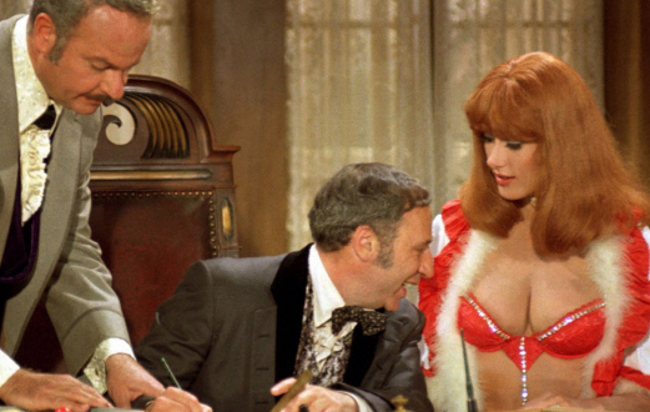
Blazing Saddles was released February 7th, 1974. It is directed by Mel Brooks and stars Cleavon Little, Gene Wilder, Harvey Korman, Madeline Kahn, and Slim Pickens. In order to scare the inhabitants of Rock Ridges into abandoning their town, Attorney General Hedley Lamarr (Korman), appoints a black man named Bart (Little) as sheriff, hoping that this will offend the townspeople who will reject him. Leaving the town defenseless. Bart must win over the townsfolk and foil Lamarr's plans with the help of a washed up gunslinger named Jim (Wilder).
Blazing Saddles is a parody of western movies. It contains a lot of allusions to earlier, classic westerns. In one scene, evoking High Noon (1952), the citizens of Rock Ridges gather together in the town church to decide what to do about the marauding bandits lead by Taggart. There is a similar scene in High Noon where Sheriff Will Kane goes to the church in Hadleyville to ask the people for help and they have a conference to decide whether or not to aid him. It also has similarities to Rio Bravo (1959), a film that was, in part, a response to High Noon. Jim, aka The Waco Kid bears is very similar to Dean Martin's character in Rio Bravo. Similarly Madeline Kahn's Lili Von Shtupp bears a striking resemblance to Frenchy (Marlene Dietrich) from Destry Rides Again (1939).
This movie is uproariously funny. Cleavon Little is clearly having a great time playing this hip, black sheriff who seems to have a bit of self awareness. Gene Wilder contrasts this with his unique sense of comedic timing and straight faced sarcasm. He and Harvey Korman get many of the best lines: "What's your name?" "Well, my name is Jim, but most people call me... Jim."; "We'll kill the first born male child in every household." "Too Jewish." The movie pokes fun at western movie cliches and Hollywood cinema in general. There is a lot of fourth wall breaking, leading up to the climax where a fight between the townsfolk and the bandits literally breaks through the wall into another movie set and then spills out into the Warner Bros. film lot. This ends with Bart and Jim going to a theater to watch the end of their own movie!
The main conflict in the film is Bart's struggle, being a that he's a black man, to win the approval of the racist white residents of Rock Ridges. This is meant as a commentary on the absence of African Americans in western movies, despite their contributions to the settlement of the west. It was also, perhaps, an indictment of the silence (largely) of Hollywood in regards to the history of racism within the United States. I appreciate this, as it adds a sense of maturity to the film.
At the same time Mel Brooks sense of humor is a little too raunchy and juvenile for my tastes. There is a lot of crude sexual humor, particularly in the scene where Lili tries to seduce Bart. There's also a scene where a bunch of cowboys eating beans around a campfire fart cacophonously. As I said this is mainly a taste issue. There are also a few scenes that dragged for me, particularly Lili Von Shtupp's musical number.
A critic (I believe it was Roger Ebert) once said that the best parodies are made by people who love the material they are satirizing (or something along those lines). Blazing Saddles feels like that. Though it savagely makes fun of many genre tropes it also seems to show affection for them. When Bart and the Waco kid ride out into the sunset at the end of the film in a limousine, it might be silly, but its also strangely heartfelt. So is the film itself.
Score: 9/10
Subscribe to:
Posts (Atom)