Saturday, August 12, 2017

Saturday Evening Cartoons: Akira (1988)


     Akira was released in 1988. It is written and directed Katsuhiro Otomo. In it Tetsuo Shima (Nozomu Sasaki), a member of a biker gang in the futuristic city of Neo Tokyo, gains psychic powers in a freak accident and becomes caught up in a secret government program involving other psychics. Shōtarō Kaneda (Mitsuo Iwata), Tetsuo's friend and the leader of the gang, sets out to find him. Meanwhile, a group of resistance fighters hope to capture Tetsuo and gain his powers for their own use.

     If the films of Hayao Miyazaki are the preeminent example of subtle, restrained anime Katsuhiro Otomo's Akira is on the opposite end of the spectrum. Adapting his own, at the time unfinished, 2000 page manga into a 2 hour movie Otomo's film moves at a relentless pace in order to include as many scenes and characters from the manga as possible. While Miyazaki's films are filled with serene scenes where little to nothing happens, Akira moves so breathlessly from one plot point to the next that you can barely keep up.

     The main plot involves the growing rivalry between Tetsuo and Kaneda, the conflict between the government and the rebels, and the efforts of the other psychics, called espers, to contain Tetsuo's powers. Kei (Mami Koyama), a member of the resistance eventually develops physic abilities of her own and is able to combat Tetsuo. Her friend and companion, Ryu (Tetsusho Genda) is working for a member of the parliament named Nezu (Hiroshi Ōtake), who is actually corrupt. All of these subplots are a little underdeveloped and is hard to keep up with them. Akira, who is an actual speaking character from the manga, appears here only in flashback and as a disassembled body in test tubes. Many other characters including Lady Miyako, the leader of a cult who hope to better control the psychics powers, and Chiyoko, a member of the resistance and a friend of Kei, are marginalized or left out all together.

     Akira paints a picture of an insane dystopian world where rioting and police violence seem to be a way of life. Yet amidst all this chaos, Neo Tokyo is filled with signs of corporate commerce. The lights and neon signs that fill the city suggest that consumerism is still rampant despite all the violence. The government, meanwhile, seems completely powerless. Yet there are still signs of hope in the end. The espers decide to sacrifice themselves to save Kaneda when he is endangered by Tetsuo's imminent self-destruction. They also suggest that Tetsuo may survive and transcend his current existence. At the end of the film, as Kaneda rides off into the ruins of the city with Kei and Kaisuke (Takeshi Kusao), and Colonel Shikishima (Tarō Ishida) watches the sun rise, we're left to wonder if the survivors can build a better tomorrow.

     The animation in Akira was really groundbreaking. It's completely hand-drawn and each frame was meticulously created by the animators. Neo-Tokyo is a neon saturated cyberpunk hellhole. At once dystopian and post-apocalyptic it provides a crucible for the diverse cast of characters to struggle through. There's depth and weight to the buildings, vehicles and people that make up the city. The scenes dealing with Tetsuo and the espers on the other hand, are distorted and dreamlike. It's like something out of the imagination of a six year old playing Five Nights at Freddy's on acid. The soundtrack, by Tsutomu Ōhashi's musical collective Geinoh Yamashirogumi, is a mix of drums, synthesized instruments and human voices that creates a sense of dissonance and tension that really complements the films tone.

     Akira is a furious, nitroglycerin fueled, nightmarish piece of animation. To quote Martin Scorsese (regarding Jean Luc Godard's Breathless) "It was too cool. I liked it. I didn't know what the hell was happening in it." Recommended to anyone who can stomach a little insanity.

Score: 8/10

Wednesday, August 9, 2017

Western Wednesdays: Wyatt Earp

     Wyatt Earp was released in 1994. It is directed by Lawrence Kasden and written by Kasdan and Dan Gordon. It chronicles the life of Earp (Kevin Costner), from his childhood in Pella, Iowa to his days as a U.S. Marshall in Tombstone, Arizona where his involvement in a feud with an outlaw band leads to the now famous gunfight at the O.K. Corral.

     The story behind the making of Wyatt Earp is almost more interesting then the film itself. Kevin Costner was originally slated to play the Earp in the film Tombstone, but disagreed with screenwriter Kevin Jarre about the direction of the story. Costner wanted the film to be more focused on his character and ultimately left the project. He then went to Lawrence Kasden (Raiders of the Lost Ark, Silverado) who wrote a script for a biopic about Earp. Worried about the potential competition from Tombstone, he used his, at the time, considerable influence in Hollywood to convince most major studios not to distribute the film (it was ultimately released under Disney's Buena Vista subsidiary). Kasdan had intended Wyatt Earp to be a tv miniseries, but Costner's involvement meant that it would be made for the big screen. In retrospect it probably would have worked out better as a miniseries.

     Wyatt Earp is overly ambitious. It attempts to condense nearly 30 years of Wyatt Earp's life into a 3 hour movie and, as a result, it feels really truncated at times. We see Wyatt Earp meet Doc Holiday (Dennis Quaid), but the incident that really brought them together, namely Holiday saving Wyatt's life in Dodge city, is omitted. In general, some scenes are omitted or pass by far too quickly while others linger on for far too long. Despite this I still quite liked the film.

     Wyatt Earp is easily the most historically accurate film about the man. Eschewing the romanticized mythologizing of John Ford's My Darling Clementine, the more loose, character driven approach of John Sturgis' Gunfight at the O.K. Coral, and the action driven Hollywood glitz of Tombstone, Kasden, Costner and Gordon set out to make a true biopic which would explore the man behind the legend. Costner's Earp is a broken man. Loosing his first wife Urilla (Annebeth Gish) shatters his world, leading him to become a drunken reprobate. Given a second chance by his father (Gene Hackman) he first becomes a buffalo skinner and then a lawman "the only thing that (he's) any good at". He's a hard man. One who won't hesitate to shoot first and ask questions later. He tells Ed Masterton (Bill Pullman), "This is a harsh land, Ed. It doesn't suffer fools." Family means everything to Wyatt, and he and his brothers share a bond that goes far beyond friendship. This devotion to family also means that the death of Urilla left a hole in Wyatt's heart that never really healed. He takes in a prostitute named Mattie Blaylock (Mare Winningham) as a common-law wife but he doesn't really love her. It's only when he meets Josie Marcus (Joanna Going) that he is able to find some measure of peace, and even then he must first contend with the murder of his brother Morgan (Linden Ashby).

     Costner does a decent job in the titular role, though his performance is perhaps, a little too subdued at times. Dennis Quad is pretty much perfect as Doc Holiday, bringing the right blend of charm and pathos to the role. Gene Hackman is great, as always, as Nicholas Earp. Micheal Madsen is somewhat wasted in the underdeveloped role of Virgil Earp, though I really liked Catherine O'Hara as Allie, Virgil's no-nonsense wife and ostensible matriarch of the Earp clan. Linden Ashby is solid, but somewhat forgettable as Morgan Earp. Mare Winningham's puts in a short but spirited performance as Mattie Blaylock. Joanna Going injects some much needed energy into the film as Josie. Tom Sizemore and Bill Pullman essentially play variations on the roles that would define their careers (in Saving Private Ryan and Independence Day respectively) as the Masterson brothers. Really there are too many characters in this film to cover everyone but, suffice to say, the rest of the cast all preform admirably.

     The best thing about this film is the visuals. Owen Roizman, the Oscar winning cinematographer of The French Connection, fills Wyatt Earp with striking, dynamic shots. He really captures the stark beauty of the American west. This is the kind of film where you could pause it at almost any random moment and get a beautiful still image to hang on your wall. The score, by James Newton Howard, is incredibly stirring and emotional. Combined with Roizman's striking imagery, it create some really powerful moments. Kasdan brings a real sense of authenticity to this film, not just through the costumes and set design, but through the way he stages the action. Anticipating the legendary shootout from Costner's Open Range, the gunfights in this film are chaotic and unpredictable.

     Wyatt Earp is certainly a flawed film but its better then its reputation would suggest. If you can look past its rather bloated, unfocused story, you'll find a visually arresting film filled with colorful performances that gives you some insight into the old west's most enduring figure.

Score: 8/10

Saturday, August 5, 2017

My Favorite Films: Kiki's Delivery Service (1989) (Saturday Evening Cartoons)


     Kiki's Delivery Service is essentially a coming of age story. Kiki sets out, with the blessing of her parents, to gain independence and make her own way. She must learn to balance her newfound responsibilities and also deal with emerging romantic feelings. This is communicated chiefly through the visuals. When she first arrives in Koriko she hopes to make a good impression on the people of the town, but she ends up flying into traffic and almost causing an accident. On her first delivery she loses the package and has to go to great lengths to retrieve it.Throughout the film, Kiki searches for acceptance from people in the town but struggles because she lacks confidence in herself. Despite this she is able to win people over through her kindness and goodwill. Osono, a pregnant women who owns a bakery, invites Kiki to live in the attic of her home after Kiki does a favor for her. A young boy named Tombo expresses interest in her but she haughtily shrugs him off. Despite this he persists and surprises her by inviting her to a party.

     She ends up missing the party in order to deliver a birthday present for an elderly women named Oku-sama. Standing in the rain outside of the home where she's delivered the package to Oku-sama's rather ungrateful granddaughter, Kiki reaches something of a low-point. After recovering from a cold she also is also able to regain some confidence when she goes out with Tombo. This confidence is shaken when some other girls who Tombo knows show up, causing her to feel jealous and leave. This leads her to lose her power of flight due to a lack of confidence in herself. She tells her cat, Jiji, "I think somethings wrong with me. I make friends, then suddenly I can't bear to be with any of them. Seems like that other me, the cheeerful and honest one, went away somewhere." Then the film does something unexpected.

     There's this great scene where Kiki goes on a kind of spiritual retreat with Ursula, an artist who lives in the woods outside of town, in order to find herself and reconnect with her powers. This helps her to come to a better understanding of herself and the person she is growing into. Because of this, Kiki's self-doubt and vulnerability end up being a positive thing. It leads here to seek self-reflection in a quiet and serene environment, something that is important to her growing as a person. Miyazaki's own restraint and sense of pacing in this film reflect this. Ultimately, this period of reflection gives Kiki the perspective she needs and she is able to regain her powers during the film's climax when Tombo' life is put in danger.

     What really makes Kiki's Delivery Service great is its subtlety and easy going atmosphere. While animation, both in the east and the west, is usually marked by bombast and larger-than-life settings Miyazaki's films are distinguished by there subtly and nuance. Despite being about someone who can fly this is a simple, down to earth story, brought to life in a beautiful, heartfelt manner by Miyazaki and the animators at Studio Ghibli. Miyazaki lets the film breath. There are many nice, quiet moments that don't really advance the story. They're just there for mood, atmosphere, and pacing. They invite the viewer to contemplate what there seeing, to really try to understand and empathize with the character.

    Though it doesn't feature the most breathtaking animation the studio has ever done, this is still a beautifully animated film. In particular it's the animators attention to detail that really draws you in to the story. Little details like the sweat on Kiki's face when she helps Oku-sama to bake her herring pie, the movement of the wind, rain and water, and the bustling activities of the people of of Koriko, really bring the world of the movie to life. But this is more than just eye candy. As I said, Miyazaki tells this story chiefly through the visuals and all of the intricate detail and expressive movement of the animation is put to use for this purpose. In the scene when Kiki flies home from after delivering Oku-sama's package, drenched by the rain and realizing that she is late for Tombo's party, the visuals tell us everything we need to now about her thoughts and emotions. Like all of Miyazaki's films, Kiki's Delivery Service displays the unpredictability of life.

     The way people and objects move is also important. In particular I love the way Miyazaki and the animators portray flying in this film. It's buoyant and graceful, giving you the impression of floating but it also feels tactile. Kiki has real weight as she maneuvers through the clouds on her broom. When I have dreams about flying, this is what it feels like. Indeed, the joy of flying and the desire to fly is a sort of motif running throughout the film. Tombo's obsession with flight is part of what initially draws him to Kiki and their mutual interest in it is what brings them together. It's partly Kiki's attraction toward Tombo that causes her to lose her powers and it's only when he is put in danger that she is able to regain them and the two are brought back together. Flying also ties in with another theme of this film, one that permeates all of Miyazaki's work: the connection between man and nature. When Kiki loses her ability to fly she also loses her ability to communicate with Jiji. The ability of young people to communicate with animals, and the loss of this as a part of growing up, symbolizing a loss of innocence, is a common trope in children's fantasy. Miyazaki takes this and feeds it into Kiki's arc. She may or may not be able to talk to her cat by the end of the story, it's left ambiguous, but she has learned to better communicate and interact with the people around her.

     The sound design is also very important and Miyazaki displays an uncanny ability to determine when to use music, ambient sound, or complete silence to express the emotion of a scene. Joe Hishaishi's score adds to the film's pleasant, easy going atmosphere and really punctuates the emotional moments. The main theme, featuring piano and solo violin is very melancholy and nostalgic while his use of accordion and plucked strings in other tracks lend a sense of youthful energy to the score and gives the world of the film a distinctly French feel.

     Kiki's Delivery Service is the kind of film I wish we could see more often. It's the kind of film that makes common, everyday events seem wonderful and magical. It's simply a joy to watch.


Thursday, August 3, 2017

Star Trek III: The Search for Spock Review

After much delay I have finally gotten back to reviewing the Star Trek movies...

     Star Trek III: The Search for Spock was released in 1984 (which, by the way, is probably my favorite year for movies). It is directed by Leonard Nimoy and written by Harve Bennet. In it Admiral Kirk (William Shatner) still recovering from the events of Star Trek II: The Wrath of Khan, learns that Spock's katra (his living spirit), which was transferred to Doctor McCoy (DeForest Kelley) must be reunited with his body and laid to rest on Vulcan. He must risk his career in order to return to the now restricted Genesis planet and retrieve the body of his departed friend.

     Star Trek III: The Search for Spock has the unenviable task of following up one of the best science fiction films of all time, Star Trek II: The Wrath of Khan. It is also burdened with bringing Spock back from the dead, a move that can't help but come off as corporately mandated. After all, it would be difficult to market Star Trek without its most iconic character. Thematically, it parallels but also subverts The Wrath of Khan. Kirk's emotional loyalty to his dead friend in this film is contrasted with the cold logic of Spock's sacrifice in that film. "The needs of the few outweigh the needs of the many" Kirk tells Spock near the end of the movie, the idea being that, while sacrificing oneself for the good of the many is noble it's also noble to risk one's life for a single human person, especially a friend, or even for a whole group to do this collectively. Jesus laid down his life so that "the many will be made righteous" but we also know that he would have done the same thing even if it would have saved only one person. "There will be more joy in heaven over one sinner who repents than over ninety-nine righteous persons."

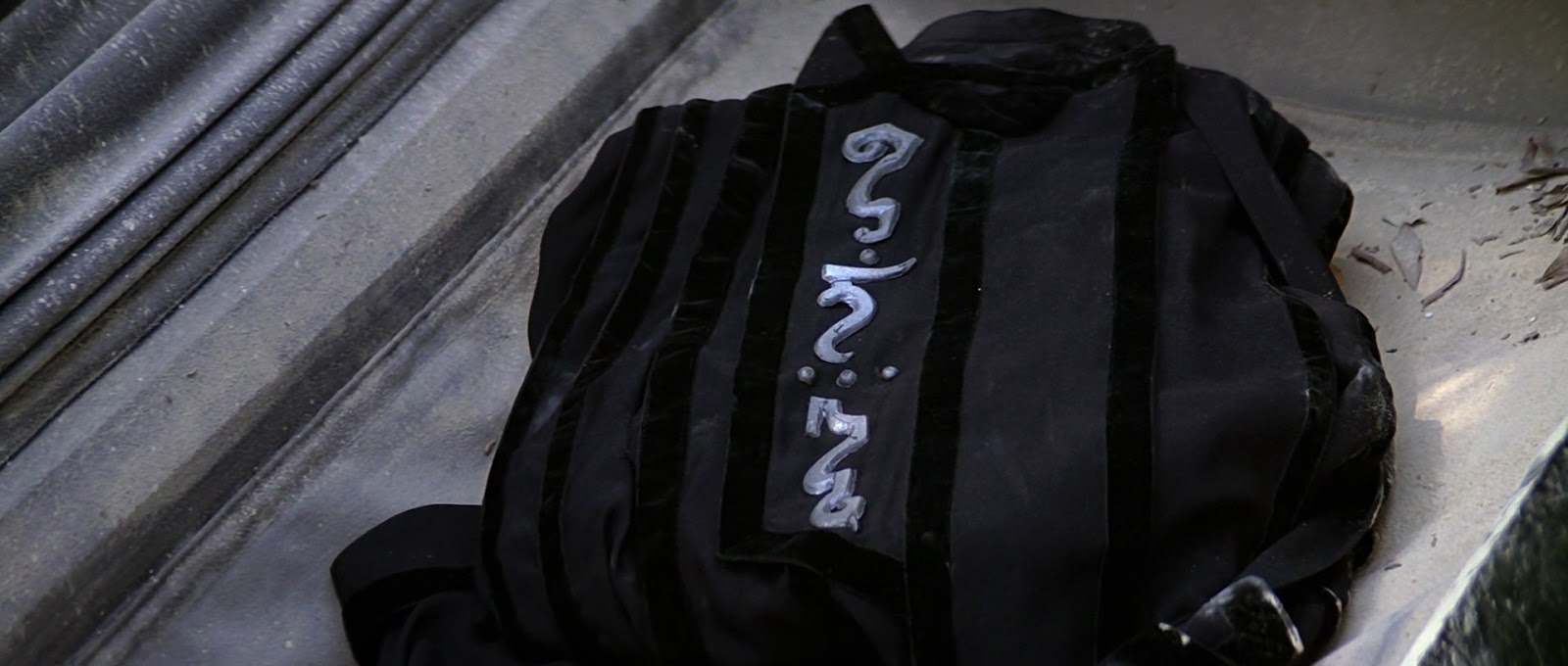
"He saw the linen cloths lying there, and the face cloth,
which had been on Jesus’a head."
    It may seem odd to quote scripture in a review for a Star Trek movie but then, this film is filled with religious allusions. A comparison could be made between Kirk's efforts to retrieve Spock and Dante's journeys in the Divine Comedy. After his experience in Wrath of Khan Kirk goes on a sort of quest, descending into purgatory and then hell, metaphorically, in order to regain his lost friend. Spock's return from the dead, on the other hand, evokes the Resurrection of Jesus. When David Marcus (Merritt Butrick) and Lt. Saavik (Robin Curtis) come across his coffin (a torpedo casing) they, like Peter and John on Easter morning, find his burial robes. Then, just before finding the newly reborn Spock, an earthquake occurs. "There was a great earthquake, for an angel of the Lord descended from heaven and came and rolled back the stone." If Khan in Star Trek II can be likened to Satan from Paradise Lost seeking revenge against Kirk the "god" who banished him from paradise, then Spock is like Jesus, who sacrifices himself to save paradise and then is brought back to life through Kirk's efforts.

     As in Wrath of Khan, the characters in this film are faced with the consequences of their actions. David, we learn, used an unstable element to create Genesis, reducing the device to a destructive force, a mistake he pays for with his life. Kirk regains the friend he lost but loses his ship and his son in the process. The destruction of the Enterprise is this films greatest conceit, as it makes Spock's return feel earned. It's also just a great, cinematic moment. The death of David Marcus, on the other hand, is its biggest mistake. Star Trek II ended with the prospect of Kirk forming a relationship with his son. Essentially he had become a father. Because David dies here, that will never come to fruition. It doesn't help that his execution by the Klingon's feels unnecessary and lacks the emotional impact it should have, as we've barely gotten to know the character. 

     I should note however, that his death will have important repercussions later one in Star Trek VI, where Kirk must put aside his hatred of the Klingons in order to pursue peaceful relations with them. Indeed, Star Trek III probably contributes more to both Klingon and Vulcan mythology than any big-screen Trek adventure. Christopher Lloyd clearly has a lot of fun in the role of Commander Kruge and imbues the character with that strange combination of savagery, loyalty and uncompromising sense of honor that would forever after be the mark of the Klingons in Trek.

     The biggest flaw of Search for Spock is it's pacing. The main conflict of the film only takes up about 40 minutes of run-time. This is preceded by nearly an hour of set up and then a 20 minute resolution where Spock's body is reunited with his katra on Vulcan. This imbalance between the three acts makes for a rather awkwardly paced movie. It's also shot and edited in a rather dull manner and, despite having a bigger budget than Wrath of Khan, it has a cheap look and feel much of the time. On the other hand the score, once again by the late, great James Horner, is magnificent. Appropriately, it's much less rousing then that of its predecessor, filled instead with understated, somber music befitting this film's subject matter. Horner also utilizes Alexander Courage's original theme for the show, making Star Trek III one of the few films of the series to do so.

     The biggest advantage Star Trek III has is it's director, Leonard Nimoy. If there's anyone who knows what makes Trek work its him. There's a real feeling of camaraderie among the Enterprise crew in this film, largely thanks to Nimoy's familiarity and friendship with the rest of the cast. Both Sulu and Uhura get nice little moments, though they are rather fleeting. The cast, generally, is in good form, though Nimoy has barely any screen time and DeForest Kelley is well, not himself through much of the run-time. As Kirk says at the beginning of the film "Enterprise feels like a house with all the children gone." In many ways that's the entire crux of this film: to bring the crew back together again so Kirk (and the franchise itself really) can begin the new lease on life that he felt he gained at the end of Star Trek II.

     Out of all the Star Trek movies, this one feels the most like an episode of the original series. This is partly due to the cheap look it often has but it's also because of the film's relatively short run time. Cut out about 15 minutes and this could easily be a two part episode of a tv show. In many ways it relies on its predecessor in order to work and, because of this, it will always be stuck in that film's shadow. It may be the weak link in the loose trilogy made up of Star Trek II, III and IV, but it's still a pretty decent film in it's own right and, in many ways, an essential part of Trek canon.

Score: 8/10


Wednesday, July 26, 2017

Western Wednesdays: The Return of Ringo (1965)

     The Return of Ringo was released in 1965. It is directed by Duccio Tessari and stars Giuliano Gemma, Fernando Sancho, and Lorella De Luca. In it Union Captain Montgomery "Ringo" Brown (Gemma) returns home from war only to find that his home has been ravaged by Mexican bandits, lead by the Fuente brothers, and he must set things aright.

     Tessari drew inspiration from the final chapters of Homer's The Odyssey in writing the screenplay for this film. Like Odysseus, Brown returns home from war after many year only to find that it has been taken over by greedy opportunists. His wife Helen (Hally Hamond), like Odysseus', is engaged to marry one of them and he must determine if she has remained faithful. Disguising himself as a Mexican peasant and taking a job with the local florist, Morning Glory (Manuel Muñiz), he begins to investigate the Fuentes doings. He eventually discovers that his wife has borne him a daughter in his absence and that she is being used by Paco Fuentes to make Helen compliant.

     Giuliano Gemma gives perhaps his best performance as the tortured Montgomery Brown. He really conveys the character's despair when he learns of his wife's supposed treachery and the psychological trauma he goes through in trying to restrain himself from revealing his presence sooner is palpable. He is clearly pained by what his wife has been forced to do and deeply frustrated by his inability to stop it. The scene where he finally reveals himself to Helen is particularly effective. Antonio Casas is also effective as the cowardly Sheriff Carson, who eventually takes courage and comes to Captain Brown's aid, as is Rinaldo Zamperla as the Mexican prostitute whose loyalties are unclear.

     Tessari fills the movie with memorable imagery: Gemma emerging at the entrance of the church in the middle of a sandstorm, like a ghost returned from the grave; the "wedding" between Helen and Paco, surrounded by caskets which, unbeknownst to Paco, contain his men who Ringo has slain. The action is decent, though Tessari use quick cutting a little too much for my taste rather of letting the action play out in longer shots. The score, by the now legendary composer Ennio Morricone, really helps to bring out the sadness in Gemma's character and lends a melancholy air to the film.

     Though occasionally a little cheesy (the less said about Gemma's Mexican "disguise" the better) and somewhat lacking in the action department, The Return of Ringo is still a really solid Spaghetti Western, featuring a psychologically driven story, told chiefly through the visuals, and a great performance from Guilano Gemma.

Score: 8/10

Monday, July 24, 2017

Musical Mondays: The Phantom of the Opera (2004)

     Andrew Lloyd Webber's The Phantom of the Opera is, perhaps, the most successful theater musical of all time. It's been on Broadway since 1988 and the West End since 1986 and has grossed over $5.6 billion. Despite this, critics have often dismissed it as empty bombast. I'd liked to think there's more to it then that. While it's true that this story doesn't really have a lot of depth on paper it does work on a raw emotional level and, if properly cast, the performances can add depth to otherwise thinly drawn characters. In other words, The Phantom of the Opera succeeds or fails mainly because of the quality of its production, or lack thereof.

     This brings us to the 2004 film adaptation of the play. Directed by Joel Schumacher and produced by Andrew Lloyd Webber himself, this film casts Gerard Butler as the mysterious Phantom of the Paris Opéra House who develops a dangerous obsession towards young soprano Christine Daaé (Emmy Rossum). It follows the plot of the play pretty much scene for scene.

     The Phantom blackmails the owners of the opera house (played by Simon Callow and Ciarán Hinds) into giving Christine the lead role in their production of Hannibal. He believes that no one can ever truly love him because of his scarred appearance. Because of this, he tries to coerce her into a relationship by exploiting her love for her long dead father. Christine at first believes that the Phantom is the spirit of her father while Raoul (Patrick Wilson), the opera's patron and Christine's childhood sweetheart, does not believe that he exists at all.

     When the Phantom kidnaps Christine in the films climax, she rejects him not because of his scarred appearance but because of the terrible acts he has committed. When he threatens to kill Raoul, who has been captured by the Phantom in his attempt to rescue her, Christine finally relents. She shows him real love and compassion and decides to stay, not just to save Raoul but in hopes that she can save the Phantom's humanity as well. This awakens the man inside the monster and he decides to let her go.
     It seems like certain decisions were made to improve on the play, or perhaps to make it more cinematic, but very little thought was put into these changes and they end up making matters worse. A good example of this occurs in the scene where Christine is wandering through the grave yard and encounters the Phantom, who she still thinks may be the spirit of her dead father. Raoul shows up and shakes her out of her reverie. In the play he is taunted by the Phantom until Christine persuades him to leave with her but in the movie the two men have a sword fight and Raoul defeats the Phantom. This seems like it could be a good idea at first. It makes Raoul stronger, more assertive character.  But then Christine pleads with Raoul to spare the Phantom, who he has at his mercy, so he just leaves. Wouldn't make more sense to turn him in to the authorities?

The film version of "Masquerade" on the left and the play on the right
     In addition to this, Joel Shumacher direction robs the musical of much of its more hypnotic and eerie qualities. In the play, there's a certain shallow, garish sensuousness to the polite society that the Phantom is hiding from and a hypnotic and seductive quality to his underground lair. Christine's seemingly mad belief that the Phantom is her father makes more sense in this atmosphere. While the film does a decent enough job with the Phantom and his world, the set and costume design in the opera house and, later, the ballroom is rather dull and uninspired. As a result, the film completely lacks the unsettling quality that made the play work and fails to draw you in in the same way.

     The biggest problem this movie has, however, is the music itself. Gerard Butler, simply put, can't sing. He's rather tone deaf and struggles to even enunciate correctly half the time. Since he is featured in most of the major musical numbers, this is a huge problem. Emmy Rossum, though not a bad singer, is really not up to the task of playing a character who's supposed to have an amazing, angelic voice. Patrick Wilson has the best voice of the three but is wasted in a role that was underwritten in the first place and is even less likable in this film's script. The musical numbers are also staged lazily and Schumacher has the actor's awkwardly speak the lyrics instead of singing them in certain scenes.

     This movie does feature some cool sets and Webber's music is great when it's not being ruined by terrible singing but, in the end, this film version of The Phantom of the Opera is the shallow spectacle critics always accused the play of being.

Score: 5/10

Saturday, July 22, 2017

Saturday Evening Cartoons: Superman, Volume 1: Son of Superman

     No character suffered more from DC's 2011 New 52 reboot than Superman. The main title went through six different writers over a five year period and Action Comics went through four. Some of these writers included Grant Morrison, author of the beloved miniseries All-Star Superman; DC Comics' new Chief Creative Officer, Geoff Johns; Greg Pak, of Planet Hulk fame; and George Perez, who was responsible for now legendary runs on Teen Titans and Wonder Woman. Throughout these various runs Superman often came across like a bitter loner, particularly during Gene Luen Yang's Before Truth story-line. His romance with and marriage to Lois Lane was removed from continuity and Superman was given a relationship with Wonder Woman instead. The Convergence crossover event in 2015 was the beginning of a change for the character. In this story-line a large number of DC characters are forced to fight each other by Braniac. Among these characters is the original, pre-Flashpoint version of Superman, who is married to Lois and now has a son. This Superman survives the events of Convergence and comes to earth with his family, continuing to use his powers to help people in secret and keeping his eye on this earth's version of Superman. The New 52 ended with Superman's death, setting the stage for the original Superman to return in DC's 2016 Rebirth relaunch.

     Peter J. Tomasi and Patrick Gleason, the same team who had handled The Final Days of Superman crossover, were assigned the Superman title for this relaunch. The first story arc in their run, entitled, Son of Superman, deals with the original Superman's struggles to establish himself and his family on this new earth after the death of its Superman. They settle in to their new home in Hamilton County and Superman is confronted by Batman and Wonder Woman, who are initially distrustful of this new Superman. Meanwhile, his son Jon must learn to control his developing superpowers.

     Tomasi and Gleason really get Superman. He is presented in this story as an assertive hero and a wise father. This is clearly a character who has been through a lot. He died at the hands of Doomsday only to come back to life, he married Lois Lane and had a son, and he survived the destruction of his entire world and must now make a new home for himself and his family. But through it all he retains that sense of optimism that is so essential to the appeal of the character. They also bring a much welcome family dynamic to the series that is just the breath of fresh air the character needed. Seeing Superman struggle to be a good husband and father really humanizes him in a way I haven't seen before. Gleason, along with inker Mick Gray really convey this grounded yet soaringly optimistic felling through their art. It's always really vibrant and graceful and Gleason handles the transition between action driven superheroics and intimate family drama with ease. The plotting is also spot on. Gleason and Tomasi really know the right time to deliver a stunning large panel or splash page and there are a lot of interesting layouts, yet its always clear where my eye is supposed to go next.

     There are some major problems with this arc. For one thing it's a little bogged down in continuity. This is most apparent in the first chapter (originally published as a one shot) where Superman and Lana Lang try to bring the New 52 Superman back to life. Superman believes that this version of himself will come back to life just as he himself once did, but finds that this is not the case. This opening to the arc exists to catch the reader up with the continuity changes brought about by Convergence and Rebirth. It does a decent enough job but, unfortunately, this also means that it takes a while for the story to really get going. Indeed it's not until the end of chapter 3 that the main villain of the arc, Eradicator, is introduced. Eradicator is a good villain for this story as it forces Jon to come to terms with his duel heritage and also allows Kal El to come face to face with his ancestry. The remaining four chapters are basically an extended fight between Superman and Eradicator which its stretched a little thin at times.

     My other problem with this arc is the inconsistent artwork. While Gleason and Gray's art is, as I mentioned, fantastic, nearly half of the book features art by other people, including Phil Jimenez and Doug Mahnke. While there art is fine on its own it doesn't mesh well with Gleason's style. The color pallet is much more subdued and the facial work generally more realistic and less expressionistic.

     Despite some of these challenges (which are really quite common to the Rebirth relaunch as a whole) Son of Superman is a strong start to Tomasi and Gleason's run. If they can work out some of the kinks moving forward, I think we're in for something really special.

Score: 8/10