Thursday, September 14, 2017

My Favorite Films: Star Trek IV: The Voyage Home

"They say the sea is cold, but the sea contains
the hottest blood of all, and the wildest, the most urgent."
-D.H. Lawrence, Whales Weep Not


     Star Trek IV: The Voyage Home is not my favorite Star Trek film (that would be Star Trek II: The Wrath of Khan) but it is the closest in spirit to Gene Roddenberry's original vision for the series: a bright future where humanity has left behind its petty conflicts and joined a larger, intergalactic community. Fun, entertaining stories with big ideas are the very essence of Trek and Leonard Nimoy, who wrote and directed this film recollected, “No dying, no fighting, no shooting, no photon torpedoes, no phaser blasts, no stereotypical bad guy. I wanted people to really have a great time watching this film [and] if somewhere in the mix we lobbed a couple of big ideas at them, well, then that would be even better.”

     At the end of Star Trek III: The Search for Spock Spock remembers that Kirk's first name is Jim. This is but a first step in the character regaining his old sense of identity. In the opening scene of Star Trek IV, we see him testing his mental faculties using a computer program on Vulcan. He aces every question until the computer asks, "how do you feel" which perplexes him. Intellectually, he's back to normal, but emotionally, he still has much to regain. Throughout this film we see him learn to stretch the truth, to "guess" and we see him rekindle his friendships with Kirk and Bones. At the end of the film, when Spock chooses to stand along side his shipmates at the court martial we get the sense that he has finally found himself again. He tells his father "They are my friends" and when asked by Sarek what he should tell his mother he replies, "Tell her, I feel fine."

     Similarly, after the crushing events of the previous two films Kirk is also struggling to move forward in his life. In addition to the emotional scars left by the destruction of the Enterprise and the death of his son, he must also deal with the material consequences of defying Starfleet Command and returning to Genesis to find Spock. This film takes him on a classic hero's journey. He leaves his home when it becomes imperiled in order to save it and on returning he regains his honor and is able to reenter society. This nicely completes Kirk's arc from the previous two films, after being confronted by his past and having gone through hell, Kirk can now get back to doing what he loves.

     Star Trek IV is a great comedy. The script, by Nicholas Meyer and Harve Bennett, is filled with quotable lines. It's not as thematically complex as Star Trek II but, as far as dialogue goes, it may have the best script of any Trek film. There are so many witty exchanges. When a disgruntled cab driver calls Kirk a dumbass he replies, "Well, uh, double dumbass on you!" Discouraged in his attempts to discuss Spock's recent death and rebirth with the Vulcan McCoy says "You're joking!" to which Spock replies, "A joke ... is a story with a humorous climax." When trying to sneak into the hospital to rescue Chekov, McCoy says that Taylor "has immediate postprandial, upper-abdominal distention." When asked by Kirk what that is, he replies "cramps." All of this dialogue is hilarious but it also feels consistent with who these characters are and who they've become. In addition, many of the scenes were at least partly improvised. This lends a great sense of spontaneity to the film. It helps that all of these actors, especially Nimoy and Shatner, already have great chemistry, as does newcomer Catherine Hicks as Doctor Gillian Taylor, the scientist whose dead set on saving "her whales." The scene where she asks Kirk and Spock if they like Italian, which was completely improvised by Shatner and Nimoy, is one of the film's funniest moments.

     Even more then in Star Trek III Nimoy goes out of his way to give the supporting cast heavier involvement in the story and more memorable scenes. While Kirk and Spock are tracking down the whales, Sulu, Scotty and Bones are tasked with obtaining the materials to construct a water tank in the ship while Uhura and Chekov must obtain a nuclear reactor to restore power to the ship. DeForest Kelley and James Doohan get to preform this wonderful scene where their characters bribe the head of the Plexicorp plant to give them the plexiglass they need in exchange for the formula for transparent aluminium (a substance which has actually been invented since the films release). Nichelle Nichols and Walter Koenig, of course, are featured in the now iconic scene where Chekov asks passersby if they can tell him where to find "the nuclear wessels." Finally, although a subplot featuring Sulu meeting his distant ancestor was ultimately cut, George Takei gets his own, briefer subplot where Sulu piloting skills (and love of antiques) are both referenced. Nimoy clearly cared about the cast and valued their contributions to the film. His direction, in general is more assured this time around, featuring longer takes and, as I mentioned, improvisational comedy.

     Another great thing about The Voyage Home, which I alluded to earlier, is that it's one of the few Star Trek movies that doesn't feature a main villain. In many episodes of the original series, the crew had to deal with scientific problems that were not caused by some malevolent being but were rather caused by a misunderstanding or were simply natural disasters. In Star Trek IV, humanity itself (or at least humanity as it existed in 1986) is the central source of adversity for the crew of the Enterprise. By hunting the humpback whale into extinction, humanity has forever deprived itself of the secrets these creatures hold. This was very prescient in the 1980's, a time when there was growing concern over the hunting of humpback whales. In one scene, reminiscent of actions taken by members of Greenpeace, the crew pilots the Bounty (their repurposed Klingon ship) in front of the whales to protect them from a group of Russian whalers.

     The whales themselves are animatronic, and they look amazing. Many people, including myself, mistakenly thought they were real on a first viewing. The sound effects for the probe where taken from a baby's heartbeat, slowed down and digitized. Originally, the studio wanted subtitles to explain the probe's message to the audience, but Nimoy disagreed as he wanted a sense of mystery surrounding the probe and the whales. Indeed, there's a respect for nature and for mystery present in Star Trek IV that is contrasted with the films sense of joy and whimsy. The score, by Leonard Rosenman, has a really lighthearted, festive quality that really complements the film's tone. The film's unique premise allowed Rosenman to write in a variety of styles including a jazz fusion piece (preformed by Yellowjackets), a classical baroque piece, and even a fugue. It's a bit dissonant but it works. I would be remiss not to mention the punk song "I Hate You", which provides the impetus for one of the films most iconic scenes. Written by associate producer Kirk Thatcher(who also played the punk on the bus who annoys Kirk by blasting the song on his boom box) it's easily the best fake punk song ever produced.

     Star Trek IV remains the most optimistic film in the Trek canon. It's not concerned with deep philosophical questions or social allegory nor is it filled with mindless action. At the end of Star Trek II Kirk says that he feels young, a statement that was severely tested in the following film. At the end of this film McCoy says "The bureaucratic mentality is the only constant in the universe. We'll get a freighter." But this acerbic statement is immediately proven false as the Enterprise comes into view and we find that the crew is finally home again. Like the whales, and like humanity itself, the crew of the Enterprise have finally been granted a second chance.

Wednesday, September 6, 2017

Western Wednesdays: The Comancheros

 
     The Comancheros was released in 1961. Based on the book by Paul I. Wellman, it is directed by Micheal Curtiz (Casablanca) and written by James Edward Grant and Clair Huffaker. In it Captain Jake Cutter (John Wayne) a Texas Ranger, arrests gambler Paul Regret (Stuart Whitman) for killing another man in a duel. The two men become embroiled in a conflict between Comanche Indians and white settlers fueled by a group of renegade arms merchants called the comancheros.

     The Comancheros is somewhat sprawling and unfocused. It sets up the romance between Regret and Pilar Graile (Ina Balin), the daughter of the comancheros leader, early on but her character doesn't appear again in the story until the last act. There are basically two competing plotlines. One focuses on Cutter's efforts to infiltrate and ultimately bring down the comencheros. The other is the rivalry, and eventual friendship, that develops between Cutter and Regret. The two plot are never satisfactorily interwoven however, and the film feels meandering and episodic as a result. Despite this, the film remains entertaining throughout, thanks largely to the cast and the quality of the production.

     John Wayne is his usual charismatic, swaggering self as Jake Cutter. Stuart Whitman does a fine job as the dandy Paul Regret and Ina Balin's fiery, untamed Pilar makes a good match for him, even if their romantic relationship is underdeveloped. Micheal Ansara puts in his usual solid character work as Amelung, one of Graile's lieutenants and the closest thing the film has to a main villain. Nehemiah Persoff's Graile is somewhat unremarkable. Meanwhile Lee Marvin, in a brief but memorable role, almost steals the show as the bad tempered comenchero Tully Crow.

     Micheal Curtiz, who was ill during the production, died shortly after the films release. Because of Curtiz's illness John Wayne had to take over directing more than once. This probably contributed to the films uneven sense of pacing. The cinematography by William H. Clothier, who also shot The Alamo for Wayne, is quite stunning and he fully takes advantage of the vistas of Utah's Professor Valley. Elmer Bernstein brings the same sense of epic adventure that he showed in The Magnificent Seven for the film's score.

     The Comencheros is a flawed film to be sure. It may not offer much in the way of a nuanced story but it's a fairly entertaining western nonetheless.

Score: 7/10

Saturday, September 2, 2017

Saturday Evening Cartoons: Laputa: Castle in the Sky


           Laputa: Castle in the Sky was released in 1986. Written and directed by Hayao Miyazaki, it is the first feature film produced by Studio Ghibli. In it a young boy named Pazu is caught up in an epic adventure when he meets Sheeta, a young girl who's on the run from the military and a band of pirates. Both seek the mysterious amulet she possesses, an artifact from the legendary flying city of Laputa.

     Like all of Miyazaki's work, Castle in the Sky is highly imaginative. The setting is really unique, the mining town Pazu resembles a Welsh mining town and the land is filled with Medieval European style architecture, the government technology has a steampunk vibe, the pirate ship, and the pirates themselves, show more of a Victorian influence, and the soldiers are dressed in 19th century style military dress. Laputa itself is a work of pure imagination, part steampunk Athens, part Garden of Eden, the flying city in the clouds is every bit as awe inducing as we've been lead to expect.

     The mythology of Laputa, which draws inspiration from Hindu legends, is a bit vague, but this adds an air of mystery to it and we're given enough information to understand what's going on. This film touches on themes related to the destruction of nature and the abuse of technology, both represented by Colonel Muska, a government agent who wants to use the power of Laputa for his own destructive ends. We see in Muska the corrupting influence of power, leading, ultimately, to indifference toward human life, while protagonist's show compassion for others and respect for nature, particularly in their sacrifice during the climax.

     My one major complaint toward Castle in the Sky is that, while all the supporting characters are interesting and unique, Pazu and Sheeta feel a little flat in comparison. This may be due in part to the English dub. I like Anna Paquin, but her Sheeta feels a little too passive and subdued. James Van der Beek's Pazu fares a little better, but he sounds older then the character is supposed to. I would very much like to see the original Japanese language version to see how it compares. The supporting cast, on the other hand, are all fantastic. Cloris Leechman's Dola, the matriarchal leader of the pirates, is particularly great, and the script allows our perception her character to grow through the course of the film, from a terrifying villain to a likable anti-hero. Mark Hamill is also great as Muska, bringing the same measure of menace and guile to the role that he brought to the Joker, though of course less unhinged.

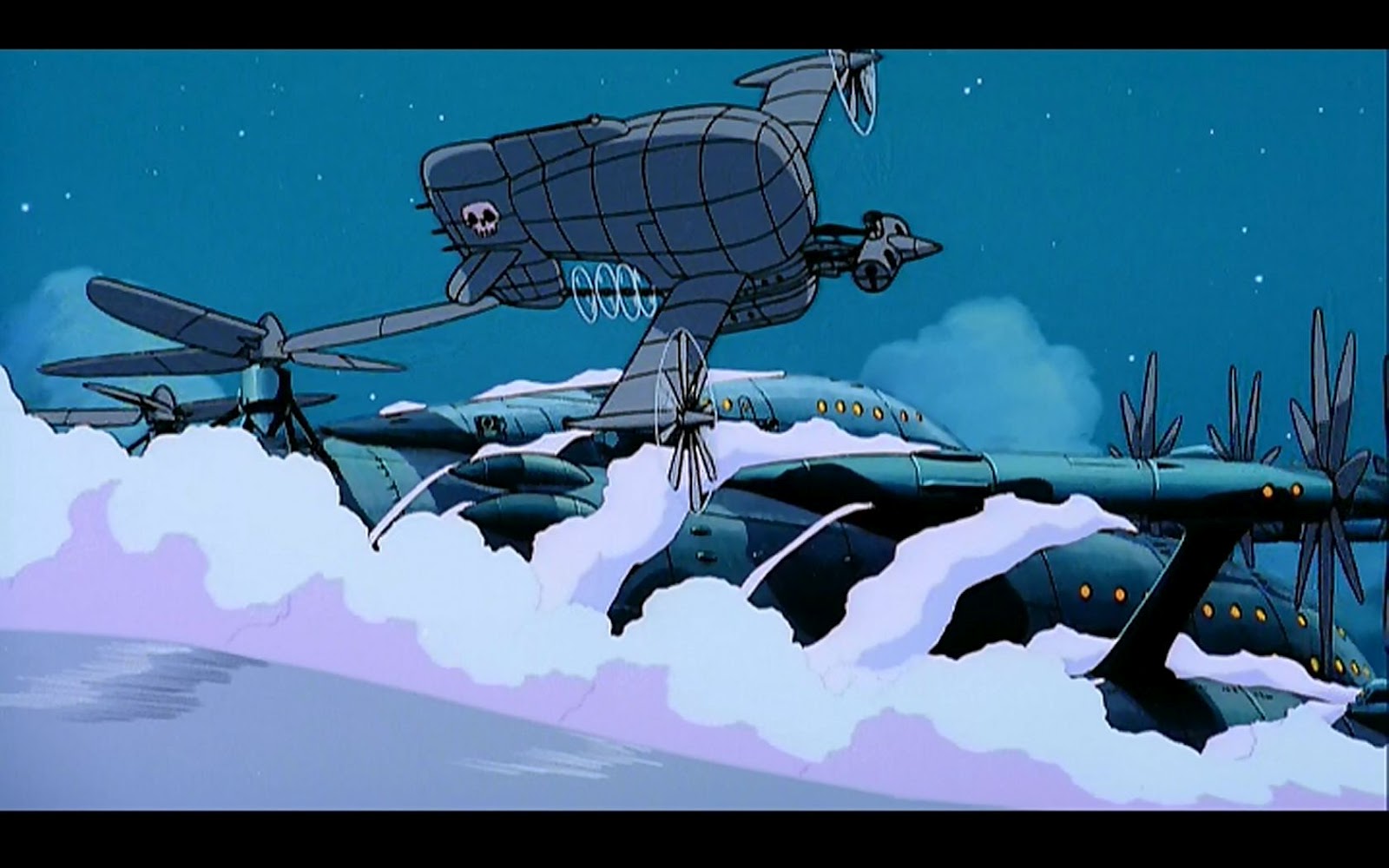
     Laputa is more of an action/adventure film then most of the Studio's output and boy is it a good one. From start to finish the action scenes are bursting with energy and creativity. The aerial battles, between the steampunk, dirigible like aircraft are particularly innovative and, like the space battles in Star Trek, take inspiration from naval battles. The animation, as always, is really stunning and the animators attention to detail is just as apparent as ever. Joe Hisaishi, who reworked his original electronic score into an orchestral one for the U.S. release of the film, writes some really majestic music for this film. The choral piece accompanying Laputa's destruction during the film's climax is among the most moving he's ever written.

     Laputa: Castle in the Sky is essential viewing for fans of anime. It launched one of the mediums great success stories with Studio Ghibli and was an important step forward for Hayao Miyazaki. It may not be his best work but it's an eminently entertaining film none-the-less.

Score: 8/10

Monday, August 28, 2017

Musical Mondays: The Umbrellas of Cherbourg (1964)


     The Umbrella's of Cherbourg was released in 1964. It is written and directed by Jacques Demy and features music by Michel Legrand. It tells the story of two young lovers, Genevieve Emery (Catherine Deneuve) and Guy Foucher (Nino Castelnuovo), whose love is tested when Guy is drafted into the French Military.

     The story follows an incredibly straightforward three act structure. In the first act we're introduced to our main characters Genevieve and her mother (Anne Vernon) who own a struggling umbrella shop, and Guy who works as a mechanic and lives with his ailing aunt Elise (Mireille Perrey). The two young lovers marriage plans are interrupted when Guy is drafted into the military and sent to the war in Algeria. In act two Genevieve learns that she is pregnant and is courted by rich young jeweler named Roland Cassard (Marc Michel). Discouraged by Guy's absence and his infrequent correspondence, she eventually accepts Roland's proposal. In act three Guy returns from the war only to find that Genevieve has married and left Cherbourg. He becomes aimless, losing his job and sleeping with a prostitute. When his aunt dies he finally comes to his senses and decides to rebuild his life with his aunt's caregiver, Madeleine (Ellen Farner).

     I won't spoil the film's denouement, which takes place four years later, but it's simply beautiful. It's simultaneously bittersweet, melancholy, uplifting, and even life-affirming. Ultimately, the film is about young love and how it rarely works out, yet it never feels depressing or jaded. Last year's La La Land owes a lot to this film, both in its tone and story. I wish more modern films would draw inspiration from Demy.

     Michel Legrand's jazzy score perfectly suits the films tone. All of the dialogue is sung as in an opera which, at the time, was a innovation. The actor's voices were dubbed by professional singers, so they all sound quite good. The actors themselves all do a great job, with Anne Vernon being a standout as the shrewd but sensitive Madame Emery. Demy directs the film with real panache, infusing it with a vivid color pallet which, as the story progresses, contrasts with the films growing sense of melancholy. Jean Rabier bright, colorful cinematography enhances the emotional impact of the film and adds to its distinct tone.

     The Umbrellas of Cherbourg is honestly one of the best musicals I've ever seen. It just has this infectious sense of joy. If you don't mind watching a film with subtitles, this is a must see.

Score: 10/10


Saturday, August 26, 2017

Saturday Evening Cartoons: The Emperor's New Groove

     The Emperor's New Groove was released in 2000. It is directed by Mark Dindal and written by David Reynolds. It tells the story of Kuzco (David Spade), an Inca Emperor, who is turned into a llama by his ex-administrator Yzma (Eartha Kitt). With the help of a llama herder named Pacha (John Goodman) he must regain his human form and his throne, and along the way learn a valuable lesson about kindness.

     This film surprised me in more ways than one. For one thing the protagonist is a singularly unlikable, self-absorbed character. At the beginning of the story there really isn't much, if anything, to separate him from the main villain. Indeed the Yzma's grievance against Kuzco fairly legitimate even though we never sympathetize with her. It's Kuzco's ability to grow as a character, past his self-centeredness, that ultimately gives him the moral high ground by the end of the story. Another thing that surprised me was Pacha's occasional selfishness. He refuses to help him the emperor unless he agrees not to tear down his village. This is completely understandable and relatable yet the fact remains that his motives are not completely altruistic. Yet he decides to help Kuzco more than once, despite the fact that he will gain nothing from it. Kuzco himself must learn from Pacha's example and, ultimately, has to choose between saving him or saving his antidote from being destroyed.

     First and foremost, The Emperor's New Groove is a comedy, and it's a hilarious one. The animation is filled with manic energy and there's a clear Chuck Jones/Looney Tunes influence here. The cast are all in top form. David Spade and John Goodman have great chemistry as the buddy duo of Kuzco and Pacha. Spade can get a little irritating but that's kind of the point and while I found Goodman's voice a little distracting at first (I kept imagining Sully saying his lines) he quickly grew into the likable, everyday guy role. However it's Eartha Kitt and Patrick Warburton who steal the show as Yzma and her dimwitted henchman Kronk. Warburton's childish, uncomprehending demeanor contrasts perfectly with Kitt's hysteria.

     The Emperor's New Groove may be a minor entry in the Disney animated canon, but nonetheless it's an eminently entertaining and well written one.

Score: 9/10

Wednesday, August 23, 2017

Western Wednesdays: The Mountain Men

     The Mountain Men was released in 1980. It is directed by Richard Lang and written by Fraser C. Heston. It tells the story of Bill Tyler (Charlton Heston) and Henry Frapp (Brian Keith), two Montana fur trappers who get into trouble when they meet Running Moon (Victoria Racimo), a Blackfoot squaw who has fled from her abusive husband, Heavy Eagle (Stephen Macht).

     Like many westerns The Mountain Men is often preoccupied with the erosion of the wilderness and the coming of civilization symbolized, in this case, chiefly through the character of Nathan Wyeth (John Glover). Wyeth is a tenderfoot who hopes to lead a wagon train over the mountains and for Frapp and Taylor, this would mean an end to their way of life. Already, their time seems to be running out. The beaver they trap are becoming scarce and the pelts they sell are no longer bringing a reasonable profit. Their buyer, Fontenelle (Ken Ruta) tells them, "Take it while you can, boys. Next year you may not be able to sell beaver at all." The wilderness, for the characters in this film represents freedom. Running Moon takes up with Tyler initially, to escape her marriage to Heavy Eagle, a marriage she had no say in. She pursues a relationship with Tyler not so much out of any physical attraction but because she desires a relationship on her own terms.

     This film was met with incredibly negative reviews on its initial reviews. Critics complained that the film seemed behind the times, displaying attitudes toward Native Americans for instance, that seemed out-of-fashion in the 1980's. I don't think this is totally unfounded. As much as Fraser Heston tries to flesh out Heavy Eagle by having him reflect on the end of life for his tribe, he can't help but come off as a one dimensional mustache twirling villain by the end. The film is also filled with insipid dialogue, choppy editing and generally over-the-top performances.

     Despite this I don't hate the movie. There are a lot of things to like about it. I do appreciate the little dimension they allow Heavy Eagle. Like Tyler and Frapp his time is running out but, unlike them, he fully realizes this. I also like the fact that Running Moon has some agency. It's she and not Taylor who ultimately defeats Heavy Eagle. In addition to this Micheal Legrand's score is really beautiful as is Michel Hugo's cinematography. Both add to the film's old school feel. In many ways I think that Charlton Heston was intentionally trying to make an older kind of western, albeit one with more swearing and violence, and the film's central theme, of the wilderness fading away, probably reflects the aging actor's self image at that time.

     I have to admit that, having grown up with Walt Disney's Davy Crockett, and NBC's Daniel Boone (both starring Fess Parker), I'm a bit of a sucker for stories set in this particular time period. I wouldn't recommend The Mountain Men to anybody but, if your anything like me, you'll probably enjoy it.

Score: 6/10

Saturday, August 19, 2017

Saturday Evening Cartoons: The Lion King

     The Lion King was released in 1994. It is directed by Roger Allers and Ron Minkoff and written by Irene Mecchi, Jonathan Roberts, and Linda Woolverton. It tells the story of Simba (Matthew Broderick) the future king of Pride Rock, who must return to his home and reclaim his heritage after a tragic accident forces him to flee.

     For many, especially those who grew up with it, The Lion King represents that absolute pinnacle of Disney animation. I didn't see it until I was 15 or 16. I've always liked it but I never considered it a favorite. The filmmakers drew from classic literature and mythology to present a traditional hero's journey and I can't help but feel that they fell a little short in this regard. My main problem is that Simba, as a protagonist, is a bit inactive. He believes he is responsible for Mufasa's death. This haunts him and he struggles to come to terms with it and to move past it. This could be a compelling inner conflict but his decisions always seem to be mandated by the advice of those around him. After he runs away from Pride Rock it's Timon and Pumba who convince him to pursue a carefree lifestyle. When he finds out from Nala what's happened to Pride Rock in his absence he is compelled to return, but it's only when he is told to do so by Rififiki and Mufasa himself that he finally decides to.

     One might argue that both characters, at this point in the movie, are simply reflections of Simba's conscience, representing his own true inner desires. I do appreciate the mystical implications of Mufasa's ghost appearing to Simba, alluding to a classic scene from Shakespeare's Hamlet. But then the film makes a big mistake. The basic plot of The Lion King is that Scar frames Simba for his father's death. All of the character's guilt and indecision are a result of his belief in this lie. When he finally confronts Scar, only to find out that his uncle engineered the whole thing, he is able, essentially, to transfer his guilt onto someone else, rendering the essential conflict inert in the film's climax. In other words there's a disconnect between Simba's emotional conflict and his physical conflict with Scar.

     Despite these structural problems, I don't dislike the film. One reason for this is that I think there's another story going on beneath the surface. Simba starts out irresponsible and with little regard for the well being Pride Rock. His father tries to instill in him a better appreciation for the world around him. "Everything you see exists together in a delicate balance. As king, you need to understand that balance and respect all the creatures, from the crawling ant to the leaping antelope. When we die, our bodies become the grass, and the antelope eat the grass. And so we are all connected in the great Circle of Life." He doesn't ultimately learn this lesson until the films climax where he witnesses, first-hand, what will happen if the circle of life is interrupted. Scar is a clever usurper but once he actually attains power he has no idea what to do with it and everything falls apart. By allowing the lions and hyenas to hunt the other creatures of Pride Rock completely unimpeded he ultimately drives them away, making his kingdom into a desolate wasteland. Simba must take his rightful place as king in order to restore things to their proper order.

     The animators do a great job evoking the natural movements of actual animals. Mufasa, Simba and the other main characters all resemble actual lions in the way they move but they also feel like characters that we can relate to. The filmmakers took a trip to Africa early on in the production process and were awed by its natural, primal beauty. They hoped to transmit some of that awe and wonder on screen and I believe they succeeded. Filled with sweeping vistas and shots of leaping antelope and stampeding wildebeest The Lion King is a visual feast for the eyes.

     The voice cast all do an admirable job. I actually quite like Matthew Broderick as Simba. He might not be a very commanding presence but he really sells the characters devil-may-care attitude when he is shirking his duties with Timon and Pumba, and his inner conflict once Nala and Rafiki enter the picture. James Earl Jones is absolutely perfect as Mufasa, imbuing the character with real gravitas but also a kind, fatherly demeanor. Jeremy Irons is also great as Scar, his ironic, disinterested line readings giving way to real perfidy at all the right moments. Nathan Lane and Ernie Sabella have great chemistry as Timon and Pumba. Rowan Atkinson channels his inner Blackadder to play the uptight, dignified Zazu. Robert Guillaume's Rafiki has just the right blend of zaniness and dignity. Finally, Madge Sinclair and Moira Kelly do their best to give the underwritten Sarabi and Nala some personality.

     The songs, by Elton John and Tim Rice, are a little hit or miss for me. While "Circle of Life" and "Can You Feel the Love Tonight" are both solid pieces that help further the story and add to emotional weight of the film, "I Just Can't Wait to be King" feels like an irritating distraction. Generally speaking Tim Rice's lyrics are rather subpar, they work alright for the highly emotional songs but the more light, comedic ones are lacking in wit. Hans Zimmer's orchestral score, on the other hand, is a masterpiece. His contribution to the emotional impact of the film and its distinct African flavor is incalculable.

     While The Lion King stumbles in trying to present an archetypal hero's journey in the vein of something like Princess Mononoke I think it succeeds in telling a more simple coming of age tale about ecological responsibility, more in the tradition of something like Bambi. It has its flaws but they are far outweighed by the films strengths.

Score: 9/10