Saturday, October 14, 2017

Geoff John's New 52 Justice League Retrospective Part 2 (Saturday Evening Cartoons)

     With the origin of the Justice League reestablished, Geoff John's had the opportunity to tell a fresher and hopefully better story in the second arc of his run. In the first arc he introduced the character of David Graves, a writer whose family is saved from Darkseid by the Justice League. His book Gods Among Us contributes to their fame and makes him into one of the world's most influential authors overnight.  He could have been a compelling villain. He is an expert on ancient mythology and has a potentially interesting motive for going after the League. Alas, this was not to be.

     In this second arc, entitled The Villain's Journey, it is revealed that Graves family contracted a disease from Darkseid's attack and died shortly after. He blames the Justice League for their deaths and travels to Mount Sumeru in order to be reunited with his family in the Valley of Souls. There he contracts a spiritual parasite called a Preta under the guise of his family and he effectively goes crazy. Unfortunately, we simply never get to know who Graves was before his family died and the final revelation, that's he's been infected by a parasite the whole time, reduces what could have been an interesting villain origin to the "guy gets possessed and goes crazy" trope. On top of this, Grave's agenda is rather convoluted. He wants to show the world that the League is not infallible but he also wants their help in releasing the "souls" from the temple and back into the world.

     Similarly, this story squanders an opportunity to really test the League psychologically. The Pretas feed off of misery and trigger traumatic flashbacks in the members of the League. So this should be a story where the League confronts their inner demons and comes out stronger but since the inner conflicts of these characters have barely been explored up to this point it has no real weight. In addition, the characters don't defeat the Pretas by overcoming their fears or learning to work together, they simply realize that their being deceived and then they "shatter" the spirits hold over Graves. In general the book doesn't devote nearly enough time to exploring the casts psychology. Instead we spend most of the book with Steve Trevor and David Graves or simply watching the League fight various, unrelated baddies.

     There's a subplot (or maybe it's the main plot?) exploring Wonder Woman's relationship with Steve Trevor. They became a couple after they met each other but Diana ended the relationship, fearing that Steve would be endangered because of it. I realize that this version of Wonder Woman, in addition to being a more warlike than usual, is inexperienced in human dating customs but this kind of attitude robs Steve of his own agency and honestly, I'm really tired of this trope. This does lead to Wonder Woman losing her temper and fighting the rest of the League when Graves kidnaps Steve Trevor and Green Lantern tries to talk her out of killing him. It also results in Wonder Woman and Superman falling for each other and kissing in a panel that made waves in the comic book community. This relationship it not set up in any way that matters and the whole thing feels forced and sensationalistic.

     The story also deals with the public perception of the League and the media's coverage of them. Early on, it appears that they may be creating a sense of dependence for many people, instead of empowerment. The government, meanwhile, is suspicious of the League and tries, to no avail, to exert more control over them. Much of the book deals with Steve Trevor trying to keep the press and the feds off of the League's back. Grave's tries to discredit the League by broadcasting Wonder Woman's fight with the her comrades over the news and this ends up causing Green Lantern to leave the group, taking the blame for the fight. This is the one story element that has at least some dramatic weight though it's all a little dark and brooding for my taste.

     The second chapter (issue #8) is a team-up with Green Arrow who wants to join the League to attain for past sins which, I assume, are explained in his own book. This chapter is entirely superfluous and only exists to set up the Justice League of America title which launched the following February and was cancelled a year later.

     The art is rather inconsistent as different pencillers did different issues. The first (#7) was drawn by Gene Ha, whose sketchy, expressionistic style clashes with Jim Lee's cleaner, more vibrant work in the later issues. Ha's work is, nonetheless, really dynamic, particularly the action scenes. The Green Lantern issue is pencilled by Carlos D'Anda whose facial work I find a little lacking. Jim Lee, who pencilled the majority of the story does his usual excellent job, though there are some continuity errors here and there. I may not be a fan of the Superman/Wonder Woman kiss but dang, Lee makes it look gorgeous. He's accompanied in the last chapter (issue #12) by David Finch and Ivan Reis and the fact that there are three different artists definitely shows.

     In the end Justice League Volume 2: The Villain's Journey fails to improve on the flaws of the first volume. The villain is rather one note and has a confusing, convoluted motivation, the League themselves lack character development and this story doubles down on the darker aspects of the New 52 relaunch. Aside from some admittedly beautiful art I find little about this book to recommend.

Score: 5/10

Next week Aquaman takes the spotlight in Throne of Atlantis...

Saturday, October 7, 2017

Geoff John's New 52 Justice League Retrospective Part 1 (Saturday Evening Cartoons)

With Justice League coming out next month I've decided to read and review Geoff Johns run during the New 52 era starting with the first trade. I'm hoping to get one of these out every week. Here goes nothing...

     When the New 52 launched in 2011 the responses from fans and critics were incredibly mixed. Unnecessary retcons, characters who seemed out of sync with their core values and a generally dark, downbeat tone rubbed many DC fans the wrong way. Perhaps no one title better illustrates what was wrong with the relaunch than Justice League. Written by Geoff Johns with art by Jim Lee this book should have been a winner but something went terribly wrong.

     The first big problem comes up almost immediately as we learn that this story takes place 5 years before the "current" timeline that the other books operate in. This effectively meant that the entire, complex history of these characters happened in a period of 5 years. This raised all sorts of questions about which events from before Flashpoint were still in canon. Did Bane still break Batman's back? How is Damien Wayne 13 years old if Bruce has only been Batman for 5 years? Was Superman killed by Doomsday? How many of the DC rogues gallery are currently operating in this universe? Some of these questions would never really be answered satisfactorily.

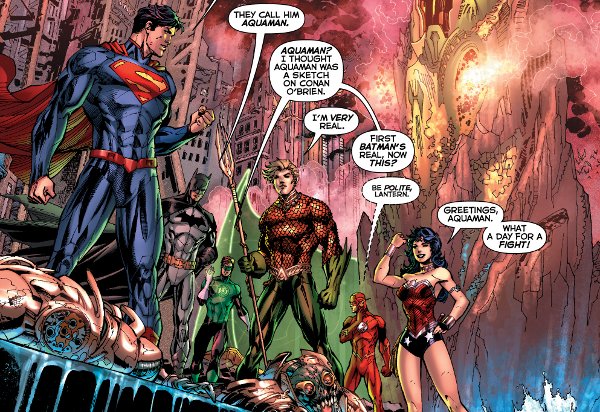
     Another problem is the visual redesign of the characters' classic costumes. Gone are Superman's red trunks and Batman's black ones. Superman now has a military-esque gorget and Wonder Woman sports a totally rad choker based on her logo. Flash, Green Lantern and Aquaman are relatively unchanged except for the addition of well, lines. Lines everywhere. I'm not sure what the motive behind this stylistic choice is but I wouldn't be surprised if, ten years down the line, putting unnecessary lines on costumes will be looked at the same way that pointless pouches in the 90's are now.

     This may be nitpicking but really there's not much to say about this book. Batman, Green Lantern, The Flash, Superman, Wonder Woman, Aquaman and Cyborg meet for the first time whilst fighting off an invasion from Apokolips. They beat Darkseid, the end. There's really not a whole lot of character development for anyone except Cyborg, as this story serves as his origin. Batman goes through kind of an arc, I guess, in that he thinks it'd be better for the world to fear him and the others at the beginning of the story and by the end has changed his mind for some reason.

     Really I'm just not sure who this book was written for. If it's for new readers than why aren't any of the characters (again excepting Cyborg) given more than the barest hint of depth. If it's for the fans then why is the majority of the cast acting out of character. Superman is impulsive and way too untrusting, Wonder Woman comes off as positively bloodthirsty, Green Lantern is mostly just a jerk and Aquaman barely registers as a character beyond affirming "I'm cooler than people think" which is something comic fans already know. The only characters done any real justice (see what I did there) are Batman and Flash. Even Darkseid comes off more as a random alien monster-of-the-week than the formidable, machiavellian villain he is.

     With that said the art is (mostly) good, though there are inconsistencies. Jim Lee really delivers some impressive, cinematic panels. The action is all pretty good, though it's also rushed and the early fight between Superman and Batman, Green Lantern, and the Flash is terribly contrived. There's this incredibly retarded moment where Batman peels the Bat symbol off his suit for no apparent reason and it magically reappears in one panel. There's also some ugly facial work.

     Justice League Volume 1: Origin is alright if you're just looking for a mindless super powered beatdown but as an introduction to these characters it fails miserably.

Score: 5/10

Next week things get worse with Volume 2: The Villians Journey...

Wednesday, October 4, 2017

Western Wednesdays: Just Pals (1920)

     Just Pals was released in 1920. It is directed by John Ford and written by Paul Schofield and John McDermott. In it Bim (Buck Jones), the town layabout of Norwalk, Nebraska, befriends a young orphan named Bill (Georgie Stone). Bim struggles to support Bill and while yearning for the love of Mary Bruce (Helen Fergusan), the town schoolteacher.

     The plot of Just Pals is basically a series of misadventures. Bim tries to make Bill attend school in order to please Mary but he becomes discouraged when he witnesses some bullies making fun of Bill because of his association with Bim. Later a scheming doctor convinces Bim to leave Bill with him, mistakenly believing that Bill is the missing son of a rich man who has offered a substantial reward for his return. At one point Bim is blamed for stealing the school memorial fund when in actuality Mary Bruce lent it to her no good boyfriend Harvey Cahill to pay his debts. He takes the blame to protect her and is run out of town. He then tries to prevent a bank robbery which Cahill is involved with but is implicated for the robbery along with the outlaws. The townfolk prepare to lynch Bim when Cahill is caught trying to force Mary Bruce to leave town with him and Bill goes for the sheriff who stops the lynching and arrests Cahill. Bim is then reunited with Bill and it turns out that the missing boy was kidnapped by his father's former chauffeur and Bim happens to run into him, claiming the reward for himself.

     A lot of this is rather contrived but there is a thread of social prejudice running throughout the film that anticipates Ford's later work. Bim and bill are looked down upon by the citizens of Norwalk who are easily lead to believe that Bim committed the crimes which the "respectable" Harvey Cahill is actually guilty for. There are some pretty dark scenes including the aforementioned lynching attempt and also a scene where it is implied that Mary Bruce tried to drown herself over her guilt concerning the school fund. Despite this the film has a cheery tone overall and is clearly not intended to leave the viewer with any sense of moral or social injustice. Buck Jones is good in the lead role and brings a lot of charisma to the film. He and Georgie Stone have pretty good chemistry together. The film-making is pretty perfunctory and the action, outside of the bank robbery, is a little hard to follow. There are some clever edits and the bank robbery, as I alluded, is pretty exciting.

     Overall Just Pals is a simplistic but still fairly entertaining western dramedy. If your not looking for anything too profound and you don't mind watching silent films, I'd recommend it.

Score: 7/10

Saturday, September 30, 2017

Star Trek: The Next Generation - 30th Anniversary Retrospective, Part 1 (Video)


I've been working on this for the past year in preparation for TNG's 30th anniversary, re-watching many of my favorite episodes and doing research about the story of the show behind the scenes. Stay tuned for more to come!


Monday, September 25, 2017

Musical Mondays: Beauty and the Beast (2017)

     Beauty and the Beast was released on March 17th of 2017. A remake of the classic animated film from 1991, it is directed by Bill Condon and adapted from the original screenplay by Stephen Chbosky and Evan Spiliotopoulos. In it Belle (Emma Watson), a young girl living in an 18th century French village, has her dream of escaping her provincial life granted when her father (Kevin Kline) is imprisoned by a mysterious Beast (Dan Stevens)

     Beauty and the Beast is an exercise in futility. This may seem like a foregone conclusion given that it's a remake of a beloved classic but Disney's track record with these remakes of their animated classics has been pretty good. The Jungle Book was my favorite film of 2016 (yes really) and, though I have yet to watch Cinderella, it was quite well received critically. Perhaps the difference is that the original versions of those films, while beloved in there own right, were not as universally acclaimed as Beauty and the Beast, which is the first animated film to ever be nominated for Best Picture at the Oscars and is often cited as the best film of the Disney Renaissance. Nevertheless, I still believe that a remake could have worked if the filmmakers were interested in taking the story in a new direction. After all, the original film made generous changes to its source material. Unfortunately this is not the direction that Disney decided to go.

     In essence, this film is a scene for scene remake of the original, albeit with a few new scenes added. The Beast's backstory is more fleshed out, there's a subplot explaining what happened to Belle's mother and Gaston tries to win Maurice's approval in order to marry Belle. None of these changes really impact the main story though. The Beast is still in need of redemption and Belle is the only one who can bring out the man behind the monster. Gaston's more subtle wooing of Belle is probably meant to make him more sympathetic but really it just wastes the audiences time. Consequently, the new scenes just end up feeling extraneous. There are also smaller changes. Belle is an inventor like her father in this version, a choice that's meant to make her seem more liberated I suppose but the film spends too much time on it. Maurice himself is much more proactive, one of the few changes I actually like. It's implied that LeFou is gay and has feelings for Gaston which, again, just seems to unnecessarily complicate the story. In this version the Beast's servants will become inanimate objects once the last rose petal falls, heightening the stakes but undermining the emotional loyalty they have to the Beast.

     The cast all do a decent enough job. Emma Watson is pretty good as Belle, bringing the same spunky, kind demeanor she brought to Hermione Granger. Dan Stevens is a bit subdued as the Beast, never really breaking out of the tortured soul archetype. Luke Evans and Josh Gad have fun as Gaston and LeFou. Kevin Kline plays a (thankfully) much more sympathetic Maurice. The musical numbers, on the other hand, don't fair so well. Most of the cast can sing well enough but you can't help but compare them to the original cast and they mostly pale in comparison. Watson, on the other hand, can't sing at all, and a generous amount of auto tune was clearly applied to her songs. The new material is alright, as an Andrew Loyd Webber fan I found "Evermore" entertaining in that overwrought "woe is me" Phantom of the Opera sort of way. But, like most of the additions to the film these songs just feel inoffensively bland and they add little of real substance to the story.

     Visually the film is actually better than I expected. When Bill Condon, who did the last two Twilight films, was announced as the director I was really skeptical but his blocking is actually pretty decent and the film has a vibrant, dynamic look. It makes me sad that Condon is being wasted on such mediocre material. The special effects are also quite well done, though the various objects in the Beast's castle never quite come alive in the same way they did in the original (this is an inherent advantage to animation). There's also way too much green-screen.

     Beauty and the Beast isn't a bad film exactly. It is well directed, well acted and (thanks to its source) has a fairly effective emotional story. Despite this the film simply fails to justify its own existence. If you've seen the original, watching this film will only be frustrating and if you haven't well, you really should. As a result I can't recommend this film as anything more than a mildly diverting curiosity.

Score: 6/10

Wednesday, September 20, 2017

Western Wednesdays: Big Jake (1971)


     Big Jake was released on May 26th, 1971. It is directed by George Sherman and written by Harry Julian Fink and R.M. Fink. In it Jacob "Big Jake" McCandles (John Wayne), an aging gunfighter, is asked by his estranged wife (Maureen O'Hara) to track down the outlaws who kidnapped their grandson "Little" Jake (Ethan Wayne). McCandles sets out to rescue his grandson, along with his two sons James (Patrick Wayne) and Micheal (Christopher Mitchum).

     Big Jake has a simple premise: McCandles must rescue his kidnapped grandson. It delivers about what you'd expect, an entertaining, if fairly straight forward action romp. It does feature an interesting faux-documentary prologue, contrasting the untamed American West of the early 20th century with the refined world of the east. The use of old black and white photographs and tin pan alley style music in this sequence brought Butch Cassidy and the Sundance Kid to mind. The Fink's (who also wrote Dirt Harry) deliver a pretty decent script with a lot of memorable hard boiled dialogue, "Dead? Next man says that I'm gonna shoot, so help me." "You can call me father, you can call me Jacob, you can call me Jake, you can call me a dirty son of a bitch, but if you ever call me "Daddy" again I'll finish this fight." The film moves at a steady, leisurely pace which serves the narrative well. The action is minimalistic but impressively mounted and very coherent. It's also considerably bloodier than your average John Wayne vehicle.

     Like The Comancheros which I reviewed two weeks ago, Big Jake is the final film of its director, in this case George Sherman. Sherman, who interestingly enough also produced The Comancheros, was in poor health during much of this film's production and, as with The Comancheros, Wayne ended up directing much of the film, though he insisted that Sherman receive the sole credit. This film also shares the same cinematographer and composer as The Comancheros, William H. Clothier and Elmer Bernstien respectively. Unsurprisingly the film features an excellent score, sometimes reminiscent of Aaron Copland, and beautiful cinematography. Clothier is really able to capture the stark beauty of Southern Mexico.

     The performances are a bit of a mixed bag. Wayne is his usual swaggering and, at this point, ornery self. Richard Boone is great as the hard-nosed leader of the outlaws who kidnap Little Jake. Maureen O'Hara shines in her brief role as McCandles estranged wife, remaining one of the few people who could hold their own in a scene with Wayne. On the other hand Patrick Wayne comes off a little stilted as the elder son with a chip on his shoulder and Christopher Mitchum is rather bland as the younger, more rash Micheal. Rounding out the main cast is Bruce Cabot who can't help but feel a little anachronistic as Jake's old Indian pal Sam Sharpnose, though he plays the part well enough.

     It may not offer anything revelatory for the genre but Big Jake is still a solid, entertaining western nonetheless.

Score: 8/10

Saturday, September 16, 2017

Saturday Evening Cartoons: Wonder Woman Vol. 3 - The Truth

     Wonder Woman Vol. 3: The Truth collects Wonder Woman #13, 15, 17, 19, 21, 23 and 25. It is written by Greg Rucka with art by Liam Sharp and Laura Martin.

     At the end of the first arc in Rucka's run, Wonder Woman discovers that she has never actually returned to Themyscira, causing her to enter a delusional, crippled state. It is also revealed that the Picket has been infiltrated by Godwatch, an organization lead by the villain Rucka created during his original run on the title, Veronica Cale, and Etta Candy is forced to go on the run. Picking up where that story left off, it's now up to Steve Trevor to rescue her from a squad of assassins sent by Godwatch and lead by Marina Maru (Doctor Poison). The first chapter basically sees Steve take down the assassins Rambo style until a helicopter sent by Etta Candy arrives to rescue him and Diana. Wonder Woman is then placed in a mental institution under an alias until she recovers. Meanwhile, Steve, Etta Candy and a newly reformed Barbara Minerva are on the run from Godwatch and go to Diana's old friend, the minotaur (or rather kithotaur) Sebastian (another Rucka creation) for help. Ultimately, Dr. Minerva gives herself up in order to save her friends and is manipulated by Cale to turn into the Cheetah once again.

     This is where the book starts to run into problems as one of the more interesting developments of the previous arc, namely the fleshing out of Barabara Ann Minerva and her reverting back to human form, is almost immediately undone. Wonder Woman's "madness" or whatever is also handled badly. Basically she talks to a snake coming out of her arm, one that only she can see, who tells her that she was lied to, which we already now. Then Sebastian comes to visit her, causing her to snap out of it and revert to her normal cognizant self. This makes me question why Rucka kept her in this state for the first three issues.

     After Wonder Woman and Steve are again attacked by Maru's assassins, the story ends with Wonder Woman confronting Cale, who is attempting to find Themyscira in order to restore her daughter who, for reasons unexplained, has lost her identity. I won't spoil the final resolution but I think that it fits Diana's character really well and it nicely lines up with the themes set up earlier in the run (with love being stronger than hate). It's also fairly heart-wrenching at times. This is followed by a sort of afterword where Wonder Woman must come to terms with the fact that the gods deceived her. Ultimately she realizes that, despite being left in the dark by her patrons, they have ultimately lead her to become an inspiring and heroic figure and they've trusted her to make the right decisions on her own. This restores Diana's devotion to the Patrons and her own faith in herself. The story ends with Diana and Steve having a long overdue date.

     As with the first two volumes of this title, The Truth suffers from the way it was published. Collecting the odd numbered issues, which tell a story taking place in the present, it leaves out the backstory, which was published in the even numbered issues. This story, which will be released in trade on November 15th, focuses on how Veronica's daughter lost her identity, leading Cale to form Godwatch, something only hinted at in The Truth. It would really make more sense to read that story first but, alas, that's not how DC has decided to publish it. With that said, it's much easier to read this title in trade than it was to try and keep up with it monthly, with the story constantly alternating between the past and the present.

     The art, by Liam Sharp (pencils) and Laura Martin (colors) is once again really good. Sharp is particularly adept at facial expressions and, coupled Martin's subdued colors, he really adds a sense of realistic emotion to the story. The plotting is quite clever with one page from the final chapter making really innovative use of reflections. On the other hand the first chapter is drawn by a different team. Renato Guedes angular pencil work doesn't blend at all with Sharp's more naturalistic style and Romulo Fajordo Jr., who was the colorist for the even numbered issues of the first and second volumes, seems out of his element as his usual bright, vibrant coloring is not suited for this story.

     The Truth may be a slow and somewhat frustrating journey, but the final destination is more than satisfying. Readers may be irked that they will have to wait until the release of Godwatch in November to really get the full story (and they may be better served to wait and read that story first) but this volume of Wonder Woman continues to prove how much Greg Rucka understands this character and her world.

Score: 8/10