Thursday, November 23, 2017

My Favorite Films: Casablanca (1942)

It's still the same old story
A fight for love and glory
A case of do or die
The world will always welcome lovers
As time goes by...

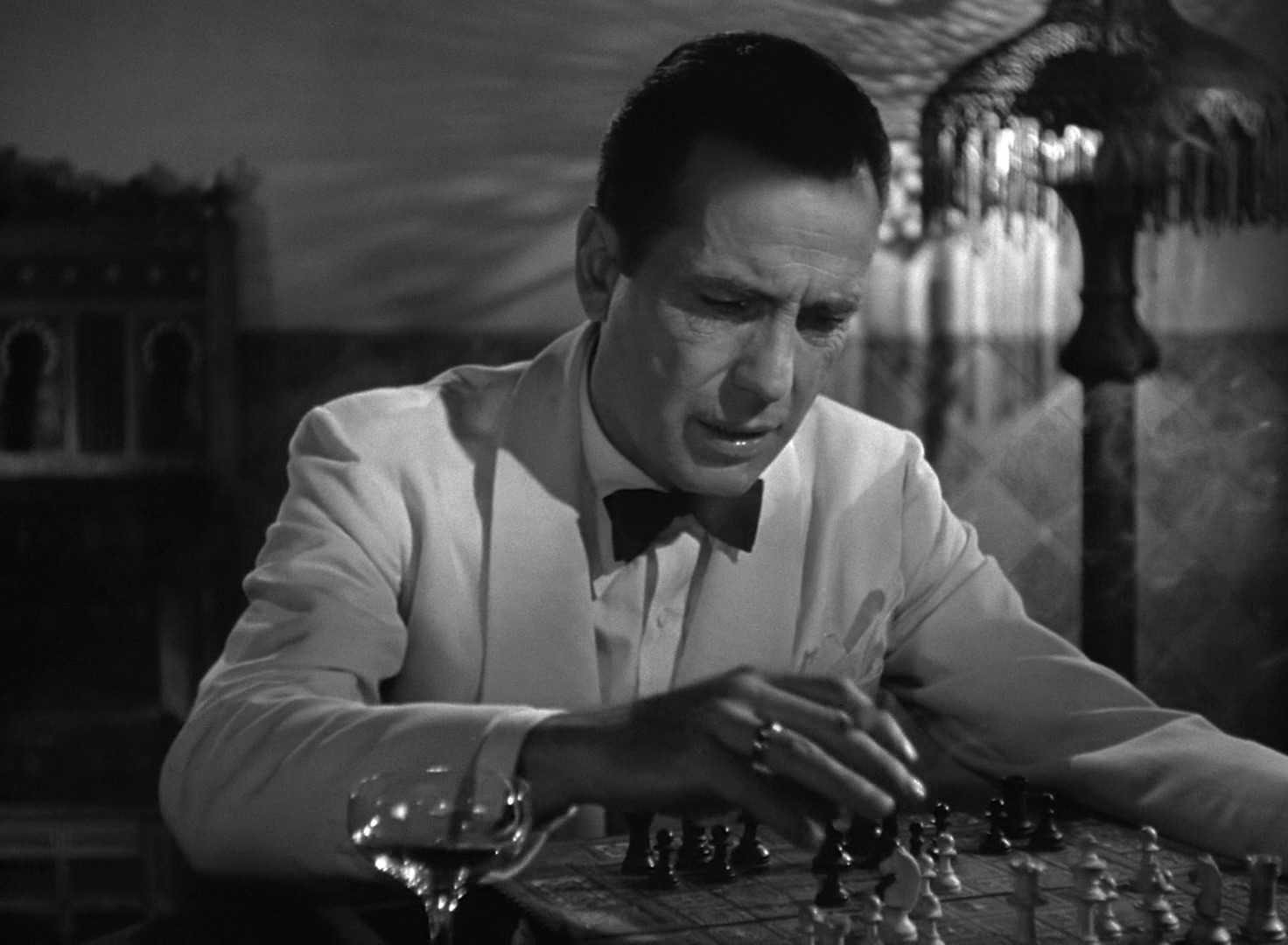
     We're 10 minutes into Casablanca before we meet the film's protagonist, Humphrey Bogart's Rick Blaine. In the meantime the film has established the world of Casablanca itself, a dangerous hive of villainy and murder and a crossroads for refugees trying to escape to the neutral United States. They are preyed upon by opportunistic criminals, like Peter Lorre's Ugarte, a petty thief whose theft of two letters of transit from German officials sets the plot in motion, and by the local authorities like Claude Rains Captain Renault, the leader of the local Vichy French police who is not adverse to using his position to take advantage of desperate refugees of the young feminine variety. As a group of immigrants watch a plane departing overhead a young Bulgarian refugee, played by Joy Page, tells her lover "Perhaps tomorrow we'll be on the plane."

     The setting of Casablanca is just as important to its success as its story is. From the smoky, dimly lit interior of Rick's Café Americain, to the airport, the symbol of escape for so many of the refugees, to the dangerous, exotic streets of Casablanca itself, the film creates a unique world where one's life or death is left to the winds of chance. As Conrad Veidt's Major Strasser says later in the film "Perhaps you have already observed that in Casablanca human life is cheap." One has to wonder what kind of person would choose to live in a place like this willingly.

     Rick Blaine is an enigma. He doesn't drink with his customers and he neglects his mistress Yvonne. His only concern, seemingly, is to manage his bar in peace. He treats his employees with respect and dignity and tries to keep his customers happy. We find out that he is a former mercenary, having run guns to Ethiopia during its war with Italy and having fought against the fascists in the Spanish Civil War. He also criticizes Ugarte for taking advantage of the refugees by charging them too much for their visas. It seems he was once a man of conviction but then we see him stand by while Ugarte is arrested despite his asking Rick for help. "I stick my neck out for nobody" he says. As the film goes on, more and more layers to his character are revealed.

     First we meet Ingrid Berman's Ilsa, a mysterious woman from his past, the memory of whom is bitter to Rick. She is now married to Paul Henreid's Victor Laszlo, a fugitive Czech Resistance leader. Her reappearance greatly unsettles Rick who begins to reflect on his past. It is revealed, through flashback, that Rick and Ilsa were once lovers who met in Paris shortly before the Nazi occupation. When the Germans invaded France Rick was forced to flee and Ilsa abandoned him leaving only a note saying, "I cannot go with you or ever see you again. You must not ask why. Just believe that I love you." We now see what made Rick into the bitter, apathetic man he has become and when Ilsa comes to the bar to explain why she left him he rudely rebuffs her, even making a veiled suggestion that she's a whore.

"Of all the gin joints, in all the towns, in all the world, she walks into mine."
     After he recovers from his state of drunken despondency we see that Ilsa's arrival has reawakened in Rick a sense of justice and fair play. When Joy Page's Annina comes to him to ask his advice in dealing with Captain Renault, who has promised her and her husband an exit visa in exchange for certain favors, he arranges for her husband to win at the his roulette table so they can pay for their visa. He has aided them despite the personal cost to him and his bar. Convinced that she will eventually come back to him, Rick begins to pursue Ilsa again but, resentful of the way he treated her the night before, she spurns his advances. However, she and Victor need Rick, as he is in possession the letters of transit that Ugarte was carrying when he was captured. When he refuses to sell them to Laszlo, she tries to take them from him at gunpoint, only to break down and confess that she is still in love with him.

     Ilsa, we learn, met Laszlo when she was quite young and became impassioned by his cause and inspired by his noble sense of idealism. The two fell in love. When she met Rick in Paris she had already been married to Laszlo for many years but believed that he had died in a concentration camp. When she learned that he was still alive she decided to withhold the truth from Rick, fearing that he would try to stay in Paris to help her and then be arrested by the Nazis. Instead she left him without any explanation. This event took an emotional toll on both Ilsa and Rick, and neither person has recovered.

     Ilsa tells Rick that she can no longer bear to be separated from him and begs him to help Victor escape. So Rick is faced with a few choices. Should he help Laszlo escape and rekindle his relationship with Ilsa or should he let her go with him? We are kept in suspense about this until the final moments of the film, where Rick, having tricked Captain Renault into aiding Lazlo's escape, tells Ilsa that she must go with him because he needs her in order to continue his work and "the problems of three little people don't amount to a hill of beans in this crazy world." Their sacrifice, set against the backdrop of the then still waging Second World War, is one of the great moments in cinema. However, this is not the end for Rick but rather a new beginning, as Captain Renault decides to cover up what his part in Lazlo's escape and the two men set off away from Casablanca to the Free French Garrison at Brazzaville.

     Like most big budget Hollywood films Casablanca was largely a collaborative effort, rather then the work of a single visionary or auteur, and every aspect of the film, from the conceptualization to the writing, the casting, the direction, the scoring and editing came together perfectly. Impressed by Murray Burnett and Joan Alison's unproduced play, Everybody Comes to Rick's, Warner Brother's story editor Irene Diamond convinced producer Hal B. Wallis to buy the script early in 1942.

     Julius and Philip Epstein were the first writers assigned to the film and they brought to it a great sense of wit. It's thanks to them that we have such quotable lines as "Remember, this gun is pointed right at your heart." "…That is my least vulnerable spot" and "I like to think you killed a man. It’s the Romantic in me…" The Epsteins left the screenplay unfinished early in 1942 to work on the Frank Capra's Why We Fight. In their absence Howard Koch was assigned to replace them. Koch put more emphasis on the political and dramatic aspects of the story, fleshing out Rick's background as a freedom fighter and placing more emphasis on his relationship with Renault. Finally, Casey Robinson was brought on to do rewrites and he contributed many of the film's romantic scenes, including the scene where Rick and Ilsa  meet again for the first time. With all these disparate visions for the screenplay it's a wonder that the final result, a brilliant fusion of biting wit and heartfelt sentimentality, is so cohesive.

     This is largely thanks to Hal Wallis, who was the script's final editor. He wrote the iconic closing line, "Louis, I think this is the beginning of a beautiful friendship," after the production had wrapped and Bogart was called in to dub it. Wallis is often credited as the one unifying creative force behind Casablanca and his contributions cannot be overlooked, particularly when it comes to the film's casting. 

     A good script, or even a great one, is nothing without talented actors to perform it and Casablanca was perfectly cast. Humphrey Bogart's Rick Blaine and Ingrid Bergman's Ilsa Lund have become so ingrained into the popular collective consciousness that it is difficult to separate their performances from their characters. Bogart is Rick and Bergman is Ilsa. Yet, when the film was in preproduction neither were the studio's first choice. They wanted George Raft as Rick and Ann Sheridan as Ilsa. But, watching the film, it is impossible to imagine anyone else in their roles. Bogart makes Rick's sense of loss and despair palpable. His naturalistic acting is perfect for the role. Watching his performance before he loses Ilsa in the flashback, he seems almost like a different person. Similarly Bergman adds another layer of depth to her character. There's is no indication, in the screenplay, of when Ilsa discovers that Lazlo is still alive but by watching her performance it becomes immediately apparent. Her interactions with Rick become much more guarded, her glances furtive.

     Dooley Wilson is also great as Rick's best friend and confidante Sam. In many ways he is the bridge between Rick and Ilsa and Wilson's subtle performance betrays a depth of friendship that is apparent almost immediately. Wilson, a vaudeville performer since the age of 12, sings the films signature tune along with most of the music in Rick's bar, contributing greatly to the film's sense of atmosphere. Paul Henreid, though not as charismatic as his costars, provides the film with its moral center as Victor Lazlo, a completely selfless man and charismatic leader, who pursues his cause with total conviction. Claude Rains on the other hand, provides the film with a great deal of levity and moral ambiguity. He perfectly captures Captain Renault's sarcastic wit and sense of irony. His conversations with Rick are brilliantly guarded. Though they never say it out loud, it's clear that both men have a mutual dislike of the political situation in Casablanca, one which they reluctantly cooperate with.

     The supporting cast is made up of experienced character actors, all of whom absolutely inhabit their roles. Conrad Veidt, is practically dripping with arrogant menace as the film's antagonist Major Strasser. Peter Lorre is his usual slimy yet strangely compelling self in his few minutes of screentime as Ugarte. Sydney Greenstreet's brings his intimidating physical presence fully to bear as the duplicitous Signor Ferrari. S. Z. Sakall brings his typical warmth and tenderness to the role of Carl, the waiter at Rick's who is also involved in smuggling émigrés out of Casablanca. The film is also filled with smaller, bit players. From Joy Page and Helmut Dantine's starry eyed immigrant lovers, to Madeleine LeBeau's kept woman Yvonne, to the pickpocket played by Curt Bois, everyone in Casablanca seems to have a story of there own, their own thoughts and desires. Many of these actors, including Bergman and Henreid, were themselves refugees from the war, adding a very personal touch to their performances. This helps to make the world of the film feel more fully realized.

     Casablanca was directed by Michael Curtiz, one of Hollywood's most prolific directors, but one without a really distinct artistic voice. His approach to directing was wonderfully minimalistic. In a Curtiz picture, the shot composition is always motivated by the demands of the story. Thus we see Ilsa and Rick framed in opposition to one another in the scene where she first comes to him to try and explain why she left, with Bogart in shadow on the right representing his intransigence in the scene and Ilsa under the light on the right, representing her position of open entreaty. His use of fluid camera movement is particularly impressive. In a many scenes the camera will effortlessly track from one character to another or from a medium shot to a wide within a single take. This kind of one shot really invites the viewer into the environment. The film was photographed by veteran cinematographer Arthur Edeson, who previous credits included All Quiet on the Western Front (1930) and The Maltese Falcon (1941). Edeson's use of light and shadow gives the film a distinct visual flavor, with many scenes having an expressionistic quality typical of film noir. Once again, Hal B. Wallis made significant contributions to the film here, insisting on all kinds of period details, including the live parrot seen at Ferrari's place. He also suggested the lower, more realistic lighting of Rick's Café.

     The musical score, by the legendary Max Steiner (who also composed the scores for King Kong (1933), Gone with the Wind (1939), The Searchers (1956) just to name a few), makes brilliant use of leitmotif. The three main musical themes in the score are based around the French national anthem, "La Marseillaise", the German patriotic anthem, the "Die Wacht am Rhein" (which Steiner also used in Sergeant York a year before) and of course Herman Hupfeld's "As Time Goes By", the use of which carried over from Burnett's play. In one of the film's most stirringly patriotic moments "La Marseillaise" is sung by the people in Rick's bar to defy the German's, who are singing "Wacht am Rhein". Throughout, Steiner uses these melodies to represent the Nazis and the forces of freedom and liberation, respectively. "As Time Goes By" is used to represent the relationship between Rick and Ilsa. This was the last song the two lovers heard in Paris before they were separated and, when Ilsa recognizes Sam in Rick's bar she asks him to it play again "for old times sake" in one of the most misquoted lines in movie history (Bergman never actually utters the line "play it again Sam"). Steiner was reluctant to use this song initially, preferring to write his own tune which he could then profit from, but it turned out to be a perfect encapsulation of the film's bittersweet love story.

     A perfect confluence of writing, directing and acting Casablanca is about as flawless as movies come. It's an eminently entertaining mix of adventure, intrigue and romance that has something for everybody, no matter your age or taste. They really don't make them like this anymore. The film just has this sense of class and elegance that have made it endure over the past 75 years. As time goes by Casablanca remains the quintessential Hollywood picture.


Saturday, November 18, 2017

Geoff John's New 52 Justice League Retrospective Part 5 (Saturday Evening Cartoons)

     Forever Evil opens with Lex Luthor meeting Thomas Kord. He wants to buy Kord industries from him and threatens to kill him and his family if he doesn't comply. He is interrupted when Grid's takeover of the electrical power in major cities causes his helicopter to crash.

     The Crime Syndicate, who arrived on Earth-0 at the end of Trinity War, announce that the world is now theirs. The Syndicate defeated the Justice League by trapping them in an Firestorm's matrix and they proceed to release all of Earth-0's villains from prison. They also capture Nightwing, revealing his identity to the world. They offer the villains a chance to join them, giving them an choice eerily similar to the one Lex offered Thomas Kord: work for the Syndicate or be slaughtered along with everyone they care about. Most of the villains comply.

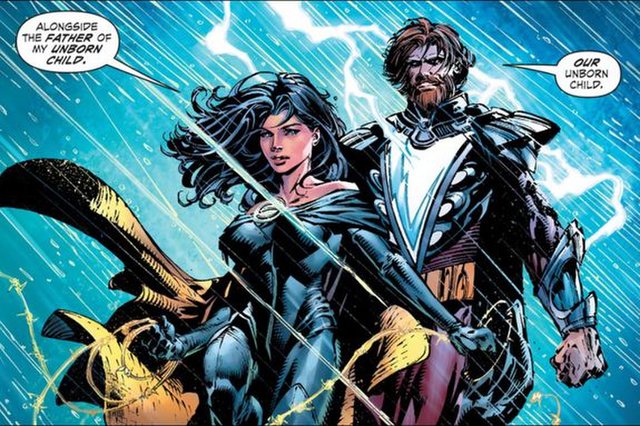
     Lex decides to defy the syndicate and he takes a Superman clone he was developing out of stasis, despite the fact that he needs another 5 years to fully develop. This is the introduction of the New 52 Bizarro. It is revealed that the Crime Syndicate have a mysterious prisoner Ultraman wants to keep alive and he moves the moon in front of the sun to create a solar eclipse. Because of this Luthor begins to suspect that Ultraman is affected by sunlight somehow. It is also revealed that Owlman and Superwoman have a child and that Owlman wants to rebuild his lost family, starting with this earth's Dick Grayson. Together, he hopes to overthrow Ultraman.


     Meanwhile, Batman and Catwoman, who survived the confrontation with the Syndicate because they left the battlefield to take care of Cyborg, take Victor to his father at Star Labs. Bruce then takes Catwoman to the bat-cave. He hopes to use his kryptonite ring to stop Ultraman, his Sinestro Corps ring to stop Power Ring, and his lighting rod from the future to stop Johnny Quick. Lex is able to tap into one of his personal,  hidden satellites in order to track the Syndicate without their knowledge. He meets the up with Black Manta, who retrieves a badly wounded Black Adam after his fight with Ultraman. Together, they team up with Captain Cold, who turned against the Crime Syndicate when they ordered the Rogues to destroy Central City and its inhabitants.

     Meanwhile, Ultraman is desperate for Kryptonite and Deathstorm begins to try and replicate Firestorm's transmutation of elements into Kryptonite. Superwoman tells him she's pregnant and informs him of Owlman's planned betrayal. He orders Power Ring to deal with the Luthor's team. He confronts them at the Wayne Enterprises Lab along with Deathstroke, Shadowthief, Giganta, Copperhead and Blockbuster. Batman and Catwoman show up and Batman tries to use his Sinestro Corps Ring only to have Power Ring smash it. Then Sinestro himself shows up and defeats Power Ring, killing him. Luthor convinces Deathstroke to betray the Syndicate, as their new world order will leave him without a purpose as an assassin, promising him a substantial reward in exchange. The ring searches for a new owner and leaves a trail leading the being who destroyed Earth-3 to Earth-0.

     The Syndicate becomes preoccupied with this supposed incision in the multiverse while Luthor and his team, who have joined up with Batman and Catwoman, find Dick Grayson trapped in a Murder Machine from Apokolips. When Batman tries to free him he sets off a time bomb, which will explode unless Nightwing's heart stops. Luthor tries to kill him and he and Bizarro fight Batman and Catwoman. Meanwhile Black Manta kills the Outsider (Earth-3 Alred Pennyworth) and Ultraman, Superwoman and Deathstorm attack Black Adam and Sinestro.

     The mysterious prisoner is released by Black Manta and Captain Cold, who defeat Atomica and Johnny Quick. The prisoner then yells, "Mazahs" summoning a Shazam like power. He kills Johnny Quick and reveals himself to be Alexander Luthor, Lex's Earth-3 doppelganger. We then find out that Lex gave Dick a cardioplegia pill to make him flatline and he gives him a shot of adrenaline to revive him. Cyborg then shows up, having defeated Grid and tells Batman and Catwoman that they need to telepathically connect with Wonder Woman using her lasso before Element Man explodes.

     We find out that Alexander Luthor is actually the father of Superwoman's child and that she manipulated the Syndicate into bringing Luthor to earth. She chose him over Owlman and Ultraman because he was more powerful. Alexander then kills Bizarro, which enrages Lex. Since Lex has Alexander's voice, he is able to calls down the lighting on him using Batman's lighting rod. This takes his power away and Lex kills him. Ultraman then attacks Luthor and destroys his weapons but Black Adam and Sinestro stop the solar eclipse, and the sun drains Ultraman's power, leaving him weak and defenseless. Batman then connects with Diana, freeing the League.

     The story end with Lex removing the kryptonite from Superman's head saving his life. The villains who helped him are given a chance for a clean break but most of them reject it. Lex pays his debt to Slade and encourages Ted Kord to take over his father's business. It is revealed that he has discovered Batman's identity. He also begins rebuilding Bizarro. Diana questions Superwoman about the tear in multiverse but she refuses to cooperate. The Anti-Monitor is revealed at the very end of the book.

Forever Evil is a pretty solid event. The main story is a lot of fun, especially when it's dealing with the DC villains bickering with each other. It's ironic that a story focusing on villains and evil doppelgangers should be the one to break the New 52's cycle of dark, downbeat stories. Lex Luthor is, for all intents and purposes, the protagonist of this story and it's a pretty good character study. At the beginning of the story he believes the world is doomed because it became over reliant on Superman and the other capes. Later, he relates to Bizarro how his fear of failing his sick sister resulted in her death but it is later revealed that this was a lie. He actually tried to save his sister but failed, leaving her an invalid. Failure is what has defined his life. It's only by failing, he realizes that one can succeed. He is not really a hero by the end, but he has gained a certain measure of humanity. He let's Ted Kord keep his father's company, despite the fact that he wants it for himself, and he gains a certain affection for his creation, Bizarro. He also comes to realize that the power he envied in Superman is really a crutch as it was Ultraman and Alexander Luthor's reliance on their powers that allowed him to defeat them. The theme of power being a source of weakness, and of the rule of the strong over the weak leading to conflict rather then order, runs throughout the story.

     The Justice League tie-ins to the main event, published in Justice League Volume 5: Forever Heroes, are a bit of a mixed bag. The first two issues focus on providing origin stories for Ultraman and Owlman. Both of them are twisted versions of Superman and Batman. Ultraman's father, Jo Il, saw his son as a pathetic weakling and pushed him to become strong and exact revenge on the being who destroyed Krypton. Owlman is Thomas Wayne, the older brother of Earth-3 Bruce Wayne, who murdered Bruce along with his parents in order to save Wayne Enterprises from his father's incompetence. The theme of shunning weakness and seeking strength at all costs runs through both of these stories. The third issue gives a brief origin for Atomica and Johnny Quick, Deathstorm and Power Ring. Atomica and Quick were Bonnie and Clyde-esque psychopaths who obtained their powers while being pursued by the police. Deathstorm was a scientist who conducted controversial experiments on vulnerable homeless people before he conducted one on himself, gaining Firestorm like powers of transmutation. Finally, Power Ring was a weakling who was tempted by the power of the ring and tricked into taking it by Abin Sur, who wanted to be free of the excruciating mental and physical pain it caused him. It also explores Grid and his motives for serving the Syndicate. Having separated from Victor Stone he now wants ability to feel emotions, something he could never do while a part of Cyborg. He hopes that inflicting pain on others will evoke some emotion inside him.

     The last three issues all focus on Cyborg and his quest to defeat Grid. He convinces his father, who is filled with guilt about what happened to his son, to put him back together and seeks out Dr. William Magnus, the creator of the Metal Men. Magnus believes himself to be a failure, as his androids refused to follow his commands and ultimately died fighting a rampaging toxic robot. He became attached to the sentient beings he created and fears to lose them again. Vic convinces him to revive their responsometers, as this is what they'd want. They assist him in luring in and fighting Grid, who brings along members of the Secret Society to help him fight them. While the Metal Men fight off the Fearsome Five, Dr. Psycho and Hector Hammond, Cyborg is hacked by Grid who wants to rip the ability to feel from him. He is trapped in the "digital universe" where he doesn't know how to operate. This experience emboldens Vic and he ultimately takes control leaving Grid trapped and feeling afraid. He finally comes to terms with his dual natures and has also reconciled with his father. His journey is easily the best part of this volume, which generally speaking, works better as an extension of Forever Evil then as a story in its own right. The story ends when Steve Trevor shows up and informs Cyborg of his plan to connect with Diana telepathically using the Lasso of Truth and Cyborg leaves to save the League.


     The art is much more consistent this time around as all of the main event was penciled by David Finch and all but one issue of Justice League (#26) was penciled by Ivan Reis. Finch's art is absolutely stunning. He really delivers on the epic moments you'd expect in an event comic while also excelling with the more subtle, character work. Reis, once again, is amazing, completely selling the heightened emotions of Vic Stone and William Magnus' stories. His attention to detail is on full display throughout the run, and it really elevates the story. Doug Mahnke's art for issue 23 is also quite strong with his darker, more subdued visuals serving Owlman's twisted origin really well.

     Forever Evil is the first really good crossover event of the New 52. It certainly helps that the main story was written by a single writer with a clear vision. Geoff Johns delivers a fun, character driven story with all the epic action you'd expect from a crossover of this scale. It's not perfect. There are a lot of plot threads that require you to read the tie-ins to understand what's going on and the Justice League issues are a bit hit-or-miss but overall I'd definitely recommend reading this, with the caveat that the set-up (in Trinity War) is pretty abysmal.

Score:
Forever Evil: 8/10
Justice League Volume 5: Forever Heroes: 7/10


Wednesday, November 8, 2017

Western Wednesdays: Slow West (2015)


     Slow West was released on May 15th, 2015. It is written and directed by John Maclean. It tells the story of Jay Cavendish (Kodi Smit-McPhee) a young Scottish man who travels to the American West to search for his lover, Rose (Caren Pistorius). Along the way he employs the services of bounty hunter Silas Selleck (Michael Fassbender). Unknown to Cavendish, there is a bounty on Rose's head, one which Selleck hopes to collect.

     Slow West deals with a subject that westerns often neglect: the experience of foreign immigrants in the west. Early in the film a Swedish couple, desperate for money, rob a trading post. Jay is forced to kill the wife in order to protect Silas. Outside they find the couple's hungry children, now orphans. This entails a loss of innocence for Jay which is a running theme throughout the film. At one point, after abandoning Silas, he meets a traveling writer named Werner, who is writing a book about the tragic experience of Native Americans in the west. Jay feels awkward around Werner asking him "You care not to share your company with a murderer?" But Werner, it turns out, is not to be trusted either. He runs off in the night with Jays horse, leaving him alone in the desert until Silas shows up and the two men reunite. The biggest naive notion that Jay holds on to through most of the film, is his unwavering love for and devotion to Rose. This, it turns out, will also prove unfounded. Jay's naivety is contrasted with Silas' cynical outlook on life. He narrates, 'To him, we were in a land of hope and good will. The way I saw it... kick over any rock and most likely a desperado will crawl out and knife you right in the heart if there was a dollar in it." Ultimately, the two men influence each other. Jay becomes more pragmatic and loses his sense of naivety. Silas, by contrast, loses some of his cynicism and finds some purpose to his life.

     Silas narration, and the often surreal tone of the film in general, give it the feeling of a story told around a campfire. There's one scene where Jay, intoxicated, stumbles on the camp of Payne, the head of Silas old gang. One of the gang, named Skelly, relates a story about a friend he once had who killed as many people as he could in order to become famous. To stop him, Skelly made a fake wanted poster with his friend's name on it but his friend, still unsatisfied, was still determined to kill more people to increase the reward money. The next morning Skelly hears a shot and sees a man standing over a body. Thinking someone has killed his friend for the reward he kills the man only to find that his friend is still alive and the man was standing over a dead bear. This scene, in many ways, seems pointless and out of place. But if you approach the whole film like a tall tale, told by a bunch of drunks around a campfire, it starts to make more sense. This is probably what I appreciate most about the film. After all, what is the western if not an extension of American folklore.

     The film is not without its flaws. Maclean's use of extended flashback is obtrusive at times and the ending is a little too neat. But if his storytelling is a little lacking he makes up for it with his biting dialogue. Jay: "Charles Darwin talks of ‘evolution by natural selection’" Silas: "For our sake lets hope he's wrong". Kodi Smit-McPhee and Micheal Fassbinder both deliver the dialogue well and they have good chemistry together. Fassbinder is quite adept by now at playing cynical loners (Magneto, Edward Rochester) and McPhee is really fits the role of the wide eyed, naive young romantic. Also worth mentioning is the beautiful cinematography courtesy of Robbie Ryan.

     The most common complaint levied against the modern western genre is that it has become tired and formulaic. While I find this is often the case movies like Slow West (or Bone Tomahawk which I reviewed a few weeks ago) are proof that it still has some life left.

Score: 9/10

Sunday, November 5, 2017

Geoff John's New 52 Justice League Retrospective Part 4 (Saturday Evening Cartoons)

Sorry I'm a day late again...

     Trinity War was published, in trade, rather haphazardly. The lead up to the event in the Justice League title (#18-20) was collected in Justice League: The Grid along with the issues pertaining to the event itself (#22 and #23). Meanwhile, all of the various titles which were involved in the main crossover (including Justice League #22 and #23) along with the tie-ins were collected in the Trinity War trade ( altogether comprising Trinity of Sin: Pandora #1-3, The Phantom Stranger #11, Constantine #5, Justice League of America #6-7, and Justice League Dark #21 and #22). So if you were reading Justice League in trade and wanted to read the full event, you'd essentially have to double dip.

Justice League #20, penciller: Ivan Reis
So how is the story itself? It begins with the League trying to recruit new members. This feels like classic Justice League with the League members gathered in the watchtower and various DC heroes invited to "tryout". In the end Firestorm, Element Woman and the Atom are selected. Later Superman and Wonder Woman create an international incident when they rescue hostages from an insurgent group in Kahndaq and a mysterious assailant attacks the batcave and steals files pertaining to Superman. It is then revealed that Atom is actually working for Amanda Waller as a spy. Waller plans to use the JLA as a contingency against the Justice League.

Trinity of Sin: Pandora #1, penciller: Daniel Sampere
     Then we get into the actual event. It begins by explaining the origin of the Trinity of Sin. Pandora finds the "box" while wandering through the woods in 8000 B.C. and opens it accidentally. The monsters this unleashes kill her family and Pandora is sentenced to an eternity of loneliness and pain by the gods. The Phantom Stranger is sentenced to walk the earth as a stranger to man and The Question loses his identity. As the seven deadly sins wreak havoc on mankind Pandora vows to destroy them. Back in the present she steals the box from the Black Room at ARGUS. One of the gods appears and admits that punishing her was a mistake. He tells her that only the darkest or strongest heart can open the box leading Pandora to seek Superman's help.

Justice League #22, penciller Ivan Reis
     Pandora then approaches Superman and Wonder Woman, asking him to open the box, but it ends up corrupting him for short time until Pandora takes the box away. Meanwhile Shazam travels to Kahndaq to return the ashes of Black Adam, who was recently killed in a fight with Shazam, to his homeland. Fearing another incident, the League follows him there, prompting Amanda Waller to send in the JLA to confront them. Ultimately, Dr. Light's powers are activated by his proximity to Superman and Superman, seemingly, kills him.

The Phantom Stranger #11, artist: Fernando Blanco
     This leads to a fight between the JLA and the League, which Superman stops by giving himself up. Batman theorizes that some outside force must have manipulated the situation to make it appear that Superman killed Light while Wonder Woman insists that it was his encounter with Pandora's box that caused him to lose control. They part ways, with Wonder Woman recruiting the Justice League Dark to find the box while Batman, Deadman, Katana, and the Phantom Stranger go to "Heavens Basement" to find and interrogate Dr. Light about his death. Phantom Stranger warns Batman that if Diana gets her hands on the box it will lead to disaster. They find Light only to discover that he has no idea what caused his death. Then the angel Zauriel shows up to punish the Stranger for returning to the afterlife after being warned not to. He is erased from existence and Batman and the others are returned to the earthly realm.

Justice League Dark #22, artist: Mikel Janin
     Meanwhile The Question goes to Superman and offers to help him find out who actually killed Dr. Light. He gives him a newspaper clipping concerning the murder of a Kahndaq businessman by Dr. Psycho around the same time that Dr. Light was killed. He then helps him to escape from ARGUS custody. While all this is going on members of the Secret Society, specifically Vandal Savage, Giganta and Signalman, are seeking the box. Pandora, having failed to find the purest heart decides to seek the darkest one. She approaches Savage and a fight breaks out. He eventually attempts to open it but fails. It turns out he still has some light left inside after all. She then goes to Lex Luthor, who is currently in prison. Before she can give him the box Wonder Woman and her allies show up to take it for themselves.

Justice League Dark #23, artist: Mikel Janin
     Meanwhile, Martian Manhunter locates Dr. Psycho and the JLA show up to arrest him. J'onn reads his mind and finds out that Psycho wasn't involved in Light's death but was a red herring planted by the Secret Society. Atom then tells the League about Waller's secret agenda. Leading Superman and the JLA to confront Waller. The Secret Society then detonate a bomb they planted in Dr. Light's body. At the same time the Phantom Stranger dies after warning Batman about the box's true nature and telling him that the Secret Society is holding Madame Xanadu hostage to prevent her from warning the League about the box. Finally, Wonder Woman takes the box from Pandora and is corrupted by it.

Trinity of Sin: Pandora #3, penciller: Daniel Sempere
     This leads to a massive fight breaking out over the box. Pandora tries to fight the sins, who are fueling the conflict in order to increase their power. She finally figures out that she must see herself in the sins, or rather see them in her, in order to destroy them. She kills envy by admitting her enviousness toward mortal beings and then precedes to slay the other sins.

Justice League Dark #23, artist: Mikel Janin

     In the meantime Shazam shows up and takes the box from Wonder Woman causing him to be corrupted by it. This creates a major magical disturbance and Deadman is able to sense Madame Xanadu's location. Zatanna determines that the box's power has combined with Shazam's to infect everyone around it so she casts a protective spell to protect herself from it. She tries to get the box away from everyone when Constantine shows up and takes it. He's unaffected because he's "already filthy" (just go with it). He brings her to the Temple of Hephaestus where Xanadu is being held just as Batman shows up with Deadman, Katana, Flash, Vibe, Green Lantern, Catwoman and Steve Trevor. Xanadu tells them that the box is not a prison for evil but a doorway to another dimension.

Justice League #23, penciller: Ivan Reis
     It's finally revealed that five years ago (of course) a mysterious man from another dimension, who has appeared throughout the story, formed the Secret Society in order to save his master. He manipulated the conflict over Pandora's box so that the League would lead him to it. At this point Pandora brings Wonder Woman and the Justice League Dark to the Temple and an another massive fight breaks out over the box.

Justice League #23, penciller: Ivan Reis
     As Batman and Superman fight over Diana, Firestorm discovers that Superman was infected with kryptonite somehow and this is what triggered Dr. Light's powers, killing him. Element Woman goes inside of Superman and finds the kryptonite lodged in his brain. Atom then reveals that she put it there as she was actually working for the Secret Society the whole time. She also reveals that Cyborg has been infected by GRID, a sentient computer virus which then proceeds to separate from Vic, leaving him powerless. The mysterious man then shows up and opens the box. He reveals that he is the Alfred Pennyworth of Earth-3, that the box comes from his world, and that only someone from his world can open it. The story ends with the Crime Syndicate emerging through the portal, setting up Forever Evil.

Flashpoint #5, penciller: Andy Kubert
     This story is extremely unfocused and overstuffed. Ultimately it's made up of two disparate stories that never really come together. One is Pandora's quest to destroy the evil she has unleashed on mankind and the other is Earth-3 Alfred Pennyworth's grand scheme to bring the Crime Syndacite to Earth-0. The entire subplot with Pandora and the Trinity of Sin turns out to be rather superfluous. This is especially frustrating as Pandora had been set up from the end of the Flashpoint, where she is revealed to be the mastermind behind the merging of the three separate timelines by Flash. Given what a waste of space her character turned out to be it's no wonder she was killed so unceremoniously in the pages of Rebirth.

The Phantom Stranger #11, artist: Fernando Blanco
     The Secret Society plot is really just a glorified set up for Forever Evil, which I'll get to later. Neither of these stories really allow time for anything but the barest of character development with our main cast. We see that Cyborg's dad is more interested in him for his scientific value then as a son. We get a nice moment where Batman gets to experience Christmas with his parents in the afterlife. The moment where Superman stops the big fight and asks to be locked up was refreshingly altruistic of him and especially welcome given the contrived nature of the whole situation.

Justice League #22, penciller: Ivan Reis
     The conflict is pretty contrived in general. I suppose you could attribute this to Earth-3 Alfred's machinations or the influence of Pandora's box but why does the box corrupt people anyway. I mean it's just a portal right? As far as the characters from the other titles go, they don't fare much better. Shazam probably does the best, following through with his determination to bury the fallen foe he has grown to respect and seeing through Constantine's manipulation. Atom seems to have a compelling inner conflict, feeling guilty about spying on her friends in the League, but it turns out she was working for the Crime Syndicate the whole time. The Phantom Stranger is given a somewhat compelling arc, though his sacrifice feels completely unnecessary as the entire episode in the afterlife doesn't really lead anywhere.

Justice League #22, penciller: Ivan Reis

     The art is all over the place which, I suppose, is to be expected in a big crossover with twenty different artists. Justice League #19 is drawn by Jesus Saiz and his art is appropriately vibrant and warm for this more lighthearted issue. The rest of the Justice League issues were penciled by Ivan Reis who does an excellent job. He really captures the colossal scale of the story and there are some really epic splash panels, especially in the last issue. Doug Mahnke's art for Justice League of America is a little stiff and angular for my taste. Mikel Janin's work on Justice League Dark is quite good and features some of the more creative layouts of the story. Various artists (too many to count really) worked on the tie-ins and there art is of varying quality but is overall pretty solid.

     Trinity War is a good example of what's wrong with current comic book event storytelling. Just when this title began to hit its stride it was interrupted by two massive events coming right off of the heels of Throne of Atlantis. The characters are finally starting to feel defined but they're lost in this sprawling event with countless other characters. There are some nice moments early on and Ivan Reis delivers the goods on the artistic front but overall this arc is really weak.

Score: 6/10

Tuesday, October 31, 2017

Musical Mondays: Sweeney Todd: The Demon Barber of Fleet Street (2007) (belated)

I apologize for being a day late on this one. Let's just say I was saving it for Halloween...

     Sweeney Todd: The Demon Barber of Fleet Street was released on December 21st, 2007. Based on the Stephen Sondheim stage musical of the same name, it is directed by Tim Burton and stars Johnny Depp and Helena Bonham Carter. In it Benjamin Barker (Depp), a former barber, arrives in London after a fifteen year absence having been exiled for a crime he didn't commit by one Judge Turpin (Alan Rickman). Learning that his wife committed suicide and that his daughter Johanna (Jayne Wisner) has become Turpin's ward, Barker changes his name to Sweeney Todd, vowing to exact vengeance on the man who destroyed his family. He reopens his barbershop atop the pie shop of Mrs. Lovett (Carter), biding his time until the opportunity for revenge presents itself.

     Sweeney Todd: The Demon Barber of Fleet Street is considered by many to be one of the greatest Broadway musicals of all time. It successfully blends horror with subversive, black comedy and tells a story about revenge and how it can consume and destroys a person. It's also filled with commentary on industrial capitalism and its dehumanizing effects on people. Benjamin Barker is a monster who  is destroyed by his own hate and desire for vengeance but he is also an innocent man caught up in the "great black pit" that is London in the early industrial revolution. Sondheim's lyrics really bring out the subversive qualities of the story, "For what's the sound of the world out there?" "Those crunching noises pervading the air" "It's man devouring man, my dear. And then who are we to deny it in here?" This is one of the Sondheim's most accomplished works with his use of overlapping, conversational lyrics reaching new heights. His score, reminiscent of works by Bernard Herrmann, is wonderfully frenetic and dissonant complementing the dark twisted nature of the story.

     Everything I said about the stage musical can be said for this film. It preserves Sondheim's book, more-or-less, completely intact. So how well executed is it? How does Jonathan Tunick, the original play's orchestrator, re-purpose the score for the film, how well do the cast perform the material, how does Burton stage the musical numbers and what does he do to make the play "cinematic"?

     Tunick expanded the size of the orchestra for his re-orchestration of the score in order to make it more cinematic and it works well, adding a certain heft to the score that was missing in the stage version. On the other hand, Burton's decision to remove the chorus line in many of the songs deprives them of their lyrical richness and leaves them feeling thin and empty. "God, That's Good" in particular is robbed of its sense of societal madness. In addition to this neither Johnny Depp nor Helena Bonham Carter can sing very well. Many critics defended Burton's decision to cast actor's that were not professional singers, arguing that the material was never really well suited to Broadway singers anyway, but I don't buy it. The musical complexity of Sondheim's songs requires a performer who can act and sing and therefore act with their voice. Depp and Carter just don't cut it for me.

     As far as their performances go, Depp is fine, bringing the right mix of detachment and demented fury to the lead role. Helena Bonham Carter is a little more problematic. As portrayed by Angela Lansbury, Mrs. Lovett is a seemingly absentminded, flustered old lady who hides a real shrewdness and manipulative cunning underneath. She brought a real sense of humor and energy to the role. Carter on the other hand just feels limp in comparison. Her Mrs. Lovett feels more indolent than anything. It's only in a few scenes ("By the Sea" in particular) that she really comes to life. The supporting cast, by contrast, are uniformly great. Alan Rickman is perfectly cast as the despicable Judge Turpin. He's positively dripping with lechery and self-righteous hypocrisy. He can't sing any better then Depp and Carter but then he doesn't have to carry any of the numbers on his own. Timothy Spall as Beadle is a no-brainer. The man has made a career out of playing slimy sycophants. Sacha Baron Cohen is also great as the pompous, scheming Pirelli as is Ed Sanders as the young, innocent and loyal Toby, a refreshing change from the man-child of the original play. Finally, Jamie Bower and Jayne Wisner as the seemingly doomed lovers Anthony and Johanna respectively are more sympathetic than in the play, where their subplot was played mostly for laughs. I think this helps to ground the film to some extant as they're the only really sympathetic characters in the story. Comparing Wisner's restrained rendition of "Green Finch and Linnet Bird" to Sarah Rice's over-the-top version in the original Broadway cast recording illustrates the difference nicely. This is one change from the original that I kind of like.

     As indicated by his decision cut many of the choruses, Tim Burton doesn't display a great understanding of the art of the musical here and his staging of the musical numbers often lacks the manic energy they demand. "A Little Priest" suffers the most. It's just far too slow and plodding, robbing the scene of its black comedic tone. In general the film feels dour and humorless, unlike the play which was, quite often, a riot. The only exception is "By the Sea" Mrs. Lovett's whimsical detour where she imagines what a married life with Mr. Todd might look like. Burton's deadpan sense of humor, which both Depp and Carter are quite adept at by now, serves this number really well as does his trademark visual flare. His art direction is consistently great. A dense labyrinth of dirty factories and creepy alleyways, London, in this movie, really looks like the forsaken hell-hole that the lyrics paint it as.


     Sweeney Todd is not a bad adaptation. The supporting cast is quite good and Burton's unique visual style captures the original works sense of tragedy and pathos. The musical numbers have been truncated but Sondheim is good enough a writer for his work to withstand at least some tampering. Ultimately it's a good musical that could have, and probably should have, been great. 

Score: 8/10

Wednesday, October 25, 2017

Western Wednesdays: Bone Tomahawk (2015)

       Bone Tomahawk was released on December 10th, 2015. It is written and directed by S. Craig Zahler and stars Patrick Wilson, Kurt Russell, Matthew Fox, and Richard Jenkins. In it two highway robbers anger a tribe of cannibals when they stumble onto their burial site. One of them, named Purvis (Davud Arquette), escapes to the town of Bright Hope where he is arrested by the sheriff (Russell) and his deputy (Jenkins). The cannibals follow Purvis to town and kidnap him and Samantha, the local doctor's assistant who is tending to Purvis. Sheriff Hunt sets out with his deputy, Samantha's husband Arthur (Wilson) and a dandy named John Brooder (Fox) to rescue the two prisoners.
     S. Craig Zahler is no stranger to the western genre, having penned his first novel, A Congregation of Jackals in 2010 which he followed with Wraiths of the Broken Land in 2013. He really knows how to write hard-boiled western dialogue. Many lines have a subversive twist. In one scene Brooder kills some Mexican bandits in cold blood leading Chicory to proclaims, "Mr. Brooder just educated two Mexicans on the meaning of manifest destiny." The script gets, perhaps, a little too sardonic in a few places but overall it's really great.

     Zahler also knows how to direct a western. This was his directorial debut and it's a really strong one. He's not afraid to use longer takes and Bone Tomahawk is a deliberately paced film as a result. There's a strange elegance to this picture that is all but unknown in mainstream modern cinema. In one early scene the camera lingers as Brooder hesitates at the exit of the bar fiddling with his hat before leaving. There's no real reason to pad the scene out this way, it's just there for tone and pacing. Zahler holds back on the more grisly elements of the film until the last act where the cannibals are finally revealed in all there bone crunching glory. Up to that it's a fairly restrained piece of survivalist horror, with the band's situation growing increasingly desperate as the film goes on. Benji Bakshi's cinematography is also wonderfully restrained. Utilizing a mix of handheld and stationary camerawork and a harsh, gray color palette he imbues the film with a grim, gritty, down-to-earth tone.

     The cast is quite strong as well. Patrick Wilson has now made a career of playing upright traditional heroes who are none-the-less relatable and down to earth. He excels at playing the fiercely determined Arthur O'Dwyer, who turns out to be the film's unlikely hero despite his busted leg. Kurt Russell is also his usual, dependable self. It's hard to imagine anyone else in the role of the pragmatic yet morally sensitive sheriff. Richard Jenkins one the other hand is cast against type. Unlike the hard-nosed authoritarian figures Jenkins usually portrays, Deputy Chicory is a humble, sensitive old man with a deep sense of loyalty to his departed wife and a penchant for constantly engaging in idle chatter. Finally, Matthew Fox puts in a solid performance as the hateful, cynical gunslinger John Brooder. His chemistry with Jenkins, in particular, is really great.

     Bone Tomahawk is a really unique western horror film. S. Craig Zahler's brilliant screenplay is bolstered by strong lead performances and his restrained direction is a welcome breath of fresh air in a world dominated by horror films like Evil Dead and The Purge. As a directorial debut you could do a lot worse.

Score: 9/10

Saturday, October 21, 2017

Geoff John's New 52 Justice League Retrospective Part 3 (Saturday Evening Cartoons)

     The third volume of Justice League opens with a short two part story about Cheetah. As the Wonder Woman title was pretty much doing its own thing at this point Geoff Johns was free to do what he wanted with the character. The results are, well, interesting. In this continuity it was not the Cheetah that corrupted Barbara Anne Minerva, quite the opposite in fact. It is revealed that Minerva, under various aliases, has committed all kinds of terrible crimes unbeknownst to Wonder Woman, who considers her a friend. Before Minerva stole its powers for herself the Cheetah was a benevolent god which protected the San Tribe. In stealing its powers, Minerva corrupted the Cheetah and the tribe now wants to kill her. This is easily the worst aspect of this story as it basically just turns Minerva into a crazy psychopath with little real depth.

     This story continues to build on Wonder Woman's self doubt and her shouldering of other people's burdens. She blames herself for what happened to Barbara Anne and to Steve during the last arc. When she finds out that Minerva was tricking her from the beginning she questions her faith in humanity. Superman, being Superman, tries to help lift her spirits. He and Wonder Woman really start to bond in this volume and to make more sense as a couple.

     In general there's a lot more character exploration and interaction in this arc then there was in the first two. Green Lantern, of course, has left the League and Flash is dealing with unexplained problems of his own, so the main cast is a little smaller and more manageable this time around. Batman gets to know Aquaman better and both men grow to respect each other more. Cyborg has to confront his fear that he may have lost his humanity and become nothing more than a machine with the illusion of self-awareness. This was hinted at in the previous volume but it's explored much more satisfactorily here. At one point he is forced to sacrifice his only surviving lung in order to undergo a procedure that will allow him to operate underwater so he can save the rest of the League. This is a pretty compelling arc compared to what has come before. Of course the focus of this book is Arthur Curry and his acceptance of his birthright as the king of Atlantis.

      The main story, collecting Justice League #15-17 and Aquaman #15-16 is the first big crossover of the run. In it a missile launch gone wrong ends up harming Atlantis, leading Aquaman's brother King Orm to mount an attack on the surface world. Aquaman reveals to Batman that Orm is using his (Arthur's) plan to attack the surface and that he left the throne because of internal pressure from Atlanteans who didn't trust him because of his time on the surface. He never really wanted the throne in the first place but was just looking for acceptance, something the League has since given him.

     He convinces The League to let him try to talk Orm down but, of course, his brother doesn't listen, ultimately leading to a contrived fight between between Aquaman and the rest of the League. It is eventually revealed that Vulko, Arthur's former advisor who has since been exiled, has engineered the conflict, presumably to get revenge for his exile. He has also stolen the king's scepter, which he uses to summon an evil underwater race called the Trench to attack the Atlanteans. Arthur's wife Mera, who was also exiled, expresses her sympathy with Vulko's motives. In the end Aquaman accepts responsibility for leaving Atlantis to his hot-headed brother and confronts him face to face. He defeats Orm in personal combat and Orm surrenders the throne to him and pledges his loyalty. It is then revealed that Vulko's true motive was pushing Arthur to accept his birthright.

     Upon learning this Aquaman is disgusted with his old friend's fanaticism and orders him to be thrown in prison. He ends the attack on the surface and uses the scepter to send the Trench home. He then turns Orm over to the League in a rather heartbreaking scene. Arthur decides to return to Atlantis, leaving Mera and his new friends behind. This emotional pay off works really well and it makes me want to check out John's Aquaman run. My one big gripe with the story is that everyone seems so wrapped up in Orm's attack that the ignore the legitimate grievance he has with the surface. After all Atlantis was seemingly attacked without any provocation whatsoever.

     As with the first few volumes, this story does not escape that sense of "dark realism" that defined the New 52. As I mentioned, Wonder Woman is losing her trust in people and it's also revealed that Batman is spying on Superman, indicating a lack of trust there as well. Steve Trevor continues his run of bad luck as he loses his job as the League's liaison to A.R.G.U.S. during the epilogue. Aquaman becomes a pretty brooding figure by the end of the story declaring "But I am alone". But these moments feel more earned here (for the most part) and certain characters (particularly Superman) seem determined to be a source of light and inspiration.

     Once again the art is something of a mixed bag. The Cheetah story is pencilled by Tony S. Daniel with inks by Richard Friend, Sandu Florea and Matt Banning. Daniels provides some really striking imagery, especially during the action scenes, but his facial work is a little off. The main story is pencilled by Ivan Reis (who did the Justice League issues) and Paul Pelletier (who did the Aquaman issues). Reis' art is really awesome. His character work is unmatched and he fills the panels with so many amazing details, which is always welcome in a story of this scale. There are some breathtaking two page spreads and both the action scenes and the smaller, more intimate ones are done superbly. Pelletier's art is generally a little rougher and more angular but it's still excellent overall. Pelletier really captures the epic emotions of this story. Once again the fact that there are different artists makes for a clash between different styles but at least in this case there's more of an excuse as this story was a crossover between two different titles. The epilogue was written by Jeff Lemire and pencilled by Brad Walker. I assume Lemire was brought on because of Green Arrow's involvement (Lemire was set to take over that title the following month) but having a different writer on the last few pages of the book is a little weird.

     Justice League Volume 3: Throne of Atlantis is a big improvement over the first two story arcs. It takes more time to establish characters and give them meaningful arcs. It's not without it's flaws, the Cheetah story is a bit of a downer and the art is a little inconsistent, but it's a step in the right direction. The book finally feels like it's starting to find its identity. I should also mention that this same story was collected as Aquaman Volume 3: Throne of Atlantis but without the Cheetah storyline and with the addition of Aquaman #0 and #14 (material that helps flesh out the relationship between Arthur and Orm). Why DC published it this way is anyone's guess.

Score: 7/10

Join me two weeks from now for Trinity War, the first giant crossover event of the New 52...