Tuesday, February 20, 2018
Update: Lent Reviews
You might have noticed that there has been a bit of a slump in the activity on my blog as of late. The reason for this is that I'm doing student teaching this semester and have had far less time for writing as a result. Nevertheless, I have decided to do lent reviews once again this year. For those of you who don't know, every year during the lent season (it's a Catholic thing) I review religious films every week. This will be my fifth year doing this. Hopefully I will also be able to do a few non-lent related posts as well.
Wednesday, February 14, 2018
Western Wednesdays: Hang Em' High (1968)
Hang Em' High was released on July 31st, 1968. Directed by Ted Post it stars Clint Eastwood as Jed Cooper, a cattle driver who is falsely accused of murder and lynched by a posse of nine men. Saved from death by Federal Marshal Dave Bliss (Ben Johnson), Cooper is made a Deputy Marshall by Judge Adam Fenton (Pat Hingle) and sets out to find the men who tried to hang him and bring them to justice.
Hang Em' High is a fairly ambitious western. It attempts to balance themes concerning justice, vengeance, and the law. Jed Cooper isn't really interested in upholding the law, he simply wants retribution against the men who hung him. He, like them, wants to take the law into his own hands. The difference is he wears a badge. He is backed up by the authority of the law, represented by Judge Fenton, and this is where his character's central conflict arises. Fenton is a bit of an authoritarian. He is the supreme arbiter of the law and criminals live or die according to his whims. His is a primitive forerunner to the law of civilization. The two men clash when Fenton condemns two cattle rustlers, who Cooper feels are worthy of reprieve, to death. He tells Cooper, "if there's no justice in Fort Grant, Cooper, there will be no statehood for this territory." This evokes the classic western theme of the necessity of violence to make way for civilization, in this case putting in a somewhat subversive light. The film's ending, which I won't spoil for those who haven't seen it, is very ambiguous and the conflict between justice and vengeance is never satisfactorily resolved. This impressed me.
Hang Em' High is a little heavy handed at times and is also lacking in humor and levity. It's definitely a dark film, given its themes and a little black humor, as is common in many of Eastwood's later films, would have been welcome. There is a romantic subplot involving Cooper and Rachel Warren (Inger Stevens), a local shopkeeper looking for her husband's killer among the Judge Fenton's prisoners. I also found the inciting incident of the film a little shaky. Cooper is hanged after Joe Hanson, the man who he purchased his cattle from, is brutally murdered. The lynchers assume that Cooper killed him and stole his cattle and they ask him to describe Hanson but the description he gives doesn't match that of the murdered man. While watching this scene I immediately deduced that the real murderer must have pretended to be Hanson and then sold the cattle to Cooper. After all if Cooper had killed Hanson, why would he lie about his appearance. I suppose one could argue that the men in the lynching party are caught up in the moment and not thinking clearly but surely at least one of them must have some doubts? It's not awful but it is a little contrived.
Ted Post's direction is very competent and restrained. The man was not a audacious filmmaker by any means but he clearly understands the basic language of cinema and how to employ it effectively. Similarly the performances, though not groundbreaking, are all pretty solid. Eastwood carries the film with his usual taciturn, stoic personality. His Jed Cooper is a somewhat inscrutable character, one who is driven by vengeance but not unaffected by compassion and conscience. Pat Hingle is, at times, over-the-top as the self righteous Judge Fenton. Inger Stevens does her best as the underwritten Rachel Warren, imbuing her with a real sense of pathos and bitterness. Ben Johnson is great as always in his brief but memorable role. The score by Dominic Frontiere, who is mainly distinguished for his TV work (The Outer Limits, The Rat Patrol) is also quite good. The main theme (which became a top-ten hit when covered by Booker T. & the M.G.'s) is incredibly memorable and contributes greatly to the films heavy, oppressive tone.
Hang Em' High is far from perfect but it does juggle some really interesting thematic ideas and features solid performances, a memorable score and proficient direction from Ted Post.
Score: 8/10
Hang Em' High is a fairly ambitious western. It attempts to balance themes concerning justice, vengeance, and the law. Jed Cooper isn't really interested in upholding the law, he simply wants retribution against the men who hung him. He, like them, wants to take the law into his own hands. The difference is he wears a badge. He is backed up by the authority of the law, represented by Judge Fenton, and this is where his character's central conflict arises. Fenton is a bit of an authoritarian. He is the supreme arbiter of the law and criminals live or die according to his whims. His is a primitive forerunner to the law of civilization. The two men clash when Fenton condemns two cattle rustlers, who Cooper feels are worthy of reprieve, to death. He tells Cooper, "if there's no justice in Fort Grant, Cooper, there will be no statehood for this territory." This evokes the classic western theme of the necessity of violence to make way for civilization, in this case putting in a somewhat subversive light. The film's ending, which I won't spoil for those who haven't seen it, is very ambiguous and the conflict between justice and vengeance is never satisfactorily resolved. This impressed me.
Hang Em' High is a little heavy handed at times and is also lacking in humor and levity. It's definitely a dark film, given its themes and a little black humor, as is common in many of Eastwood's later films, would have been welcome. There is a romantic subplot involving Cooper and Rachel Warren (Inger Stevens), a local shopkeeper looking for her husband's killer among the Judge Fenton's prisoners. I also found the inciting incident of the film a little shaky. Cooper is hanged after Joe Hanson, the man who he purchased his cattle from, is brutally murdered. The lynchers assume that Cooper killed him and stole his cattle and they ask him to describe Hanson but the description he gives doesn't match that of the murdered man. While watching this scene I immediately deduced that the real murderer must have pretended to be Hanson and then sold the cattle to Cooper. After all if Cooper had killed Hanson, why would he lie about his appearance. I suppose one could argue that the men in the lynching party are caught up in the moment and not thinking clearly but surely at least one of them must have some doubts? It's not awful but it is a little contrived.
Ted Post's direction is very competent and restrained. The man was not a audacious filmmaker by any means but he clearly understands the basic language of cinema and how to employ it effectively. Similarly the performances, though not groundbreaking, are all pretty solid. Eastwood carries the film with his usual taciturn, stoic personality. His Jed Cooper is a somewhat inscrutable character, one who is driven by vengeance but not unaffected by compassion and conscience. Pat Hingle is, at times, over-the-top as the self righteous Judge Fenton. Inger Stevens does her best as the underwritten Rachel Warren, imbuing her with a real sense of pathos and bitterness. Ben Johnson is great as always in his brief but memorable role. The score by Dominic Frontiere, who is mainly distinguished for his TV work (The Outer Limits, The Rat Patrol) is also quite good. The main theme (which became a top-ten hit when covered by Booker T. & the M.G.'s) is incredibly memorable and contributes greatly to the films heavy, oppressive tone.
Hang Em' High is far from perfect but it does juggle some really interesting thematic ideas and features solid performances, a memorable score and proficient direction from Ted Post.
Score: 8/10
Sunday, February 11, 2018
My Favorite Films: Iron Man (2008)
This might come as a surprise to some people, but I'm fairly new to the geek culture scene. Seven years ago I'd never seen a super-hero movie in my life. Along with works of science fiction and fantasy, comic book inspired movies were generally discouraged by my parents. That all changed when I watched Jon Favreau's Iron Man back in 2011. Iron Man seemed like a different kind of superhero. He had no superpowers, no secret identity and he didn't fight flashy supervillains (or so I thought). Surely this was an exception my parents superhero prohibition. Then I watched the movie.
It initially drew me in with it's Rambo/James Bond style story-line of a man who uses his wits and skills to overcome a superior foe but, as it went on, the comic book world-building (personified by Clark Gregg's agent Coulson) started to draw me in. At this point I was already aware that Iron Man was going to cross over with Hulk, Thor and Captain America in The Avengers, but I never for a second thought that that would ever work. This film and the ones that followed it would prove me wrong. This was the first step in a long journey to my becoming a comic book geek. Seven years later, I've watched every movie and television show in the Marvel Cinematic Universe (sans Inhumans), as well as countless other DC and Marvel films, and am now a regular patron of my local comic book store. And I owe it all to Iron Man.
So what about the film itself, does it hold up as a piece of entertainment? As should be obvious from the title of this review, yes it does. In fact, it seems even more fresh and exciting than it did when I first saw it. One thing that surprised me was how much of a sleaze Tony Stark is at the beginning of the film. He misses the award ceremony presided over by his friend Rhodey to go gambling, he sleeps with the "crusading" journalist who questions the ethical implications his company's selling of weapons, and he treats the sale of the new, powerful Jericho missile like he's selling a sports car. Taking a self-centered, egotistical but still likable jerk through a redemptive arc has become a staple of the MCU, the origin stories of Thor, Star Lord and Doctor Strange are all variations on this theme, but none of them have felt quite as risque or degenerate as Tony Stark.
In the comics, Tony Stark doesn't initially stop producing weapons after becoming Iron Man, rather this is something the writers introduced later on, as the comic book industry became more socially aware. Incorporating this into his origin was an ingenious move on the writers' part. The movie does a really good job, in general, with condensing different elements from 40 years of Iron Man comics into a single narrative and with capturing the spirit of its source material. At his core Tony Stark is a man who is constantly trying to atone for the sins of his past in order to build a better future, and that is exactly what the character from the movies is.
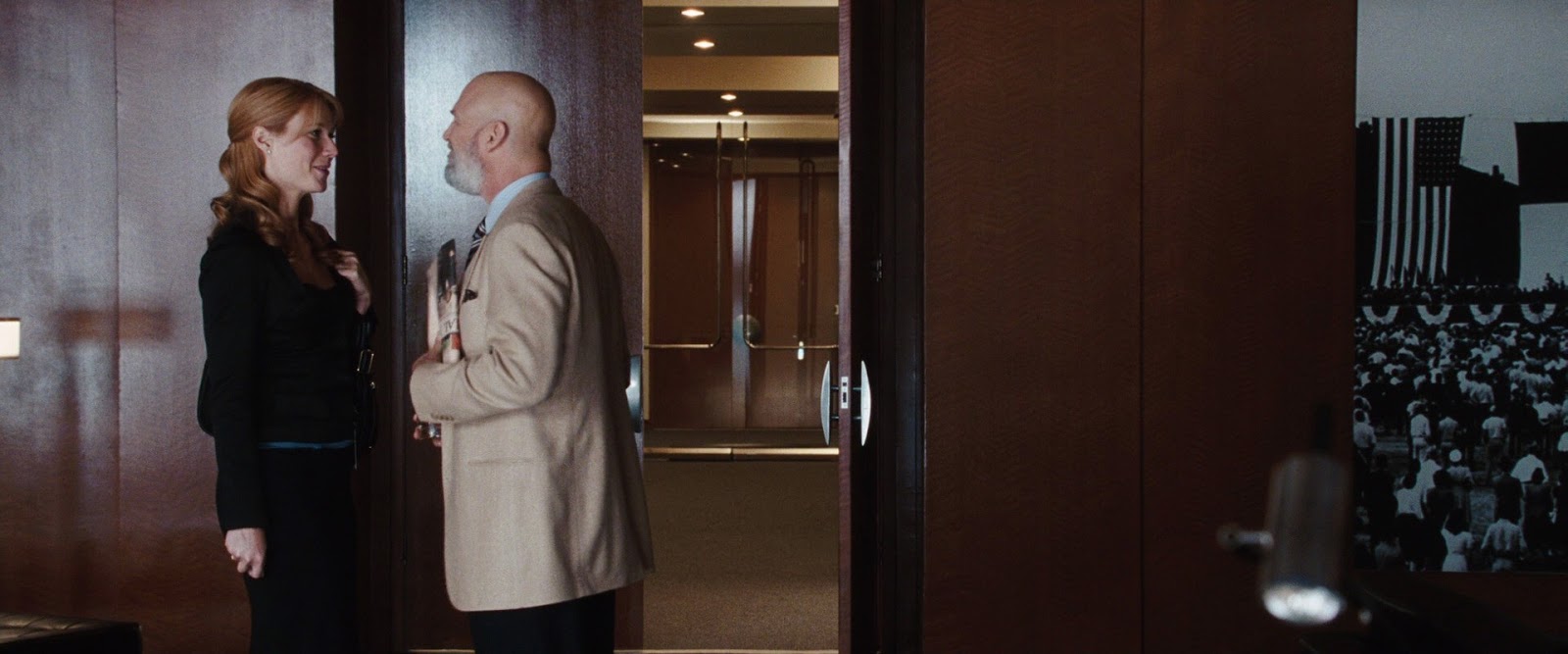
One thing that really distinguishes this film from many of the other movies in the Marvel Cinematic Universe is its sense of earnestness. There is a scene about halfway through the movie where Tony asks Pepper Potts to hack into Stark Industries computer system in order to uncover who else Obadiah Stane has sold weapons to. Pepper, at first, refuses to help him, as she feels that Tony is endangering his life through his endeavors. Tony, however, is insistent telling her that he shouldn't be alive, "unless it was for a reason. I'm not crazy, Pepper. I just finally know what I have to do. And I know in my heart that it's right."
Heart is a theme that runs throughout the film, being symbolized, most explicitly, by the arc reactor in Tony's chest, which also serves as the movies maguffin. He builds this in Afghanistan, after being attacked and kidnapped by terrorists, who use his own weapons against him, leaving him with shrapnel traveling toward his heart. Along with this new, artificial "heart" comes the sobering realization that he has lived, up to this point, a lie, deluding himself into thinking that all of his weapons development served the good of humanity. This is emblematic of his life in general, one of constant partying and indulgence but one with no real meaning. At first, Stark's predicament leads him to defeatism and it's only through the encouragement of his fellow prisoner, Yinsen, that he decides to build the Iron Man suit and attempt an escape. Yinsen is killed when he draws off the terrorists to buy Tony time to power up the suit. With his dying breath he tells Stark, "Don't waste it. Don't waste your life." Watching this good man die to save him gives Tony the final push he needs. He decides, from this moment forward, to use his resources and his genius in service of humanity.
Tony Stark is, front and center, the focus of this film but the supporting characters are still adequately fleshed out and their relationships with Stark feel genuine. Obadiah Stane is a much more unassuming and restrained supervillain then had been typical up to this point. Though it's clear that he is envious of Tony's fame and success he never let's this get in the way of his plans. Rather he is able to subtlety manipulate Tony so that the revelation that he was behind Stark's kidnapping feels both a shocking and, somehow, like something we should have seen coming. Pepper Potts is also a more fully formed character then your usual movie love interest. She clearly has feelings for Tony but won't pursue them because she knows he's irresponsible and self obsessed. As he grows as a character we see her grow closer to him yet, even by the end of the film she is not ready to fully commit to a relationship, turning the tables when he tries to win her over by reminding her of their almost-not-quite kiss earlier in the film. "Are you talking about the night that we danced and went up on the roof, and then you went downstairs to get me a drink, and you left me there, by myself?"
The film is subtly subversive like that and the romance between Tony and Pepper owes more to screwball comedies like His Girl Friday then to comic books. The typical hand wringing the protagonist would go through over revealing his secret identity to his significant other is simply not present here. Pepper just stumbles upon Tony as he's changing out of his Iron Man armor and he immediately takes her into his confidence. Similarly, the scene at the end where Tony reveals his secret identity to the world may not seem surprising 10 years later but, at the time, it was unprecedented. In the movie world up to this point every super-hero had a secret identity and this usually played a big role in the story of the film. By having Tony say "I am Iron Man" on national television the film was breaking precedent and opening the door for a different kind of superhero movie moving forward, one less beholden to the conventions of soap opera romance.
Like most Marvel movies Iron Man is filled with subversive humor but it works dramatically in a way many others don't because having Tony's bravado undercut by a humorous moment serves as a comeuppance for his egoism and vanity rather than undermining the character's heroism. Similarly the characters own sardonic sense of humor is not just there so the audience can have a laugh at the expense of the story, rather it comes from a character place. Tony uses it as a shield, hiding his personal trauma behind a public face that is snarky, irreverent and supremely self-confident.
One element that really makes Iron Man stand out among it superhero brethren is Jon Favreau's direction. He approached the film like an indie comedy (a genre that Favreau cut his teeth in) making generous use of improvisational acting and overlapping dialogue. Indeed, at the start of production Favreau had more of an outline then a full-fledged script, so most of the dialogue was improvised by he and Robert Downey Jr. The scene at the press conference, where Tony announces that his company will no longer produce weapons, was scripted by Downey himself the night before it was shot. Allowing his actors this level of input into his film allowed them to really shape their characters and bring them to life. It also resulted in more genuine, spontaneous human interaction in the actors' onscreen exchanges. As a result, Iron Man has a realistic, down-to-earth tone that is really unique within the superhero genre.
Of course, Robert Downey Jr. absolutely carries the film. He was an inspired choice to play Tony Stark. When he was cast the actor was coming off of a six year recovery period after a long struggle with substance abuse, arrests, and numerous legal troubles. His own life had been something of a redemption story and Downey really clearly channeled his life experience into the role. He worked exceptionally well with Jon Favreau, improvising and "creating" his character as the production went along. He also has great chemistry with his fellow cast members, particularly Gwyneth Paltrow. Paltrow and Jeff Bridges really convey the fact that their characters have a long, complicated relationship with Tony that extends beyond what we see in the film. Some actors embody the characters they play but Robert Downey Jr. made Iron Man his own. The success of the film would lead the actor to an unprecedented level of fame and popularity, and he topped Forbes list of highest paid actor's for three years in a row, from 2013 to 2015.
The world of Iron Man is filled with technology that seems just out of reach, from the computer program's Tony uses, to the weapons he builds, to the suit itself everything feels really believable. This is largely thanks to the many effects artists who worked on the film. This is the last film Stan Winston, the special effects artist behind Jurassic Park and Alien, would ever be involved in and, while there's nothing here as groundbreaking as his earlier work (but really, what is?) the special effects of Iron Man are still spectacular. I would go so far as to say that there as good or better as any Marvel movie made before or since. CGI is always more convincing when used along side practical effects, it gives the effects artists a more realistic basis for there work and helps the audience to believe what there seeing on screen. The suits built by Stan Winston Studios lend Iron Man a sense of realism you couldn't attain otherwise. The sound design, by Skywalker Sound, is also great, helping to breath life into all of Stark's tech.
For better or for worse Iron Man changed cinema. It made both Tony Stark and Robert Downey Jr. into household names and it kicked off the Marvel Cinematic Universe, an idea the rest of Hollywood is still struggling to try and replicate. Personally it helped me to begin my journey as a comic book fan and led me to a heavier involvement in modern cinema. Besides this, its a great piece of entertainment with witty dialogue, energetic performances, and jaw-dropping special effects all in service of a focused, character-driven origin story with genuine heart and emotion.
Monday, January 29, 2018
Musical Mondays: Evita (1996)
Evita was released on December 26th, 1996. Adapted from the 1976 concept album by Andrew Lloyd Webber and Tim Rice, it is directed by Alan Parker and written by Parker and Oliver Stone. It tells the true story of Eva PerĂ³n (Madonna), the first lady of Argentina from 1946 through 1952, chronicling her rise to fame and her political career.
From a historical standpoint, Evita is somewhat flawed. Lloyd Webber based his original album on the book Evita: The Woman with the Whip by Mary Main. The historical value of this book has since been brought into question and much of it is sensationalist and unfairly unbalanced in its evaluation of her political career (the author was an staunch anti-Peronist). Because of this, the film paints a decidedly unflattering picture of Eva and her husband's leadership while, in reality, the Peron government achieved some significant reforms and moved the country toward a more democratic form of government. They were certainly not beyond criticism, Juan Peron could be ruthless toward his political enemies and was basically a dictator, albeit a duly elected one, but the Peron's were not the nakedly self-serving leaders the film paints them as.
The film maps out the main points of Eva's life. The abandonment of her and her mother by her bourgeois father, her acting career in Buenos Ares and her meeting with Juan Peron (Jonathan Pryce), her rise to international fame as the first lady of Argentina, and her death. It subscribes to the popular myth that she was taken to Buenos Ares by a musician named Agustin Magaldi (Jimmy Nail), whose mistress she is. After arriving there, she begins having affairs with various influential men. Meanwhile, a military coup has supplanted the current Argentinian government and Juan Peron has begun rising to power. Eventually Eva meets Peron at a charity concert for victims of the 1944 San Juan earthquake and the two become lovers.
Peron is arrested by the current administration who feel threatened by his increasing influence with the people but Eva rallies them together labor and they mount a massive protest for Peron's release. After his release elections are held and Peron, with Eva's help, becomes the new President of Argentina. Eva then embarks on the famous "Rainbow Tour" to boost Argentina's international image. Returning to Argentina, Eva establishes a foundation to help the poor. In the last act, she declines the position of vice President offered by her husband when she is diagnosed with cancer. When she dies, millions of people attend her funeral to mourn their departed idol.
The film is basically about how politicians use their political platform as a stage, manipulating their supporters much in the same way as actors manipulate an audience. As a common poor girl from the streets who rose to the highest position imaginable, Evita gives the people of Argentina hope. They see her as one of them and she uses this trust to help get Juan elected. "He supports you, for he loves you; Understands you, is one of you; If not, how could he love me?" As the first lady, Eva continues to shape her public image and to win the favor of the people. There is a dual image of Evita in this film. The woman who grew up in poverty and tries to use her position of power to give the people some hope, in whatever limited way she can, and the manipulative, self-serving woman who will do or say whatever she feels is necessary top get ahead.
The film is not so much interested in who Eva was as a person as it is with the public's perception of her, personified in Che (Antonio Banderas), the film's narrator. Throughout the film Che provides wry commentary on Evita's actions, typically characterizing her as a power hungry diva. "Instead of government we had a stage; Instead of ideas, a prima donna's rage." Yet Che sometimes betrays a level of sympathy and even a sneaking admiration for Evita. So the musical is very meta, examining the role of drama in shaping the viewers emotions. Because of this it is somewhat better suited to the stage, where the audience shares the same physical space as the actors in whose hands the audience's suspension of disbelief lies. Film, on the other hand, is a little more complicated, as the actor's performances are really secondary to the cinematography, editing, and all the various visual storytelling devices a filmmaker may decides to utilize. Because the manipulation of the audience in a movie is more complicated and less direct then in a play, the metaphor of political performance does not come off as strongly here. That's not to say that Evita can't or doesn't work as a film, but the theatre is really the ideal medium for it.
The music and the lyrics of Evita are just brilliant. This is probably the most sophisticated of Andrew Lloyd Webber and Tim Rice's collaborations together. Lloyd Webber's use of theme is particularly strong here, and the wide range of musical styles employed throughout the score from classical choral pieces ("Requiem for Evita") to rhythmic Latin music ("Buenos Aires") to the composer's signature rock tunes ("Oh What a Circus") to more traditional, Broadway-style, emotionally charged ballads ("Another Suitcase in Another Hall"). Rice's layered, at times overlapping lyrics provide the story with its meta-textual overtones. A new song called "You Must Love Me" was written for the film by Rice and Lloyd Webber, the first new song they'd worked on together in nine years. It's a nice addition, helping to humanize both Eva and Juan to a greater extent. The film also makes a different use of "Another Suitcase in Another Hall", having Eva sing it when Magaldi leaves her behind. This helps to tie the song more closely to Eva's character, so it makes more sense when a passage from it shows up later in "Your Little Body's Slowly Breaking Down".
The cast is quite strong. Madonna, Pryce and Banderas can all sing quite well (particularly Madonna) and all three are well suited to there roles. Madonna finds the right balance between craftiness and genuine pathos. She's no Patty LuPone but, for a recording artist she does an admirable job. Price is perfectly cast as Juan Peron. The actor has this enigmatic quality to him, combining a slimy unscrupulous disposition with a certain quiet, inner dignity. Banderas is his usual energetic self as Che and puts a lot of passion and sardonic charm into his musical numbers. Alan Parker's direction is a little MTV for my taste, using dutch angles, quick cutting and a minimum use of wides, but it fits the material (this was originally a concept album after all) and the costume and set design is quite impressive.
Evita is a musical that is, in my opinion, better suited to the stage. Never-the-less, the inherent strength's of Webber and Rice's score still come through on film and, with a strong cast and impressive production value this is probably as good as an adaptation of this material can be.
Score: 8/10
From a historical standpoint, Evita is somewhat flawed. Lloyd Webber based his original album on the book Evita: The Woman with the Whip by Mary Main. The historical value of this book has since been brought into question and much of it is sensationalist and unfairly unbalanced in its evaluation of her political career (the author was an staunch anti-Peronist). Because of this, the film paints a decidedly unflattering picture of Eva and her husband's leadership while, in reality, the Peron government achieved some significant reforms and moved the country toward a more democratic form of government. They were certainly not beyond criticism, Juan Peron could be ruthless toward his political enemies and was basically a dictator, albeit a duly elected one, but the Peron's were not the nakedly self-serving leaders the film paints them as.
The film maps out the main points of Eva's life. The abandonment of her and her mother by her bourgeois father, her acting career in Buenos Ares and her meeting with Juan Peron (Jonathan Pryce), her rise to international fame as the first lady of Argentina, and her death. It subscribes to the popular myth that she was taken to Buenos Ares by a musician named Agustin Magaldi (Jimmy Nail), whose mistress she is. After arriving there, she begins having affairs with various influential men. Meanwhile, a military coup has supplanted the current Argentinian government and Juan Peron has begun rising to power. Eventually Eva meets Peron at a charity concert for victims of the 1944 San Juan earthquake and the two become lovers.
Peron is arrested by the current administration who feel threatened by his increasing influence with the people but Eva rallies them together labor and they mount a massive protest for Peron's release. After his release elections are held and Peron, with Eva's help, becomes the new President of Argentina. Eva then embarks on the famous "Rainbow Tour" to boost Argentina's international image. Returning to Argentina, Eva establishes a foundation to help the poor. In the last act, she declines the position of vice President offered by her husband when she is diagnosed with cancer. When she dies, millions of people attend her funeral to mourn their departed idol.
The film is basically about how politicians use their political platform as a stage, manipulating their supporters much in the same way as actors manipulate an audience. As a common poor girl from the streets who rose to the highest position imaginable, Evita gives the people of Argentina hope. They see her as one of them and she uses this trust to help get Juan elected. "He supports you, for he loves you; Understands you, is one of you; If not, how could he love me?" As the first lady, Eva continues to shape her public image and to win the favor of the people. There is a dual image of Evita in this film. The woman who grew up in poverty and tries to use her position of power to give the people some hope, in whatever limited way she can, and the manipulative, self-serving woman who will do or say whatever she feels is necessary top get ahead.
The film is not so much interested in who Eva was as a person as it is with the public's perception of her, personified in Che (Antonio Banderas), the film's narrator. Throughout the film Che provides wry commentary on Evita's actions, typically characterizing her as a power hungry diva. "Instead of government we had a stage; Instead of ideas, a prima donna's rage." Yet Che sometimes betrays a level of sympathy and even a sneaking admiration for Evita. So the musical is very meta, examining the role of drama in shaping the viewers emotions. Because of this it is somewhat better suited to the stage, where the audience shares the same physical space as the actors in whose hands the audience's suspension of disbelief lies. Film, on the other hand, is a little more complicated, as the actor's performances are really secondary to the cinematography, editing, and all the various visual storytelling devices a filmmaker may decides to utilize. Because the manipulation of the audience in a movie is more complicated and less direct then in a play, the metaphor of political performance does not come off as strongly here. That's not to say that Evita can't or doesn't work as a film, but the theatre is really the ideal medium for it.
The music and the lyrics of Evita are just brilliant. This is probably the most sophisticated of Andrew Lloyd Webber and Tim Rice's collaborations together. Lloyd Webber's use of theme is particularly strong here, and the wide range of musical styles employed throughout the score from classical choral pieces ("Requiem for Evita") to rhythmic Latin music ("Buenos Aires") to the composer's signature rock tunes ("Oh What a Circus") to more traditional, Broadway-style, emotionally charged ballads ("Another Suitcase in Another Hall"). Rice's layered, at times overlapping lyrics provide the story with its meta-textual overtones. A new song called "You Must Love Me" was written for the film by Rice and Lloyd Webber, the first new song they'd worked on together in nine years. It's a nice addition, helping to humanize both Eva and Juan to a greater extent. The film also makes a different use of "Another Suitcase in Another Hall", having Eva sing it when Magaldi leaves her behind. This helps to tie the song more closely to Eva's character, so it makes more sense when a passage from it shows up later in "Your Little Body's Slowly Breaking Down".
The cast is quite strong. Madonna, Pryce and Banderas can all sing quite well (particularly Madonna) and all three are well suited to there roles. Madonna finds the right balance between craftiness and genuine pathos. She's no Patty LuPone but, for a recording artist she does an admirable job. Price is perfectly cast as Juan Peron. The actor has this enigmatic quality to him, combining a slimy unscrupulous disposition with a certain quiet, inner dignity. Banderas is his usual energetic self as Che and puts a lot of passion and sardonic charm into his musical numbers. Alan Parker's direction is a little MTV for my taste, using dutch angles, quick cutting and a minimum use of wides, but it fits the material (this was originally a concept album after all) and the costume and set design is quite impressive.
Evita is a musical that is, in my opinion, better suited to the stage. Never-the-less, the inherent strength's of Webber and Rice's score still come through on film and, with a strong cast and impressive production value this is probably as good as an adaptation of this material can be.
Score: 8/10
Saturday, January 27, 2018
Saturday Evening Cartoons: Mary and the Witch's Flower (2017)
SPOILER WARNING!
Mary and the Witch's Flower is the first feature film released by Studio Ponoc, a new Japanese animation studio formed by former members of Studio Ghilbi. Going in, I was afraid it might just Studio Ghibli-like film, but of lesser quality, much like many of the more recent Pixar films. I'm happy to report that my fears were, at least somewhat, allayed. That's not to say that the film greatly diverges from the general tone and style of a Studio Ghibli film, both visually and story-wise it owes a lot to Hayao Miyazaki, Ghibli's foremost director, but is does stand up as a solid piece of animation in its own right.
Outside of Miyazaki, this film's biggest source of inspiration is clearly J.K. Rowling's Harry Potter. Like Harry, Mary escapes from her boring everyday life to find a wonderful, but dangerous, magical one. Also like Harry, Mary discovers that she has greater heritage then she realized and she goes through a bit of a hero's journey before discovery this. This is where the film falters a little for me, as Mary never really has any personal weaknesses to overcome or lessons to learn.
The real problem is that, when she is whisked away to Endor College on her broom, Mary is basically forced into a situation where she feels compelled to hide the truth, and she is somewhat justified for doing so. On returning to her own world, she shows no real interest in ever going back to Endor college. She has no heroic motivations or aspirations. Through no real fault of her own, Mary reveals the address of her neighbor Peter to Madame, who then kidnaps him in order to force Mary to give the witch's flower back. Mary does this only to be betrayed by Madame who imprison both her and Peter until she and Doctor Dee can conduct a dangerous experiment on them using the flower. Mary feels guilty for causing Peter to be captured but, since she did so by accident, it's not a very compelling emotional conflict for her.
Still relying on on outside sources of power, Mary uses the spell-book she accidentally took from Madame to help her and Peter escape. At this point it is revealed that Aunt Charlotte was once a witch who stole the fly-by-night from Madame and Doctor Dee to put an end to the wicked experiments they did with it. When Peter is captured once again Mary is faced with a choice: abandon him and return home before the power of the fly-by-night fades or attempt to save him and risk never returning. She decides to try and save him only to have her broom broken. This is a low point for her character. Up to now she has relied on magic to get by. Without it she comes close to giving up only to take courage and attempt to save Peter on her own. This is beautifully symbolized by the broom, which picks itself up and tries to hop around, though broken in two.
Though the film has struggled to give Mary much of an internal struggle up to this point I think this works pretty well. At the beginning of the film she is accident prone and can't seem to do anything right. Because of this, when she first discovers the "fly-by-night" and the magical world of Endor College she relies on the power granted her by the flower to try and impress Madame and Doctor Dee and, later, to escape from them. By placing her in a situation where she can no longer rely on this power, the writers allow Mary to gain a greater sense of self confidence and become a little more assertive.
The villains could also use a little more fleshing out. Madame and Doctor Dee, we learn, were once good and kind but, when they found the fly-by-night, they were corrupted by the allure of its power. This could potentially be an interesting backstory for them, but we never really understand what exactly the pair hope to accomplish through their experiments. We know that they hope to transform all humans into witches but why exactly? Do they believe that this would benefit humanity in some way? Do they hope to attain fame and power for themselves? It might help if we had a better understanding of how this world worked. Why, exactly, does Endor College exist in a hidden world apart from normal humans? Are there other schools for witches that compete with it? Is there some sort of government or authority to oversee the witches? Do all witches live apart from humanity? Is there any non-magical folk in the normal world who are aware of their existence? The film doesn't tell us any of this.
While the film's story is lacking in certain aspects, the animation is simply amazing. From the quaint idyllic village where Mary and her Aunt live to the reality bending realm of Endor College, the world of Mary and the Witch's Flower feels fully realized, at least from a visual standpoint. The character work is equal impressive, with some really expressive facial work and dynamic movement, especially during the flying scenes. The score by Takatsugu Muramatsu is emotionally stirring and evocative. There's a really elemental feel to much of it which befits the magical world the film presents.
While far from perfect, Mary and the Witch's Flower marks a fairly strong start for Studio Ponoc. I look forward to seeing what's in store for the studio in the future.
Score: 8/10
Wednesday, January 17, 2018
Western Wednesdays: Adios, Sabata (1970)
The Spaghetti Western genre always contained elements of camp and burlesque. There is a heavy dose of black comedy that pervades Sergio Leone's famed dollars trilogy, particularly in the second installment, For a Few Dollars More. There also tends to be a somewhat rehearsed feeling to much of the action. Lee Van Cleef's Douglas Mortimer dispatches his bounty with a Bond-like coolness and proficiency, going so far as to carry a virtual armory in his saddlebag. As the genre progressed into the late 1960's these elements would become more common and more pronounced. Many Italian directors moved toward outright parody while others would pursue a more tone more in line with late Connery era Bond films, where the reality is heightened to an absurd degree yet everyone in the film takes it completely seriously. The master of this new breed of spaghetti westerns is certainly Gianfranco Parolini, whose earlier film, If You Meet Sartana, Pray for Your Death (1968) helped to establish a new and often imitated approach to the genre.
Adios, Sabata followed closely on the heels of Parolini's Sabata (1970), which featured Lee Van Cleef as a more larger-then-life version of his character from For a Few Dollars More. Originally it was intended as a stand-alone piece called Indio Black, but the film was redubbed for international audiences (that is, audiences outside of Italy) after the success of Sabata despite the fact that it starred Yul Brynner instead of Van Cleef. Ironically, Van Cleef turned down the main role instead opting to play Chris in The Magnificent Seven Ride, a role originally played by Brynner.
The film is set in Mexico at the during the reign of Maximilian I, the brother of Austrian Emperor Joseph I, who took charge of the Mexican monarchy started by Napoleon III of France as part of his attempt to establish an ally in North America. If this sounds complicated, don't worry, the film doesn't attempt to explore the complicated politics of the period in any way, nor should it. The characters and their moralities in Parolini's films are pretty paper thin. You know that Sabata is the good guy because he gives money to monks and poor orphans but, at the same time, he's a loner who has no loyalty to political causes, including that of the revolutionaries who hire him. The villain, and you know he's the villain because he enjoys shooting unarmed prisoners in the back, an Austrian colonel named Skimmel, is played by Gérard Herter. Skimmel attempts to cover up his theft of the emperor's gold by blaming in on Mexican revolutionaries. To do this he has a fake shipment stolen by his own men, dressed up as Mexican bandits. Unbeknownst to Skimmel however, the real Mexican revolutionaries have hired Sabata to help them steal the shipment for themselves.
The film's action centers around Sabata and his companions, including the double-dealing, piano playing Ballantine (Dean Reed), the patriotic Escudo (Ignazio Spalla), and the tap dancing Septembre (Sal Borgese), who catapults lead balls with his feet. After seizing the gold shipment from Skimmel's men they spend most of the film running away from hired goons who want the gold for themselves (it is a little unclear who hired them and for what purpose). They eventually discover that the bags they think are filled with gold are actually filled with sand. The climax of the film focuses on their attempt to steal the gold back from Skimmel before he flees over the border with it. Along the way there are many twists, turns and double-crosses. The film ends with a scene reminiscent of The Good, the Bad, and the Ugly, but punctuated by a moment that could have been pulled from Adam West Batman.
Parolini's three Sabata films are often referred to as 'circus westerns, as the director delights in presenting over-the-top, comic-book like set-pieces. Adios, Sabata is no slouch in this area. From Sabata's harmonica lever-action rifle (a creation of the film) to Septembre's shoes with built in slingshots, to the Skimmel's model ship with canon's that fire bullets, this film is filled with Bond-like gadgetry and over-the-top acrobatics. The various shootouts usually end (or are escalated) by a character showing up with superior weaponry. Parolini handles these scenes with finesse, though there is some sloppy editing here and there, and Bruno Nicolai's rousing score perfectly captures the lively, tongue-in-the-cheek tone of the film.
Adios, Sabata may not be a particularly deep film but it is a ton of fun. Featuring strong direction from Parolini, spectacular action scenes, solid performances, and a memorable score I would definitely recommend this film to any fan of the spaghetti western genre, though western purists may be better advised to steer clear.
Score: 8/10
![]() |
| Lee Van Cleef in Sabata (1969) |
The film is set in Mexico at the during the reign of Maximilian I, the brother of Austrian Emperor Joseph I, who took charge of the Mexican monarchy started by Napoleon III of France as part of his attempt to establish an ally in North America. If this sounds complicated, don't worry, the film doesn't attempt to explore the complicated politics of the period in any way, nor should it. The characters and their moralities in Parolini's films are pretty paper thin. You know that Sabata is the good guy because he gives money to monks and poor orphans but, at the same time, he's a loner who has no loyalty to political causes, including that of the revolutionaries who hire him. The villain, and you know he's the villain because he enjoys shooting unarmed prisoners in the back, an Austrian colonel named Skimmel, is played by Gérard Herter. Skimmel attempts to cover up his theft of the emperor's gold by blaming in on Mexican revolutionaries. To do this he has a fake shipment stolen by his own men, dressed up as Mexican bandits. Unbeknownst to Skimmel however, the real Mexican revolutionaries have hired Sabata to help them steal the shipment for themselves.
The film's action centers around Sabata and his companions, including the double-dealing, piano playing Ballantine (Dean Reed), the patriotic Escudo (Ignazio Spalla), and the tap dancing Septembre (Sal Borgese), who catapults lead balls with his feet. After seizing the gold shipment from Skimmel's men they spend most of the film running away from hired goons who want the gold for themselves (it is a little unclear who hired them and for what purpose). They eventually discover that the bags they think are filled with gold are actually filled with sand. The climax of the film focuses on their attempt to steal the gold back from Skimmel before he flees over the border with it. Along the way there are many twists, turns and double-crosses. The film ends with a scene reminiscent of The Good, the Bad, and the Ugly, but punctuated by a moment that could have been pulled from Adam West Batman.
Parolini's three Sabata films are often referred to as 'circus westerns, as the director delights in presenting over-the-top, comic-book like set-pieces. Adios, Sabata is no slouch in this area. From Sabata's harmonica lever-action rifle (a creation of the film) to Septembre's shoes with built in slingshots, to the Skimmel's model ship with canon's that fire bullets, this film is filled with Bond-like gadgetry and over-the-top acrobatics. The various shootouts usually end (or are escalated) by a character showing up with superior weaponry. Parolini handles these scenes with finesse, though there is some sloppy editing here and there, and Bruno Nicolai's rousing score perfectly captures the lively, tongue-in-the-cheek tone of the film.
Adios, Sabata may not be a particularly deep film but it is a ton of fun. Featuring strong direction from Parolini, spectacular action scenes, solid performances, and a memorable score I would definitely recommend this film to any fan of the spaghetti western genre, though western purists may be better advised to steer clear.
Score: 8/10
Monday, January 1, 2018
Musical Mondays: Meet Me in St. Louis (1944)
Meet Me in St. Louis was released on February 28th, 1944. It is directed by Vincente Minnelli and stars Judy Garland, Margaret O'Brien, Tom Drake, Leon Ames, Mary Astor, and Lucille Bremer. In it Esther Smith (Garland), a young lady living with her family in St. Louis, Missouri, falls in love with John Truett (Drake), the boy next door. She and her family are shocked when they find out that their father has been offered a better position in his firm and is planning to uproot the family and move to New York.
Meet Me in St. Louis is told in a somewhat episodic fashion, split into three seasonal vignettes. The first, taking place in the summer of 1903, introduces the Smiths, a middle class St. Louis family consisting of Mr. and Mrs. Smith (Ames and Astor, respectively) their four daughters, Rose (Bremer), Esther, Agnes (Joan Carroll) and Tootie (O'Brien), their son Alonzo Jr. (Henry Daniels) their grandfather (Henry Davenport) and their maid, Katie (Marjorie Main). Esther has a crush on John Truett, the boy next door, who she meets at her family's neighborhood house party. Alonzo, the father and breadwinner of the family, is often kept out of the loop as to the goings on within his home. Much of this first act deals with Esther and John falling in love and with the family's efforts to help Rose receive a long distance call from her beau Warren Sheffield in private. An act which is thwarted by Mr. Smith, who is unaware that his daughter is expecting a call from a suitor.
The next act, taking place on Halloween of 1903, introduces some conflict into the story as Mr. Smith, arriving home after a rather hectic Halloween, announces his plans to move the family to New York so that he can take advantage of a business opportunity there. Much to his surprise this greatly upsets his family, who have their roots in St. Louis and are loath to leave the city, especially so close the the World's Fair, which will open the following Spring. Ultimately though, the family support their fathers decision to leave.
The final act, taking place over Christmas, serves as the films climax. Preparing to leave their beloved city for New York after the holiday, the Smith's remain somewhat tense. Rose's boyfriend, Warren, has decided to go to the Christmas Eve ball with Lucile Ballard, the girl her brother Lon wanted to go with. This causes some animosity between the siblings but Esther convinces them to go to the ball together. Esther herself is devastated when John reveals that he won't be able to take her to the ball as his tuxedo's locked up at the tailor's. Hoping to cheer her up Esther's Grandpa offers to take her to the ball himself, an offer she accepts. In the end Lucille Ballard decides to dance with Lon and Warren with Rose, leaving only Esther without her desired partner but John shows up, surprising her, and he proposes to her outside of the ballroom. Esther returns home worried about whether her relationship with John can survive their separation when her family moves away. She comforts Tootie, who is greatly upset about the upcoming move and Mr. Smith, witnessing this, realizes how much leaving the city will affect his family and decides not to take the job in New York. That same night, Warren Sheffield hastily proposes to Rose. The film ends the following Spring, at the opening of the St. Louis World Fair, as the Smiths attend the event together as a family.
This film is filled to the brim with memorable tunes, some of them being period songs from the time of the St. Louis Exposition and others original songs written, mostly, by Hugh Martin and Ralph Blane. From the longing sighs of "The Boy Next Door" to the energetic whimsy of "The Trolley Song" to the warm sentimental tones of "Have Yourself a Merry Little Christmas" many of Martin and Blane's songs would go on to become popular standards. Producer Arthur Freed wrote "You and I" a song which serves, in many ways, as the heart of the film, with the mother and father and then the rest of the family uniting, in song in their living room despite their misgivings about moving to New York. The framing of this scene, from Minnelli, is absolutely brilliant, as the children and their grandpa gradually gather around their mother and father, symbolizing the unity of the family. Minnelli, along with cinematographer George J. Folsey give the film a picturesque look, with many shots resembling paintings by Currier and Ives.
The film is also filled with lively performances. Judy Garland (who met and eventually married Vincente Minneli on the set of this film) is at her most luminous here, with no sign of her later neurotic tendencies. Her voice is, of course, absolutely beautiful and makes me long for the days before autotune, when Hollywood musicals cast actors who could act and sing. Tom Drake is perfect as the earnest boy-next-door John Truett. Leon Ames is surly but lovable as Mr. Smith and Mary Astor brings an air of motherly strength and authority to Mrs. Smith. Harry Davenport is simply wonderful as the sly but benevolent Grandpa. Finally, seven year old Margaret O'Brien nearly steals the show as the mischievous young delinquent, Tootie.
Meet Me in St. Louis is simply a joy to watch. It paints an idyllic, almost dreamlike picture of turn-of-the-century life in an American town. It's a wonderful blend of music, humor, and drama held together by a touching story about family and community.
Score: 9/10
Meet Me in St. Louis is told in a somewhat episodic fashion, split into three seasonal vignettes. The first, taking place in the summer of 1903, introduces the Smiths, a middle class St. Louis family consisting of Mr. and Mrs. Smith (Ames and Astor, respectively) their four daughters, Rose (Bremer), Esther, Agnes (Joan Carroll) and Tootie (O'Brien), their son Alonzo Jr. (Henry Daniels) their grandfather (Henry Davenport) and their maid, Katie (Marjorie Main). Esther has a crush on John Truett, the boy next door, who she meets at her family's neighborhood house party. Alonzo, the father and breadwinner of the family, is often kept out of the loop as to the goings on within his home. Much of this first act deals with Esther and John falling in love and with the family's efforts to help Rose receive a long distance call from her beau Warren Sheffield in private. An act which is thwarted by Mr. Smith, who is unaware that his daughter is expecting a call from a suitor.
The next act, taking place on Halloween of 1903, introduces some conflict into the story as Mr. Smith, arriving home after a rather hectic Halloween, announces his plans to move the family to New York so that he can take advantage of a business opportunity there. Much to his surprise this greatly upsets his family, who have their roots in St. Louis and are loath to leave the city, especially so close the the World's Fair, which will open the following Spring. Ultimately though, the family support their fathers decision to leave.
The final act, taking place over Christmas, serves as the films climax. Preparing to leave their beloved city for New York after the holiday, the Smith's remain somewhat tense. Rose's boyfriend, Warren, has decided to go to the Christmas Eve ball with Lucile Ballard, the girl her brother Lon wanted to go with. This causes some animosity between the siblings but Esther convinces them to go to the ball together. Esther herself is devastated when John reveals that he won't be able to take her to the ball as his tuxedo's locked up at the tailor's. Hoping to cheer her up Esther's Grandpa offers to take her to the ball himself, an offer she accepts. In the end Lucille Ballard decides to dance with Lon and Warren with Rose, leaving only Esther without her desired partner but John shows up, surprising her, and he proposes to her outside of the ballroom. Esther returns home worried about whether her relationship with John can survive their separation when her family moves away. She comforts Tootie, who is greatly upset about the upcoming move and Mr. Smith, witnessing this, realizes how much leaving the city will affect his family and decides not to take the job in New York. That same night, Warren Sheffield hastily proposes to Rose. The film ends the following Spring, at the opening of the St. Louis World Fair, as the Smiths attend the event together as a family.
This film is filled to the brim with memorable tunes, some of them being period songs from the time of the St. Louis Exposition and others original songs written, mostly, by Hugh Martin and Ralph Blane. From the longing sighs of "The Boy Next Door" to the energetic whimsy of "The Trolley Song" to the warm sentimental tones of "Have Yourself a Merry Little Christmas" many of Martin and Blane's songs would go on to become popular standards. Producer Arthur Freed wrote "You and I" a song which serves, in many ways, as the heart of the film, with the mother and father and then the rest of the family uniting, in song in their living room despite their misgivings about moving to New York. The framing of this scene, from Minnelli, is absolutely brilliant, as the children and their grandpa gradually gather around their mother and father, symbolizing the unity of the family. Minnelli, along with cinematographer George J. Folsey give the film a picturesque look, with many shots resembling paintings by Currier and Ives.
The film is also filled with lively performances. Judy Garland (who met and eventually married Vincente Minneli on the set of this film) is at her most luminous here, with no sign of her later neurotic tendencies. Her voice is, of course, absolutely beautiful and makes me long for the days before autotune, when Hollywood musicals cast actors who could act and sing. Tom Drake is perfect as the earnest boy-next-door John Truett. Leon Ames is surly but lovable as Mr. Smith and Mary Astor brings an air of motherly strength and authority to Mrs. Smith. Harry Davenport is simply wonderful as the sly but benevolent Grandpa. Finally, seven year old Margaret O'Brien nearly steals the show as the mischievous young delinquent, Tootie.
Meet Me in St. Louis is simply a joy to watch. It paints an idyllic, almost dreamlike picture of turn-of-the-century life in an American town. It's a wonderful blend of music, humor, and drama held together by a touching story about family and community.
Score: 9/10
Subscribe to:
Comments (Atom)