Wednesday, May 19, 2021

Western Wednesdays: The Ballad of Lefty Brown (2017)

     The Ballad of Lefty Brown was released on December 15th, 2017. It is written and directed by Jared Moshé. In it a cowboy named Lefty Brown (Bill Pullman) sets out to avenge the murder of his boss. 

     Loyalty is the central theme of The Ballad of Lefty Brown. The plot is set in motion when Edward Johnson (Peter Fonda), the boss and long time friend of our eponymous protagonist, is murdered and Lefty sets out to bring his killers to justice. Accompanying Lefty is Marshal Tom Harrah (Tommy Flanagan), an old friend of Lefty and Ed from back in the day. Tom has been sent by another old friend, James Bierce (Jim Caviezel), now a Governor, with all the responsibility that entails, to dissuade Lefty from his task, preferring to let the army handle it. After some heated debate (that involves Tom being tied up by Lefty), Harrah is persuaded to help Brown track down the killers, convinced it's what Ed would have wanted. They also meet Jeremiah Perkins (Diego Josef), an aspiring gunfighter who looks idolizes Tom, Ed and Jimmy (all of whom have had dime store novels written about their former exploits).


      When it is revealed that Bierce was behind Ed's murder, as he had opposed the building of a new railway, Tom is torn between loyalty to Jimmy and to his departed friend. Meanwhile, Lefty is framed for the murder in order to detract attention away from Bierce. He is captured by Ed's grieving widow Laura (Kathy Baker), who believes that he is the murderer. It is up to him to escape and uncover the conspiracy. 

     Many westerns fall into one of two categories, they will either portray the west as a place to escape the decadence and emptiness of modern society or as a brutal wilderness to which the protagonists must bring the benefits of civilization. Lefty Brown fits firmly in the former mold. Its characters have forged their own place in the wilderness and the railroads, along with the development they will bring, are seen as a threat to this. Jimmy, in buying into the myth of progress that the railroad represents, becomes a villain.

     This attitude, I suppose, also informs the films attitude toward vigilante justice. The films ends with Lefty and the townsfolk lynching Bierce, believing that he will use his political connections to clear himself of Ed's murder. Earlier in the film we see Johnson take the law into his own hands to hang a murderer he and Lefty caught. In many ways this idea of justice carries throughout the film, as Lefty pursues Ed's killers against the urging of Jimmy and Tom, who prefer to leave the job to the competent authorities.


      The film can be a little heavy handed with its themes at times. Jimmy's monologue before he is hanged, maintaining the justice of his actions in his own eyes, is, in particular, a little hard to swallow considering that he's about to loose his life. Another problem is that the film doesn't really explain why Ed opposed the railway in the first place. Clearly Jimmy's pursuit of progress has corrupted him. Is the film suggesting that this pursuit is inherently corrupting? That perhaps it is better to maintain a more "settled" existence? By the time the credits role, it remains unclear.

     The Ballad of Lefty Brown features a great cast. Bill Pullman puts in a sensitive performance as the slow-witted but unflinchingly loyal Lefty Brown. Peter Fonda lends a real sense of gravitas to Edward Johnson. Though he has very little screen time, his character looms over the film like the ghost of Hamlet's father. Kathy Baker, meanwhile, is every bit his equal as Johnson's matriarchal wife, Laura.  Jim Caviezel is suitably (if uncharacteristically) sleazy as the treacherous Jimmy Bierce while Tommy Flanagan is his usual cantankerous self as Tom Harrah, the haunted, hard-drinking Irishman. Joe Anderson is suitably menacing as the killer-for-hire Frank Baines. Finally, young Diego Josef holds his own among a veteran cast as Jeremiah Perkins, the would-be gunslinger befriended by Lefty.  
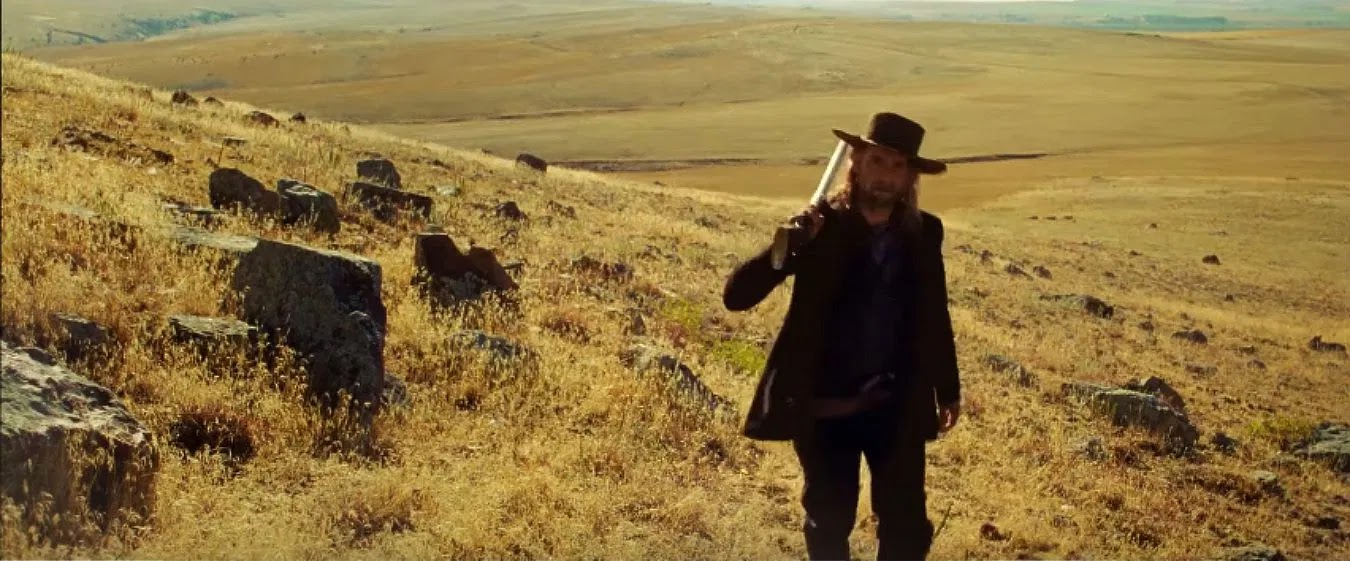
     Jared Moshé does a great job in this, his second film as a director. His use of hand held camera's lends a sense of uneasy to much of the film. This is contrasted with the locked down wide shots of the landscape, emphasizing the unchanging and indifferent order of nature. David McFarland's cinematography captures the stark beauty of the Montana landscape while H. Scott Salinas somber score is used sparingly but effectively. 

     All in all The Ballad of Lefty Brown is an above average western. Given the current dearth in the genre's output of late, I would certainly recommend for any and all western fans. 

Score: 8/10

Thursday, May 13, 2021

Western Wednesdays: Rocky Rhodes (1934) (Belated)

Apologies that this was late. I've been sick the last few days...

     Rocky Rhodes was released by Universal Pictures on September 24th, 1934.  Directed by Alfred Raboch and written by Edward Churchill from a story by W. C. Tuttle it stars Buck Jones as Rocky Rhodes, a cowboy who is called home by his father when trouble starts brewing at the home ranch in Cactus City, Arizona.

     Rocky Rhodes gets off to a shaky start with a rather uninspiring opening where Rocky and his terribly unfunny comic-relief sidekick (Stanley Fields' Harp Haverty) trade barbs with one another in the office of the Chicago stock yards where they work. After receiving a letter from his father requesting that he return home he and Harp are taken by surprise when a fire flares up which destroys the stockyards. There is then a tedious (and rather pointless) scene where the two men take a train to Cactus City and Rocky gets into a fight with a snarky cowhand. 

     Once we reach Cactus City the film picks up considerably. Rocky discovers that his father has been murdered, an act for which his trusted foreman, Paul Fix's Joe Hilton, stands accused. Fix is busted out of prison with the help of the real murderers, who shoot him in the back after his escape. Dan Murtch, head of the Cactus City Investment, is the man behind all the trouble. He plans to force the local ranchers, including John Street (Alfred P. James) and his daughter Nan (Sheila Terry), to sell their spreads to him but Rocky interferes. To get him out of the way, Murtch has Rocky framed for robbing the bank, causing Rhodes to go on the run. He must clear his name and prove who the real criminals are before Murtch can carry out his plans.

     Ted D. McCord's cinematography is quite good. There's a lot of nighttime photography which is particularly dynamic. Though Alfred Raboch's direction is inconsistent, at times it really shines. The climax is really thrilling with Rocky calling out Murtch in the saloon and then chasing him to the Street's ranch where an injured Nan is trying to crawl away before the explosives, planted by Murtch's men, go off. Hilton's death scene is genuinely poignant, as he reminisces about the god ol' days with Rocky and Harp. Paul Fix sells it really well. The scene where Rocky tells his mother (Lydia Knott) about his father's murder is also emotional, perhaps uncomfortably so, as Buck picks her up and carries her around the house!

     It's definitely a flawed film, marred in particular by occasionally jarring cuts and Stanley Fields insufferable comic relief. In the end, though at times crude Rocky Rhodes delivers the goods and is a solid start to Jones tenure at Universal.

 Score: 7/10

Saturday, May 8, 2021

Saturday Evening Cartoons: Ponyo (2008)


     Ponyo was released on July 19th, 2008. Written and directed by Hayao Miyazaki it is loosely based on The Little Mermaid by Hans Christian Andersen. In it a young human boy named Sōsuke (voiced by Frankie Jonas in the English dub) befriends a goldfish named Ponyo (Noah Cyrus), who begins turning into a human after ingesting some of his blood.

     Like most of Miyazaki's movies Ponyo is loosely plotted. There are two central conflicts, one arising from the other. The first is between Ponyo and her father Fujimoto (Liam Neeson), a human wizard/scientist. After meeting and falling in love with Sōsuke, Ponyo longs to become human but her father forbids it. Ponyo runs away from her father to be with Sōsuke, using her magic to make herself human, but the magic that is released as a result of this creates an imbalance in nature, resulting in an enormous tsunami which threatens to destroy Sōsuke's sea-side village home. Both conflicts are resolved rather easily when Fujimoto tells Ponyo's mother Gran Mamare (Cate Blanchett) about her actions and she decides that Ponyo can become human providing that Sōsuke can prove his love for her. This also restores the balance of nature. 

      There is a general theme of familial conflict running throughout the film. Ponyo's clashes with her father who does not want her to become human. It can be inferred that Fujimoto, having turned his back on the human world for a life under-the-sea, is hurt by his daughter's desire to, essentially, do the opposite. In any case the parallel between Fujimoto, who gave up a human life after falling in love with a sea goddess, and Ponyo, who gives up her life as a fish after falling in love with a human. There is also tension among Sōsuke's family. His mother (Tina Fey) harbors resentment toward his father (Matt Damon), a sailor who, because of his job, is never around. 

     Ponyo is a lovely looking film, even if less impressive then some of Studio Ghibli's earlier efforts. It features more streamlined animation then many of the studio's earlier films. The backgrounds are not as painterly and the characters more cartoonish. Yet it has that quality that many of their films do of making the movement and expressions of the characters feel grounded. Its portrayal of magic is also very matter-of-fact magic, as is Miyazaki's custom, and the characters feel like real people with real problems. The voice cast are uniformly solid except perhaps for Neeson, who feels a little miscast as Ponyo's quirky wizard father. 

     Ponyo is an enchanting little movie with beautiful animation and likable characters. The story may be a little lightweight but that's part of the charm.

Score: 8/10

Wednesday, April 28, 2021

Western Wednesdays: Junior Bonner (1972)

    Junior Bonner was released on June 11th, 1972. It is directed by Sam Peckinpah and written by Jeb Rosebrook. It stars Steve McQueen as Junior 'J.R.' Bonner, a down-on-his-luck rodeo rider who enters the Independence Day rodeo in his hometown of Prescott, Arizona. 

      Junior Bonner is a film about aging. 'J.R.' Bonner is over the hill. As the film opens, we see him being thrown from a bull during a rodeo, an event he thinks back to again and again over the course of the film. When he returns to Prescott he finds that his childhood home is being bulldozed, courtesy of his entrepreneurial brother, Curly (Joe Don Baker). Like most of Peckinpah's protagonists, J.R. is a man out of sync with modernity. 

     So is his father, Robert Preston's Ace Bonner, who has a complicated relationship with his son. Ace, like J.R., was a rodeo rider, and it is pretty clear that he was a major inspiration for his son. On the other hand, Ace always had a stormy relationship with his wife, Elvira (Ida Lupino). Ace is a womanizer and a heavy drinker and, as a result of this, he and Elvira have separated. Ace is also a financial failure, having become so desperate that he sells his land to his own son at a ridiculously low price to fund his ill-advised gold mining attempts. 

     Junior Bonner is also a film about family. Bonner is disgusted by Curly's cynical, money making schemes, particularly his selling of their fathers land. He struggles to avoid becoming his father, and repeating his failures, while at the same time trying to follow in his footsteps. Both men refuse to bend to the cynical, greedy ways of the modern world. Both want nothing to do with Curly's money-making schemes and Junior even turns down an offer from rodeo owner Buck Roan (Ben Johnson) to become a financial partner. At one point, as Junior and his mother discuss her moving to a mobile home, she tells him, "You and Ace. Maybe you're the lucky ones, drifting the way you do." To this Bonner replies, "Maybe." This exchange, I think, sums up the film's central themes really well. 

     This is probably the most uplifting, or at least, the least depressing of Peckinpah's films. It ends with J.R. using his winnings from the rodeo to buy his father a ticket to Australia, where he has been planning to go to pursue gold mining again. He helps his father but on his own terms, doing it because he chooses to and not because of any manipulation from Ace. At the same time there is, to some extent, reconciliation between the members of the Bonner family. Junior and Curly settle their differences while Ace and Elvira are able to let go of their bitterness toward each other. While they all go their separate ways, they depart on terms of mutual understanding.

     Peckinpah's signature use of staccato editing is fully on display here, especially in the first act of the film, with its continual flashing back to Junior's failed ride on the bull and the juxtaposing of Ace's house being demolished and Junior driving through the construction site. In another, particularly lyrical scene Ace and Junior escape the rodeo parade and ride through the town together, ending up at an abandoned railway station, with Peckinpah making striking use of slow motion to emphasize how out-of-sync these men are with their surroundings. 

     Interestingly, Robert Preston and Ida Lupino were only 12 years older then McQueen, despite playing his parents. The aging actors give subtle, sensitive performances, especially McQueen whose able to temper usual his cool-as-ice persona with a world-weary, melancholy demeanor. Joe Don Baker is great as the Junior's sleazy younger brother while Barbara Leigh does the best she can with limited material as woman who shares a fleeting sexual encounter with Bonner. Familiar faces like Dub Taylor, Don 'Red' Barry, Bill McKinney and, of course, Ben Johnson fill out the cast nicely. 

     Though not as immediately arresting as some of the more violent pictures that Peckinpah was known for, Junior Bonner a still great film.

Score: 9/10

Saturday, April 17, 2021

Saturday Evening Cartoons: All-Star Superman (2011)

      All-Star Superman was released on DVD and Blu Ray on February 22nd, 2011. An adaptation of the acclaimed comic book series of the same name by Grant Morrison and Frank Quitely the film is directed by Sam Liu and written, for the screen, by Dwayne McDuffie. 

     All-Star Superman opens with a classic bit of super-heroics, as Superman rescues Dr. Leo Quintum and his scientist, who are researching the sun from a genetically-enhanced time-bomb clone controlled by Lex Luthor. It turns out that, in doing so, he received an overdose of solar radiation, supercharging his cells but also, slowly, killing them off. In other words, Superman is going to die. Clark decides to make the most of his remaining time on earth, most importantly, revealing his identity to Lois Lane. Lex, who engineered Superman's demise, has escaped from prison and is carrying out his plans the hero's final humiliation and his own rise to power. 

     Meanwhile, Superman performs various heroic deeds as he prepares for his death, including finding a permanent home for the people of Kandor, giving Lois superpowers for 24 hours as a birthday present by using a formula he created from his DNA,  confronting (and ultimately saving) two lost Kryptonian astronauts, answering the "Unanswerable Question" posed by the The Ultra-Sphinx, and fighting off an invasion by the Subterranosauri caused by Samson and Atlas. The film greatly condenses the original miniseries. There Kal-El had to complete 12 labors before he died, much like Herucles. The film cuts six of these completely and dramatically changes a seventh, which undercuts the mythological feel of the comic. Two major subplots, involving Superman traveling to the Underverse and traveling back in time to meet his father, are also cut which is a shame as these were some of the more emotionally resonant chapters in the comic. It also cuts out one of the comic's most iconic moments, where Superman saves a young girl who is about to commit suicide. 

     Nonetheless, the film does a good job bringing the story to the screen and preserving its central themes. Indeed, I found that I better understood the comic (I had only read it once) after watching the film. One of the main thematic threads is Lex Luthor's envy of Superman. He has pursued power and knowledge all his life, but compared to Superman's abilities (which he didn't have to work to attain), all of his efforts seem to pale. As he tells Clark Kent when he comes to interview him in prison, "Doesn't his very existence diminish you? Diminish us all?" But, despite everything, Superman does not resent Luthor, he instead feels regret that this man has wasted his own talents on his hateful, self-centered pursuits. 

     Unfortunately, there are also some strongly transhumanist themes here. In some ways this was always sort-of inherent to the character but it is brought to the fore-front here. This is most apparent in Dr. Quintum's P.R.O.J.E.C.T. lab which "engineer(s) new forms of humanity ... for the eventual betterment of mankind." Dr. Quintum is the kind of character who might easily be a villain in another story, but to Morrison he is an inspirational figure. This issue also extends to Superman himself. Because he can't have children with Lois, he eventually figures out how to use artificial insemination so that Lois can bear a son like him. The movie does change this, which I get to shortly. 

     The presence of these themes is mitigated by the film's much more traditional central themes of mortality and sacrifice. Kal-El must come to terms with his imminent death. Like the hero he is, this serves not as a crushing blow but as a motivation to do better. When he flies away for the last time to repair the broken sun, he is prepared to lay down his life for the people of earth, even if the film suggests that he will ultimately survive. It is this sacrifice that inspires Luthor to make amends, in some extent, for all his wrongs, analyzing the heroes DNA so that he can figure out a way for Lois to bear a "son" like Superman. This is probably the biggest change form the comic, where Superman figures it out himself. I like this better as it shows that Superman's greatest power has always been to inspire others. 

     The film does a good job bringing Frank Quitely's unique art style to life. It is somewhat streamlined, as you'd expect, but many of the iconic moments from the book are nonetheless rendered beautifully. The voice cast is excellent all around. James Denton does a fine job as Superman, evoking that duel sense of down-to-earth humanity and unwavering moral uprightness and optimism that have made the character so endearing. Christina Hendricks is a fairly solid Lois Lane though, as in the comic, she is not given that strong of material to work with. Anthony LaPaglia is excellent as Lex Luthor and Morrison's take on the character is one of the most unique and interesting that I've read. 

     In the end, All-Star Superman, though not a perfect adaptation, does get to the essence of the comic it's based on and even makes some subtle improvements though it also shares many of the original story's flaws.

Score: 7/10

Saturday, April 10, 2021

Thoughts on the Snyder Cut (Video)

     So I watched the Snyder Cut of Justice League the other night and decided to do a video giving my initial thoughts. 

     Upon further reflection I still feel that the film is not good but is easily better then the theatrical cut as well as Man of Steel and Batman v Superman (which I just re-watched). There are definitely some contrivances with the way Steppenwolf is called to the earth initially and, as I address in the video, I am not convinced that the League's becoming united is adequately developed.  


Score: 6/10

Saturday, April 3, 2021

Lent Reviews Week 6: A Time for Miracles (1980)

     A Time for Miracles is a made-for-television movie produced by ABC. Directed by Michael O'Herlihy and written by Henry Denker in collaboration with Sister Mary Hilaire, it originally aired on December 21st, 1980. It tells the story of the first American born saint, Elizabeth Ann Seton, here played by Kate Mulgrew (best known for playing Captain Janeway on Star Trek: Voyager).

     The film opens with a group of clergy discussing Mother Seton's cause for canonization. The Postulator for her cause (played by John Forsythe) still needs to produce one more miracle in order for her to be canonized. That miracle, he will later argue, is the fruit of her life's work: the Catholic parochial school system in the United States. Looking through the notes he has compiled on her case, the Postulator begins reminiscing on her life. The film relies too heavily on this narrative device at times, breaking the cardinal rule of show-don't-tell. Some important moments in her life, including the death of her daughter, are revealed via Forsythe's voice-over and glossed over in one or two brief scenes.

     Nevertheless, the film does a pretty fair job of retelling her life story. After loosing her husband to tuberculosis, she finds herself poor and destitute with four young children to take care of. The Fellichi's, an Italian family that Elizabeth and her husband were staying when they went in Italy hoping the climate would improve his health, offers her financial and emotional support. Inspired by their generosity she begins to form an attraction to Catholicism, despite her strict Episcopalian upbringing. Returning to America, she starts a school for young girls but, after becoming a Catholic, she finds herself without any students, being looked on with suspicion by the largely Protestant, anti-Catholic community in her home state. 

     Archbishop John Carroll (Lorne Greene) invites her to start a school for girls in Baltimore and found a religious congregation, based on the rule of the Sisters of Charity (founded by Saint Vincent de Paul), to run the school. Though reluctant at first because of her obligations to her children, she eventually agrees, on the condition that her children remain under her care and that the school be free-of-charge for the poor. Though she is successful at first, this is not the end of her troubles. Her first school house is primitive and provides little shelter from the winter's cold. Later, her faith is challenged when she looses both of her daughters to sickness. But through it all she perseveres. 

     The film does take some liberties with the real story. The romantic attraction between her and Fillipo Fillici (Rossano Brazzi) is, as far as I'm aware, an invention but, other then that, the film stays true to the saint's inspiring story. Elizabeth's devotion to the Blessed Virgin is not portrayed, though the film does emphasize her deep love for Jesus in the Blessed Sacrament and her devotion of St. Joseph.

     The film's writer, Henry Denker, was not a Catholic but a Jew. I would not wonder that this informed the films attitude toward Religious intolerance, as much emphasis is placed on the persecution faced by American Catholics at this time. He did, however, have experience with Christian material having written the script for the religious radio series The Greatest Story Ever Told (later adapted into the novel and, subsequently, the film of the same name). He was also helped in his duties by Sister Mary Hilaire. Denker was a prolific author and playwright and it shows. Despite the constraints placed on him by the film's limited runtime, he and Sister Mary provide the film with a fairly witty screenplay. The scenes between Mother Seton and Father Caroll are especially good. One scene in particular sticks out, where Elizabeth, after being offered coffee by the Archbishop, says, "I'm partial to coffee, so in this instance at least, I can say, 'Father, take this cup from me.'" With that said, there are times when the dialog is a little too on-the-nose, especially in the aforementioned narration. 

     Kate Mulgrew is magnificent as the titular saint and the film stands, firmly, on her shoulders. She brings a real sense of pluck and vigor to the role of the indefatigable saint, but there's also a tragic side to Mother Seton which Mulgrew brings out. We get a real grasp of her deep sense of pain and loss at losing her husband and later her two daughter, her self-doubt regarding her mission and the burden it places on her family but also of her ultimate faith and trust in God. Lorne Greene puts in a solid performance despite his questionable accent. The rest of the older supporting cast do an adequate job but many of the younger actors fair less well. I should also note that the film is well shot by Don Birnkrant, who makes good use of shadows and contrasts.

     All in all, A Time for Miracles is a middling made-for-TV movie, elevated by its occasionally clever script and a truly great performance from Kate Mulgrew.

 Score: 7/10