Wednesday, November 2, 2022

Shocktober 2022, Week 4


Our viewing this week included two stone cold classics, a few overlooked gems and a Platinum Dune's remake... 

1. Village of the Damned (1960)

A solid British sci-fi/horror film, Village of the Damned is helmed with restraint by German director Wolf Rilla. The plot involves a group of children, born under mysterious circumstances, who possess unexplained and powerful mental capacities. The script, based on a novel by John Wyndham, does a good job exploring the ethical implications of the story. The cast, led by George Sanders in a rare heroic role, all put in solid performances especially Martin Stephens as leader of the "children."  The films ending is, perhaps, a little nihilistic but it makes for a suspenseful climax.

Score: 7.8/10

2. Friday the 13th (2009)

One of the many remakes of classic horror films put out by Platinum Dunes in the mid-to-late 2000's, at times Friday the 13th feels more like a sequel then a remake, taking place many years after the events of the original movie, which are referenced in a somewhat ret-conned fashion. It's not a bad film by the standards of the series (which are admittedly pretty low) but it lacks the low budget charm of the older films and Jason, possibly as an attempt to freshen things up, acts out of character occasionally, killing by stealth where he would usually resort to a more direct approach. 

Score: 5.8/10

3. Death Line (1972)

A deeply disturbing horror film, Death Line chronicles a series of mysterious in the London Underground caused by a cannibal living beneath the surface of the city, the lone survivor of a group of descended construction workers who were trapped in the tunnels after a 1892 cave-in. Director Gary Sherman dwells with uncomfortable protractedness on this primitive sub-culture, utilizing agonizingly long tracking shots of rotting corpses and human refuse to chilling effect. Donald Pleasence's sardonic performance as the inspector charged with investigating the disappearances offers some relief from the horror but its Hugh Armstrong who steals the show with his sympathetic portrayal of the pathetic cannibal. I can't say it's an edifying watch but it's a powerful piece of work, nonetheless. 

Score: 8/10

4. Picnic at Hanging Rock (1975)

The film that put Peter Weir (Witness, The Truman Show) on the map, Picnic at Hanging Rock may not seem like a horror film at first glance, but it invokes a deeper sense of terror then most conventional horror films. An adaptation of the novel of the same name (allegedly based on actual events) the film tells the story of the disappearance of three schoolgirls and one of their teachers while on a fieldtrip to Hanging Rock, a geological formation in Victoria, Australia. The less I reveal the better. Suffice it to say that the sight of an overweight girl screaming was never more terrifying.

Score: 9.4/10 

5. The House of Seven Gables (1940)

A very loose adaptation of Nathanial Hawthorne's classic novel, The House of Seven Gables is not exactly a horror film, but it includes enough creepy, gothic elements to make it appropriate October viewing material. Like most Universal adaptations the film is (mostly) well cast. Vincent Price and Margaret Lindsay are particularly good as Clifford and Hepzibah Pyncheon. On the other hand, Dick Foran is severely miscast as Matthew Holgrave and can't really deliver the period dialogue convincingly and his romance with Phoebe (played by Nan Grey) is incredibly stilted. Screenwriter Lester Cole placed more emphasis on Hawthorne's condemnation of greed and far less on the religious aspects of the novel. The author's subtle critique of rigid traditionalism becomes an all-out attack here. The novel the film is an effective enough little drama when considered on its own but the disrespect for the original work is hard to overlook. 

Score: 7.8/10

We also re-watched:

Nosferatu (1922)

If I had to pick one horror film as the greatest of all time (as distinct from my favorite, which is probably Halloween) it would have to be Nosferatu. Few films can match its sense of impending doom, which builds and builds until the climax. More importantly, the film does not get lost in the horror but, like the book that inspired it, is grounded in an essentially Christian worldview. The evil of the vampire is brought about as a consequence of sin and, in the end, there is a sense of hope and an affirmation of the ultimate triumph of good over evil, even if at great cost. 

Score: 9.6/10

Aliens (1986)

The only good sequel to Ridley Scott's original masterpiece, Aliens ups the body count, and the number of Aliens but also, at least in some ways, undermines the original. Where in Alien the creature was described as a "perfect organism" here it is reduced to an expendable member of a colony of thousands, all lead by a queen. Disregarding this, Aliens is still a great film in its own right. James Cameron is firing on all cylinders and, as he did in The Terminator, delivers a perfect blend of action and horror. Later sequels would try and fail to recapture the spirit of the original. Perhaps, in retrospect, Cameron was wise to do his own thing. 

Score: 8.5/10

Sunday, October 23, 2022

Shocktober 2022, Week 3


     In the past, my brother and I have watched through the Halloween, Friday the 13th, and Nightmare on Elm Street series. This year we watched all of the Child's Play movies, which was a more grueling experience then I had anticipated.   

 1. Child's Play (1988)

A less outright campy film then I anticipated, Child's Play is a solid slasher with unusually likable, grounded characters, impressive special effects and solid direction from Tom Holland (who also directed the underrated cult classic Fright Night). What was most surprising is how restrained the film is. The body count is remarkably low, and the blood are gore are kept to a minimum. The films greatest liability, ironically, is Chucky himself. The thuggish New York mobster voice used by Brad Dourif (who I usually love) lends a comic effect to the otherwise creepy doll and the more he speaks, the less scary the film is. 

Score: 7.5/10

1. Child's Play 2 (1990)
The second film in the series is closer to what I would have expected, a semi-serious slasher with a good does of camp. The blood and gore are amped up, though its still relatively restrained until the climax, and the deaths feel more mean-spirited this time around. Chucky has more screentime in this film but the film wisely remains centered on Andy Barclay (Alex Vincent reprises his role from the original) and Christine Elise is a good addition as Kyle, a fellow foster kid who takes Andy under her wing. It is less scary then the first film, and not as well-paced, but overall it is a solid sequel. 

Score: 6.8/10

3. Child's Play 3 (1991)

Andy (now played by Justin Whalin) is recast as a teenager this time around but, surprisingly the filmmakers did not decide to increase the sexual content (usually a staple of the slasher film) and, if anything, Child's Play 3 feels more benign than its predecessor. That's about the only compliment I can give this film, which is boring in the extreme. The pacing is erratic and the characters stupid and dull. The rules established by the first film are ignored (a trend which will only increase as the series goes on) and the credulity of a 4-foot-tall puppet menacing full grown adults is only exacerbated by this film's military school setting.

Score: 5.6/10

4. Bride of Chucky (1998)

A soft reboot, Bride of Chucky sees the titular possessed doll resurrected through the efforts of his old flame Tiffany (played by Jennifer Tilly). The plot is incredibly contrived and the conditions for Chucky to possess someone else's body are almost completely retconned. The main characters are bland and there is much more screentime dedicated to Chucky (as opposed to the "sympathetic" human characters) then heretofore. The romance introduced between Chucky and Tiffany leads to some really bizarre sexual content and, coupled with completely unnecessary BDSM elements early on, this makes watching the film a distinctly uncomfortable experience. 

Score: 3.2/10

5. Seed of Chucky (2004)

The focus in this installment is squarely on the puppets and the result is an almost unwatchable mess. Glen, the child of Chucky and Tiffany resurrects them this time around (in a way that, once again, ignores previously established lore) and the plot involves Chucky's family trying to attain human bodies. They single out Jennifer Tilly (played by herself) and the director she is having an affair with but to supply a body for Glen they impregnate the actress. There is not as much uncomfortable sexual stuff this time around but the series does begin to dip into LGBT themes (which will continue in the final film, also directed by Don Mancini).

Score: 2.6/10

6. Curse of Chucky (2013)

In this, the first direct-to-video installment in the franchise, director Don Mancini returns to the series roots. Chucky is mysteriously mailed to the isolated home of paraplegic Nica Pierce and her mother Sarah. When the mentally unstable mother's death is attributed to suicide, Chucky begins killing off the grieving family members one by one. It's a good premise but the film is held back by its limited budget and a rather contrived plot. Continuity with the previous film is maintained (shakily) by a third act twist which undermines, to some extent, the verisimilitude of the film and hurts the pacing via tedious expository flashbacks.  

Score: 5.8/10

7. Cult of Chucky (2017)

The last installment of the franchise (now continued in the 2021 SyFy television series) sees Nica Pierce, committed to an insane asylum after the event of Curse of Chucky, stalked once again by the killer doll.  Alex Vincent returns as Andy Barclay (introduced in an after-credit scene in the previous film), now an obsessive adult, who is determined to destroy Chucky once-and-for-all. The lore is, to use a charitable term, expanded, and now Chucky can inhabit multiple bodies at once. Chucky has become such a parody of himself that the film is almost completely lacking in genuine suspense. This is easily the most mean-spirited film in the series and watching Chucky (and even some of the staff and the asylum) torment the poor mental patients makes for tedious viewing.

Score: 4/10

Tuesday, October 18, 2022

Shocktober 2022, Week 2


This week we watched a mix of stone-cold classics (a few of which we'd never seen before!) and some unrated gems. 

1. The Birds (1963)
In contrast to his first venture into the genre, Alfred Hitchcock's The Birds is simultaneously more hopeful and more ambiguous. Beneath the film's outrageous central concept there's a story about a dysfunctional family that is able to come together in a time of adversity. It's not a perfect film by any means, the effects work is overly ambitious at times and the reliance on rear-screen projection makes this one of Hitchcock's less visually interesting films. Yet the director is, as ever, the master of suspense and does a brilliant job slowly building the tension until it practically explodes in the third act. He also evokes a sense of dread and of mystery, evoking, at times, the sublime which is the true mark of horror in its purest form.

8.4/10

2. The Exorcist (1973)

The scariest movie ever made? Probably not but the slow burn pacing and subtle, character driven story feels refreshing in comparison to the frenetic, scare-a-minute possession films that owe their inspiration to this 1973 classic. The cast is in excellent form especially Ellen Burstyn as the harried mother and Jason Miller as the doubting Father Damien. Max von Sydow is perfectly cast in his brief but important role as the titular exorcist. Director William Friedkin takes a show-don't tell approach and Fr. Karras' character arc, in particular, is highly ambiguous. Does he despair in the end, or find redemption? There are no easy answers, but such is life. Ironically, it's the film's most iconic moments (the possessed Regan turning her head 180 degrees or crawling down the stairs on all fours like a spider) that left me cold. 

8.2/10

3. Tucker & Dale vs. Evil (2010)
Simultaneously a brilliant satire of slasher films and a heartwarming romance, Tucker & Dale vs. Evil is a rather underrated horror comedy. Tyler Labine and Alan Tudyk have perfect chemistry as the titular hillbillies whose peaceful vacation is interrupted by a group of college kids who mistakenly believe them to be serial killers. The resulting mayhem is bloody but also hilarious as the students inadvertently off themselves in increasingly creative ways including shooting themselves, impaling themselves with a stake, and jumping headfirst into a woodchipper (this is not a movie for the faint of heart), all of which is interpreted by Tucker and Dale as some sort of insane suicide pact. Grounding the film is the budding romance between the shy, insecure Dale and the levelheaded psychology major Allison. 

7.8/10

4. Stalking Moon (1968)

Though it's not really a horror film, Stalking Moon feels like a prototype for the slasher genre as its main antagonist Salvaje (which means "Ghost" in Apache) is portrayed as an almost unstoppable force of nature who, by the end of the film, racks up a body count that would put Michael Myers to shame. Stalking Moon is an excellent, straightforward thriller, a kind of film that's practically nonexistent today. Gregory Peck is excellent as the irritable but compassionate scout, Sam Varner as is Eva Marie Saint as the adopted white captive Sarah Carver, who's devotion to her Indian son is admirable even if it leads her to make some imprudent decisions. Charles Lang's austere camerawork is complemented by Fred Karlin's subtle, easygoing orchestral score. They really don't make em' like this anymore.

8.4/10

We also re-watched: 

5. Scream (1996)

In many ways Scream could be better described as a mystery thriller that deconstructs slasher movies then as a horror film in its own right. In any case, genre veteran Wes Craven, who played in establishing the genre with Nightmare on Elm Street, was perhaps the perfect person to tear it down, even if the script occasionally strays into the territory of a heavy-handed apologia for the genre ("Movies don't create psychos Movies make psychos more creative!"). It certainly helps that the main cast are all likable people (a rarity for the slasher genre) which makes it all the more suspenseful when they are placed in danger and keeps you guessing as to the true identity of the killer. 

7.8/10

6. Evil Dead 2 (1987)

A more slick film than its predecessor Evil Dead 2 is also even more off-the-wall with its, at times, surreal mix of horror and slapstick. Bruce Campbell is more seasoned this time around and, in addition to obtaining his iconic chainsaw hand, Ash also becomes the cocky, half crazed hero we all know and love in this film. Raimi ups his game with the camerawork in this film and the effects are, at times, astounding for a movie with such a modest budget. It's a more then worthy sequel by all standards, even if it retcons the original film. 

7.8/10

7. Army of Darkness (1992)

The final installment in Raimi's iconic trilogy fully embraces the absurd as Ash is transported the Middle Ages where he must retrieve the Necronomicon and fight off an army of the dead in order to earn his way back home. The horror this time around is muted in favor of a more lighthearted send-off for Ash, who must overcome his selfish tendencies and assist the "primitive screwheads" who he has gotten into trouble through his own incompetence. Raimi's cinematic influences were never more apparent, and the film, at times, feels more like a loving, zany tribute to Ray Harryhausen and the Three Stooges than anything else. The film oversteps its budgetary constraints at times and is lacking in the low budget charm and efficient pacing of its predecessors but it's still the most purely entertaining of the trilogy. 

Score: 7.6/10

Next week I'll tackle the Chucky movies... 

Monday, October 10, 2022

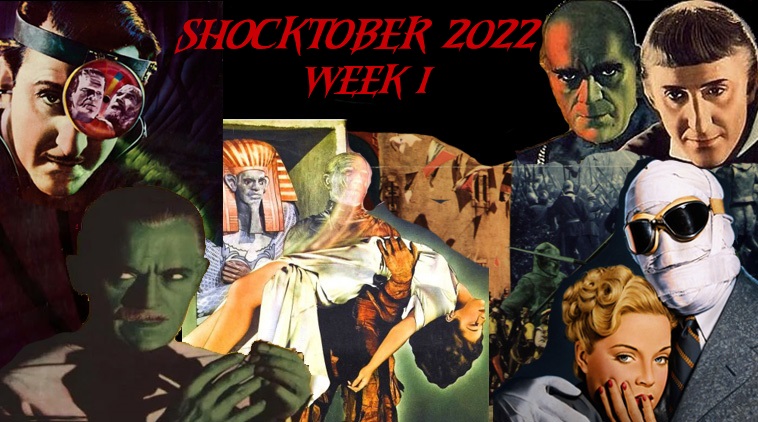
Shocktober 2022, Week 1


Well, it's that time of year again! My brother and I have once again set out to watch a horror film every day this month. This week week continued our watch-through of the Universal horror cycle (you can read my thoughts on the films up to this point here, and here). 

1. Son of Frankenstein (1939)

The third in Universal's Frankenstein cycle, and the last to feature Boris Karloff as the legendary monster, Son of Frankenstein sees Basil Rathbone as the titular son of the mad scientist from the original film returning to the family estate to complete his father's work. Though lacking deeper themes of the first two movies, this film retains the gothic visuals and slick production value associated with this middle era of Universal horror. One of the more memorable images is of the monster, seen only in silhouette, throttling an unsuspecting victim. The monster's "death" scene is probably the most dramatic up to this point, as it is thrown into a pit of molten sulfur and dies an excruciating death which anticipates that of the T-1000 in Terminator 2. It also has a great cast. Karloff is magnificent as usual, even if his role is less juicy this time around. Rathbone makes for a cool-headed contrast to Colin Clive's neurotic portrayal in the earlier films. Bela Lugosi steals the show as Igor, a now iconic character introduced for the first time in this picture (the original film had a similar character whose name was Fritz). Lionel Atwill is also featured in a memorable role as the shrewd, one-armed Inspector Krogh. On the other hand, American actors Josephine Hutchinson and Donnie Dunagan feel slightly out-of-place in the 18th century German setting. Nevertheless, it's a solid sequel overall. 

Score: 7.8/10


2. Tower of London (1939)

A fairly faithful B-movie version of Shakespeare's Richard III, Tower of London is not really a horror film in the conventional sense. As in the play that inspired it, there is plenty of murder and, added here, a good does of macabre imaginary courtesy of Boris Karloff's fictional, club footed executioner, Mord. The role of Richard III was offered to Brian Donlevy and George Sanders but ultimately went to Basil Rathbone, an obvious choice in retrospect. The cast is excellent all around especially Vincent Price, who impresses in one of his first roles as the drunken, cowardly Duke of Clarence. The film also impresses visually, which is not surprising considering that director Rowland V. Lee went over budget in order to complete it. Art director Jack Otterson consulted historical records to recreate the titular tower and the studio hired over 300 extras to recreate the battles of Bosworth and Tewkesbury. The film's use of traditional Latin hymns contributes to its historical verisimilitude and George Robinson's atmospheric cinematography captures the action with great aplomb. 

Score: 8.5/10

3. The Invisible Man Returns (1940)

Vincent Price steps into Claude Raine's shoes in this sequel to the 1933 classic. His character, Geoffrey Radcliffe, (a different invisible man from the one portrayed by Raines) is decidedly more sympathetic then his predecessor. Convicted of the murder, Radcliffe is saved from death row by the brother of the original invisible man (John Sutton), who, convinced of Radcliffe's innocence, gives him the invisibility potion to allow him to escape. Sir Cedric Hardwicke plays the real murderer while Nan Grey is Radcliffe's patient and loyal fiancé. The film plays on the plot of the first film by having Radcliffe struggle to keep at bay the megalomania which consumed the first invisible man and Price elevates what is otherwise a fairly by-the-numbers sequel, lacking the witty, darkly comedic script of the original. 

Score: 7.5/10

4. Black Friday (1940)

Uniting Boris Karloff and Bela Lugosi for the fifth time, Black Friday is another quasi-horror film, wtih elements of science fiction and film noir. Karloff stars as Dr. Ernest Sovac, a scientist who uses his experimental brain transplant procedure to save his friend Professor George Kingsley (Stanley Ridges) after he is fatally injured in a traffic accident. Unfortunately for Kingsley, Sovac was forced to use part of a criminal's brain to rehabilitate him, leading the professor to develop an alternate personality. There are clear shades of Jekyll and Hyde here but also of Frankenstein as Sovac allows his ambition and desire for fame to get the better of him and puts his friend in danger for his own aggrandizement. Lugosi is featured in a minor role as a gangster but, sadly, shares no screentime with Karloff. 

Score: 7.4/10

5. The Mummy's Hand (1940)

The Mummy's Hand is not really a sequel in the conventional sense as none of the characters from the first film return, but it set the standard for the series moving forward, introducing Kharis, the iconic mummy wrapped in bandages (portrayed here by Tom Tyler) in contrast to the more regal figure played by Boris Karloff in the 1932 original. Dick Foran (best known for his singing cowboy roles) is the lead, playing an archeologist named Steve Banning who is convinced that he has discovered the location of Princess Ananka's tomb. Peggy Moran is his love interest while Wallace Ford and Cecil Kellaway provide the (occasionally out-of-place) comic relief. Eduardo Ciannelli rounds out the cast as the Egyptian priest tasked with keeping Kharis alive. The characters are likable and there's some really creepy imagery, but the film is held back by its inconsistent tone and slow pacing (the monster doesn't show up until the half-way mark). 

Score: 7.5/10

6. The Invisible Woman (1940)

Completely unrelated to the films the preceded it, The Invisible Woman features Virginia Bruce as Kitty Carroll, who volunteers for Professor Gibbs' (John Barrymore) invisibility experiments in order to get revenge on her overbearing boss.  Essentially a screwball comedy, Woman is certainly the funniest film in the series and features some truly memorable gags. It also features some of the more impressive special effects in the series. On the other hand the plot is rather unfocused at times and the romance between Carol and Dick Russell (a rich playboy portrayed by John Howard) is underdeveloped. The film also feels more than a little exploitive in its treatment of Carol, particularly in any scene where she takes her clothes off (there's no nudity of course, as she's invisible). 

Score: 7/10 

We also re-watched:

The Evil Dead (1981)

Though easily the weakest of the trilogy on a technical level, I've always been drawn to the first film for its creative ingenuity. Sam Raimi basically went out with a few friends and a 16mm camera and made the film on a shoe string budget. The grotesque effects are incredibly impressive considering the film's budget and Raimi's camerawork is deservedly the stuff of legend. It's not a great film by any means (the plot is confusing, the performances hokey, and the characters paper thin) but I find it endlessly rewatchable. The fact that Raimi was a Michigan native and choose the historic Redford Theater (which I've been to many times) for the film's premiere also makes it more endearing (if such a term can be used to describe a film where a character is raped by tree). 

Score: 6.8/10


Wednesday, August 10, 2022

My Favorite Films: Winchester '73 (1950)

     Winchester '73 was my introduction to the films of Anthony Mann who has since become one of my favorite directors. While not as famous say John Ford or Sergio Leone, Mann's contribution to the western genre was enormous. In particular, the five westerns he made with James Stewart stand out for their excellence. 

     Mann's command of cinematic grammar is nowhere more apparent. His noir roots are especially on display in this film (the only one of the sequences shot in black and white) in his use of low angles for example, which often punctuate moments of violence or brutality on the part of the hero. Mann also had a penchant for shooting outdoors and, in his westerns, the landscape practically becomes a character in its own right. This is particularly true in the climax, where Stewart's character plays a deadly game of cat-and-mouse with his own brother, their fratricidal battle pitted against a rocky backdrop which suggests a struggle against nature itself. Cinematographer William H. Daniels captures these moments beautifully. 

     Mann's unique visual qualities are greatly complemented by Borden Chase's screenplay, which explores some of the genre's core themes. For Mann the west was a mythic canvas, on which he could tell stories about the human condition. Winchester 73' was originally a Fritz Lang project with very existential themes about a man whose identity becomes tied to the weapon he carries, leading to a desperate journey to recover it when it is stolen. Mann and Chase completely overhauled this script, crafting a story about retribution and the nature of power against a backdrop of genuine western history.

     The film uses famous figures and events from the history of the west very loosely. The shooting contest which opens the film takes place in Dodge City where none other than Wyatt Earp (Will Greer) is the sheriff! The film takes place shortly after the Battle of Little Big Horn, which would place it sometime in the summer of 1876, which happens to be the same year that Earp was made the sheriff of Dodge. Mann and Chase use the audience familiarity with these historical figures and events to inform character and are able to avoid what might otherwise have been tedious exposition. Earp's reputation precedes him. So much so that when the very mention of his name is enough to cause Lin to back down when he confronts the sheriff (who's not wearing his badge) over the forced removal of Lola from the town. Because we, the audience, know who Earp is, we immediately understand McAdam's reaction when he learns the sheriff identity. Similarly, the oblique references to the Custer's last stand lend an immediate air of danger to the film's setting. 

     The film uses these historical references to explore the "winning of the west." We learn early on that Custer and his men have been massacred by the Sioux at Little Big Horn, and it was their use of the repeating rifle that gave them an edge over the calvary, who were still using the older single shot weapons. This advantage is turned against them when they attempt to attack the cavalry detachment that Linn and High Spade are hold up with. Expecting to overwhelm the cavalry with superior fire power they are taken by surprise when they come up against the civilian's Winchesters. Through this use of superior force, the white men win the day. 

     Masculinity is a prominent theme in many of Mann's films and in Winchester 73' the titular rifle, "One of a Thousand," acts as a sort of metaphor for the masculine, as we see it pass through the hands of various figures who embody, or fail to embody, various masculine traits. Stewart's character Linn McAdam wins the rifle in a shooting match and is, notably, the only character to obtain it legitimately. This symbolizes McAdam's moral uprightness. By contrast McNally's "Dutch" Henry Brown steals the rifle from McAdam after losing the contest to him. Again, this illustrates the difference between the two men. One has an innate sense of justice and fairplay, the other is willing to do whatever it takes to get what he wants. 

     From Dutch Henry the rifle passes to John McIntire's Joe Lamont, a man who makes his living selling rifles to the Indians. Lacking in both moral fiber of McAdam and the ruthlessness of Dutch Henry, Lamont must resort to duplicity to obtain the weapon. He swindles the outlaw out of it by asking an outrageous price (which Dutch can't afford) for the guns and ammunition he desperately needs. It is afterwards taken by Chief Young Bull (Rock Hudson), whose mode of acquisition (he kills Lamont when the trader refuses to sell him the gun) is consistent with his single-minded drive to punish the race who have taken so much from his people. Young Bull too is killed, this time in battle involving McAdam. But rather than being returned to its rightful owner, who is blissfully unaware that his stolen property has fallen into Indian hands, it is instead awarded to one Steve Miller (Charles Drake) by a grateful calvary sergeant for his apparent bravery in fighting off the Indian attack. 

     Miller only ended up joining the fight after abandoning his fiancé, Shelley Winters' Lola Manners, on the prairie. He is haunted by this act of cowardice and sees the rifle as a token of redemption. His newfound sense of self-worth is tested when he meets up with Dan Duryea's "Waco" Johnnie Dean. Refusing to sell the rifle he is goaded by Waco into going for his gun and subsequently killed. Waco is a malicious and cruel man, a fact illustrated by the way he humiliates Miller in order to obtain the rifle, but he is also cowardly in his own way. He surrenders to rifle to Dutch Henry without argument, implying to Lola that he will shoot him in the back later. He is only willing to stand up to those he perceives to be weaker than himself. 


     The masculinity of these characters is also illustrated in the way they treat women. Steve treats Lola with servile deference and betrays a deep insecurity about her which leads to his downfall. Waco, after murdering him by exploiting these weaknesses, treats her with contempt while Dutch Henry wants nothing to do with her. Only Lin treats her with respect and dignity. His first instinct is always to protect her. When they first meet, she is being railroaded out of town and Lin attempts to intervene only to find that the sheriff (who happens to be the famous Wyatt Earp) is the man forcing onto the stage. Later, when they meet in the cavalry encampment, he lends her his pistol. He allows Dutch too escape, temporally, when she jumps in the line of fire to help a young child about to be trampled. 

     Lola herself is something of a "prostitute with a heart of gold" archetype, she feels trapped in her profession and longs for a more domestic life. In many ways this reinforces the films' themes about gender roles, men have a protective role and women a nurturing one. But does break away from the archetype, at least to some extent. Lola is willing to stand up to Waco, even shaming him for using woman and children as a shield. But she's also smart enough to realize that she has to go along with him for the time being. She is generally shown to be somewhat "street smart". When McAdam gives her his pistol, she tells him that she "knows about the last one." Later, when he tries to pass off the Sioux war signals as birdcalls, she asserts that she knows what they are. 

     Ultimately, Linn recovers the rifle by slaying Dutch who, it is revealed, is Linn's brother and the murderer of their father. Though this is portrayed as a just act, the ambiguity of introduced by the intensely personal nature of McAdam's quest for retribution is also explored. Linn admits too his friend "High-Spade" Frankie Wilson that he feels uneasy about tracking down Dutch but "Some things a man has to do, so he does 'em." His friendship with High Spade is another thing that humanizes Linn. Qouting his departed father he tells him "He said if a man had one friend, he was rich. I'm rich."

     Mann always brings out the best in his actors and this film has an excellent cast. Stewart's performance brings out the actor's darker side, something Mann would probe more and more as their collaboration continued. Stewart's ability to convey emotion and thought with the subtlest change of facial expression never ceases to amaze me. Millard Mitchell provides a laid-back counterweight to Stewart as his friend "High-Spade", his dry sense of humor providing some much-needed levity. Shelley Winters spirited performance captures both the vulnerability and the toughness of her character. Stephen McNally terse delivery and his permanent scowl give Dutch Henry a genuine sense of menace while Dan Duryea provides a more colorful contrast as Waco Johnnie Dean, stealing every scene he's in with his sardonic, scornful wit. Charles Drake is perfectly cast as the cowardly Steve Miller while Mann regulars John McIntire and Jay C. Flippen round out the cast in memorable supporting roles. 

     Winchester 73' set a high bar for Mann and Stewart's collaborative efforts. Mann's shrewd directing is bolstered by a magnificent cast and a sharp, economical script from Borden Chase. The actor and director would go on to collaborate on more ambitious projects, but none are quite as flawless as this first effort. 

Tuesday, July 12, 2022

My Favorite Films: A Bridge Too Far (1977)

    Like The Longest Day, the other great Hollywood World War 2 epic based on the works of Cornelius Ryan, A Bridge Too Far was independently produced. Daryl F. Zanuck risked a personal fortune to tell the story of the Normandy Invasion in the former while, in the latter, maverick mogul Joseph E. Levine came out of retirement to fulfill a promise he had made to Ryan (who died of cancer in 1974) to bring his book about Operation Market Garden to the big screen. While it doesn't quite capture the tight plotting or the enormous scale of its predecessor, A Bridge Too Far is still a great film in its own right.

     The film really captures the tragedy of war (something Zanuck wanted to focus on more in The Longest Day). Many of the film's strongest scenes are not big battle sequences but subtle moments of genuine humanity amidst the inhumanity of war. This is something of a theme running throughout the film. Early in the film Sergeant Eddie Dohun (James Caan) promises his captain that he will survive the battle, and we later see him fulfilling this promise at great personal risk, even threatening to shoot the surgeon at the field hospital unless he operates immediately. Throughout the film we see Liv Ullmann's Kate ter Horst (whose narration opens the film) caring for the wounded and dying. The film's final image is of her and her family leaving their now ruined home to join a group of refugees. 

     This is not to say that the film does not have some impressive spectacle. The parachute drop, featuring hundreds of extras and many authentic C47s, is draw dropping. The battle scenes are also impressively mounted. Particularly well done is the assault on the bridge at Nijmegen by members the 82nd Airborne. Its intensity and realism anticipate the more famous beach landing in Saving Private Ryan. A particularly memorable moment, which actually happened, is Major Julian Cook's (Robert Redford) repetition of "Haily Mary, full of grace" in time with his rowing. In general, the film does not shy away from portraying the religiosity of the people who lived through the event. In the penultimate scene, the British wounded, left behind, sing "Abide With Me" as they await their imminent capture once the Germans arrive. 

     Much credit has to go to Joseph Levine, who risked a small fortune to finance the film. Levine had promised Cornelius Ryan, on his deathbed, that he would bring the author's book to the screen. To carry this out he sought out the relatively inexperienced director Richard Attenborough, an actor who had made propaganda films for RAF during the war. Attenborough does an admirable job behind the camera, holding together the various moving parts while maintaining focus on the human story. Like Levine, he was dedicated to ensuring that the film stayed true to history, insisting that it be shot on location in the Netherlands. He uses a documentary-like approach behind the camera, which is complemented by cinematographer Geoffrey Unsworth's muted, naturalistic lighting.

     Attenborough was friends with the film's composer, John Addison, who had served with the British XXX Corps during Market Garden. Addison and Attenborough were agreed that the film, with its documentary approach, would benefit from a minimal use of orchestral music. The director suggested that Addison focus on the characters while writing his score, rather the scoring the battle scenes. His score, surprisingly, brings out the ironic side of the story more than anything else. Yet there's sense of underlying sadness and tragedy there as well. 

     Much of this can also be credited to screenwriter William Goldman, best known for penning Butch Cassidy and the Sundance Kid (1969) and All the President's Men (1976), both historical films with a deep layer of irony. What holds the rather complex plot together is Goldman's ingenious analogy of a western movie, where XXX Corps is the cavalry on the way to rescue the beleaguered settlers (the airborne troops), only in this case they arrive too late. His script stays admirably close to the actual events. So many small details, that one might expect to be creative liberties, are actually true. A German soldier did just happen upon the allied plans in a downed glider. The allied planes did inadvertently drop supplies behind the German lines. Goldman does a particularly good job showing how blindsided most of the allied commanders were by their success and how these unforeseen and, often, highly coincidental events lead, ultimately, to disaster. This was particularly tragic for the Dutch civilians, whose eagerness for liberation early in the film is bitterly let down by its end. The Germans, on the other hand, are shown to be demoralized and resigned and then subsequently incredulous at their temporary success. 

     Attenborough and Addison were not the only people involved in the film who served during the war. Dirk Bogarde, who plays General Browning, the man tasked with coordinating the operation, served on General Montgomery's staff during the war. Paul Maxwell, who portrays Maxwell Taylor in the film, was in the Canadian Artillery. Hardy Krüger, who plays an SS Panzer Division commander based on Heinz Harmel, was impressed into an SS division near the end of the war when he was only 16. What's particularly remarkable is that most of the cast bear a striking resemblance to their real-life counterparts, yet another trait the film shares with The Longest Day. 

     Levine, lacking studio resources, relied on star power to sell the film, and he brought in some of the biggest names in Hollywood. Edward Fox stands out as the commander of XXX Corps, Lieutenant-General Brian Horrocks. Fox's combination of enthusiasm and wit make him a perfect fit for the role of the charismatic commander. Michael Caine provides a sardonic, laid-back contrast to Fox as his subordinate, Lieutenant-Colonel J.O.E. Vandeleur. Sean Connery's presence lends a sense of manliness and gallantry to Major-General Roy Urquhart, the commander of the 1st British Airborne Division, who became surrounded and isolated miles away from their objective. Connery does a good job conveying the General's growing frustration and disenchantment as the battle progresses. Anthony Hopkins shines as Lieutenant-Colonel John Frost, whose advance units reached Arnhem early, only to be cut off from the rest of their unit and slowly decimated by the overwhelming superiority of the German forces. Frost was an eccentric commander, who went into battle with a hunting horn and would coolly walk through the streets of Arnhem while under enemy fire, and Hopkins portrayal is spot on. Finally, Gene Hackman puts in a passionate performance as the Polish General Stanisław Sosabowski, whose opposition to the plan lead to his being made a scapegoat for the other commanders after it failed. 

     Of the Americans, Ryan O'Neal is surprisingly effective as Brigadier General James Gavin, bringing an unexpected weight and gravity to the role of the famous general. Robert Redford gets some of the film's strongest material as Major Julian Cook while Elliot Gould adds a sense of irony as Colonel Robert Stout (a fictional character inspired by Robert Sink, commander of the 506th Parachute Regiment). Finally, James Caan brings his brash, swaggering presence to bear as Staff Sergeant Eddie Dohun (whose name in real life was Charles Dohun). Laurence Olivier and Liv Ullmann, meanwhile bring a real sensitivity and sense of sympathy to the Dutch civilians Jan Spaander and Kate ter Horst (known as the "Angel of Arnhem"). Finally, Maximilian Schell helps to humanize the German commander Wilhelm Bittrich capturing his incisive leadership and gallantry, especially in his treatment of the defeated enemy.

     A Bridge Too Far is both a stirring epic and a poignant tragedy. The way filmmakers managed to compress this highly complicated event into a manageable and comprehensible 3-hour film while maintaining a delicate balance between irony, spectacle and genuine pathos, is truly impressive.