As with my Clone Wars Season 1 review (I may get back to that show soon, no promises) I'm going to briefly cover each episode and than give my general thoughts. Also SPOILERS.
Episode 1 "Pilot"
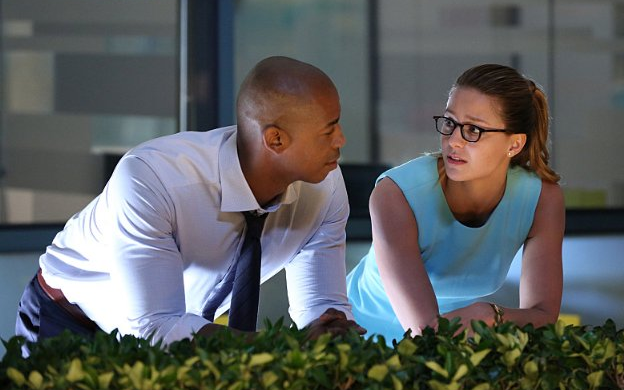
Kara Zor-El (Supergirl) is sent to Earth by her mother Alura to protect her younger cousin, Kal-El. The explosion of Krypton forces her ship off course and into the Phantom Zone for 24 years, before landing on Earth. Kal-El, now an adult and going by the name Superman, puts Kara in the care of the Danvers. Twelve years later, Kara reveals herself to the world when her adoptive sister's, Alex, plane is sabotaged. This episode also introduces Hank Henshaw, head of the Department of Extra-Normal Operations (DEO), where Alex works; Cat Grant, the owner of CatCo Worldwide Media, where Kara works; Winn, Kara's cowroker and friend; and James Olsen, a photographer who is a good friend of Superman. Kara learns that there are hundreds of aliens on the planet in hiding, most whom came from a prison (Fort Rozz) that crashed on Earth, and that her mother was the one responsible for imprisoning them. Her actions attract the attention of Vartox (Owain Yeoman), who she must subdue. The episode ends by introducing Astra In-Ze, Alura's identical twin sister, who wants to conquer Earth.
This episode is a decent enough origin story. It establishes the show's lighthearted tone, introduces the main cast, and gives us Supergirl's backstory. The villain is a bit generic and the supporting characters have yet to get fleshed out but that's alright with me as the focus here is Supergirl. 8/10
Episode 2 "Stronger Together"
Supergirl hones her skills with the help of Winn and James and undergoes physical training at the DEO under Alex and Hank. She has to contend with Fort Rozz escapee Hellgrammite, who kidnaps Alex and takes her to Astra.
This episode is a decent follow up to the pilot, with Supergirl having to prove to herself that she can be a hero. The supporting characters start to get fleshed out more and their is an important character reveal. 8/10
Episode 3 "Fight or Flight"
Supergirl goes up against Reactron, one of Superman's most powerful enemies. In a tense moment, James calls in Superman, who saves her. Kara also has to deal with Cat Grant, who wrote an expose portraying Supergirl as a typical millennial and exposing her as Superman's cousin, and Alex, who is upset that Kara revealed her identity to James and Winn. It also introduces shady businessman Maxwell Lord, who is kidnapped by Reactron.
This is a fairly strong episode dealing with Supergirl stepping out of her cousin's shadow. Her interactions with Superman (who is only briefly seen from behind) are quite well done. Cat and Winn get some much needed character development. On the flip side Peter Facinelli's Maxwell Lord comes across like an evil, discount, Tom Cruise and a some tedious and typical love triangle is set up between Kara, James and Winn, with James ex-girlfriend, Lucy Lane, showing up at the end for good measure. 8/10
Episode 4 "Livewire"
Cat Grant demotes CatCo's shock jock, Leslie Willis, after a controversial bashing of Supergirl. During a thunderstorm Leslie is struck by lightning and gains electromagnetic powers.Taking the name Livewire Leslie seeks revenge against Cat and it's up to Supergirl to protect her. Meanwhile we meet Kara's mother Eliza and friction surfaces between her and Alex over Kara coming out as Supergirl. The episode ends with Eliza revealing to Alex that Jeremiah disappeared while working for the DEO.
This episode is my favorite of the first four. Brit Morgan has a lot of fun as Livewire and is reasonably well fleshed out. Cat Grant and Alex get more layered, as Cat's relationship with Leslie and Alex's relationship with her mother are explored and paralleled. 9/10
Episode 5 "How Does She Do It?"
Supergirl has to deal with a bomber who is threatening Maxwell Lord's company and babysit Cat's son Carter while she is out of town. Ultimately Carter is put in harm's way. James and Lucy decide to start dating again.
Having a lot of focus on Maxwell Lord and also dealing with James and Lucy's rather typical relationship issues, this is generally a weaker episode. With that said they do try to flesh Lord out and contrast his cynicism with Supergirl's optimism, and the subplot with Cat's son is fun and well integrated with the main plot. 7/10
Episode 6 "Red Faced"
Supergirl is asked by Lucy's father, General Sam Lane, to fight the military's new combat android Red Tornado for a training exercise. When it goes rogue she is forced to take it down. Meanwhile Cat has to deal with her overbearing mother and James faces disapproval from General Lane.
This is a really strong episode that sees Supergirl and other characters dealing with anger and frustration. Supergirl is frustrated with her relationship problems and the distrust shown toward her by General Lane, and, ultimately, because she doesn't fit in. Cat and James have to deal with similar problems. Red Tornado makes for a formidable threat for Supergirl and there confrontation is quite well done. There is even a scene between Alex and Maxwell Lord (my two least favorite characters) that I actually liked. 9/10
Episode 7 "Human for a Day"
Supergirl's battle with Red Tornado have left her temporarily without her powers when an earthquake threatens national city. Meanwhile Alex and Hank are trapped beneath the DEO with a dangerous alien criminal Jemm, on the lose. Alex confronts Hank about her father's disappearance.
"Human for a Day" is another excellent episode. Seeing Supergirl deal with feeling powerless is really interesting and, ultimately, inspiring. The subplot with Jemm at the DEO is less interesting but the reveal at the end is really cool. 9/10
Episode 8 "Hostile Takeover"
Astra is captured and to sew doubt she tells Supergirl that Alura used her (Supergirl) to capture her. Kara, James, Winn, and Lucy help Cat to expose a corrupt CatCo official who wants her job. Non and the Kryptonians take over Lord Industries. Cat reveals that she knows Kara's secret.
This a really busy episode. I like alot of the stuff here. Kara's struggle with doubt over her mother's intentions makes for compelling drama and there are some nice moments with Cat. The cliffhanger at the end is also really effective. 9/10
Episode 9 "Blood Bonds"
Non defeats Supergirl and kidnaps Hank Henshaw, offering to trade him for Astra. General Lane, in charge of the DEO in Henshaw's absence, refuses this offer and instead tortures Astra. Cat threatens to fire Kara because being an assistant is a waste of time for a superhero. James and Winn try to investigate Maxwell Lord's suspicious activities.
There is some good stuff in this episode. The exchanges between Kara and Astra really help to flesh her out more. On the flip side Maxwell Lord remains a really uncompelling villain and the big reveal from the last episode that Cat knows Supergirl's identity is brushed off way too easily. Overall a mixed bag. 8/10
Episode 10 "Childish Things"
Winn's father Winslow Schott Sr., aka the Toyman, escapes from prison and tries to persuade his son to join him in his criminal exploits. Hank infiltrates Lord Industries.
This is a really great episode. Winn get's some much needed character development, his father is a really compelling villain and Hank has to make a hard choice near the end of the episode that has a lot of weight. There is some rather typical romance going on but it's easy to overlook given the episodes strengths. 10/10
Episode 11 "Strange Visitor from Another Planet"
Supergirl saves an anti-Alien Senator from an Alien creature. Hank reveals that he knows of this creature and wants revenge against it for killing his family on Mars. Kara helps Cat to reunite with her son Adam.
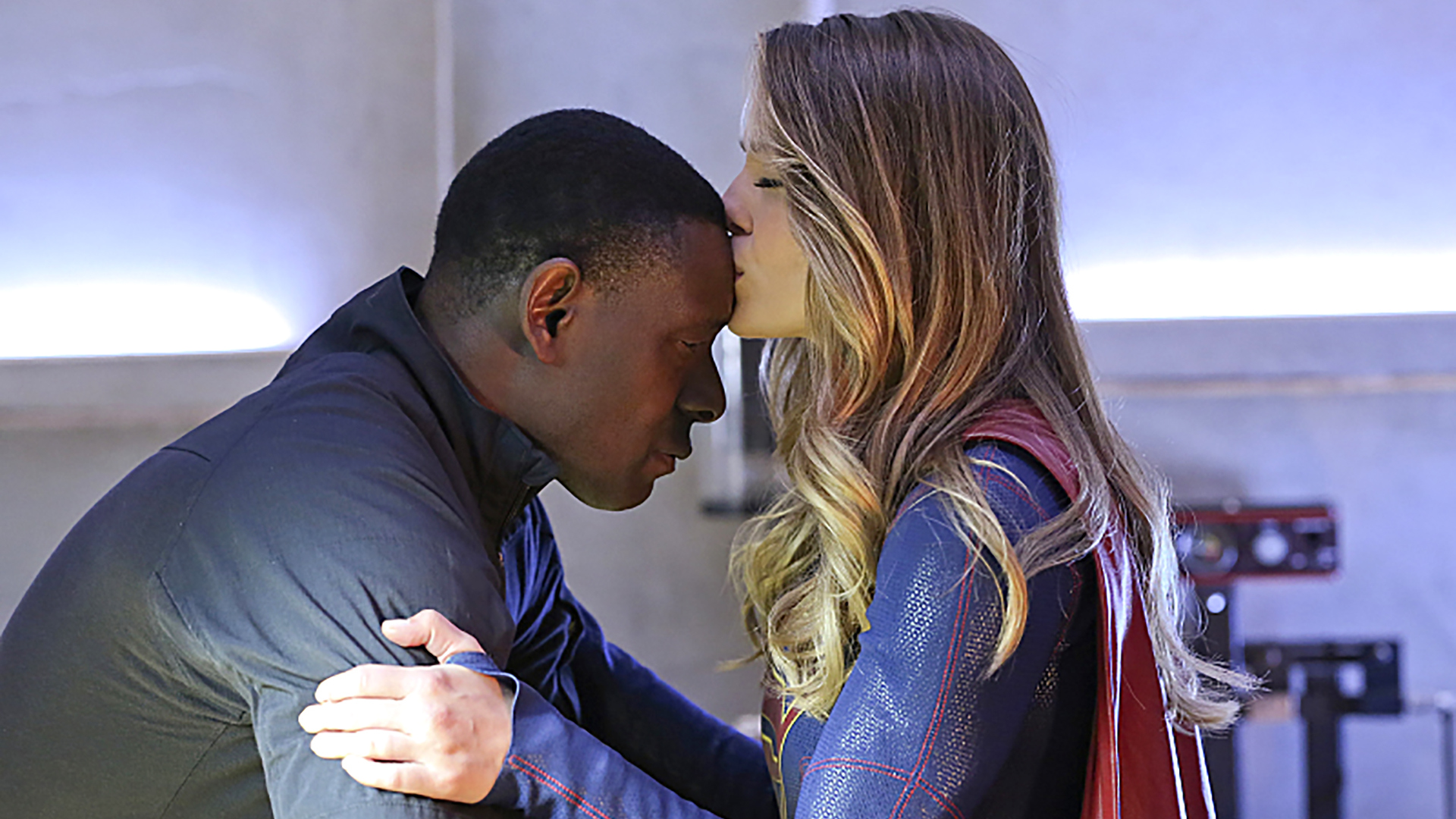
This episode really digs into Hank's past, becoming perhaps the darkest episode of the series. David Harwood does a great job portraying J'on J'onzz rage and sense of loss. The subplot with Adam is, perhaps, less interesting but overall this episode is really strong. 9/10
Episode 12 "Bizarro"
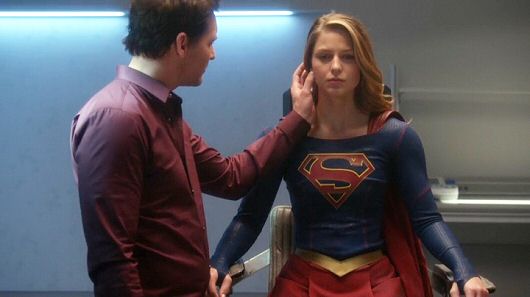
Maxwell Lord creates an evil doppelganger of Supergirl using her DNA and a comatose victim. She and the DEO must deal with this threat along with the fact that Lord knows her secret identity. Meanwhile Kara's date with Adam goes badly, angering Cat.
This is a really weak episode. Though some of the conflict between Supergirl and Bizzaro is interesting the whole subplot with Adam really falls flat and Peter Facinelli continues to chew the scenery as Maxwell Lord. 6/10
Episode 13 "For the Girl Who Has Everything"
A mysterious plant, sent by Non, attacks Kara and puts her into a dreamlike state where she believes she is back on Krypton. Alex, Hank, Winn, James, and Maxwell Lord (who is aprisoner of the DEO after the events of the last episode) struggle to pull her out of it's grip. Hank must pose as Kara to keep her from getting fired from her job at CatCo.
Yet another great episode. Alex really shines here, her desire to protect her sister even at the risk of her own life is palpable. Astra and Maxwell Lord both get more depth, with her displeasure at Non's scheme and his deciding to help Kara. Also the scenes where Hank has to pretend to be Kara are hilarious and Benoist really pulls it off. 9/10
Episode 14 "Truth, Justice and the American Way"
When an armored alien known as the Master Jailer begins killing Alien fugitives in National City, Kara, Alex and J'onn track him down. Cat assigns James and Lucy to investigate Maxwell Lord's disappearance, leading to tension between Kara and James. Cat hires a new assistant, Siobhan Smythe, in order to punish Kara for breaking up with Adam.
"Truth, Justice and the American Way" is one of the best episodes of the season. Seeing Kara struggle with the moral compromises of holding Maxwell Lord prisoner without due process is really compelling and the Master Jailer works really well as an ideological foe in this context. We also have to see her deal with her anger toward J'onn for killing Astra and Alex's guilt for being the person who actually killed her. 10/10
Episode 15 "Solitude"
A hacker who blackmails Cat Grant into releasing information stolen from a cheating website turns out to be an AI called Indigo, who escaped from Fort Rozz. Supergirl must stop her from destroying National City with a nuclear missile. Meanwhile J'onn and Alex try to convince Kara to come back to the DEO, which she quit after the events of the last episode, an James and Lucy struggle with relationship problems.
This episode is a mixed bag. The conflict between Supergirl and Indigo is great, as is the dynamic between her, Alex, and J'onn. The love triangle stuff between Kara, James, and Lucy, on the other hand, is pretty groan worthy. 8/10
Episode 16 "Falling"
When Supergirl comes into contact with Red Kryptonite, manufactured by Maxwell Lord to defeat Kryptonians, she gradually begins to turn evil, becoming more aggressive and abrasive both as Supergirl and Kara Danvers. When she almost kills Cat by throwing her off a building, it's up to J'onn and Alex to stop her reverse the effects of the Red Kryptonite with an antidote provided by Max.
"Falling" is a pretty strong episode. Seeing Kara's darker side makes for some really compelling drama and J'onn's sacrifice at the end feels really earned. With that said I've always found these virus/brainwashing turns the hero evil plots a bit hard to believe. 9/10
Episode 17 "Manhunter"
Lucy Lane and Marine Colonel James Harper conduct an investigation into J'onn J'onzz after he reveals his identity at the end of "Falling". Supergirl struggles to win back the city's trust and Siobhan Smythe plots revenge on Kara for getting her fired.
Another excellent episode, "Manhunter" helps to flesh out J'onn (and Kara's) backstory and finally reveals what happened between him and Jeremiah Danvers. Lucy Lane finally becomes more likable. Kara's self doubt after her actions in the last episode is also well done. The subplot with Siobhan is less compelling but overall this episode is still really strong. 9/10
Episode 18 "World's Finest"
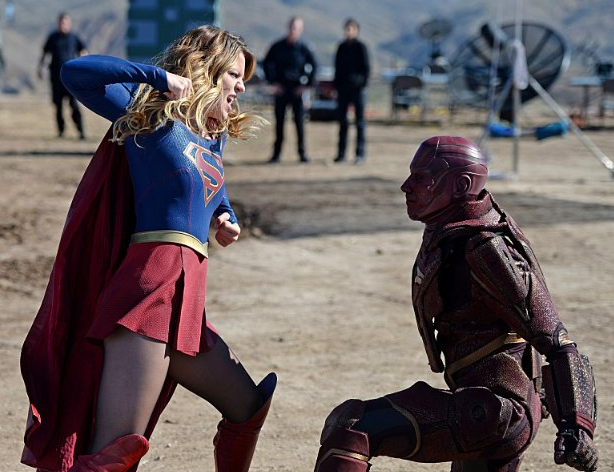
The Flash (from the CW show of the same name) shows up in National City from an alternate universe and Kara, Winn, and James try to help him find a way back home. When Siobhan, who it turns out has powers and is now calling herself Silver Banshee, breaks Livewire out of prison and they plot revenge on Cat Grant and Kara it's up to Supergirl, with Flashes help, to stop them.
Though not the deepest episode ever "World's Finest" is certainly the most fun and, consequently, one of my favorites. It helps that the overarching narrative is not cast aside as Kara continues to deal with the city's distrust and Siobhan continues her journey to the dark side. 10/10
Episode 19 "Myriad"
The citizens of National city fall under a form of mind control called the Myriad effect and controlled by Non and Indigo. Only Kara, because of her Kryptonian upbringing, along with Maxwell Lord and Cat Grant, who Max has shielded from Myriad with some tech. Together they must find a way to stop Non. Lord suggests using a Kryptonite bomb he developed to destroy Non and his allies, but which will also wipe out a large portion of National City's populace. Cat and Kara resist this plan. Meanwhile J'onn and Alex, who have sought refuge at Eliza's house, hear about the incident on the news.
Myriad is an interesting but very flawed set up for the finale. There are quite a few plot contrivances, like Maxwell Lord sending Cat earrings which will protect her from Myriad the day before Non uses it or Alex insisting on accompanying J'onn to National City and consequently falling under Myriad's influence. On the other hand there are a lot of interesting ideas and some really good character exchanges. 8/10
Episode 20 "Better Angels"
Alex, now controlled by Myraid, attacks Kara and almost almost kills her when Eliza shows up with J'onn and talks her down. Supergirl then broadcasts a hopeful message to the city, breaking Myriad's control over the people. Non and Indigo then decide to kill everyone on earth by increasing Myriad's amplitude, which will explode everyone's brains. It's up to Kara and J'onn to confront them and prevent this from happening.
Alot of the promising ideas set up in the last episode are thrown out her as Supergirl stops Myriad way too easily and too early in the episode. The rest of the episode hinges on the idea that Kara will have to sacrifice herself to stop Non and Indigo, an idea that is contrived and leads to some overly sentimental moments. With that said, the action is well done and there is a really nice moment between Cat and Kara at the end of the episode that gives a good amount of closure to their relationship throughout the season. Overall a disappointing finale. 7/10
Like many network superhero fare
Supergirl's handling of romantic relationships can be rather clumsy. It is far too reliant on trying to make the audience root for a certain couple to get together, in this case Kara and James, and then continually putting obstacles in the way of that happening, particularly in the form of really typical love triangles. We have to see James go through a rather tiresome back and forth relationship with Lucy, one which obviously won't last, Kara have a really short and uninvolving relationship with Cat's estranged son, which creates unneeded conflict between her and Cat, and Winn struggle with his unrequited love for Kara while he is stuck in the "friend zone" only to get over her and start dating Siobhan Smythe (he as some
bad luck with relationships). On top of being put through all of this uncompelling drama there is also the problem that Kara and James have very little real chemistry and as result I'm not really interested in seeing them get together in the first place.
Another major problem the show has is with its overarching villain plot. Non and Astra are not very compelling or fleshed out villains. Astra does get better as the show goes on and her death in "For the Girl Who Has Everything" really leads to some compelling drama. After she dies however were just left with Non and he's a character I don't really understand. He seems to want the same thing Astra wanted, namely to rule earth (through Myriad presumably) in order to make a it better place. But it's confusing because he goes against her wishes before she dies, sending the Black Mercy to attack Kara despite her making a deal to leave Kara alone, and he generally comes off as more ambitious and lusting for power. He also seems bent on getting revenge on Kara for Astra's death but at the same time tries to convince Kara to join him in "Myriad". Indigo is more consistent, albeit extremely simplistic, in her desire for power. In "Myriad" she tries to convince Non to abandon earth and instead use Myriad to conquer other planets where Supergirl won't be around to stop them. This could be an interesting set up, with Non torn between devotion to his wife's vision and his own desire for power, but its his character is not well defined enough for it to work.

Finally there is the shows treatment of Superman (of course!). He is never seen on screen. This would be fine, I completely understand the writers wanting to keep the focus on Supergirl and not have her be overshadowed by her more well known cousin. The problem is that the show keeps teasing us with not-quite appearances of Superman. Sometimes this works. When Kara is snapchatting Clark at CatCo his texts are classic Clark Kent and help to define this universe's version of the character without actually having him show up in person. But then you have episodes like "Fight or Flight" where a cgi Superman briefly flies in to save Kara from Reactron and just as abruptly flies away without a word to his cousin to see if she's alright. This incident is used to create some interesting drama between James, who is too used to relying on Superman, and Kara, who wants James to show some confidence in her abilities. The problem is that I don't buy that Clark wouldn't show more personal interest in Kara, particularly when other members of his family are consistently causing her problems, and having him show up like this only serves to bring these kinds of questions (which are never addressed) to the forefront. This becomes really ridiculous in the season finale where Superman shows up (as a cgi double again) only to fall under Myriads control, despite Kara being immune to it, and then falling into a coma after Supergirl stops Myriad. In one particularly frustrating scene Superman boots can be seen as he lays, off screen, on a stretcher at the DEO.

What
Supergirl does really well is building up its central characters. Hank Henshaw, Alex, and Cat Grant all get more interesting as the season progresses and there relationship with Supergirl continues to change. We find out that Hank is actually J'onn J'onzz, a shape shifting alien from a dead race who is hiding on earth and was saved by the Jeremiah Danvers from the real Hank Henshaw, and more and more information about his tragic backstory is revealed as the season progresses. Cat Grant goes from being a somewhat typical jerky boss at the beginning of the season to feeling like a much more vulnerable human character by the time the season ends. She also becomes a kind of mentor for Kara as the two gain a mutual respect for each one another. Alex and Kara's relationship and sisterly bond is also explored through the course of the season and you really start to understand why they care about each other. Kara herself grows a lot as a character, becoming more confident and sure of herself and learning to confront her inner demons. Melissa Benoist really carries the show, differentiating Supergirl from Kara Danvers while channeling the combination of inner confidence and vulnerability that tie her two identities together. As a result of this, Benoist's Supergirl has quickly become my favorite of the current prime time superheroes.

Another thing this show has going for it is it's sunny optimism, especially in contrast to
Arrow and to Marvel's Netflix shows (not that there's anything wrong with the darker tone of those shows). Supergirl sometimes doubts herself and she often makes mistakes, but she always picks herself up and tries to do better. In the episode "Human for a Day" when she loses her powers she decides to confront an armed robber, hoping to talk him down before he hurts anyone, despite the fact that she is just as vulnerable as any other human. Her optimism is often put into conflict with the more pessimistic views of Maxwell Lord who sees her and the other Kryptonians as a threat and is willing to commit all kinds of unsavory acts to "protect" people from them. Even Kara's sister Alex has crossed moral boundaries in order to keep Kara safe, killing her aunt Astra and imprisoning Lord in without due process. Alot of these issues come to a head in my favorite episode of the season "Truth, Justice and the American Way" where Kara ultimately releases Lord after being confronted by a Punisher-esque alien vigilante who executes criminals without any compunction. Another challenge to the show's optimism comes in "Falling" where the city loses its faith in Supergirl after she is temporarily turned evil by Red Kryptonite poisoning. Two episodes later in "World's Finest" the people of National City decide to stand beside Supergirl (and Flash) in her fight against Livewire and Silver Banshee in a scene that almost made me tear up.
Supergirl is not a perfect show but it's strong central characters and unflagging optimism make up for a lot of it's flaws. If it get's renewed for a second season hopefully the writers will improve on the show's overarching plot and start writing more compelling romance.


_highnoon.jpg)